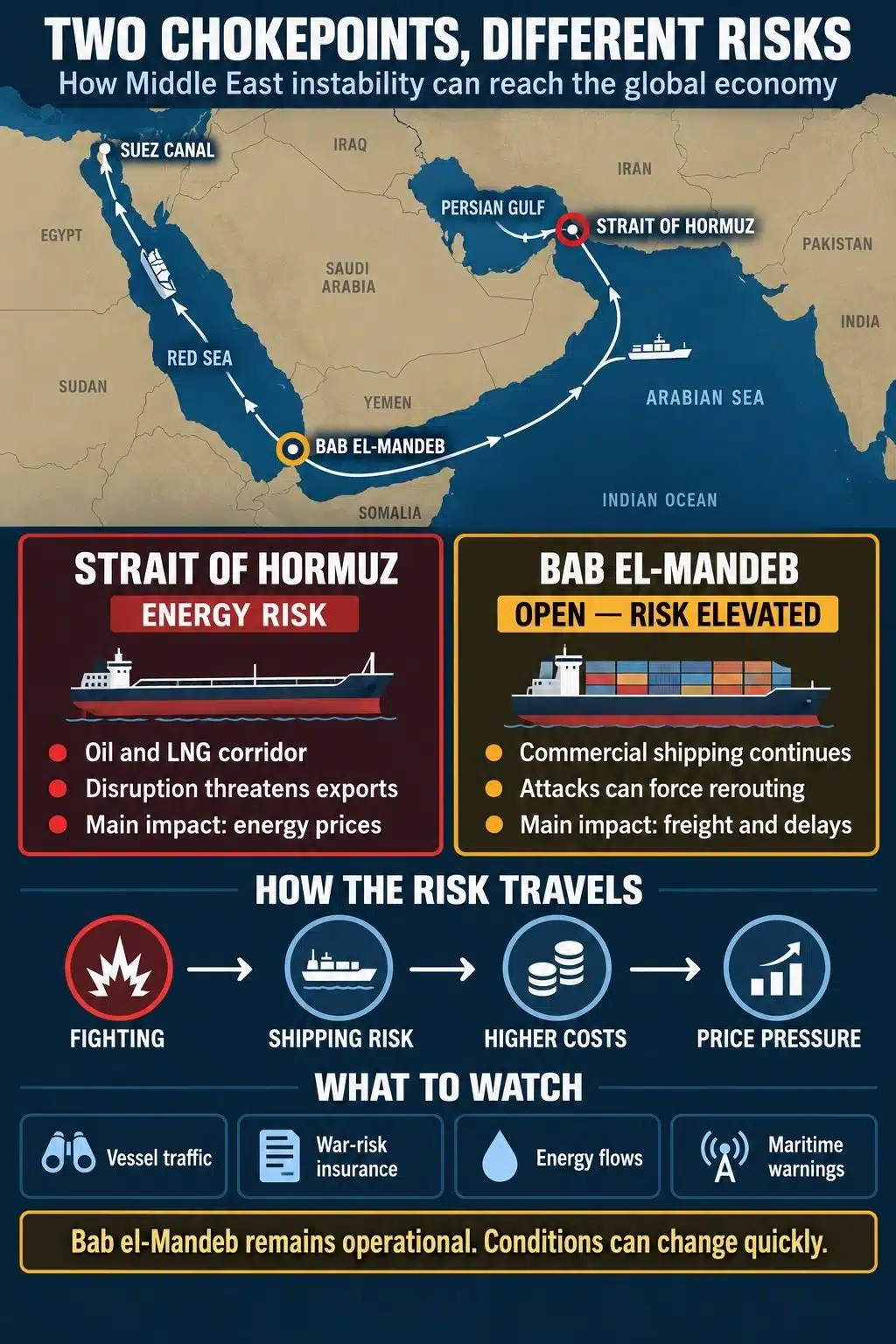
I begin with the map and the Middle East global risk because it shows how a war centred on Iran can reach household budgets thousands of kilometres away.
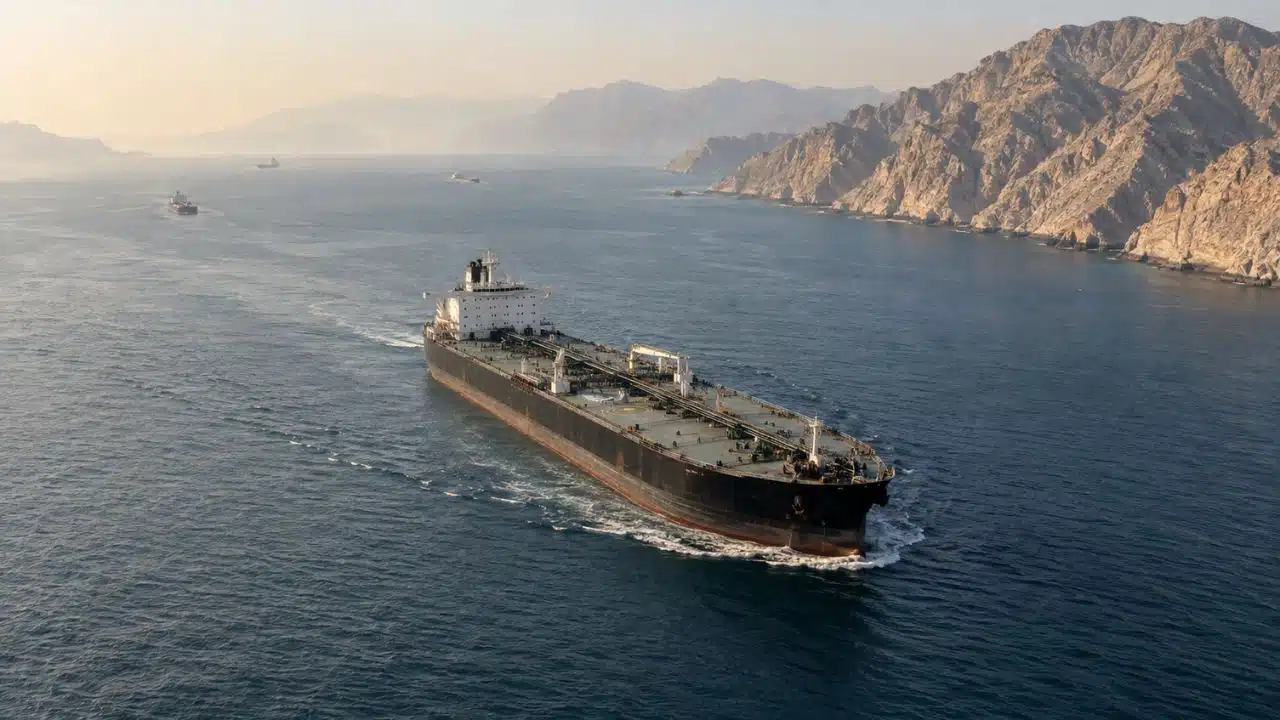
The United States and Israel attacked Iran on 28 February. Tehran retaliated across the region, and traffic through the Strait of Hormuz – the Persian Gulf’s main maritime exit – fell sharply. Over the weekend of 12 and 13 September, preliminary data recorded only four commodity vessels leaving the Gulf and 10 entering it, about half the recent daily pace. Before the war, Hormuz handled about 125 large commercial ships of all kinds each day, although that broader count is not directly comparable with the commodity-vessel figure.
At the same time, a drone attack closed Saudi Arabia’s East-West oil pipeline, the main route carrying Saudi crude around Hormuz. In Yemen, the Iran-aligned Houthis seized more of the Red Sea coast and Perim Island at the mouth of the Bab el-Mandeb strait.
Bab el-Mandeb traffic remained near its recent average, so the second chokepoint is not closed. But Saudi Arabia’s main backup route is less secure just when it matters most, leaving the energy system little room for another shock.
Why I call the risk immediate
Calling the Middle East the world’s largest risk is a judgment. I use immediate deliberately.
The shock can move from a military incident to household costs within days. Ships turn back, insurers raise war-risk premiums and refineries lose crude. Importers need more dollars for the same fuel, pushing up transport, food and power costs.
The International Energy Agency calls the combined impact the greatest threat to global energy security in its history and the largest oil-supply disruption the market has experienced.
In 2025, around 25% of the world’s seaborne oil trade passed through Hormuz. The strait of Hormuz also carried almost one-fifth of global liquefied natural gas trade. About 80% of the oil and oil products moving through it went to Asia. This is therefore an Asian economic crisis as much as a Middle Eastern security crisis.
Hormuz has no full replacement
Hormuz funnels exports from Gulf producers through one narrow passage. Most cannot simply choose another coast.
Saudi Arabia and the UAE can bypass the strait with some crude. The IEA puts their available pipeline capacity at 3.5 million to 5.5 million barrels a day, far below normal Hormuz volumes. Qatar and the UAE have no equivalent LNG route.
The U.S. Energy Information Administration estimated that oil flows through Hormuz fell from 21.6 million barrels a day in the final quarter of 2025 to 4.9 million in the second quarter of 2026. LNG flows dropped from 10.5 billion cubic feet a day to 0.8 billion over the same period.
Ships can turn off or manipulate tracking signals in dangerous or sanctions-sensitive waters. The EIA says Hormuz data have been particularly unreliable since late February and are frequently revised. The exact count is uncertain; the collapse in normal traffic is not.
The backup route is under pressure
Before the 11 September attack, Saudi Arabia’s East-West pipeline moved about 4 million barrels a day to the Red Sea, roughly 4% of global supply.
As of 13 September, Saudi Arabia had not disclosed the damage or a repair schedule. Industry sources told Reuters that stocks at Yanbu could maintain exports for five to seven days. One estimate put full repairs at five to six weeks, although partial pumping could resume sooner.
The Houthis add a separate risk. They are aligned with Iran but have their own leadership and a long conflict with Saudi Arabia. A U.S.-Iran deal might calm Hormuz without settling Yemen or making the Red Sea commercially safe.
Hormuz is already severely disrupted. Bab el-Mandeb is operating, but its risk has risen. Saying both are closed exaggerates the present; assuming the second will remain safe ignores the fighting.
Diesel may matter more than crude
Brent dominates headlines, but the tighter pressure now sits further down the supply chain.
The IEA estimated that Gulf refined-product and LPG exports in August were 3.7 million barrels a day, or nearly 60%, below February. Net diesel and gasoil exports had fallen to just over a quarter of their prewar level.
Diesel moves trucks, farm machinery and backup generators. A country may find replacement crude yet struggle to buy finished fuel. Nearly 3 million barrels a day of Gulf refining capacity is offline because of attacks or blocked export routes. Damage to Russian refineries has tightened the same markets.
Emergency stocks have cushioned the shock. IEA members made a record 400 million barrels available in March, yet observed global inventories had fallen by about 507 million barrels since February by the end of August. The release bought time; it did not restore supply.
Energy pressure becomes food pressure
The crisis reaches beyond petrol stations. More than 30% of global urea trade normally passes through Hormuz, along with about 20% of traded ammonia and phosphate, according to the IEA. These are essential fertilizer inputs.
Natural gas is both a fuel and a feedstock for fertilizer. A prolonged disruption can therefore raise farming costs and, later, food prices. The outcome depends on exchange rates, inventories, planting seasons and government support, so higher food inflation is a risk rather than an automatic result.
A waterway may remain legally open yet become too expensive if crews, owners and insurers judge it unsafe. Longer voyages consume more fuel and delay cargoes.
One agreement cannot settle every conflict
It is tempting to imagine one negotiation reopening trade. The politics are more fragmented.
Washington and Tehran have their own military, nuclear and sanctions dispute. Iran and the Gulf states are discussing regional security and shipping. Oman postponed a 14 September meeting at which Iran and Gulf Arab governments were expected to discuss a Hormuz arrangement, citing the need for consensus. Iran has said it will not reopen the strait until the United States meets its demands. Yemen remains a separate conflict.
Progress on any track would still help. A durable agreement covering attacks on ships and access through Hormuz could lower the immediate danger. It would not repair damaged facilities, refill inventories or settle the struggle around Bab el-Mandeb overnight. A ceasefire headline and a return to normal trade are not the same event.
Why Bangladesh feels the shock quickly
For Bangladesh, this is already more than a distant market story. Bangladesh Petroleum Corporation said in March that the country imports about 95% of its fuel. On 6 March, the government imposed daily purchase limits after panic buying and stockpiling. LNG disruption also led to gas rationing and the closure of several fertiliser plants.
Those March measures describe the first shock, not necessarily today’s rules. The deeper problem is import dependence and concentrated supply.
Qatar supplied 4.15 million tonnes of Bangladesh’s nearly 7 million tonnes of LNG imports in 2025, about 59%. On 6 July, Petrobangla said QatarEnergy had halved its scheduled deliveries for 2026. By then, Bangladesh had received no cargo loaded at Qatar’s Ras Laffan terminal since the war began and had bought 35 spot cargoes since March to help cover the gap.
Spot purchases offer flexibility but expose Bangladesh to volatile prices. Costlier energy also raises demand for foreign currency and strains reserves, subsidies and the exchange rate. Fuel, power and fertilizer costs then spread through the economy.
The Asian Development Bank’s April outlook made the risk unusually clear. Its 4% growth forecast for fiscal 2026 assumed that the Middle East conflict would not be significantly prolonged and that global supplies would gradually normalise. Six months into the war, that assumption looks fragile.
Bangladesh cannot control the war. It can publish clear stock data, diversify suppliers, protect essential users and counter rumours before they trigger panic buying.
Middle East Global Risk: What could change the outlook
The least damaging path would combine reliable Hormuz access, a restart of the Saudi pipeline and fewer attacks near Bab el-Mandeb. Oil prices could ease quickly, but insurance costs, product shortages and depleted inventories would take longer to recover.
A prolonged disruption would leave some cargo moving under escort or by alternative routes while diesel, LNG and fertiliser stayed tight. The worst case is deterioration at both chokepoints, costing exporters the main passage and a critical workaround.
The EIA’s September forecast assumes that most Middle Eastern production and trade flows will not return to pre-conflict averages until the second quarter of 2027. That is a scenario based on stated assumptions, not a promise.
I am watching physical flows before political slogans: Hormuz tanker movements, the Saudi pipeline, Bab el-Mandeb traffic, Gulf diesel exports and Qatar’s LNG loadings. In Bangladesh, the clearest signals are fuel stocks, spot-LNG prices, gas allocation and retail prices.
I see the Middle East as the world’s most immediate global risk because several conflicts are weakening the same energy and shipping system at once. The danger extends beyond the fighting to the loss of spare routes, capacity and inventory. With fewer shock absorbers left, the next serious incident could travel quickly from a narrow waterway to an ordinary household budget.