Nothing kills Software-as-a-Service (SaaS) momentum faster than Friday deployment anxiety or unexpected production downtime. If your engineering team is spending more time fixing broken builds than shipping new features, your pipeline is a bottleneck, not a conveyor belt. The best DevOps tools changes this reality, turning risky, manual deployments into routine, automated events.
Here are the 10 most effective tools for building a resilient, high-speed SaaS deployment pipeline, categorized by their role in moving code from a developer’s machine to your users’ screens.
CI/CD and Code Delivery
These tools form the engine of your pipeline, automatically testing, building, and delivering your application code every time a developer commits a change.
1. GitHub Actions
- Best for: Startups and teams already deeply embedded in the GitHub ecosystem.
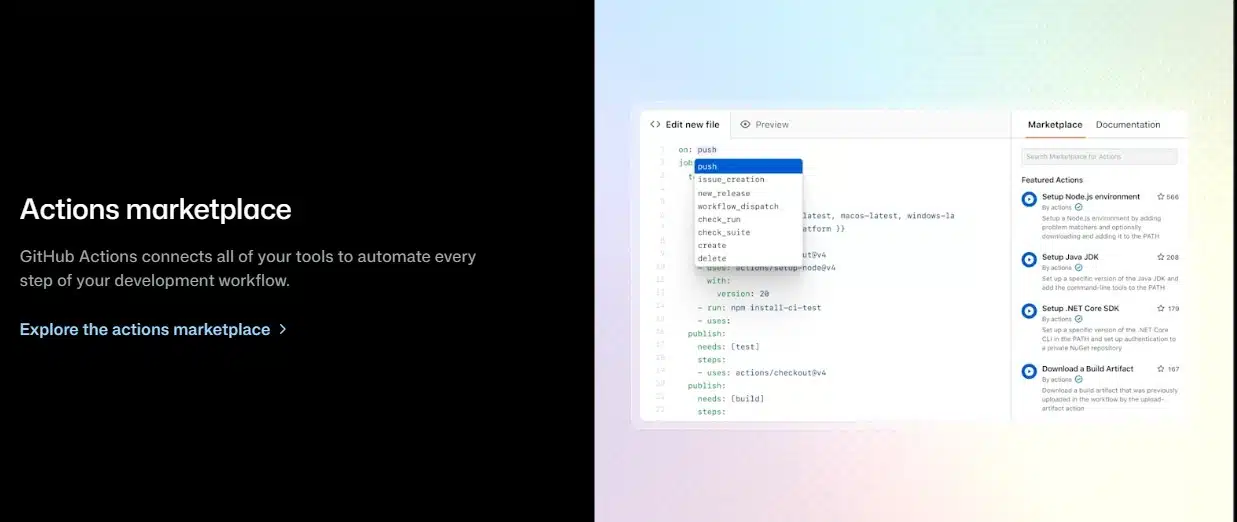
- GitHub Actions embeds automation directly into your source code repository. By using YAML-based workflows, teams can trigger builds, run tests, and execute deployments the moment a pull request is merged. Because it requires no separate CI server and feeds seamlessly into container registries, it is the fastest starting point for modern SaaS teams looking to eliminate pipeline friction.
2. GitLab CI/CD
- Best for: Enterprise SaaS needing strict compliance and built-in security out of the box.
- GitLab provides a complete, all-in-one platform handling source control, CI/CD, and advanced security scanning natively. For SaaS companies processing sensitive user data, GitLab’s built-in DevSecOps features automatically scan for vulnerabilities before code is ever deployed. This provides a massive compliance advantage without forcing teams to stitch together third-party security plugins.
3. CircleCI
- Best for: Agile teams requiring massive parallelism and lightning-fast build times.
- When pipeline speed is the absolute top priority, CircleCI excels. It is designed for cloud-native agility, offering intelligent caching and advanced parallel execution to drastically reduce build times. For engineering teams pushing dozens of microservice updates daily, shaving minutes off every build translates directly into major productivity gains.
4. Argo CD
- Best for: Kubernetes-native continuous delivery and preventing configuration drift.
- Argo CD operates on GitOps principles, fundamentally changing how code reaches production. Instead of a CI tool forcefully pushing changes to your servers, Argo CD sits inside your Kubernetes cluster, watches your Git repository for changes, and automatically pulls those updates in to match the desired state. This pull-based approach makes rollbacks instantly executable and guarantees your Git repository remains the ultimate source of truth.
5. Harness
- Best for: Complex, multi-cloud deployments requiring automated canary releases and AI-driven rollbacks.
- Harness is a standalone Continuous Delivery platform built for scale. It stands out by utilizing machine learning to monitor new deployments in real time. If Harness detects anomalous behavior, CPU spikes, or error loops immediately after a release, it automatically rolls the application back to the last stable version, actively protecting your SaaS uptime without human intervention.
Infrastructure, Orchestration, and Monitoring
While CI/CD delivers the code, this stack provides the resilient, automated foundation that your application actually runs on.
6. Docker
- Best for: Creating immutable, environment-agnostic application packages.
- Docker remains the foundational standard for SaaS deployment. By wrapping your application code and its specific dependencies into an isolated container, Docker ensures your software runs exactly the same in production as it did on a developer’s local machine. It is the essential first step before attempting to scale with orchestration tools.
7. Kubernetes
- Best for: Scaling microservices and ensuring high availability during massive traffic spikes.
- Kubernetes is the undisputed industry standard for running distributed SaaS applications. It takes the containers built by Docker and automates their deployment, handles load balancing, and provides self-healing capabilities by automatically restarting failed instances. If your SaaS requires zero-downtime updates and massive scalability, Kubernetes is the engine that keeps it running.
8. Terraform
- Best for: Provisioning and version-controlling cloud infrastructure across AWS, GCP, or Azure.
- Terraform allows teams to define and provision their entire cloud infrastructure using declarative code. Before you can deploy applications, Terraform builds the foundational networks, load balancers, and database clusters. It ensures your staging and production environments are identical, version-controlled, and easily reproducible across any major cloud provider.
9. Ansible
- Best for: Automating server setup, security policies, and software provisioning on virtual machines.
- While Terraform provisions the raw cloud hardware, Ansible configures the software running inside it. Ansible is an agentless tool using simple YAML playbooks to automate system setup, manage user access, and enforce security policies across hybrid environments. It works perfectly alongside modern containers for managing underlying database clusters or legacy infrastructure.
10. Prometheus
- Best for: Scraping real-time metrics and triggering performance alerts in containerized environments.
- Deploying code is only half the battle; monitoring the live result is the other. Prometheus is an open-source systems monitoring toolkit specifically built for dynamic infrastructure. It seamlessly scrapes metrics from your Kubernetes clusters and application endpoints, allowing your team to configure alerts that catch performance regressions the moment a deployment goes live.
Scaling Your SaaS with the Right Stack
Building a successful SaaS platform requires more than just writing great code; it requires a delivery mechanism you can trust. There is no single universal DevOps pipeline, but the most resilient platforms share a common architecture: version-controlled infrastructure, immutable containerized applications, and highly automated delivery. By selecting tools that actively complement each other, like GitHub Actions testing code, Docker containerizing it, Terraform building the servers, and Argo CD deploying the final product, you eliminate deployment friction. This allows your engineering team to focus entirely on building a better product, confident that the pipeline will handle the delivery safely and automatically.
Frequently Asked Questions on the Best DevOps Tools
1. What is the difference between traditional CI/CD and GitOps?
Traditional CI/CD relies on a push model: a central server runs your tests and forcefully pushes the new code into your production servers. GitOps relies on a pull model: a tool like Argo CD lives directly inside your infrastructure, constantly watches your Git repository, and pulls changes in. GitOps ensures that what is written in your repository is exactly what is running in production.
2. Do I really need Kubernetes for a new SaaS startup?
Not necessarily. Kubernetes is incredibly powerful but introduces a steep learning curve and operational overhead. If you are an early-stage startup seeking product-market fit, managed services like AWS App Runner, Vercel, or a simple Docker environment are often faster and cheaper. Transition to Kubernetes only when you specifically require high availability, auto-scaling microservices, or complex multi-cloud flexibility.
3. Terraform vs. Ansible: Which one should I use?
Most mature SaaS pipelines use both in tandem. Terraform is an orchestration tool best suited for creating the actual cloud infrastructure, like virtual private clouds, load balancers, and raw servers. Ansible is a configuration management tool best suited for installing software and managing the internal settings on the machines that Terraform just built.
4. How do I secure a SaaS deployment pipeline?
Start by implementing the principle of least privilege for all service accounts connected to your pipeline. Never hardcode API keys or database passwords; rely on a dedicated secrets manager like HashiCorp Vault. Finally, integrate tools directly into your CI process to automatically scan container images and code dependencies for known vulnerabilities before they are cleared for deployment.
5. What is the best CI/CD tool for a small, bootstrapping team?
GitHub Actions is the optimal starting point for small teams. Because the automation is built directly into the platform where your code already lives, there is no external infrastructure to manage and no separate accounts to configure. Its generous free tier easily covers the requirements of most early-stage SaaS pipelines, allowing small teams to automate immediately with zero upfront cost.