
To use AI in marketing without losing brand voice, give the tool clear brand rules, approved source material, a narrow task, and mandatory human review. AI is useful for organizing research, drafting variations, and repurposing existing content, but it should not define your position, invent claims, or approve the final message.
The strongest workflow treats AI as an assistant, not an editor or brand strategist. Build a short voice guide with preferred language, banned phrases, audience expectations, and real examples. Then verify every factual claim and revise the draft until it sounds recognizably yours—not merely polished, fluent, and generic.
Brand Voice Needs Clear Rules
Many voice guides rely on adjectives such as friendly, confident, and professional. These are too broad. A useful guide explains the choices behind the words.
Does the brand define technical terms? Is humor suitable around customer problems? Which claims require evidence? How direct should calls to action be? The answers create usable instructions.
Voice is the brand’s recognizable character; tone changes with the situation. A launch email can be upbeat, while an outage update should be restrained. Both should sound like the same company.
AI in Marketing Without Losing Brand Voice
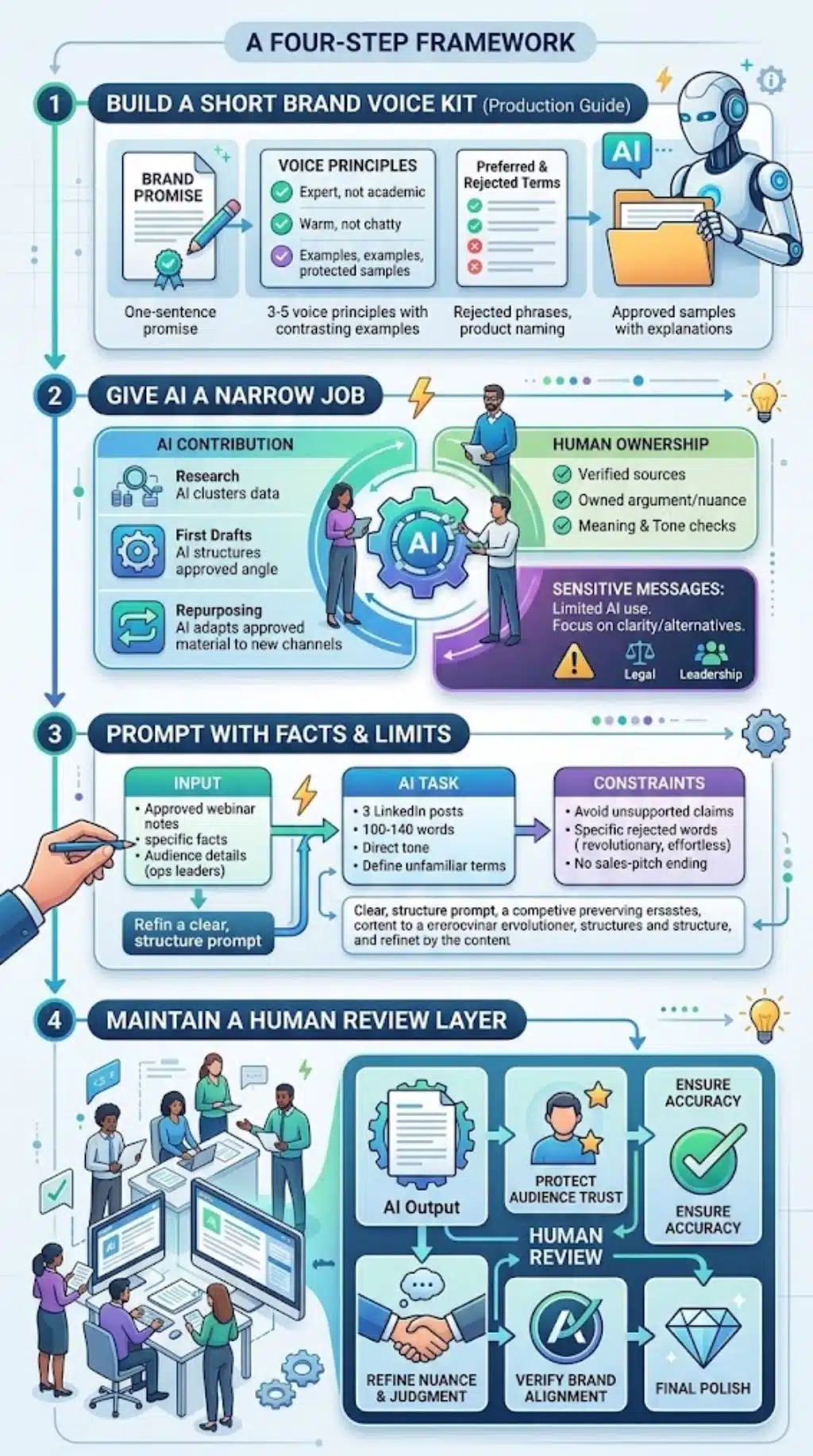
AI in marketing without losing brand voice starts with clear rules, approved examples, focused prompts, and human review. This approach improves efficiency while protecting consistency, accuracy, judgment, and audience trust.
Build a Short Brand Voice Kit
Do not upload a long brand book and expect the tool to find the relevant rules. Create a short production guide with:
- A one-sentence brand promise and audience description
- Three to five voice principles with contrasting examples
- Preferred terms, rejected phrases, and product naming rules
- Standards for evidence, comparisons, and calls to action
- Tone notes for different channels and sensitive announcements
- Approved samples with notes explaining why they work
The notes matter. “Expert, not academic” might mean defining an acronym without explaining familiar ideas. “Warm, not chatty” could permit contractions but reject opening banter.
Use recent material. Old campaigns may contain language the current team has rejected. For teams using AI in marketing without losing brand voice, this guide should be the working source of truth.
Give AI a Narrow Job
Decide what the tool may contribute and what a person must own:
- Research: AI can group supplied notes and flag gaps. A person verifies the sources and conclusions.
- First drafts: AI can structure an approved angle. The editor owns the argument, nuance, and wording.
- Repurposing: AI can adapt approved material for another channel. A reviewer checks that shortening it has not changed the meaning.
- Sensitive messages: Limit AI to identifying unclear language or suggesting alternatives. Use specialist, legal, or leadership review when the risk justifies it.
A sound approach to AI in marketing without losing brand voice starts with outlines, headline options, transcript cleanup, and repurposing. Crisis statements, regulated claims, layoffs, and customer-harm messages need tighter control. Fluent writing can still show poor judgment.
Prompt With Facts and Limits
A prompt cannot create a point of view from a few adjectives. It can enforce decisions the team has already made:
Turn the approved webinar notes into three LinkedIn posts for operations leaders, each 100 to 140 words. Use a direct tone and define unfamiliar terms. Avoid “revolutionary,” “effortless,” and unsupported claims. Use only supplied facts. Flag missing information. Avoid a sales-pitch ending.
Separate the facts, audience, voice rules, and output requirements. This makes AI in marketing without losing brand voice easier to manage because editors can trace weak copy to missing evidence, a vague task, or poor guidance.
Edit Facts Before Style
Any process for AI in marketing without losing brand voice needs two reviews. First, check accuracy and framing. Verify every statistic, quotation, product claim, customer result, and comparison. Generative AI can present false information confidently, so plausible wording is not proof.
Then review voice. Look for generic openings, inflated promises, overexplaining, repetitive rhythm, and aggressive calls to action. “Make it more human” is vague. Request a precise change, such as removing exaggeration while preserving a limitation.
Use five questions:
- Could a direct competitor publish this unchanged?
- Does any claim exceed the supplied evidence?
- Does the draft use language the brand has rejected?
- Has the channel-specific tone altered the underlying voice?
- Would the responsible editor approve the message, not merely its grammar?
If a competitor could publish it unchanged, add a clearer position or original detail.
Protect Sensitive Information
Privacy is part of using AI in marketing without losing brand voice. Customer interviews, product plans, employee messages, and contracts may contain confidential or personal information.
Check the service’s terms, retention, training settings, and administrator controls. Plans can differ. OpenAI currently says Business, Enterprise, and API content is not used for model training by default; individual ChatGPT users manage training through Data Controls. Other providers may differ.
Create a “never paste” list covering credentials, customer records, contracts, embargoed announcements, and restricted licensed material. Remove personal details the task does not require.
Good governance for AI in marketing without losing brand voice also covers output. Product claims need evidence. Never invent testimonials, case studies, statistics, quotations, or customer results. In the United States, the FTC’s Consumer Reviews and Testimonials Rule covers AI-generated fake reviews presented as genuine experiences.
Disclosure rules vary. In the EU, Article 50 of the AI Act has applied since August 2, 2026. It covers direct AI interactions, deepfakes, and some public-interest text. Substantively reviewed text under human editorial responsibility can qualify for an exemption from that labelling duty. Global campaigns still need local review.
For U.S. copyright, AI assistance does not prevent protection, but protection extends to human-authored expression. Prompts alone do not necessarily establish authorship. Other jurisdictions may differ.
Turn Corrections Into Better Rules
Teams using AI in marketing without losing brand voice should record recurring edits. If reviewers repeatedly repair the same phrase or claim, update the guide and add a dated before-and-after example.
Custom models are often premature. A versioned guide, approved examples, a controlled prompt, and a named reviewer address the immediate problem: unclear standards.
Pilot one low-risk workflow. Track rewriting, factual corrections, missed voice rules, and approval time. Google does not treat AI assistance as an automatic Search violation, but generating many pages without added value may breach its scaled content abuse policy.
Common Shortcuts That Weaken Brand Voice
Watch for these habits:
- Asking the tool to discover the brand’s position instead of supplying one
- Treating one successful prompt as a permanent system
- Feeding it unapproved examples because they are convenient
- Approving a draft because it is grammatical and on schedule
- Using the same tone for an advertisement, apology, help article, and executive post
- Removing editors from high-volume channels because each item seems minor
Brand drift usually appears across a body of work, not in one spectacularly bad sentence.
Final Thoughts
Using AI in marketing without losing brand voice is an editorial discipline. Give the tool approved evidence, a defined task, concrete rules, and firm limits. Keep people responsible for accuracy, judgment, and final approval.
Start with one low-risk workflow and review its first batch closely. If readers recognize who is speaking and trust the message, the system is useful.
Frequently Asked Questions (FAQs)
Does a Company Need a Custom AI Model to Preserve Brand Voice?
Usually not. A concise guide, approved examples, controlled sources, and consistent review can solve early problems. Consider customization only when the use case, volume, privacy requirements, and evaluation method are clear.
Must Every AI-Assisted Marketing Asset Be Labelled?
No single answer applies worldwide. Requirements depend on the jurisdiction and content. Synthetic spokespeople, deepfakes, endorsements, political material, and regulated campaigns deserve local legal review. Internal drafting does not automatically carry the same duties as published synthetic media.
How Often Should a Brand Voice Guide Be Updated?
Use editorial triggers rather than a fixed calendar. Update the guide when recurring edits expose a gap, positioning changes, or a new channel creates a tone problem. Keep dated before-and-after examples.