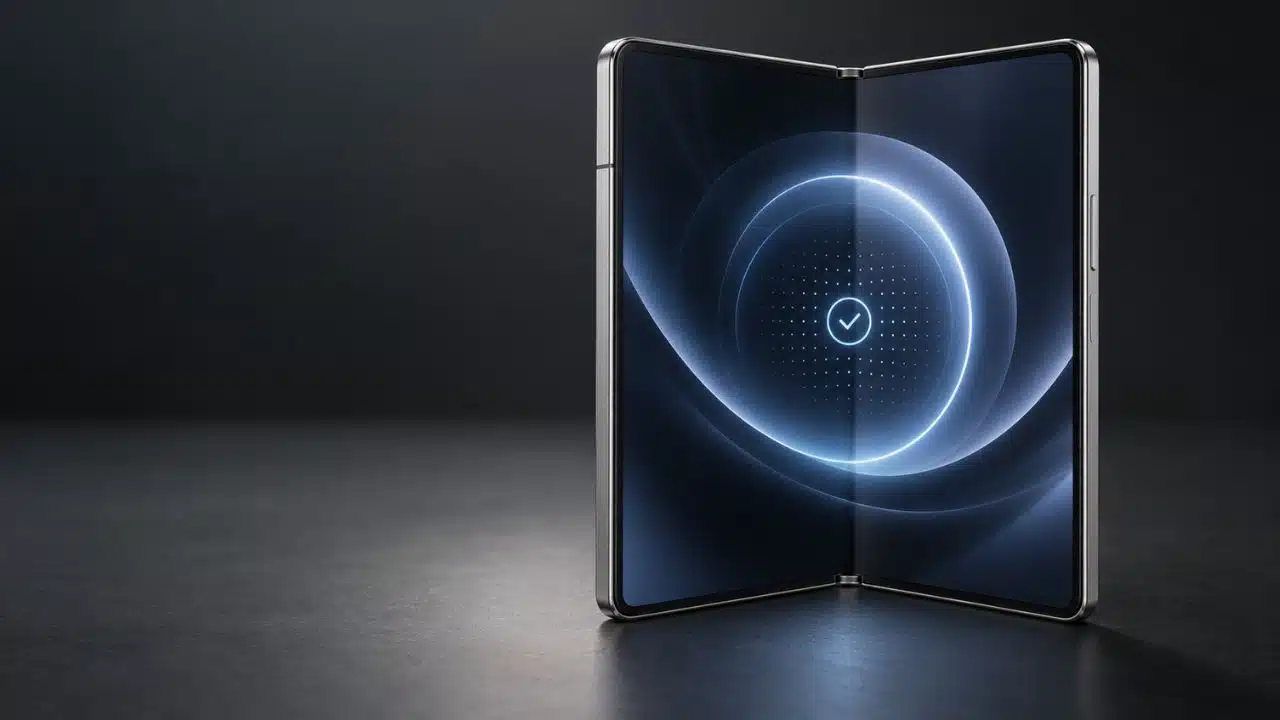
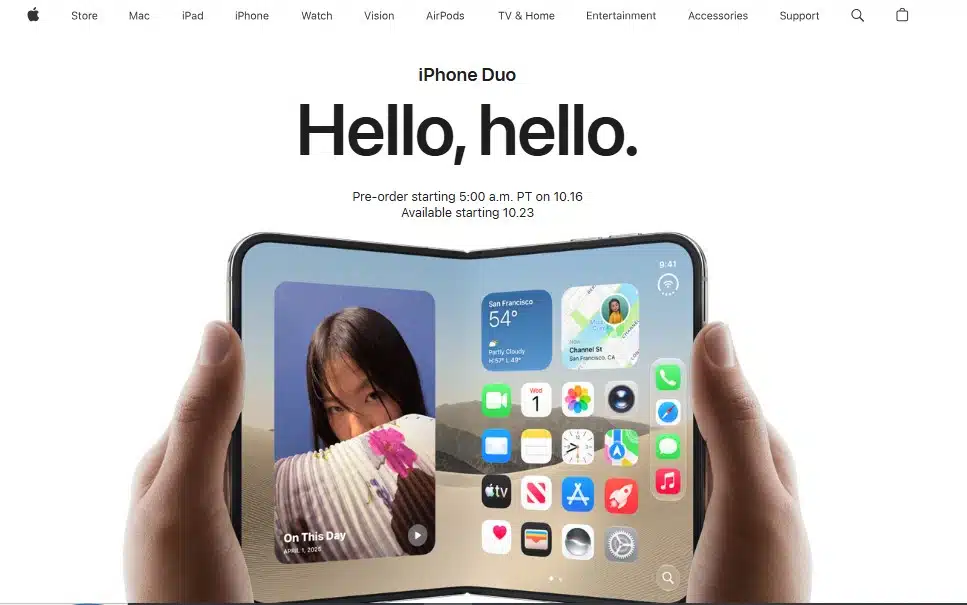
Apple’s new era is taking shape with the iPhone Duo, the company’s first foldable iPhone. Unveiled on September 9, 2026, the device combines a 5.4-inch outer display with a 7.6-inch inner display, runs on the A20 Pro chip and introduces an iOS 27 experience designed around folding, Split View multitasking and dual-screen camera features. It starts at $1,999, with preorders opening October 16 and availability beginning October 23.
The hardware is the headline, but I think the more useful question is what the fold changes in daily use. Apple has rebuilt parts of the iPhone experience around multitasking, new camera uses and Siri AI. That gives the Duo a clearer purpose than novelty alone, while leaving real questions about durability, software support and whether a $1,999 phone can provide enough value.
Siri AI, private cloud compute, and Apple Reference Image showed where Apple believes its next advantage lies. The direction is coherent, but its promises still need to work outside a managed presentation.
The iPhone Duo Is a Statement, Not a Mainstream Phone
The iPhone Duo is Apple’s boldest hardware change in years, but its importance goes beyond the folding display. I see it as a showcase for Apple’s hardware-and-software integration rather than an immediate replacement for the standard iPhone.
Apple Arrives Late—but With a Familiar Strategy
Apple did not invent the foldable phone. Samsung has sold foldable models since 2019, while Huawei and other manufacturers have continued developing the category.
Apple has often allowed others to establish a category before introducing a more controlled version of its own. This time, it wants consumers to believe it has made the foldable that finally feels like an iPhone.
Software Gives the Fold a Purpose
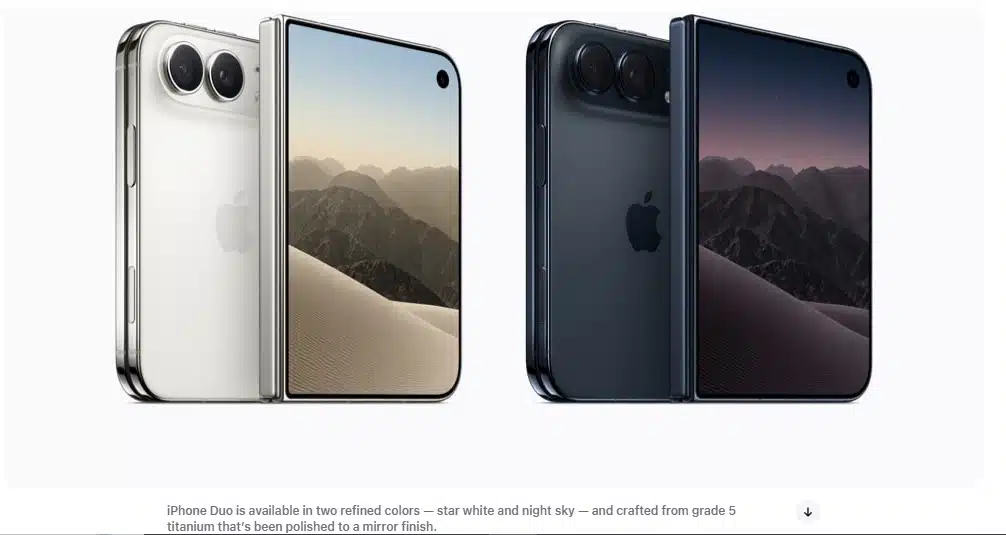
The Duo has a 5.4-inch outer display and opens to reveal a 7.6-inch inner display. Apple has adapted iOS 27 so the extra space does more than enlarge existing content.
Split View allows two applications to run side by side on an iPhone for the first time. Users can save application pairs, open two Safari windows or keep a Siri AI conversation visible beside another application.
The A20 Pro chip and vapor-chamber cooling support these more demanding uses. Yet a folding screen becomes valuable only when people have a practical reason to open it. That will depend on software support and everyday habits, not the novelty of the hinge.
Premium Hardware Sits at the Center of Apple’s Strategy
Apple is introducing its most ambitious ideas through devices designed for customers willing to pay more. This reduces the financial risk of experimenting with expensive technology, but it also limits who can experience Apple’s newest thinking.
A $1,999 Testing Ground
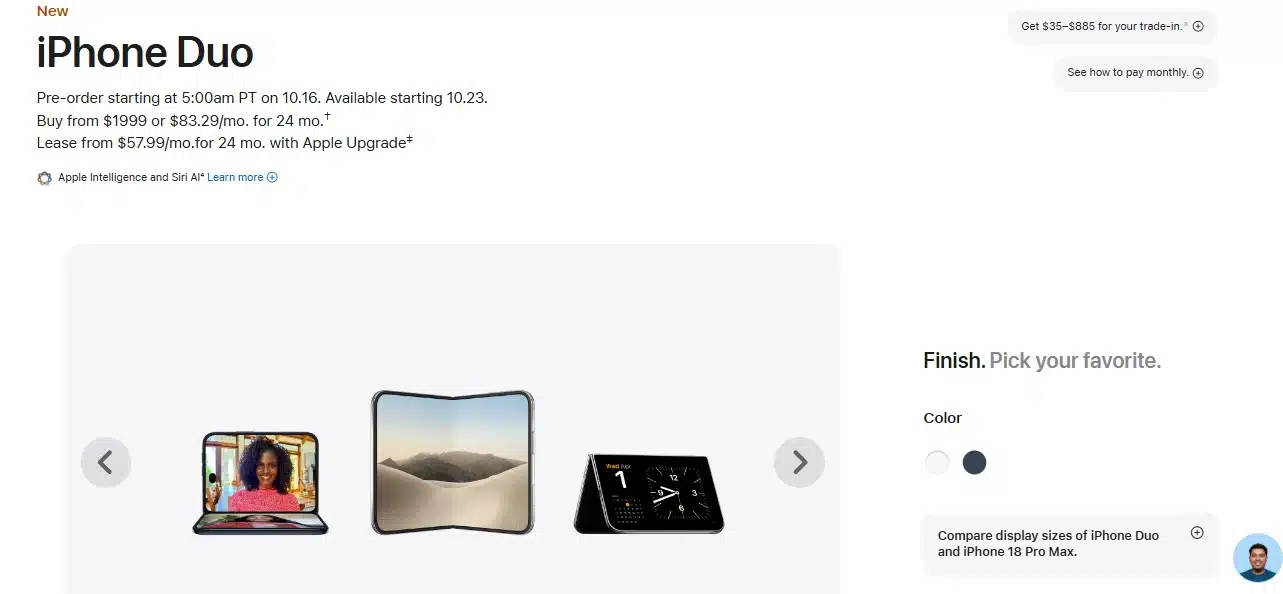
The iPhone Duo starts at $1,999 for 256GB of storage. Preorders begin October 16, with availability starting October 23. At that price, I do not see it becoming the default iPhone soon. It is better understood as a statement product and a public testing ground.
Early users will reveal whether the larger display changes everyday behavior. They will also expose issues a keynote cannot settle: hinge durability, display wear, application compatibility and repair costs.
Premium pricing extends beyond the Duo. The iPhone 18 Pro starts at $1,199, while the Pro Max begins at $1,299. Both cost $100 more than the previous Pro models. Their upgrades include the A20 Pro chip and a 48-megapixel main camera with variable aperture.
Launching expensive new technology at the top of the market gives Apple room to refine it. The weakness is accessibility. A $1,999 phone may influence the industry, but most consumers will observe that future long before they can afford it.
Siri AI Is the More Important Product
The iPhone Duo may influence Apple’s hardware lineup, but Siri AI could change how people interact with the entire ecosystem. Its value will depend less on impressive conversations than on whether it can complete ordinary tasks accurately.
From Voice Commands to Personal Context
Apple is rebuilding Siri as a conversational assistant that can understand personal context. It is designed to search across messages, emails, photographs and notes; respond to information displayed on the screen; and take actions inside supported applications. A dedicated Siri application will also keep conversations together across Apple devices.
Siri AI is meant to move beyond simple voice commands and become an intelligent layer connecting users with information scattered across their devices.
That is where I think Apple has a genuine opportunity. Siri does not need to replace every general-purpose AI service. It needs to become useful when access to personal applications provides an advantage. Finding an old photograph or retrieving a reservation number may not look spectacular onstage, but those are the tasks that could make an assistant valuable every day.
The Promise Is Ahead of the Proof
Apple has made ambitious Siri promises before, so caution is reasonable. Siri AI begins rolling out in beta with iOS 27 on September 14. English comes first, with five additional languages scheduled for October. Some capabilities will still vary by language and region.
The beta label matters. Apple has shown what Siri AI is intended to do, not how reliably it will respond to millions of unpredictable requests. One incorrect appointment, misunderstood message or unwanted action could damage trust faster than several successful demonstrations can build it.
Trust Is Becoming an Apple Product
As AI gains access to more personal information and creates increasingly realistic content, capability is no longer the only measure that matters. Apple is trying to make privacy and content provenance practical reasons for choosing its ecosystem.
Privacy Is Part of the Architecture
Apple says Apple Intelligence will process requests on the device whenever possible. When a task needs more computing power, private cloud compute can connect to larger server-based models. According to the company, information used for those requests is not stored or made accessible to Apple.
This architecture plays to Apple’s strengths because it controls the chips, devices and operating systems involved. Yet privacy becomes more complicated as Siri gains access to photographs, documents, conversations and schedules.
Users will need clear permissions and understandable controls. They should know what Siri can access, be able to withdraw that access and correct the assistant when it misunderstands a request. Trust cannot exist only in technical documentation. People must experience it through predictable behavior.
Apple Reference Image Addresses a Different Trust Problem
Apple Reference Image extends this strategy beyond personal data. On the iPhone 18 Pro, the feature can apply secure, pixel-level signing to image data at capture, helping verify what the camera sensor originally recorded. Apple also plans to support identification of certain images generated or edited with AI.
For journalists, publishers and verification teams, this could matter more than another increase in camera resolution. Smartphones are often the first cameras present when news happens. Reliable capture information could give newsrooms another way to examine photographs before publication.
The feature will not initially be available in the European Union or China. Its wider value will depend on whether publishers and platforms can preserve and interpret its authentication data.
It is not a complete solution to misinformation. A genuine photograph can still receive a false caption, lose important context through cropping or be presented as evidence of an unrelated event. Provenance can help establish how an image file was created. It cannot determine whether every claim attached to that image is true.
Even with that limitation, I consider the Apple Reference Image one of the event’s most consequential announcements. Apple is building tools that can create and edit photorealistic content while also trying to distinguish generated material from camera capture. Creation and verification increasingly need to develop together.
John Ternus Is Signaling Evolution, Not Reinvention
John Ternus’s first major event as Apple CEO carried clear symbolic weight. Yet the announcements suggest a refinement of Apple’s existing strategy rather than a sudden reset.
A Hardware Engineer Takes the Lead
Ternus became Apple CEO on September 1, while Tim Cook moved into the role of executive chairman. His hardware-engineering background made the iPhone Duo a fitting centerpiece, even though the device was developed over several years.
Ternus appears willing to place ambitious hardware back at the center of Apple’s identity while retaining the premium pricing, ecosystem control and privacy positioning strengthened under Cook.
I do not see a clean break with the previous era. I see Apple adding a more visible engineering character to an established strategy. Whether that becomes a genuine transformation will depend on the products and decisions that follow.
Apple’s New Era: The Real Test Comes After the Keynote
A presentation can establish a direction, but it cannot prove that the products will fulfill their promises. Apple’s strategy will be judged through independent testing, everyday AI reliability, global availability and whether consumers find enough practical value to justify the prices.
Apple’s response to the AI era connects premium devices, personal AI, private processing and digital-content verification.
The weaknesses are equally clear. The hardware is exceptionally expensive. Siri AI begins as a beta with limited language support. Some capabilities depend on future updates, regional approval and developer participation. The iPhone Duo’s durability and daily usefulness remain unproven.
I am not ready to describe this as Apple returning to its revolutionary past. Folding an iPhone does not establish that. Calling an AI assistant trusted does not automatically make it trustworthy.
But Apple now has a more defined strategy. It is betting that people will value integration over openness, local processing over unrestricted data collection and verifiable creation over digital uncertainty.
The iPhone Duo shows what Apple wants its future hardware to become. Siri AI and Apple Reference Image show what the company believes will make that future worth trusting. Now the products must earn the confidence already built into Apple’s message.