Early math often gets reduced to counting. Parents hear a child recite numbers to 20 and naturally assume that is where mathematical learning begins.
But long before children add, subtract, or recognize written numbers, they are learning to notice relationships. One thing is bigger than another. Two objects belong together. Something happens again. A sequence has a predictable order.
Pattern play for toddlers gives children a simple way to explore that kind of structure.
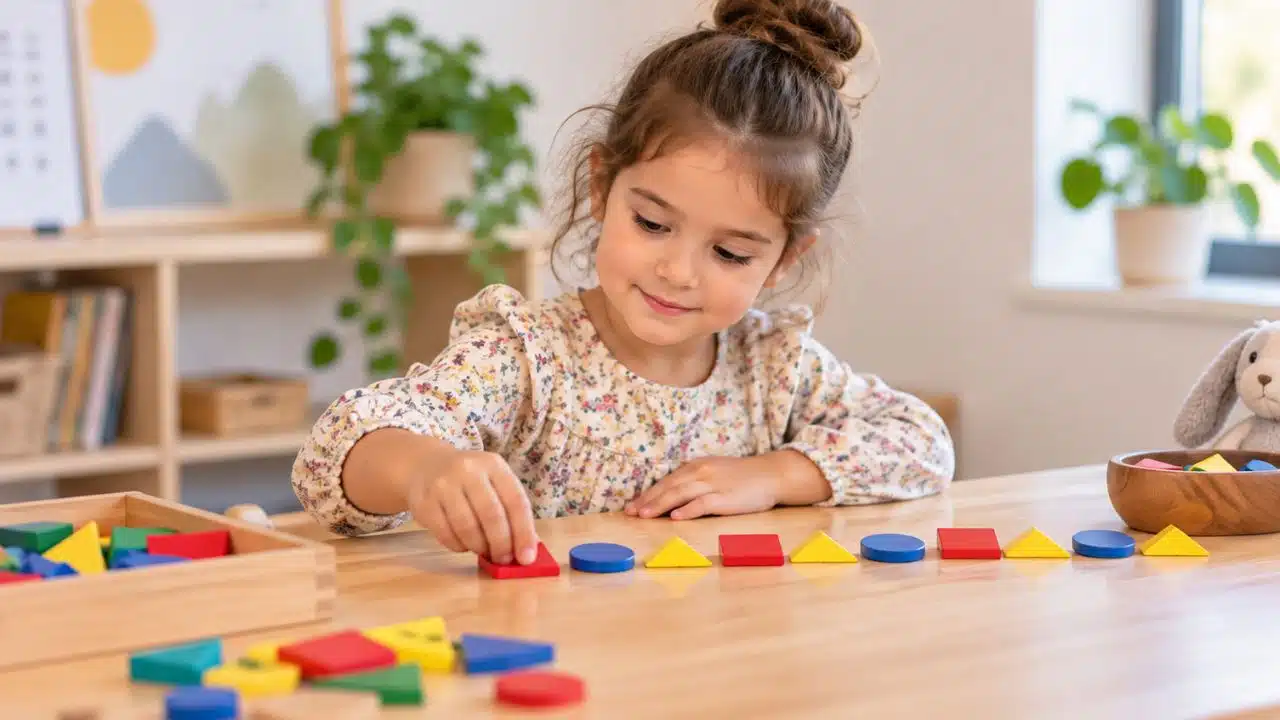
A red block followed by a blue block, then another red and another blue, may look like ordinary play. So can clap-stomp-clap-stomp or spoon-cup-spoon-cup. The important part is not the objects themselves. It is the rule underneath them.
Pattern activities are not a shortcut to producing a child who is “good at math.” Research does not support treating them as a special form of brain training. They are better understood as one useful part of early math skills, alongside counting, quantity, sorting, shape, space, comparison, and measurement.
And they happen to be easy to build into ordinary play.
Children Need to Notice the Rule, Not Just the Colors
A line of colorful objects is not automatically a mathematical pattern.
Consider:
red – blue – red – blue – red – blue
What makes this a pattern is the part that repeats: red-blue.
Now replace the blocks:
car – bear – car – bear – car – bear
The objects have changed, but the structure is still AB.
This distinction matters because a child can sometimes continue a familiar sequence without really understanding what makes it repeat. They may have learned that “blue comes after red” rather than recognizing a reusable rule.
A more revealing challenge is to change the materials.
Make a red-blue-red-blue pattern with blocks, then put the blocks away and offer two kinds of toy animals. Can the child make the same kind of pattern?
Cow-pig-cow-pig shows more than simply adding another blue block. The child has carried the relationship from one set of objects to another.
That is the kind of understanding worth encouraging.
Patterning Has a Place Among Early Math Skills
Young children meet mathematics throughout ordinary life, even when nobody calls it math.
A child choosing the larger piece of fruit is comparing size. Filling and emptying containers introduces capacity. Building a tower involves shape, balance, position, and spatial reasoning. Putting cars in one basket and animals in another is classification.
Patterns belong in that same group of early experiences.
Early-childhood mathematics guidance from NAEYC and NCTM includes patterns and relationships alongside number, geometry, measurement, classification, and other foundational ideas. Their guidance also emphasizes play, conversation, reasoning, and everyday activity rather than pushing young children too quickly toward formal calculation.
Patterning contributes something quite specific: it asks children to look for structure.
To continue a pattern, a child has to notice what has already happened and use that information to decide what belongs next. To explain a pattern, the child has to go a little further and identify what repeats.
Later mathematics depends heavily on recognizing relationships and regularity. That does not make a preschool block activity “early algebra” in the school sense, and adults do not need to dress it up with that label. The simpler point is enough: recognizing structure is mathematical thinking.
The Research Is Encouraging, but It Has Limits
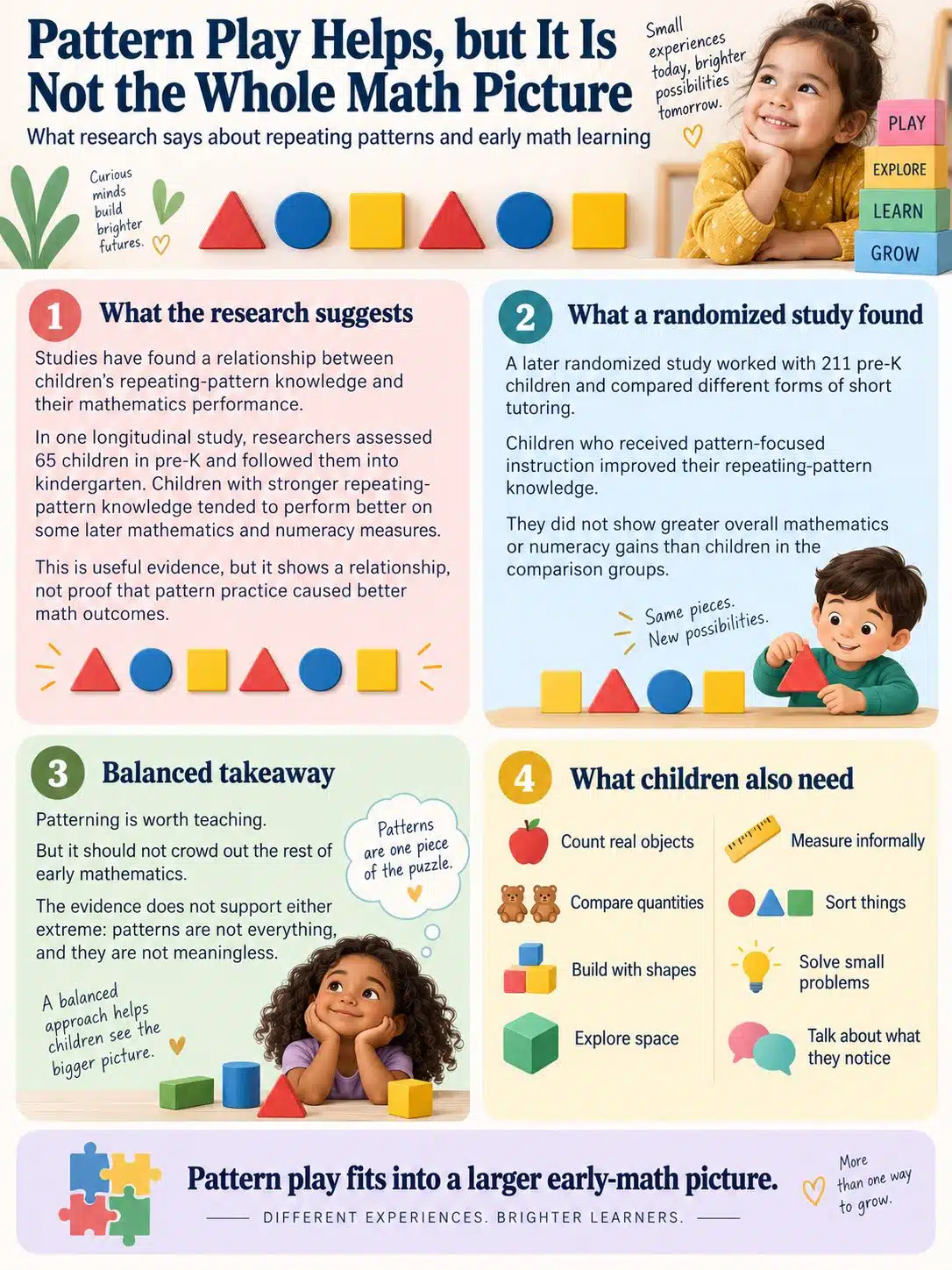
Studies have found a relationship between children’s repeating-pattern knowledge and their mathematics performance.
In one longitudinal study, researchers assessed 65 children in pre-K and followed their mathematics development into kindergarten. Children with stronger repeating-pattern knowledge tended to perform better on some later mathematics and numeracy measures, even after the researchers accounted for several other abilities.
That is useful evidence, but it does not show that practicing patterns caused the children to become better at mathematics.
A later randomized study makes that distinction clearer. Researchers worked with 211 pre-K children and compared different forms of short tutoring. Children who received pattern-focused instruction improved their repeating-pattern knowledge. They did not, however, show greater overall mathematics or numeracy gains than children in the comparison groups.
Parents and educators do not need to choose between “patterns are essential” and “patterns do nothing.” Neither position reflects the evidence very well.
Patterning is worth teaching. It just should not crowd out the rest of early mathematics.
A child needs opportunities to count real objects, compare quantities, build with shapes, explore space, measure informally, sort things, solve small problems, and talk about all of it.
Pattern play fits into that larger picture.
For Toddlers, Start With Movement
Adults often reach for blocks or activity cards first, but a toddler’s own body may be an easier teaching tool.
Try:
clap – stomp – clap – stomp
Or:
tap – tap – pause – tap – tap – pause
You can also make a walking pattern: one ordinary step, one big step, one ordinary step, one big step.
Movement removes some of the clutter. The child does not have to remember color names, manipulate small pieces, or keep objects neatly aligned. They can simply join the repetition.
Do the sequence several times and then pause before the next movement.
Give the child a moment.
A toddler who raises a foot because they expect the stomp has already noticed something about the pattern, even if they cannot explain it.
There is no need to follow that moment with a series of questions. For very young children, participating and anticipating can be enough.
Build Difficulty Gradually
Simple AB patterns are a sensible starting point:
red-blue-red-blue
clap-stomp-clap-stomp
spoon-cup-spoon-cup
Once a child can comfortably copy and extend those, change the structure.
Try:
AAB: red-red-blue, red-red-blue
ABB: car-block-block, car-block-block
AABB: jump-jump-clap-clap
ABC: spoon-cup-plate, spoon-cup-plate
Vanderbilt’s early patterning guidance uses a similar progression, starting with simpler repeating patterns before introducing more complex units.
The useful progression is not just from short to long. It is from doing to understanding.
A child might move through these kinds of challenges over time:
- Join a pattern someone else makes.
- Copy a simple pattern.
- Fill in a missing piece.
- Continue the sequence.
- Make a pattern independently.
- Show which part repeats.
- Recreate the same structure with different materials, sounds, or movements.
There is no need to attach those steps to rigid ages.
If AB patterns are still difficult, making the sequence longer will not help. Stay with the simpler rule and change the activity instead.
If AB has become easy, increasing the complexity of the repeating unit is usually more meaningful than producing a 20-object red-blue row.
One Question Can Reveal More Than Ten Guesses
“What comes next?” has its place. It teaches prediction.
But if adults ask only that question, pattern play can turn into a guessing exercise.
Try changing the conversation:
- “What part keeps happening again?”
- “Show me where it starts over.”
- “How did you know the bear goes there?”
- “Can you make a different pattern with these?”
- “Can you turn this block pattern into a sound pattern?”
- “Something changed in this row. Can you find it?”
- “Do you think this is a pattern? Why?”
Not every interaction needs a question either.
An adult might simply say, “You used two yellow blocks and then one green block. Then you did the same thing again.”
That kind of description puts language around what the child has made without turning play into a performance.
Young children do not need to demonstrate understanding on demand every time an adult notices a learning opportunity.
Your House Already Contains Pattern Materials
Special pattern kits can be useful in classrooms, but most families do not need to buy anything.
At breakfast, make banana-strawberry-banana-strawberry.
While folding clothes, try sock-shirt-sock-shirt.
Line up two types of toy vehicles.
Use cups and spoons.
Make patterns with footsteps on a walk or with movements during a song.
Outside the home, children can notice repeated designs on fences, paving, clothing, tiles, windows, or playground equipment. Not every repeating visual arrangement will be a perfect classroom-style sequence, and that is fine. The conversation can be as simple as noticing that something appears again and again.
Songs are especially useful because repetition is built into them. If a child knows a repeated movement or sound well, pause before it happens and see whether they anticipate it.
The best pattern activity is often the one that requires almost no preparation.
That matters because a two-minute game repeated naturally over several days is far more realistic for most families than a carefully prepared activity that becomes another item on the schedule.
Small Objects Are Not Worth the Risk With Toddlers
Buttons, beads, counters, coins, and small craft pieces make visually neat patterns. They are also unnecessary for teaching the concept to a young toddler.
Small objects can present a choking hazard. U.S. Consumer Product Safety Commission guidance specifically warns about small parts for children under 3, and families should also follow the age warnings and safety standards that apply where they live.
There are plenty of larger alternatives:
large blocks, cups, soft toys, chunky puzzle pieces, pictures, footsteps, claps, drumbeats, cushions, or large toy animals.
The mathematics does not improve because the materials look more like classroom manipulatives.
For toddlers, safe and simple wins.
Give Help Without Taking Over
Pattern play becomes less useful when the adult controls every move.
Suppose a child builds:
red – blue – red – red
The quickest response is to replace the final red block with blue.
It is usually more interesting to wait.
Point back to the beginning. Say the colors slowly. Ask the child to look again. They may notice the mismatch themselves.
If they do not, there is no crisis. Model the pattern another time.
Guided play research suggests that adult-supported play can help some areas of learning, including aspects of early mathematics. The evidence is not uniform enough to justify turning every play session into a hidden lesson, though.
Children still need plenty of time to build something that has no educational objective at all.
A useful adult role is to notice when mathematical thinking appears and occasionally give it a little more room.
Some Common Pattern Activities Are Overrated
Worksheets are probably the clearest example.
A worksheet can help an older preschooler practice recognizing a pictured sequence. It may also be useful for an educator who wants a quick snapshot of whether a child can complete a familiar type of pattern.
But it is a poor replacement for moving, building, comparing, talking, making mistakes, changing materials, and inventing patterns.
Color-only activities can also become limiting. If every pattern is red-blue-red-blue, children may start to associate “pattern” with alternating colors instead of repetition itself.
Use sound. Movement. Shape. Size. Objects. Position.
A pattern can be:
loud-soft-loud-soft
big-small-big-small
stand-sit-stand-sit
car-bear-bear-car-bear-bear
The structure matters more than the medium.
And avoid making complexity the measure of success. A child who can explain an AB pattern may understand more than a child who successfully guesses the next item in an elaborate sequence.
What If a Child Is Not Interested?
Do not assume the child “doesn’t understand patterns” because they walk away from a row of blocks.
Change the format.
A child who ignores counters may happily copy a drumbeat. One who refuses to sit at a table may enjoy a jump-clap pattern across the room. A child who loves vehicles may respond to car-bus-car-bus long before they care about colored cubes.
Interest matters because patterning is easy to teach through play. There is little reason to force it.
If the child loses interest after 30 seconds, stop.
You can find another opportunity later while getting dressed, singing a song, setting out snacks, or walking to the park.
Repeated low-pressure encounters are more appropriate for toddlers than trying to finish an activity because an adult has decided it is “math time.”
Patterning Is Useful Because It Fits Into Real Childhood
There is a tendency in early learning to package ordinary development into special exercises.
Pattern play does not need that treatment.
Its strength is that it can sit inside things children already do: moving, singing, arranging, building, noticing, sorting, and copying adults.
It also scales naturally.
A toddler can anticipate clap-stomp. A preschooler can continue red-red-blue. Later, the same child may recognize the repeating unit, fix an error, invent a new rule, or represent a block pattern with movements.
That progression matters more than owning the right materials or finishing a certain number of activities.
Patterning is one thread in a much larger mathematical childhood. Number sense, quantity, shape, spatial reasoning, classification, measurement, comparison, and problem-solving deserve just as much attention.
Final Thoughts
Early math skills do not begin with worksheets or memorized sums. They begin when children notice relationships and try to make sense of them.
Pattern play for toddlers is a practical way to support that process because it requires almost nothing: two movements, two objects, two sounds, and a rule that repeats.
Start with something easy enough for the child to join. Clap-stomp. Car-bear. Big-small. When that becomes familiar, leave a gap, change the materials, or ask the child to make the pattern instead.
There is no need to push for complicated sequences or treat patterning as a predictor of future academic success. Keep it alongside counting, building, sorting, comparing, measuring, and ordinary conversation about the world.
If a child begins to notice what repeats, predict what belongs next, and eventually explain the rule, the activity is doing useful mathematical work.
Frequently Asked Questions about How Pattern Play Builds a Math-Ready Brain
At what age can children start learning simple patterns?
Children can be exposed to repetition from infancy through songs, routines, movement, and sound. Formal pattern activities are not necessary for babies. As toddlers become able to copy actions and arrange objects, adults can introduce very simple repeating patterns such as clap-stomp or red-blue. Readiness varies, so interest and participation are more useful guides than a fixed age.
How often should parents do pattern activities with toddlers?
There is no evidence-based need for a daily pattern lesson or a set number of minutes. Short, natural interactions are enough. A parent might make a movement pattern during a song one day and arrange two types of fruit at snack time another day. If the child is enjoying it, continue. If attention disappears, move on.
Should a preschooler be able to identify AB, AAB, and ABC patterns?
These labels are useful for adults and educators, but children do not need to memorize the terms. What matters more is whether they can notice, copy, extend, create, and eventually explain repeating structures. Start with a simple AB pattern and introduce more complex patterns only when the child is comfortable with the earlier ones.
Does difficulty with patterns mean a child will struggle with math?
No. A single pattern activity is not a reliable measure of a child’s overall mathematical ability. Young children develop at different rates, and performance can change with the materials, instructions, attention, language demands, and familiarity of the task. If there are broader concerns about a child’s development or learning across several areas, those concerns are better discussed with an appropriate early-childhood or health professional.