History is rarely just a collection of dates; it is the living, breathing story of human ambition, tragedy, and triumph. When we look at September 10, we uncover a fascinating intersection of colonial resistance in the Indian subcontinent, revolutionary scientific advancements in Europe, and seismic geopolitical shifts in North America. This is a date that witnessed the dying breaths of fierce revolutionaries, the birth of mathematical geniuses, and the crack of the last guillotine in France.
For the Bangalee sphere and the broader Indian subcontinent, September 10 carries deep emotional resonance. It is a day of remembrance for martyrs who laid down their lives for independence and for literary giants who reshaped cultural landscapes. At the same time, the rest of the world has seen this date host maritime battles that defined the borders of North America, the birth of modern fashion and sports icons, and the flipping of a switch that allowed scientists to peer into the origins of the universe.
In this comprehensive archive report, we journey across continents and centuries to unpack exactly what happened on this day. From the mud-soaked trenches of the Battle of Balasore to the hallowed halls of CERN in Switzerland, here is your in-depth guide to the history, famous birthdays, notable deaths, and global observances of September 10.
The Bangalee Sphere
The Indian subcontinent, and the Bangalee sphere in particular, holds September 10 as a day of profound historical weight. It is marked by the ultimate sacrifice of anti-colonial revolutionaries and the passing of literary icons who shaped the Bengal Renaissance.
Historical Events & Movements
-
1915: The Battle of Chasakhand (Balasore) and the Fall of Bagha Jatin
The Indian independence movement witnessed one of its most heroic and tragic chapters on September 10, 1915. Jatindranath Mukherjee, universally revered as Bagha Jatin (Tiger Jatin), died in the Balasore District Hospital. The day before, Jatin and his young revolutionary associates had engaged in a fierce, 75-minute gun battle against heavily armed British Indian police led by Charles Tegart in the muddy trenches of Chasakhand, Orissa. Hoping to secure German arms to stage a pan-Indian mutiny (the Hindu-German Conspiracy), their plot was intercepted. Mortally wounded in the abdomen, Jatin’s death on September 10 sent shockwaves through Bengal, inspiring a generation of freedom fighters, including Subhas Chandra Bose.
-
1971: Diplomatic Tides Turn in the Bangladesh Liberation War
By September 10, 1971, the Bangladesh Liberation War was entering a critical phase. The Indo-Soviet Treaty of Peace, Friendship, and Cooperation (signed in August) was actively deterring foreign intervention on behalf of West Pakistan. Inside East Pakistan, the Mukti Bahini (freedom fighters) were escalating their guerrilla warfare against the Pakistani military. September 10 marks a period where international media, previously censored, began exposing the full scale of the humanitarian crisis, swinging global public opinion irrevocably toward the cause of an independent Bangladesh.
Famous Births
Govind Ballabh Pant (Born 1887)
Born in Almora (present-day Uttarakhand), Pant was a towering figure in India’s fight for independence alongside Mahatma Gandhi and Jawaharlal Nehru. He served as the first Chief Minister of Uttar Pradesh and later as India’s Home Minister. His efforts in abolishing the zamindari system and establishing Hindi as an official language earned him the Bharat Ratna in 1957.
Basappa Danappa Jatti (Born 1912)
Better known as B.D. Jatti, he was an influential Indian politician who served as the 5th Vice President of India. Crucially, he stepped in as the Acting President of India in 1977 following the sudden death of Fakhruddin Ali Ahmed.
Calyampudi Radhakrishna Rao (Born 1920)
Born in the Madras Presidency, C.R. Rao became one of the greatest mathematicians and statisticians of the 20th century. His groundbreaking contributions, including the Cramér–Rao bound and the Rao–Blackwell theorem, revolutionized data analysis. He lived to the age of 102, leaving an unmatched legacy in global science.
Famous Deaths
Sukumar Ray (Died 1923)
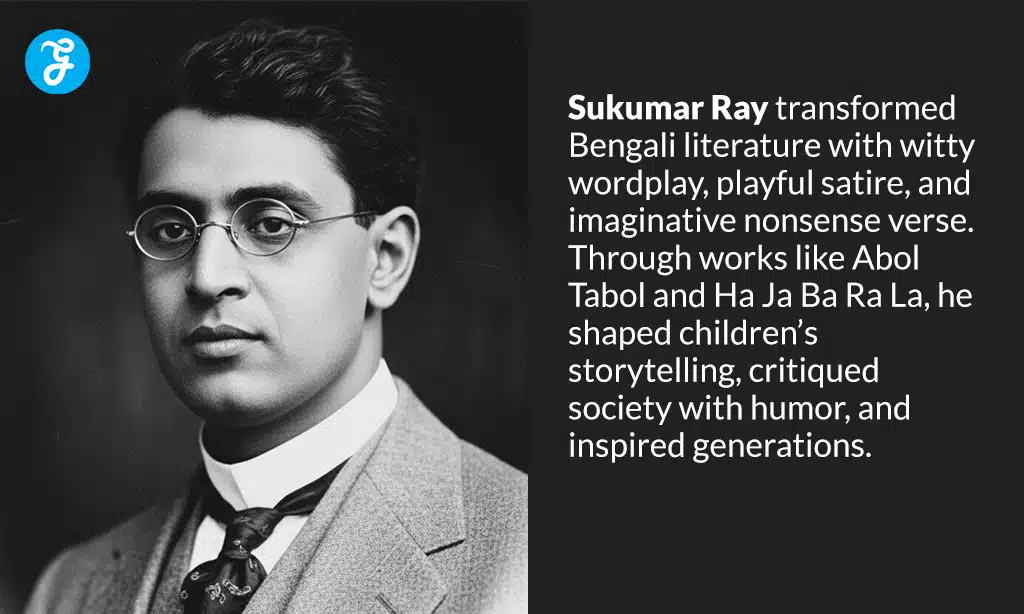
Sukumar Ray (1887–1923) was a pioneering Bengali poet, humorist, writer, and illustrator who transformed Bengali children’s literature with his unique style of nonsense verse, satire, and imaginative storytelling. The son of writer Upendrakishore Ray Chowdhury and father of filmmaker Satyajit Ray, he created unforgettable works such as Abol Tabol and HaJaBaRaLa.
His playful writing often contained sharp social criticism and clever wordplay. He also contributed significantly to the family magazine Sandesh. Sukumar Ray died of kala-azar on September 10, 1923, at the age of only 35, but his literary legacy remains deeply influential.
Bagha Jatin (Died 1915)
Bagha Jatin, born Jatindranath Mukherjee (1879–1915), was a prominent revolutionary leader and one of the leading figures of the Jugantar movement against British rule. He earned the nickname “Bagha Jatin” after reportedly killing a Bengal tiger with a dagger. During World War I, he helped organize an armed uprising against the British with planned German support as part of the Indo-German Conspiracy. In September 1915, Jatin and four companions were surrounded by British forces near the Buribalam River in Odisha.
Despite being heavily outnumbered, they fought a fierce battle for around 75 minutes. Seriously wounded by gunfire, Jatin died on September 10, 1915, at the age of 35. His bravery and sacrifice made him an enduring symbol of India’s revolutionary struggle for independence.
International Observances & Holidays
While some nations celebrate their sovereignty on this day, the global community unites around a critical public health initiative.
-
World Suicide Prevention Day (Global): Endorsed by the World Health Organization (WHO) and hosted by the International Association for Suicide Prevention (IASP), September 10 is dedicated to raising awareness that suicide is a preventable tragedy. The day focuses on reducing stigma, sharing resources, and encouraging open conversations around mental health crises worldwide.
-
Teachers’ Day (China): Since 1985, the People’s Republic of China has observed September 10 as National Teachers’ Day. It is a day steeped in the Confucian tradition of revering educators, where students express gratitude to their mentors through gifts, cards, and ceremonies.
-
Gibraltar National Day (Gibraltar): This day commemorates the pivotal 1967 sovereignty referendum where the citizens of Gibraltar overwhelmingly voted (12,138 to 44) to remain a British Overseas Territory rather than pass under Spanish sovereignty. The Rock of Gibraltar turns into a sea of red and white as residents celebrate their identity.
-
St. George’s Caye Day (Belize): A colorful national holiday in Belize marking the 1798 Battle of St. George’s Caye, where British Honduras (with the help of enslaved people who chose to fight alongside the British) successfully repelled a massive Spanish invasion fleet.
Global History
Beyond the subcontinent, September 10 has been a stage for empires clashing, technology leaping forward, and modern borders being drawn.
United States: Battles & Patents
-
1608: Captain John Smith was elected president of the council in Jamestown, Virginia—the first permanent English settlement in the Americas. His rigorous leadership (“He that will not work shall not eat”) is largely credited with saving the starving colony.
-
1813: The Battle of Lake Erie became one of the most significant naval engagements of the War of 1812. American Commodore Oliver Hazard Perry led his fleet to a decisive victory over the British Royal Navy. His subsequent dispatch remains legendary: “We have met the enemy and they are ours.”
-
1846: American inventor Elias Howe was granted the first US patent for a sewing machine using a lockstitch design. This invention drastically revolutionized garment manufacturing, paving the way for the modern textile industry and fundamentally altering domestic labor.
Canada: Stepping Onto the World Stage
-
1939: In a monumental moment of national sovereignty, the Parliament of Canada independently declared war on Nazi Germany following the invasion of Poland. Unlike World War I, where Britain’s declaration automatically dragged Canada into the conflict, the 1931 Statute of Westminster gave Canada diplomatic autonomy. Prime Minister William Lyon Mackenzie King’s declaration on September 10 proved Canada was fighting as an independent nation.
Europe & United Kingdom: Empires and Executions
-
1547: The Battle of Pinkie Cleugh took place near Musselburgh, Scotland. It was the last pitched battle between Scottish and English armies, resulting in a catastrophic defeat for the Scots during the conflict known as the “Rough Wooing.”
-
1919: The map of Europe was violently redrawn with the signing of the Treaty of Saint-Germain-en-Laye. The Republic of German-Austria was forced to sign the treaty with the Allied Powers, officially dissolving the Austro-Hungarian Empire, capping the Austrian military at 30,000 men, and ceding vast territories to newly formed nations like Czechoslovakia and Yugoslavia.
-
1977: In Marseille, France, a convicted murderer named Hamida Djandoubi became the last person in the Western world to be executed by the guillotine. France would officially abolish capital punishment four years later in 1981.
-
2002: Switzerland, known for its strict historical neutrality, finally abandoned its isolationist stance and officially joined the United Nations as a full member.
-
2008: The European Organization for Nuclear Research (CERN) successfully fired the first protons around the 27-kilometer underground tunnel of the Large Hadron Collider (LHC) in Geneva. It marked the dawn of a new era in particle physics, eventually leading to the discovery of the Higgs boson.
Rest of World: Africa and Asia
-
1960 (Italy/Africa): At the Rome Olympics, Ethiopian runner Abebe Bikila stunned the world by winning the marathon completely barefoot. Not only did he set a world record, but he also became the first sub-Saharan African to win an Olympic gold medal, shifting the global axis of long-distance running toward East Africa forever.
-
1974 (Africa): After a grueling 11-year war of independence, Portugal officially recognized the independence of Guinea-Bissau. This came in the wake of the Carnation Revolution in Lisbon, which triggered the rapid decolonization of Portugal’s African territories.
Notable Births & Deaths (Global)
September 10 has welcomed visionary thinkers, artists, and athletes, while also witnessing the tragic, often violent, passing of historical luminaries.
Famous Births
-
Arthur Compton (Born 1892, American): A brilliant physicist who won the Nobel Prize in Physics in 1927 for discovering the Compton effect, which demonstrated the particle nature of electromagnetic radiation. He also played a key role in the Manhattan Project.
-
Arnold Palmer (Born 1929, American): Universally known as “The King,” Palmer was one of the greatest and most charismatic players in golf history. His television-friendly appeal popularized the sport globally in the 1950s and 60s.
-
Karl Lagerfeld (Born 1933, German): The legendary and enigmatic creative director of Chanel, Fendi, and his own eponymous label. He completely reinvented modern haute couture before his death in 2019. (Note: Lagerfeld notoriously obscured his birth year, but records heavily point to 1933).
-
Stephen Jay Gould (Born 1941, American): A giant in the field of evolutionary biology and paleontology. He co-developed the theory of “punctuated equilibrium,” proposing that evolution occurs in rapid bursts of speciation followed by long periods of stability.
-
Jack Ma (Born 1964, Chinese): The billionaire business magnate and philanthropist who co-founded Alibaba Group. He became a global symbol of China’s staggering rise in the technology and e-commerce sectors.
-
Colin Firth (Born 1960, English): The acclaimed Academy Award-winning actor celebrated for his roles in The King’s Speech, Pride and Prejudice, and A Single Man.
Famous Deaths
-
Mary Wollstonecraft (Died 1797, British): A foundational philosopher of the feminist movement. She wrote the groundbreaking A Vindication of the Rights of Woman (1792), arguing that women are not naturally inferior to men but only appear to be because they lack education. Tragically, she died of postpartum septicemia (childbed fever) just 11 days after giving birth to her daughter, Mary Shelley, who would later write the literary masterpiece Frankenstein.
-
Empress Elisabeth of Austria (Died 1898, Austrian): Famously known as “Sisi,” the beautiful and melancholic Empress was assassinated on this day in Geneva, Switzerland. An Italian anarchist named Luigi Lucheni, seeking to kill any member of royalty, stabbed her in the heart with a sharpened needle file as she walked to a steamboat.
-
Huey Long (Died 1935, American): Nicknamed “The Kingfish,” the fiercely populist US Senator and former Governor of Louisiana died two days after being shot in the Louisiana State Capitol by Dr. Carl Weiss. His “Share Our Wealth” program had made him a formidable political threat to FDR during the Great Depression.
-
Anita Roddick (Died 2007, British): The visionary founder of The Body Shop. She pioneered the concept of ethical consumerism, proving that a global corporate business could successfully campaign for environmental justice and strictly ban animal testing.
“Did You Know?” Trivia
Here are three fascinating, lesser-known facts related to September 10 that make for perfect historical conversation starters:
-
The First Drunk Driving Arrest: Long before breathalyzers existed, a 25-year-old London taxi driver named George Smith made dubious history on September 10, 1897. After slamming his electric cab into a building, he became the very first person in the world to be arrested and fined (25 shillings) for drunk driving.
-
The Grunge Revolution Began: On September 10, 1991, Nirvana released the single “Smells Like Teen Spirit.” It received little fanfare on its exact release day, but within weeks, it completely destroyed the hair-metal dominance of the 1980s, bringing Seattle grunge into the mainstream and altering rock music forever.
-
The British War Cabinet’s Desperate Order: During the horrific heights of the Blitz in 1940, Winston Churchill’s War Cabinet issued a deeply controversial directive on this day. They secretly ordered that British bomber pilots unable to find their specific military targets over Germany should no longer bring their bombs home—they were instructed to drop them “anywhere” to maximize psychological damage.
Quote of the Day
“I only regret that I have but one life to lose for my country.”
— Nathan Hale
Final Thoughts
September 10 serves as a profound mirror reflecting humanity’s capacity for both catastrophic destruction and breathtaking innovation. On one hand, it is a day scarred by the assassination of empresses in Geneva, the execution of revolutionaries in the muddy trenches of Balasore, and the final chilling drop of the guillotine in France. On the other, it is a day illuminated by Elias Howe’s industrial ingenuity, the birth of literary rebels like Sukumar Ray and Mary Wollstonecraft, and the activation of the Large Hadron Collider—humanity’s greatest machine.
Whether we are remembering the diplomatic masterstrokes that aided the birth of Bangladesh in 1971 or celebrating the barefoot Olympic triumph of Abebe Bikila in Rome, this date proves that history is never static. It is a continuous, overlapping narrative of individuals stepping up to challenge the status quo. As we observe the anniversaries attached to September 10, we are reminded that the actions taken on this day—whether by a politician, a poet, or a scientist—continue to ripple through the world we navigate today.