September 8 stands as a day that has fundamentally altered the trajectory of empires, redefined global borders, and birthed cultural icons. From the unveiling of a Renaissance masterpiece in Florence to the deadliest natural disaster in American history, the events of this day weave a complex narrative of human resilience, artistry, and geopolitical shifting.
The Bangalee Sphere & The Subcontinent
The historical tapestry of the Indian subcontinent and the Bangalee diaspora features moments of profound cultural resonance, political maneuvering, and border resolutions on September 8.
Critical Historical Events
-
The Tin Bigha Corridor Agreement (2011): In a historic move to resolve decades of border disputes stemming from the 1947 partition, India and Bangladesh signed an agreement granting unrestricted 24-hour access through the Tin Bigha Corridor. This narrow strip of Indian territory previously cut off the residents of the Dahagram-Angarpota enclaves from mainland Bangladesh. The diplomatic breakthrough ended the virtual captivity of thousands, allowing them proper access to medical care, education, and commerce.
-
Sultanate Transitions (1320): Ghiyath al-Din Tughluq ascended to the throne, becoming the Sultan of Delhi and founding the Tughluq dynasty. His reign marked a significant period of administrative reform and territorial expansion across the subcontinent.
Famous Births
-
Bhupen Hazarika (1926): Born in Sadiya, Assam, this legendary playback singer, lyricist, and filmmaker transcended linguistic barriers, heavily influencing both Assamese and Bengali culture. His baritone voice carried themes of communal amity, universal justice, and empathy. Awarded the Bharat Ratna posthumously, his legacy remains deeply ingrained in the cultural consciousness of the region.
-
Huseyn Shaheed Suhrawardy (1892): Born in Midnapore, West Bengal, Suhrawardy became one of the most prominent Bengali politicians of the 20th century. A champion of civil rights and a key figure in the Bengal Provincial Muslim League, he later served as the Prime Minister of Pakistan, shaping the early democratic framework of the nation.
-
Asha Bhosle (1933): The legendary Indian playback singer, whose career spans over eight decades, was born in Sangli. With a Guinness World Record for the most studio recordings, her versatile voice has defined the golden era of Indian cinema.
Notable Deaths
-
Feroze Gandhi (1960): The prominent Indian freedom fighter, politician, and journalist. As a member of the Lok Sabha, he established a reputation as a fierce anti-corruption crusader.
-
Sheikh Abdullah (1982): Known as the “Lion of Kashmir,” he was a central figure in the politics of Jammu and Kashmir. His shifting relationship with the Indian central government deeply influenced the region’s modern political landscape.
International Observances & Holidays
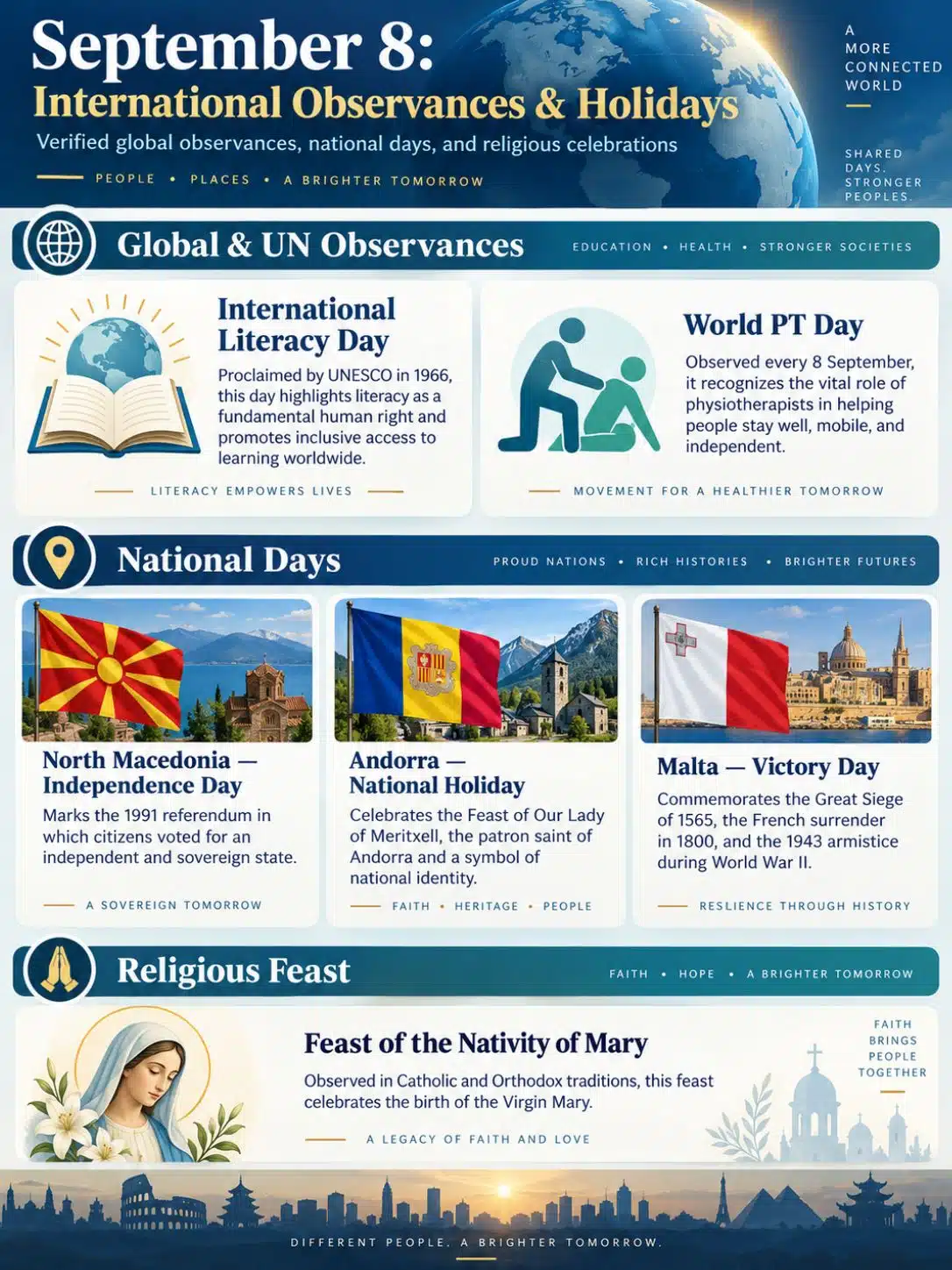
September 8 is officially recognized by global institutions and sovereign states to celebrate education, independence, and historical survival.
Global & UN Observances
-
International Literacy Day: Established by UNESCO in 1966, this day underscores literacy as a fundamental human right. It serves as an annual reminder that despite technological advancements, over 770 million adults worldwide still lack basic reading and writing skills. The day often focuses on bridging the digital divide and empowering marginalized communities through education.
-
World Physical Therapy Day: Designated in 1996 to recognize the crucial contribution of physical therapists to keeping people well, mobile, and independent.
National Days & Religious Feasts
-
Independence Day (North Macedonia): Citizens celebrate the 1991 referendum where an overwhelming majority voted to formally secede from Yugoslavia, establishing the Republic of Macedonia without the bloodshed that characterized the wider Balkan conflicts.
-
National Holiday (Andorra): Commemorates the signing of the Pareatge in 1278, a feudal charter that established the unique co-principality arrangement of Andorra, shared between the Bishop of Urgell and the Count of Foix (now the President of France).
-
Victory Day (Malta): A remarkable triple commemoration honoring the end of the Great Siege of Malta (1565), the surrender of French troops to the British (1800), and the armistice of Italy during WWII (1943).
-
Feast of the Nativity of Mary: A significant feast in the Catholic and Orthodox calendars celebrating the birth of the Virgin Mary.
Global History
United States
-
The Founding of St. Augustine (1565): Spanish admiral Pedro Menéndez de Avilés landed in Florida, establishing St. Augustine. It remains the oldest continuously occupied European-established settlement within the borders of the continental United States, predating Jamestown by over 40 years.
-
Surrender of New Amsterdam (1664): The Dutch colonial settlement of New Amsterdam quietly surrendered to an English naval fleet without a single shot fired. The British swiftly renamed the strategic port city New York, fundamentally altering the trajectory of American commerce and culture.
-
The Galveston Hurricane (1900): A Category 4 hurricane made a direct hit on the prosperous island city of Galveston, Texas. With a 15-foot storm surge sweeping over the low-lying island, an estimated 8,000 to 12,000 people perished. It remains the deadliest natural disaster in U.S. history, prompting the elevation of the entire city and the construction of the Galveston Seawall.
-
Presidential Pardon (1974): President Gerald Ford issued a full, free, and absolute pardon to Richard Nixon for any crimes he may have committed against the United States during the Watergate scandal. The controversial decision likely cost Ford the 1976 election but was intended to heal a deeply polarized nation.
United Kingdom
-
The Passing of a Monarch (2022): Queen Elizabeth II, the longest-reigning monarch in British history, died peacefully at Balmoral Castle at the age of 96. Her 70-year reign spanned the post-WWII austerity era, the dismantling of the British Empire, and the dawn of the digital age. Her death immediately triggered “Operation London Bridge” and the accession of King Charles III.
-
The V-2 Rocket Blitz (1944): The German military launched its first V-2 ballistic missile against London. Unlike the V-1 flying bombs, the V-2 was a supersonic weapon that dropped from the stratosphere without warning, opening a terrifying new chapter in modern warfare.
Europe
-
Michelangelo’s David (1504): After three years of meticulous labor on an abandoned, flawed block of marble, Michelangelo unveiled his 17-foot masterpiece in the Piazza della Signoria in Florence. The statue immediately became a potent symbol of civil liberties and the defense of the Florentine Republic against powerful rivals.
-
Armistice of Cassibile (1943): U.S. General Dwight D. Eisenhower officially announced the armistice with Italy. The unconditional surrender removed one of the Axis powers from WWII, though it immediately triggered a swift and brutal German occupation of the Italian peninsula.
Russia
-
Battle of Kulikovo (1380): Grand Prince Dmitry Donskoy led a coalition of Russian principalities to a monumental victory over the Golden Horde at the Don River. While the Tatar yoke would continue for another century, Kulikovo shattered the myth of Mongol invincibility and centralized Russian power around Moscow.
-
The Siege of Leningrad Begins (1941): German forces severed the last land connection to the Soviet city of Leningrad (now St. Petersburg). The ensuing 872-day blockade was one of the longest and most destructive sieges in human history, resulting in the starvation and death of nearly one million civilians.
China & Asia
-
Partition of Korea (1945): Following the surrender of Japan, U.S. troops arrived in southern Korea to officially accept the Japanese surrender south of the 38th parallel, while Soviet forces occupied the north. This hastily drawn line would calcify into the border between North and South Korea, setting the stage for the devastating Korean War.
-
Treaty of San Francisco (1951): Forty-nine nations signed a peace treaty with Japan, officially terminating World War II in the Pacific and restoring Japanese sovereignty. Notably, the Soviet Union refused to sign, and neither the People’s Republic of China nor the Republic of China was invited due to the ongoing dispute over legitimate representation.
Australia & The Rest of the World
-
SEATO Formation (1954): In response to the growing influence of communism in Asia, representatives from Australia, France, New Zealand, Pakistan, the Philippines, Thailand, the UK, and the US signed the Manila Pact. This established the Southeast Asia Treaty Organization (SEATO), a mutual defense pact modeled after NATO.
Notable Births & Deaths (Global)
September 8 marks the birth of medieval kings, classical composers, and civil rights icons, as well as the passing of monumental historical figures.
Famous Births
| Name | Year | Nationality | Legacy / Significance |
| Richard the Lionheart | 1157 | English | King of England, renowned military leader, and central Christian commander during the Third Crusade. |
| Antonín Dvořák | 1841 | Czech | Romantic composer famous for his New World Symphony and integrating folk rhythms into classical music. |
| Patsy Cline | 1932 | American | Legendary country singer and pop music crossover pioneer, known for hits like “Crazy” and “I Fall to Pieces”. |
| Bernie Sanders | 1941 | American | U.S. Senator and progressive political figure who fundamentally shifted the modern American political discourse. |
| Ruby Bridges | 1954 | American | Civil rights icon who, at just six years old, became the first African American student to integrate an all-white elementary school in the South. |
| Pink (Alecia Moore) | 1979 | American | Three-time Grammy Award-winning singer and songwriter known for her powerful vocals and acrobatic stage performances. |
Famous Deaths
| Name | Year | Nationality | Cause / Legacy |
| Queen Elizabeth II | 2022 | British | The longest-serving monarch in British history, dying peacefully of old age after 70 years on the throne. |
| Richard Strauss | 1949 | German | Prominent composer of the late Romantic and early modern eras, famed for tone poems like Also sprach Zarathustra. |
| Leni Riefenstahl | 2003 | German | Highly skilled but deeply controversial film director whose cinematic techniques pioneered modern filmmaking, yet she remains infamous for directing Nazi propaganda films like Triumph of the Will. |
| Prince Buster | 2016 | Jamaican | Singer, songwriter, and producer who helped define the sound of ska in the 1960s and inspired the late 70s Two-Tone movement. |
Fascinating “Did You Know?” Trivia
-
The Final Frontier: The iconic science fiction television series Star Trek made its broadcast debut on NBC on September 8, 1966. Created by Gene Roddenberry, the show pushed social boundaries, featuring the first interracial kiss on American television, and birthed a multi-billion dollar cultural franchise.
-
The Pledge of Allegiance: Written by socialist minister Francis Bellamy, the American Pledge of Allegiance was first published in a children’s magazine called The Youth’s Companion on September 8, 1892. It was originally intended for use in any country, reading: “I pledge allegiance to my Flag and the Republic for which it stands…”
-
The Invention of Scotch Tape: On September 8, 1930, 3M employee Richard Drew successfully marketed transparent cellophane adhesive tape. Originally designed to help auto mechanics paint two-tone cars, “Scotch Tape” became a household necessity during the Great Depression for repairing broken items.
-
Shattering the Home Run Record: On September 8, 1998, St. Louis Cardinals slugger Mark McGwire hit his 62nd home run of the season, breaking Roger Maris’s 37-year-old major league record of 61.
The Enduring Legacy of September 8
Reflecting on September 8 reveals a date uniquely positioned at the crossroads of cultural triumph and historical tragedy. From the chisel strikes that birthed Michelangelo’s David to the stroke of a pen that opened the Tin Bigha Corridor, this day underscores the human desire to shape the world.
It is a day that witnessed the brutality of the Galveston Hurricane and the Leningrad siege, yet also gave us the soaring music of Dvořák and the pioneering courage of Ruby Bridges. The passing of Queen Elizabeth II in 2022 serves as a definitive marker, reminding us that history is not just a collection of dates, but a living, breathing continuum. September 8 is a testament to our capacity to endure, create, and redefine the boundaries of what is possible.