

Most founders hear “exit” and think about the sale price. That is understandable, but it is also incomplete. SaaS exits can involve cash, buyer shares, investor preferences, retained equity, earnouts, employment agreements, and obligations that continue long after the deal closes.
I find it more useful to begin with four questions: Who is buying? What do they actually want? How will the transaction be structured? How much of the stated value will shareholders really receive?
Two companies can be acquired for the same headline amount while delivering very different outcomes for their founders. Understanding those differences is what turns an attractive offer into an informed decision.
What Is a SaaS Exit?
A SaaS exit is a transaction that gives founders, investors, employees, or other shareholders liquidity from their ownership in a software company. An acquisition is one exit route, but it does not always mean the buyer purchases everything or that the founder leaves immediately.
A buyer may acquire the entire company, purchase a controlling stake, buy selected assets, or primarily hire the team. The founder might leave after a transition, remain as an executive, or retain equity for a possible second payout later.
An IPO is also commonly described as an exit, but it is not an acquisition. It creates a public market for the company’s shares, usually with restrictions on when insiders can sell.
The Seven Main SaaS Acquisition Paths
The primary SaaS acquisition paths are strategic sales, private equity platform buyouts, PE-backed add-ons, long-term holding company acquisitions, operator-led purchases, acquihires, and asset sales.
1. Strategic Acquisition
A strategic buyer is another operating company that sees value beyond the SaaS business’s current revenue.
It may want to add a missing product capability, enter a new market, reach a specific customer base, acquire specialist technology, or avoid spending years building a similar product internally. These expected synergies can support a strong valuation, but a strategic buyer does not automatically pay more than other buyers.
Founders should ask what happens after closing. Will the product remain available? Will it be folded into a larger platform? Will the brand survive? Will the buyer retain the team?
A strong strategic fit can produce an excellent exit, but it may also bring the most dramatic changes to the company.
2. Private Equity Platform Buyout
In a platform buyout, a private equity firm acquires the SaaS company as a central investment rather than immediately combining it with another business.
The firm typically plans to increase the company’s value through organic growth, stronger management, better pricing, improved efficiency, or additional acquisitions. It may buy the whole business or take control while asking the founder to retain some ownership.
That retained stake, known as rollover equity, can create a second opportunity for liquidity. It also keeps the founder exposed to the company’s future performance under new governance. The first payout may be secure, but the second one is not.
3. PE-Backed Add-On Acquisition
An add-on acquisition happens when an existing private equity portfolio company buys a complementary SaaS business.
The buyer may want an adjacent product, a new geography, additional customers, proprietary data, or technology that strengthens its current platform. Because it already operates in the software market, it may understand the target’s business more quickly than a general buyer would.
The tradeoff is integration. The acquired company may adopt the buyer’s technology, pricing, sales process, brand, and management structure. Founders considering this path should understand how much independence will remain after closing.
4. Long-Term Software Holding Company
Some software holding companies acquire profitable SaaS businesses with the intention of owning them for a long period rather than preparing them for resale within a conventional private equity cycle.
This can appeal to founders who want to protect the product, team, or company identity. However, promises about permanent ownership and operational independence should be tested carefully.
Look at what the buyer did with previous acquisitions. Did it preserve the brands? Did management remain? Were prices, teams, or products consolidated? A buyer’s operating history reveals more than its acquisition pitch.
5. Operator, Search-Fund, or Management Buyout
Smaller profitable SaaS companies can attract individual operators, search funds, small investment groups, or members of the existing management team.
These buyers usually care about dependable cash flow, manageable technical operations, low churn, transferable customer relationships, and limited dependence on the founder. They are often purchasing a business they expect to operate directly.
That makes founder dependence a critical issue. A profitable SaaS company can still be difficult to transfer if one person controls sales, product decisions, customer support, and development. Clear processes and a capable team make the business more valuable and easier to hand over.
6. Acquihire
An acquihire is designed mainly to acquire the company’s employees and expertise rather than preserve the full business.
The buyer may want the engineering team, product knowledge, or specialist talent. Employment and retention packages can therefore represent a large part of the overall economic arrangement.
The original product may be closed after the acquisition, and shareholder proceeds can be limited once liabilities and investor preferences are addressed. An acquihire can preserve jobs and avoid a disorderly shutdown, but it should not be confused with a conventional strategic sale.
Founders should also separate the purchase price from compensation tied to future employment. Money earned by staying with the buyer for several years is payment for future work, not cash received from selling the company.
7. Asset, IP, or Customer-Book Sale
In an asset sale, the buyer purchases selected parts of the business rather than acquiring the entire legal entity.
Those assets may include the codebase, intellectual property, domain, trademarks, customer agreements, integrations, data rights, or a particular product line. This route is useful when the buyer wants the valuable parts of a company without taking on all its liabilities.
The original entity normally remains responsible for anything the buyer does not assume. It may still need to pay creditors, settle employee matters, complete tax filings, distribute the remaining proceeds, and formally wind down.
Asset sales can recover meaningful value, but they are not automatically simple or clean.
Buyer Type and Deal Structure Are Different Things
The buyer path explains who is acquiring the business and why. The deal structure determines what legally changes ownership.
A strategic buyer, PE firm, holding company, or individual operator could use any of the following structures.
Stock or Equity Sale
In a stock sale, the buyer purchases shares in the existing corporation. For an LLC or partnership, the equivalent transaction involves purchasing the relevant ownership interests.
The company continues to own its contracts, accounts, intellectual property, and other assets. The buyer takes control of the existing entity, including its known and unknown liabilities.
Contracts may still contain change-of-control provisions requiring notification or consent.
Asset Sale
In an asset sale, the buyer purchases specified assets and assumes only the liabilities identified in the agreement.
Software, customer contracts, trademarks, data, domains, vendor relationships, and employee arrangements may each require separate handling. The seller’s entity remains responsible for excluded assets and liabilities.
Merger
In a statutory merger, the target combines with the buyer or a subsidiary created for the transaction. One entity survives according to the agreed legal structure.
A merger can make it easier to acquire all outstanding ownership interests without negotiating an individual sale with every shareholder. It still requires the appropriate board, shareholder, contractual, and regulatory approvals.
Despite the name, a merger does not necessarily mean both companies are equal. Many transactions presented publicly as mergers are economically acquisitions.
How Are SaaS Companies Valued in an Acquisition?
SaaS companies are usually valued according to their revenue quality, retention, growth, profitability, customer concentration, product strength, and operational risk. There is no single multiple that applies to every SaaS business.
Growing recurring-revenue companies are often discussed using ARR or revenue multiples. Larger profitable companies may be valued using EBITDA. Smaller owner-operated businesses may be assessed using seller’s discretionary earnings.
The metric is only the starting point. Buyers still need to determine how reliable the underlying business is.
Revenue Quality and Retention
Not all ARR deserves the same valuation.
Buyers examine whether revenue is contractual, recurring, collectible, and likely to survive the ownership change. They review cancellations, discounts, refunds, usage-based charges, implementation fees, contract lengths, renewal terms, and late payments.
Gross revenue retention shows how much existing revenue remains before expansion. Net revenue retention includes upgrades and cross-sells. Strong expansion is valuable, but it should not be used to hide heavy underlying churn.
Growth, Profitability, and Margins
Growth matters, but buyers also care about what it costs to produce that growth.
A company expanding through unsustainable discounts or excessive acquisition spending may be less attractive than a slower business with better retention and cash flow. Gross margin also matters because hosting, support, onboarding, and AI inference costs can make apparently scalable revenue expensive to deliver.
The Rule of 40 can provide a broad view of growth and profitability, particularly for mature software companies. It should be treated as a reference point, not a universal pass-or-fail test.
Customer and Founder Concentration
A SaaS company can have impressive ARR and still be fragile.
If one customer represents a large portion of revenue, its next renewal can materially change the company’s value. Buyers will examine major contracts, renewal dates, cancellation rights, customer satisfaction, and change-of-control clauses.
The same principle applies to founder dependence. A company becomes easier to acquire when customer relationships, product decisions, sales, and operations do not rely entirely on one person.
Product, Security, and AI Risk
Technical diligence looks beyond whether the software currently works.
Buyers may review architecture, scalability, uptime, security incidents, documentation, open-source components, cloud dependencies, technical debt, backup procedures, and intellectual-property ownership.
For AI-enabled SaaS, they may also examine model-provider dependence, data rights, inference costs, output quality, privacy controls, and whether the product has a defensible advantage beyond access to a third-party model.
Why the Headline Price Is Not the Founder’s Payout
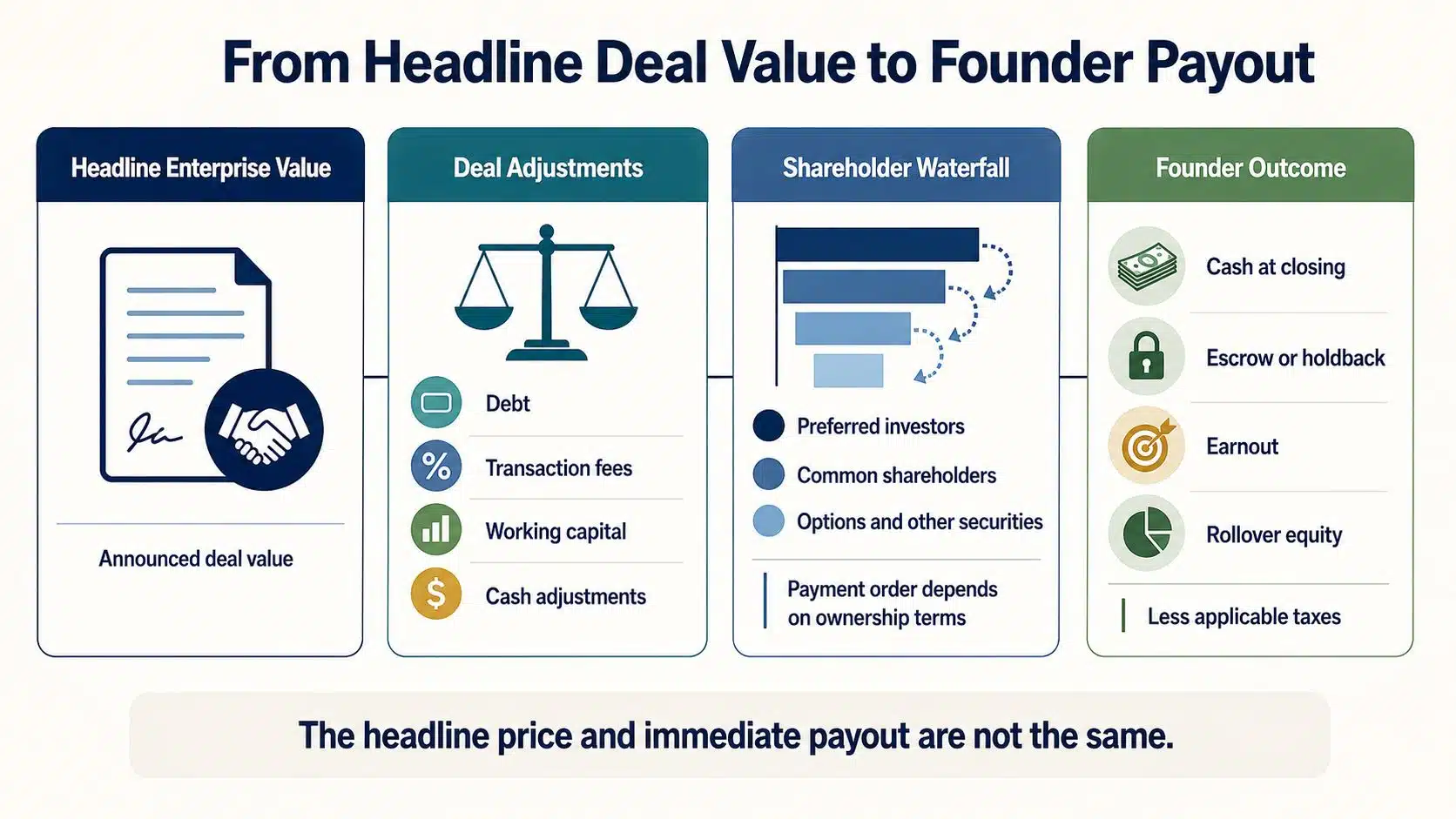
The amount announced for a SaaS acquisition is not necessarily the amount available to founders or shareholders.
The headline enterprise value may be reduced or adjusted by:
- Debt and debt-like obligations
- Transaction and advisory expenses
- Working-capital adjustments
- Escrow or holdback
- Taxes
- Investor liquidation preferences
- Convertible notes, options, warrants, or other securities
- Deferred or contingent payments
Once the final equity value is known, the company’s distribution waterfall determines who gets paid and in what order.
Preferred investors may be entitled to receive a specified amount before common shareholders. Because founders and employees often hold common stock, their payout can be much lower than their ownership percentage initially suggests.
My rule is simple: never judge an offer until the complete shareholder waterfall has been modeled. The important number is not only what the company is worth, but what each shareholder receives at closing and what remains conditional.
Deal Terms That Can Change the Real Value
A lower offer with clean terms can be more valuable than a higher offer filled with uncertainty.
Cash at Closing
Cash paid at closing carries the least future performance risk. Even then, founders should account for escrow, tax, indemnification exposure, fees, and possible purchase-price adjustments.
Earnout
An earnout provides additional payment if the business reaches specified targets after closing.
It should be treated as a conditional value. The agreement needs to define the targets, accounting rules, measurement period, reporting rights, and how the buyer may operate the business during that period.
This matters because the founder may no longer control pricing, hiring, product investment, or sales strategy after the sale.
Rollover equity allows the founder to retain exposure to the acquired company or the buyer’s new ownership structure. It can create valuable future upside, but it also introduces another period of illiquidity and risk.
Public buyer shares can change in value before they become sellable. Private buyer shares may remain illiquid for years. Neither should automatically be treated as equivalent to cash.
Employment and Retention Conditions
A buyer may require founders or key employees to remain after closing.
Salary, bonuses, retention awards, and future vesting should be evaluated separately from the acquisition proceeds. If receiving the money depends on continued employment, it is compensation for future work.
What Happens During a SaaS Acquisition?
A typical SaaS acquisition moves through preparation, buyer discussions, a letter of intent, due diligence, final negotiations, approvals, closing, and integration.
The main stages are:
- Founders and the board define the desired outcome.
- The company prepares financial, legal, commercial, and technical records.
- Potential buyers are approached directly or through an adviser.
- Interested buyers sign confidentiality agreements and review initial information.
- Buyers submit preliminary offers.
- The preferred buyer issues a letter of intent.
- Financial, legal, tax, commercial, security, and technical diligence begins.
- The parties negotiate the purchase agreement and disclosure schedules.
- Required shareholder, customer, lender, and regulatory approvals are obtained.
- The transaction closes and the transition begins.
A letter of intent does not guarantee that the acquisition will close. Much of it may be non-binding, while confidentiality and exclusivity provisions can still be binding.
Exclusivity also prevents the seller from negotiating with other buyers for an agreed period. Founders should resolve the major economic and structural issues before giving up that leverage.
What Founders Should Prepare Before Selling
Acquisition preparation is mostly the unglamorous work of ensuring the company’s records match the story being told about it.
Buyers commonly examine:
- ARR, MRR, churn, retention, margins, and customer-level revenue
- Financial statements, billing records, taxes, refunds, and deferred revenue
- Customer contracts, renewal terms, assignment rights, and service obligations
- Intellectual-property assignments from founders, employees, and contractors
- Security incidents, privacy compliance, backups, and access controls
- Source code, infrastructure, documentation, technical debt, and open-source licenses
- Employment agreements, contractor arrangements, and key-person risks
- The cap table, options, warrants, notes, investor rights, and board approvals
Problems in these areas do not always end a transaction. They can, however, delay closing, reduce the price, increase the escrow, or push more consideration into an earnout. The best time to clean these records is before a serious buyer appears.
Final Thoughts
A SaaS exit should not be judged by the headline offer alone. The buyer’s motivation, transaction structure, payment terms, distribution waterfall, closing certainty, and post-sale obligations determine what the deal is actually worth.
Founders who understand those elements can compare offers on more than price. They can decide how much certainty they want, how involved they are willing to remain, and what they want to happen to the product and team.
That is the practical way to evaluate SaaS exits: start with the outcome you want, then choose the acquisition path that can realistically deliver it.
Frequently Asked Questions About SaaS Exits
1. What is the most common exit for a SaaS company?
A complete sale to a strategic or financial buyer is common, but smaller SaaS companies may also sell to operators, search funds, or software holding companies. The most realistic route depends on the company’s size, profitability, growth, and founder dependence.
2. Are SaaS companies always valued using ARR?
No. High-growth recurring-revenue companies may be valued using ARR, while larger profitable companies may be assessed using EBITDA. Smaller owner-operated businesses may be valued using seller’s discretionary earnings.
3. Is a strategic buyer better than private equity?
Not automatically. A strategic buyer may offer stronger synergies, while a PE buyer may provide retained equity and continued involvement. The better choice depends on the price, payment certainty, operating plan, and founder’s goals.
4. Can an unprofitable SaaS company be acquired?
Yes. A buyer may value its growth, technology, customers, team, or market position. However, weak retention, poor unit economics, or no credible path to profitability can reduce the valuation or produce more conditional terms.
5. Does a founder need an M&A adviser to sell a SaaS company?
Not every small transaction requires one. An experienced adviser can become valuable when the ownership structure is complex, several buyers may compete, or the founder needs help with valuation, outreach, negotiation, and process management.