
Juggling three open browser tabs, a fast-moving Slack channel, and an active conference call feels productive right up until you realize it took two hours to draft a simple 300-word memo.
The fundamental reason why multitasking fails isn’t a lack of discipline—it is a hard neurological limitation. The human brain is simply not wired to process multiple complex tasks at the same time.
What Happens in the Brain During Context Switching
When you think you are doing two things at once, your mind is actually toggling back and forth between them at high speed. This mechanism relies on the prefrontal cortex, which governs executive function, planning, and selective focus.
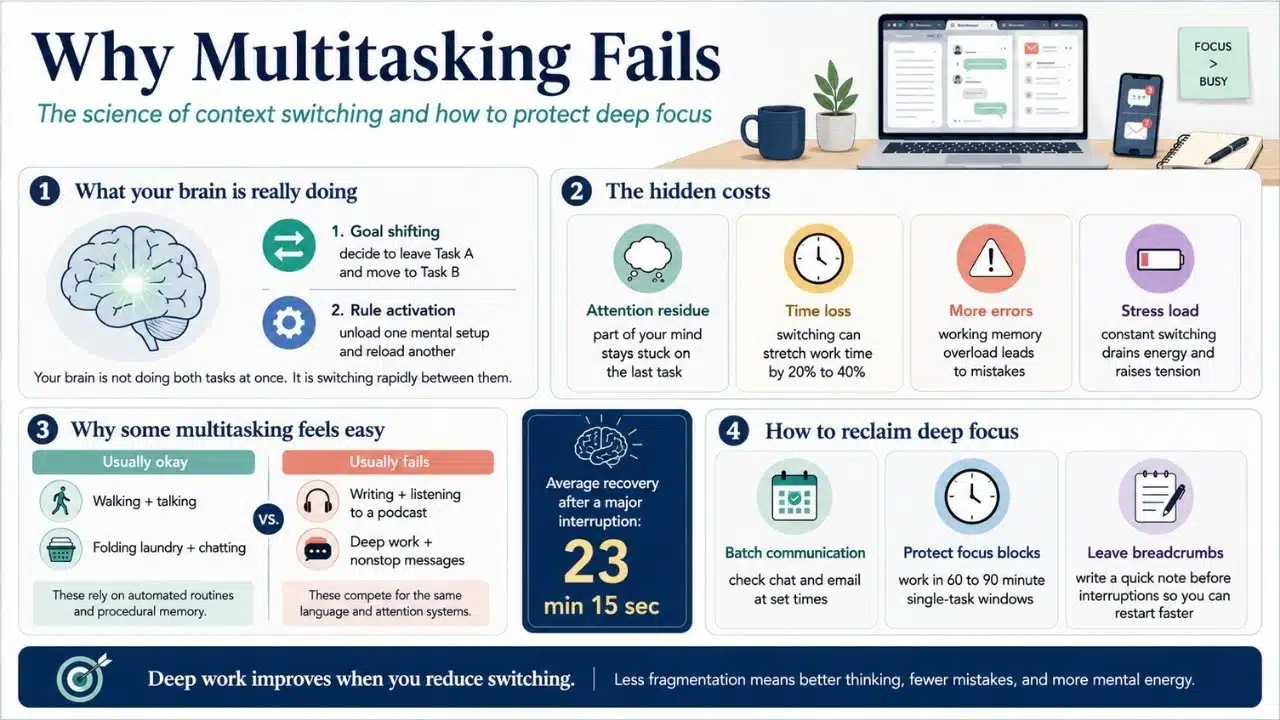
Switching focus isn’t an instantaneous flip of a light switch. Every single transition requires your brain to execute a two-part sequence:
Goal Shifting: Deciding to turn away from Task A and reorient toward Task B.
Rule Activation: Discarding the mental rules and context required for Task A, then loading the operational memory for Task B.
While a single toggle takes only a fraction of a second, doing it hundreds of times throughout the day creates massive mental friction.
The True Costs of Fragmented Attention
The tax paid for constant context switching goes far beyond lost minutes. It fundamentally alters the quality of your work and your mental energy levels.
Attention Residue Eats Your Processing Power
When you jump away from an unfinished report to answer a quick message, your mind does not make a clean break. Research by Dr. Sophie Leroy shows that a portion of your cognitive capacity stays tethered to the previous task. This “attention residue” means you are tackling the new task with only a fraction of your working memory, leading to shallower thinking and missed nuances.
The Re-Orientation Penalty
Toggling between non-trivial projects can increase the total time required to finish them by 20% to 40%. You aren’t saving time; you are spending extra minutes every single cycle trying to remember where you left off, what the data meant, or what you were about to type.
Memory Overload and Frequent Errors
Working memory has strict capacity limits. Forcing the brain to repeatedly clear out and reload information leads to predictable errors, overlooked details, sloppy calculations, and poor phrasing in communications.
Stress and Burnout
Rapid switching triggers the release of cortisol and adrenaline. By mid-afternoon, this constant neurochemical surge leaves you feeling drained, irritable, and incapable of making sound decisions, even if you spent the day sitting at a desk.
Why You Can Walk and Talk, But Can’t Write and Listen
People often point to simple daily habits to argue that multitasking works. You can easily walk through a park while listening to music or fold laundry while chatting with a friend.
However, these activities rely on procedural memory—automated motor pathways that require virtually no intervention from the prefrontal cortex.
Multitasking breaks down the moment two activities compete for the same cognitive channels. You cannot write a thoughtful proposal while listening carefully to a podcast because both tasks demand language processing. Your brain is forced to drop one channel to process the other, leaving gaps in comprehension across both.
Reclaiming Deep Focus
Overcoming fragmented focus requires changing how you structure your environment rather than relying on sheer willpower.
-
Batch communication into dedicated blocks. Turn off real-time notifications for chat and email. Checking inbox feeds three designated times a day prevents constant micro-interruptions.
-
Protect single-tasking windows. Set aside 60- to 90-minute blocks of uninterrupted deep work for high-priority projects. Close extraneous tabs and put devices on do-not-disturb mode.
-
Leave “breadcrumbs” before stepping away. If an urgent interruption forces you away from a complex task, take ten seconds to write a quick note describing where you stopped and what the immediate next action is. This minimizes the re-orientation lag when you return.
Moving Beyond Fragmented Attention
Working smarter isn’t about fitting more inputs into a single hour. Real cognitive performance comes from giving a single, high-value problem your full operational capacity until it is finished. When you design your day to minimize switching, the quality of your output goes up, errors drop, and you finish the workday with your mental energy intact.
Frequently Asked Questions(FAQs) on Why Multitasking Fails
Why does multitasking feel so satisfying if it works so poorly?
Clearing small items like replying to a message or deleting an email triggers a micro-hit of dopamine. This tricks your brain into feeling accomplished and productive, even though you spent energy on low-value tasks while stalling major projects.
Does context switching permanently ruin your attention span?
No, but it conditions your brain to expect constant novelty. When you habituate your mind to constant distractions, sustained focus on a long-form document or complex problem starts to feel uncomfortably dull.
How long does it actually take to recover from a major interruption?
A classic study from the University of California, Irvine found that it takes an average of 23 minutes and 15 seconds to return to the original task and regain deep focus after a significant distraction.