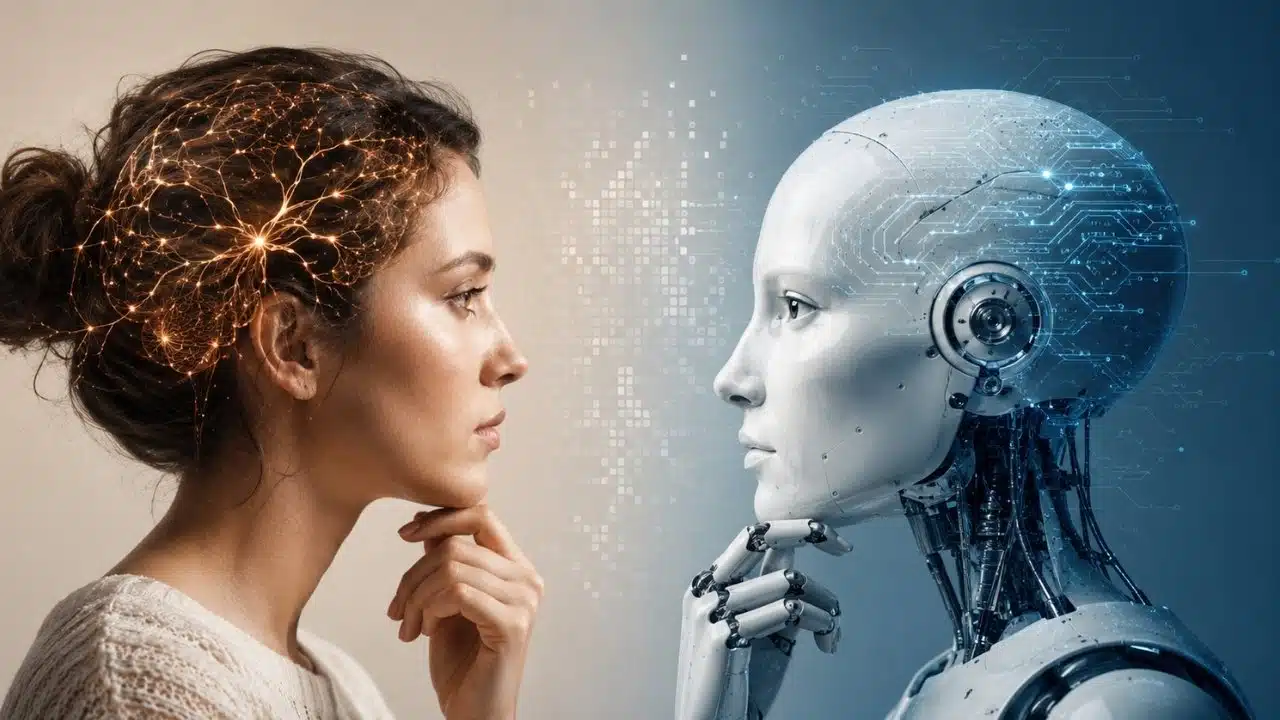
While artificial intelligence mimics human cognitive functions through mathematical models, human intelligence operates through biological neural networks, real-world experience, and subjective consciousness. Understanding the core differences between artificial intelligence vs human intelligence helps enterprise leaders and technical teams deploy machine learning responsibly while leveraging human judgment where algorithms fall short.
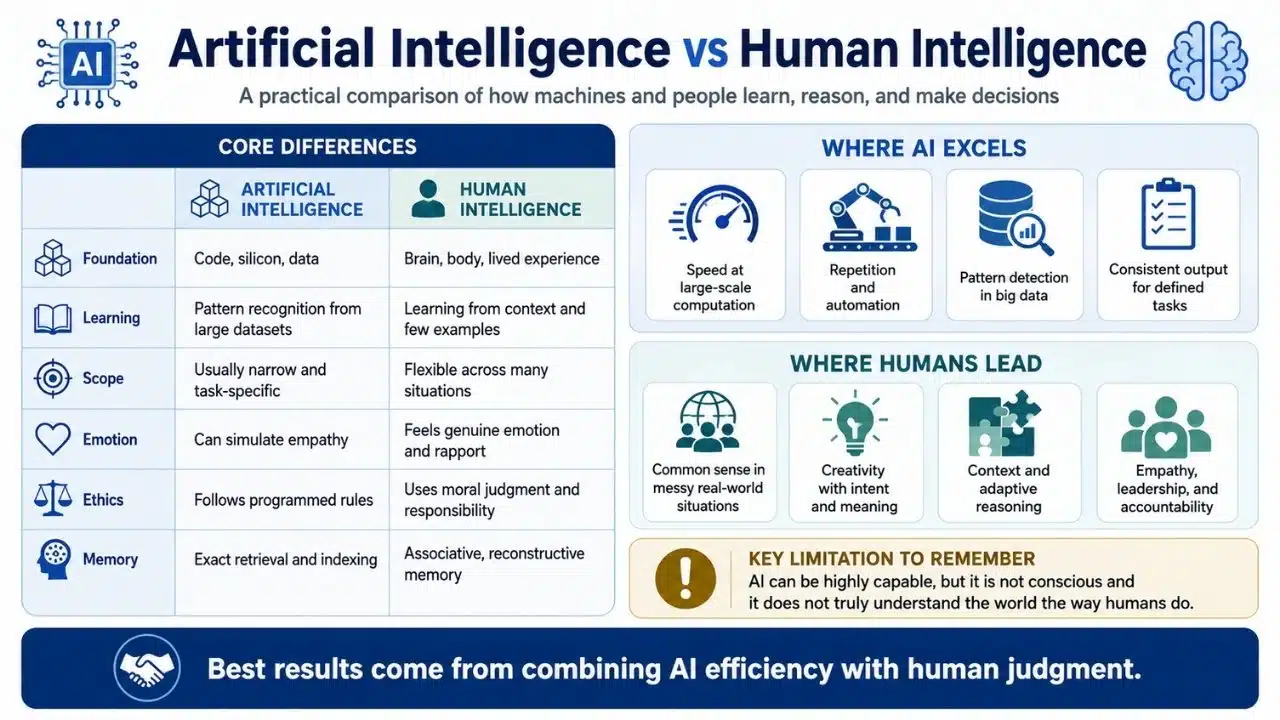
| Dimension | Artificial Intelligence (AI) | Human Intelligence (HI) |
| 1. Primary Foundation | Silicon chips, digital logic, and code | Biological brain, organic synapses, and body |
| 2. Learning Mechanism | Statistical pattern recognition over data | Experiential learning, intuition, and context |
| 3. Data Requirements | Demands thousands to billions of data points | Learns from single examples or low-sample inputs |
| 4. Operational Scope | Excel at narrow task specialization | Broad, multi-domain general adaptability |
| 5. Emotional Capability | Synthesizes and mirrors language cues | Feels genuine empathy, emotion, and rapport |
| 6. Ethical Reasoning | Executes pre-programmed rules and constraints | Weighs moral agency, values, and consequences |
| 7. Creative Output | Recombines existing statistical distributions | Originates novel intent, meaning, and art |
| 8. Speed & Scale | Computes billions of operations per second | Biological speeds with contextual filtering |
| 9. Energy Consumption | Requires kilowatts to megawatts of cloud power | Operates on roughly 20 watts of biochemical energy |
| 10. Memory Model | Exact database retrieval and vector indexing | Associative, reconstructive, and story-driven |
| 11. Common Sense | Prone to hallucinations and edge-case errors | Intuitive world models and real-world logic |
| 12. Consciousness | Non-sentient algorithmic processing | Subjective self-awareness and lived experience |
12 Ways Artificial Intelligence Differs From Human Intelligence
1. Biological vs. Digital Architecture
Human intelligence originates from an organic central nervous system comprising roughly 86 billion neurons interconnected by trillions of synapses. Artificial intelligence relies on silicon hardware, digital microprocessors, and mathematical weights optimized through backpropagation algorithms.
2. Data Requirements and Sample Efficiency
Modern machine learning models require petabytes of text, images, or sensor data to achieve high accuracy. A human child, by contrast, can recognize a new animal species after seeing a single illustration, demonstrating incredible sample efficiency driven by prior world knowledge.
3. Deep Conceptual Understanding vs. Pattern Matching
AI does not “know” concepts in the human sense; it calculates probability distributions across vector spaces. While Large Language Models generate coherent paragraphs, they process syntax without intrinsic semantic comprehension or lived context.
4. Broad Generalization vs. Narrow Specialization
Most AI systems excel within a specific domain—such as playing chess, diagnosing medical scans, or translating text. Human intelligence possesses domain-general flexibility, allowing individuals to transfer logic effortlessly from one task (like driving a car) to another (like navigating a crowded boat).
5. Simulated Cues vs. Genuine Empathy
AI can analyze tone and output empathetic-sounding phrases, but it lacks emotional capacity. Human communication relies on non-verbal cues, shared lived experiences, and emotional connection that machines cannot replicate.
6. Moral Agency and Ethical Responsibility
Algorithms optimize for specific loss functions without understanding fairness, justice, or human dignity. Humans evaluate the ethical weight of choices, balancing competing values, legal frameworks, and social responsibility.
7. Generative Recombination vs. True Original Intent
Generative AI produces creative artifacts by identifying statistical patterns in human-created datasets. Human art and innovation stem from emotional intent, cultural context, existential reflection, and the desire to convey personal perspective.
8. Processing Speed vs. Contextual Prioritization
Computers evaluate complex numerical calculations in milliseconds, far exceeding human cognitive speed. However, human brains excel at filtering out irrelevant noise instantly, prioritizing critical stimuli in unpredictable, chaotic environments.
9. Power Efficiency and Neuromorphic Computing
Training a state-of-the-art AI model consumes gigawatt-hours of electricity and requires massive cooling infrastructure. The human brain performs sophisticated reasoning, sensory integration, and motor control on a energy budget of about 20 watts.
10. Reconstructive Memory vs. Index Retrieval
AI retrieves stored data from databases or vector indexes with exact fidelity unless parameters are modified. Human memory is reconstructive—it reshapes memories based on current context, emotional state, and narrative coherence, aiding high-level abstract problem-solving.
11. Tacit Knowledge and Common Sense
Humans possess vast stores of unwritten, tacit knowledge about how the physical world operates (e.g., gravity, social politeness, physical boundaries). AI systems often fail unexpectedly when encountering edge cases that violate basic common sense assumptions.
12. Subjective Consciousness and Sentience
Human intelligence is accompanied by qualia—the internal, subjective experience of feeling, perceiving, and existing. AI remains an unconscious computational tool that processes inputs to generate probabilistic outputs regardless of how convincing those outputs appear.
Harmonizing Human Intuition and Algorithmic Scale
Artificial intelligence and human intelligence represent two fundamentally different approaches to problem-solving. While AI systems dominate in raw computational speed, data processing, and high-volume pattern recognition, human minds remain unmatched in emotional nuance, ethical accountability, sample-efficient learning, and genuine creative intent.
Rather than viewing artificial intelligence as a direct substitute for human cognition, high-performing organizations treat AI as an intellectual force multiplier. The most resilient technical workflows keep humans in the loop—combining machine speed and precision with human empathy, contextual judgment, and strategic oversight to drive responsible, long-term innovation.
Frequently Asked Questions(FAQs) on Artificial Intelligence vs Human Intelligence
Can artificial intelligence eventually replace human intelligence?
AI is designed to automate specific repetitive, data-heavy tasks, but it lacks the general adaptability, emotional depth, and moral reasoning required to fully replace human intelligence. The most effective workforce strategy combines AI processing power with human oversight.
What is the difference between General AI and Narrow AI?
Narrow AI (which exists today) performs specific tasks like image recognition or language generation within set boundaries. Artificial General Intelligence (AGI) refers to hypothetical future systems capable of matching human-level reasoning across all cognitive domains.
Why does AI struggle with real-world common sense?
AI lacks a physical body and lived experiences in the real world. It learns strictly from static datasets or simulated environments, making it vulnerable to edge cases that humans navigate intuitively.