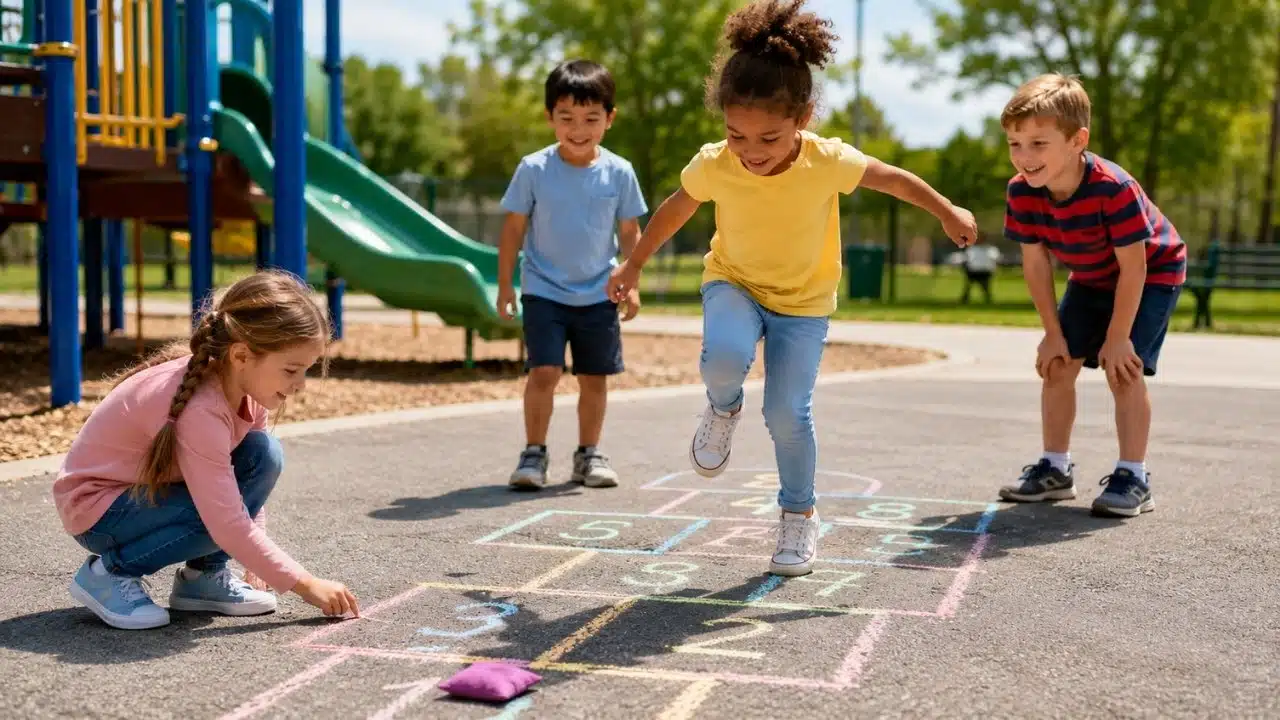
Combining physical movement with numerical practice turns abstract concepts into concrete physical experiences. Incorporating active playground games that teach math allows young learners to develop spatial awareness, counting fluency, and measurement skills through collaborative play, reinforcing core early math concepts outside the classroom.
| Game Name | Primary Math Skill | Ideal Age Range | Equipment Needed |
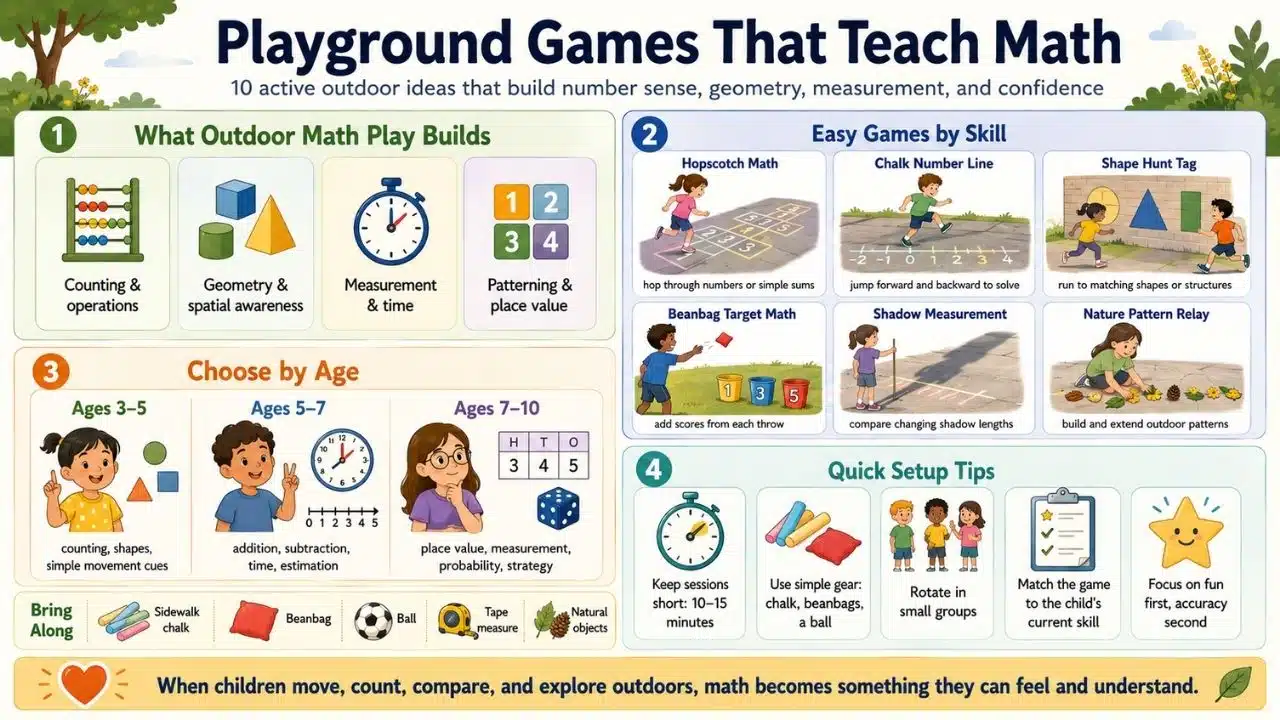
| Hopscotch Math | Number sequence & Addition | Ages 4–8 | Sidewalk chalk, beanbag |
| Red Light, Green Light Counting | Skip counting & Estimation | Ages 3–7 | None |
| Chalk Number Line Jump | Addition, Subtraction & Magnitude | Ages 5–9 | Sidewalk chalk |
| Shape Hunt Tag | Geometry & Spatial reasoning | Ages 4–7 | Playground structures |
| What’s the Time, Mr. Wolf? | Telling time & Elapsed time | Ages 5–8 | None |
| Simon Says Geometry | Angles, Symmetry & Shapes | Ages 5–9 | None |
| Beanbag Target Math | Mental addition & Probability | Ages 6–10 | Sidewalk chalk, beanbags |
| Four Square Place Value | Place value (Ones, Tens, Hundreds) | Ages 6–10 | Playground ball, chalk |
| Shadow Measurement Race | Non-standard measurement | Ages 5–9 | Chalk, tape measure |
| Nature Pattern Relay | Classification & Patterning | Ages 4–8 | Natural objects (leaves, acorns) |
10 Active Playground Games That Teach Math
1. Hopscotch Math
Draw a traditional hopscotch grid with sidewalk chalk, substituting random numbers or simple addition equations (e.g., $3 + 2$) into each square. Children toss a marker into a square, solve the equation, and hop through the grid. This builds balance alongside number sequence recognition.
2. Red Light, Green Light Counting
Adapt the classic game by requiring the leader to call out specific counting rules instead of just colors. For example, “Take 5 steps forward by 2s!” or “Hop backward 3 steps!” Children practice skip counting and spatial estimation while controlling their physical movement.
3. Chalk Number Line Jump
Draw a large 0-to-20 number line across the pavement. Call out simple addition or subtraction problems ($7 + 4$ or $12 – 5$) and have children physically jump forward or backward along the line to find the answer. Physical movement along a line grounds the concept of numerical magnitude through kinesthetic learning.
4. Shape Hunt Tag
Designate specific playground features as “safety zones” based on their geometric properties—such as “any four-sided rectangle” or “a structure with parallel bars.” When the tagger calls out a shape or property, players must identify and run to a matching structure before being tagged.
5. What’s the Time, Mr. Wolf?
One child acts as the “Wolf” while others ask, “What time is it, Mr. Wolf?” If the Wolf answers “4 o’clock,” players take four steps forward. When the Wolf calls “Dinner time!”, players run back to the start line. This game connects spoken numbers directly to step counts and temporal awareness.
6. Simon Says Geometry
Use body movements to teach geometric terms. Call out instructions like “Simon says make a 90-degree angle with your arms,” “Simon says make parallel lines with your legs,” or “Simon says show a line of symmetry.” Children translate abstract spatial definitions into physical postures.
7. Beanbag Target Math
Draw concentric circles on the ground with chalk, assigning different point values to each ring (e.g., 1, 5, 10, and 20). Children throw three beanbags into the target and add their total scores together, practicing rapid mental addition and risk evaluation.
8. Four Square Place Value
Label the four squares of a standard court as Thousands, Hundreds, Tens, and Ones. As players bounce the ball to another square, they call out a digit. The receiving player must instantly state the full number formed by all four digits in order, building multi-digit place value recall.
9. Shadow Measurement Race
Partner children up on a sunny day to trace each other’s shadows on the pavement using chalk at different times of the day. Using non-standard units (footsteps, hand spans) or tape measures, kids track, record, and compare how shadow lengths change over time.
10. Nature Pattern Relay
Set up teams and place bins of natural materials (pinecones, leaves, small stones) at the end of the playground. Teams run back and forth in a relay to create, extend, or complete complex repeating patterns (AABB, ABC, ABBC) on the ground using the collected items.
Beyond the Playground: A Vetted Digital Math Tool
While active outdoor games build spatial reasoning and gross motor math fluency, structured mobile tools can complement active play when transitioning indoors—helping children practice fine motor number formation, recognition, and counting in a quiet, focused setting.
123 Magic Number Fun
Available on both Google Play and the App Store, 123 Magic Number Fun by Edutorial bridges the gap between active playground games and guided digital practice. It offers early learners a safe, structured environment to solidify the numerical concepts they explore outdoors.
-
Google Play Teacher Approved: Holds an official badge verifying compliance with strict educational standards, safety protocols, and age-appropriate design.
-
Targeted Early Math Skills: Features guided number tracing for digits 1 through 50, interactive counting puzzles, and number recognition mini-games that reinforce playground counting rules.
-
Confidence-Building Design: Uses high-contrast visual pathways and instant prompts to foster independent problem-solving, self-paced learning, and positive digital habits.
What to Do Next
Pick 1 or 2 games that match your child’s current math focus—such as Hopscotch Math for addition or Shape Hunt Tag for geometry—and bring a pack of sidewalk chalk to your next playground visit. Short, 15-minute sessions of active outdoor play build lasting numerical confidence and physical coordination.
Frequently Asked Questions (FAQs)
How do playground games improve math understanding compared to indoor worksheets?
Playground games engage whole-body movement, linking abstract numerical concepts to spatial awareness, physical distance, and tactile interaction. This multi-sensory engagement strengthens memory retention and reduces math-related anxiety.
What age range benefits most from outdoor math games?
Children aged 3 to 10 derive the greatest benefit. Early learners (ages 3–6) build basic counting and shape recognition skills, while older children (ages 7–10) apply playground mechanics to place value, multiplication arrays, and measurement analysis.
How can teachers and parents manage large groups during outdoor math play?
Structure games around clear station rotations or small team relays with explicit rules. Using visible chalk boundaries and simple equipment ensures all participants remain actively engaged without long wait times.