Have you ever tried to learn artificial intelligence on your own? You watch videos, read articles, and still feel lost. The problem usually isn’t you. It’s that you’re learning alone, and learning alone is hard. The fix is simpler than you might think.
Real AI communities can shrink your learning curve from months to weeks. When you join the right group, you get answers fast, and you meet people who struggled exactly like you did. According to research, genuine AI communities with active members help beginners move from confusion to confidence much quicker than solo learning ever could.
These aren’t small groups, either. The Global AI Community has 207 local chapters across 78 countries. Deep learning AI brings together 2.6k active members. These are real networks built for learning.
In this guide, I’ll walk you through the 10 best AI communities for beginners. You’ll find machine learning support, data science forums, prompt engineering groups, and plenty of friendly AI enthusiasts. Some communities are free, some charge money, and all of them work.
1. OpenAI Developer Community
The OpenAI Developer Community is a hub where builders, researchers, and AI enthusiasts gather to share code, ask questions, and collaborate on projects. And it’s big. According to OpenAI’s own community announcement, “Celebrating 1 Million Members and Introducing the Community Leaderboard,” the forum passed 1 million members in 2026. That scale matters because it means someone has almost always hit your exact problem before, and answers come fast.
You get access to official documentation, API guides, and real-world examples that show you how to build with ChatGPT and GPT-4. Developers post their work regularly, answer tough questions, and celebrate wins together.
You can explore how others built chatbots, content generators, and AI agents that solve real problems. Members share their failures along with their successes, which helps newcomers get unstuck quickly.
What You’ll Learn Inside
Joining gives you direct access to builders working on advanced projects. Expect active threads about the following:
- Natural language processing and prompt engineering
- API best practices and troubleshooting
- Fine-tuning models and managing costs
- Deploying AI applications at scale
The conversations move fast, so you pick up practical knowledge quickly. You see how experienced developers structure their code, handle edge cases, and optimize their queries. Watching real problems get solved beats reading tutorials alone.
2. r/MachineLearning Subreddit
r/MachineLearning stands out as a thriving hub where AI learners gather daily on Reddit to share ideas, ask questions, and discuss the latest breakthroughs in machine learning. Per subreddit-tracking data cited in 2026 roundups such as Linkeddit’s “Largest Subreddits 2026” analysis, the community has grown to roughly 3 million members as of mid-2026. That size means fresh discussion around the clock, no matter when you show up with a question.
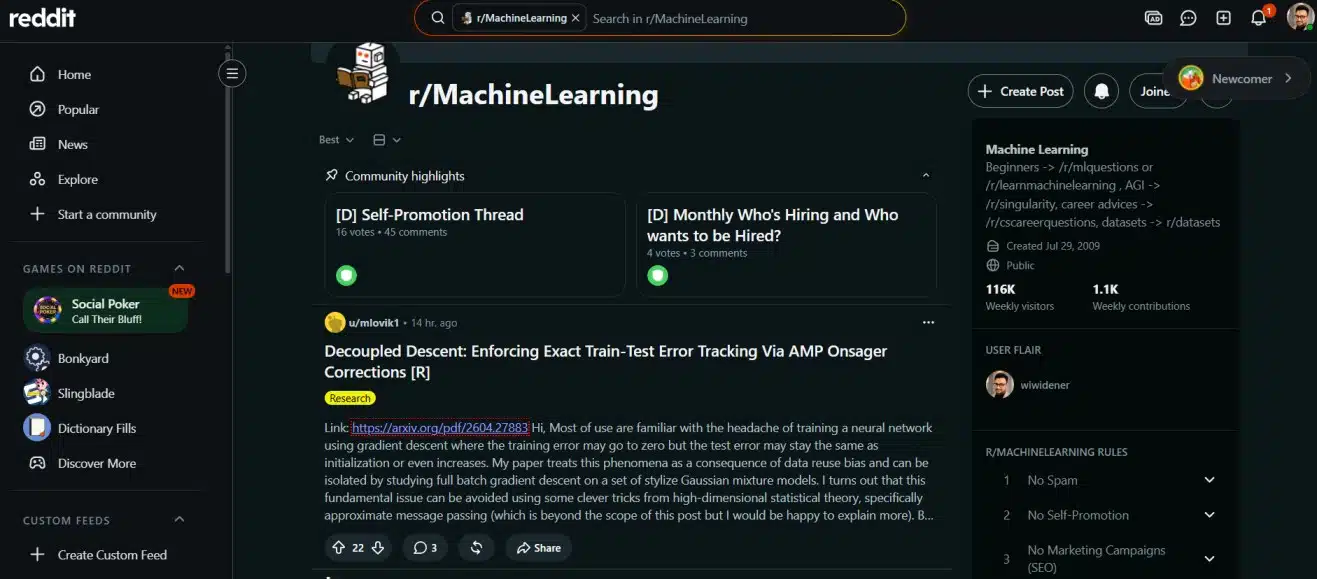
The subreddit attracts researchers, engineers, and curious beginners who post papers, projects, and real-world applications of deep learning models. You’ll find discussions about transformers, generative adversarial networks, and the large language models that shape modern AI.
The community moderates conversations carefully, so you get high-quality content instead of spam. Knowledge sharing happens naturally here, without gatekeeping or pretension.
Why Beginners Stick Around
Members work with tools like TensorFlow, PyTorch, Streamlit, and CrewAI on real problems, and they share what they learn. Here’s what you can expect:
- Code snippets and honest debates about data engineering approaches
- Open-source projects you can contribute to, which builds your portfolio fast
- Shared resources from AI publications, Medium articles, and LinkedIn posts
- Practical conversations about LLMs like Claude, Gemini, and DALL-E 3
Posting your own questions connects you with experienced practitioners who remember what it felt like to be new. That kind of community support helps you avoid common pitfalls and speeds up your whole learning journey.
3. Hugging Face Forums
The Hugging Face Forums serve as a meeting place for AI learners and experts who share code, ask questions, and solve problems together. You can post about machine learning projects, get feedback on your work, and learn from others who use large language models and other AI tools daily.
Members answer questions fast, so you get help when you need it most. People discuss everything from building AI applications to working with datasets, which means real learning happens here every single day.
More Than Just Q&A
Joining this community also opens doors to networking opportunities with developers and data scientists from around the globe. You’ll see discussions about practical AI resources, model training, and how to use tools like DALL-E 3 for AI art projects.
Members share their wins and failures, which teaches you more than any textbook could. The forums let you collaborate on projects, find teammates for hackathons, and build friendships with people who get excited about the same stuff you do.
Start by reading threads about topics that interest you. Then jump in with your own questions or answers.
4. Kaggle: Your Gateway to Data Science and AI
Kaggle serves as your launchpad into data science and AI learning. You can access thousands of datasets, competitions, and notebooks all in one place and practice real skills by solving actual problems that companies face.
You’ll compete with other learners, share your code, and get feedback from experienced practitioners. This hands-on approach beats reading theory alone.
Many employers look at Kaggle profiles when hiring data scientists, and the platform’s scale backs that up. According to Kaggle’s own community milestone posts, the platform surpassed 29 million registered users by February 2026 and ran 68 competitions worth $3.668 million in prizes in 2025 alone. That makes it the largest machine learning competition platform out there, so a strong profile here genuinely gets noticed.
Learning by Doing
Kaggle’s notebook feature lets you write code, test ideas, and publish your work instantly. You can fork other people’s notebooks to see how they solved problems, then modify the code for your own projects. Along the way, you pick up SQL, Python, and machine learning techniques through practice, not just videos.
Here’s how that plays out in real life. One learner entered a beginner competition with a baseline notebook scoring 0.62, then spent two weeks studying community notebooks and collecting peer reviews.
| Stage | Result |
|---|---|
| Starting baseline notebook | Score of 0.62 |
| After merging insights from 3 public notebooks + 1 detailed peer review | Score of 0.78 |
| Within 10 days of publishing the improved notebook | 12 constructive comments and 5 forks |
Community forks and step-by-step feedback turned a baseline into a competitive notebook in under two weeks. That’s collaboration speeding up both learning and portfolio building at the same time.
Discord communities linked to Kaggle discussions also help you find teammates for competitions. The datasets range from simple to complex, so you can pick challenges that match your skill level and grow from novice to skilled analyst at your own pace.
5. DeepLearning.AI Community
DeepLearning.AI brings together about 2,600 members who share a passion for artificial intelligence and machine learning. The community offers real value through its News section, which hosts 8.9k posts in AI Discussions alone.
Members get access to structured learning paths covering PyTorch, generative AI, data engineering, and machine learning specializations. The forum organizes sections like Course Q&A and Latest Topics, so you find answers fast and stay current with what’s happening in AI.
You can ask questions about your coursework, share projects, and connect with people who understand your learning goals.
Built for Beginners
The community staff includes volunteers who answer questions about courses and general AI topics, making it a genuinely supportive space. Events like “Your First Steps in AI” on January 27 give you chances to learn from experts and meet other learners.
You’ll also find resources for:
- Neural networks and deep learning fundamentals
- Math for machine learning, including linear algebra, calculus, and statistics
- AI for social good, covering health and climate change
Members post calls for collaborators, attend AI hackathons, and join meetups throughout the year. The community even runs alpha-testing programs where members help test new courses before launch. That hands-on involvement means you learn faster and build your network with people serious about AI knowledge sharing.
6. Global AI Community
The Global AI Community spans 207 local chapters across 78 countries, making it one of the largest networks for AI learners and builders anywhere. You can join existing chapters in cities like Boston, Chennai, Johannesburg, and Milan, or start a new one where you live.
A fresh chapter launched in Sukkur District in 2026, showing how quickly this network grows. Members like Toghrul Jabbarli earned recognition as “Organizer of the Week” for leading the Baku chapter, proof that individual contributions really do matter here.
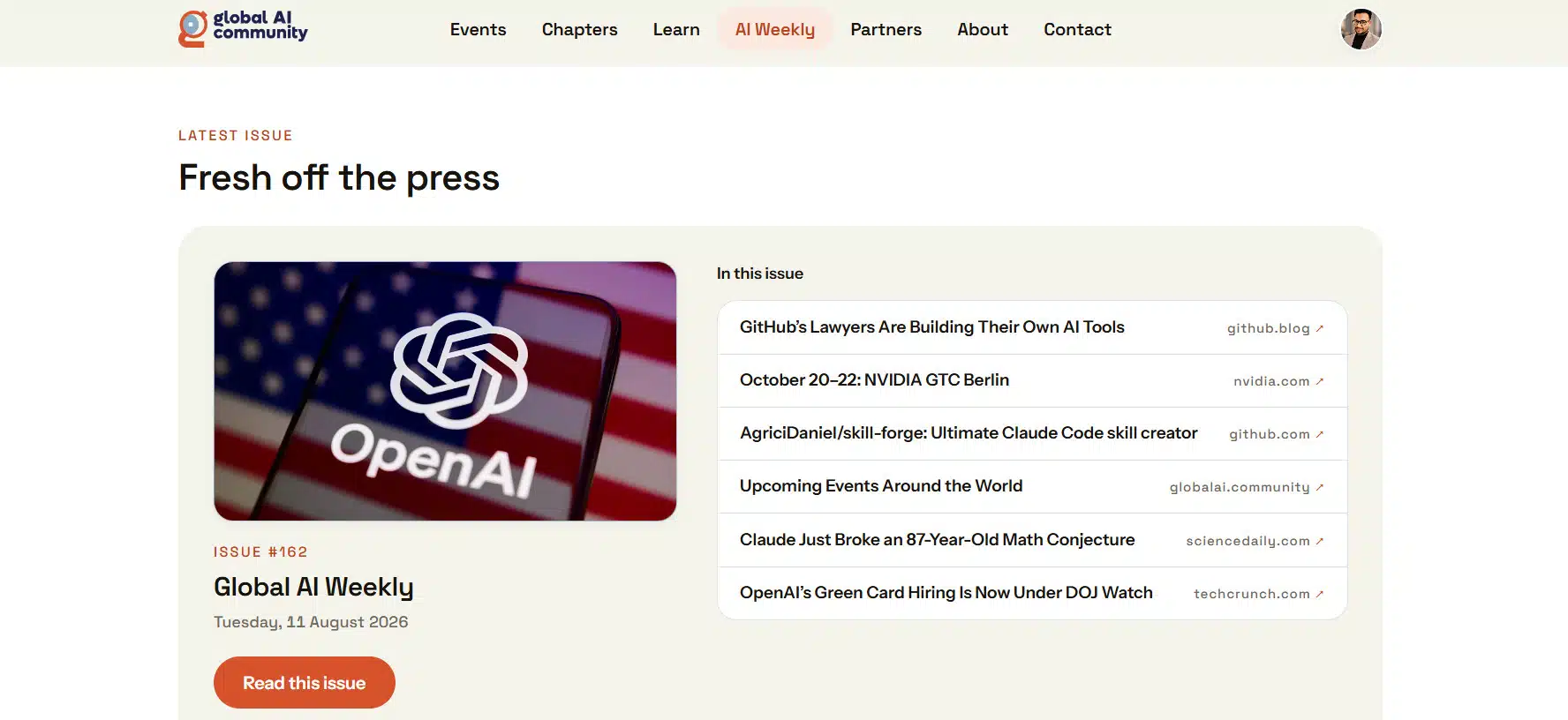
The community hosts Global AI Construct events in places such as Nagpur, Mbarara, and Ibadan, bringing people together to learn and share ideas. Their Discord server keeps builders connected between events, so you can ask questions, share projects, and find collaborators anytime.
Ways to Get Involved
- Attend free local meetups through your nearest chapter
- Join Discord discussions about large language models, AI security, and data science
- Collaborate on group projects with people using tools like DALL-E 3 and DeepSeek
- Start your own chapter if none exists nearby
The community structure focuses on engagement and AI networking, not passive lectures. Beginners and experienced practitioners learn side by side, which makes it an easy first step if you want real human connection in your learning.
7. Learn Prompting Community
Learn Prompting stands out as a free, open-source platform that teaches you how to work with large language models like GPT-4 and DALL-E 3. You get hands-on training in prompt engineering, which is simply the skill of asking AI the right questions to get the best answers.
And this skill pays off. According to LinkedIn’s 2026 workforce report data, as summarized in a 2026 RezScore analysis of US job postings, listings requiring AI-literacy skills like prompt engineering grew 70 percent year over year. Standalone “prompt engineer” titles actually fell about 30 percent because the skill is now folding into broader AI and engineering roles. In other words, prompt engineering is becoming something employers expect from everyone, which makes learning it here a smart career move.
The community welcomes beginners and experts alike, so you won’t feel lost if you’re just starting out. Members share tips, tricks, and real-world examples that show you exactly how prompts work, and the resources stay free.
Stay Motivated with Real-Time Chat
Slack channels connect members who want to talk in real time about their progress and challenges. People post experiments, ask questions, and celebrate wins together.
You’ll find that other learners face the same struggles you do, which makes the whole experience less lonely. The community also hosts discussions about new AI tools and techniques, so you stay current as the field moves.
8. TensorFlow User Groups
TensorFlow User Groups bring together people who code with this popular machine learning tool. These groups meet online and in person to share what they know. Members discuss projects, ask questions, and help each other solve problems.
You get to meet other learners at your level, plus experienced developers who have worked with TensorFlow for years.
Topics These Groups Cover
- Introduction to TensorFlow for AI users
- Convolutional neural networks, NLP, and time series prediction
- Custom models, layers, and loss functions
- Custom and distributed training, advanced computer vision, and generative deep learning
- Professional certificate preparation
The best part is the course-specific support. Dedicated Q&A channels answer questions about exercises and technical issues, and you can download notebooks and manage your workspace with help from other members.
9. AI Village for Security Insights
AI Village stands out as a community where security professionals and AI enthusiasts meet to tackle real problems. Members focus on how AI systems can be attacked and, more importantly, how to defend them.
The community runs competitions and workshops that teach you machine learning security from the ground up. Its flagship events happen annually at DEF CON, where AI Village hosts red-teaming and capture-the-flag competitions. Based on 2026 DEF CON coverage from CyberScoop and the Center for Security and Emerging Technology, participants attempt tasks like extracting hidden data, bypassing safety classifiers, and demonstrating live prompt injection attacks against deployed models. If you want hands-on AI security experience, that gives you a specific event to plan around each year.
Discussions here explore topics like prompt injection attacks and model poisoning in detail. This is where you learn what can go wrong before it happens in production.
Who You’ll Meet
Joining AI Village through Discord gives you access to security-focused conversations that other communities skip over. You’ll meet researchers, engineers, and security experts who care about protecting AI systems and who present real findings on how to break and fix AI applications.
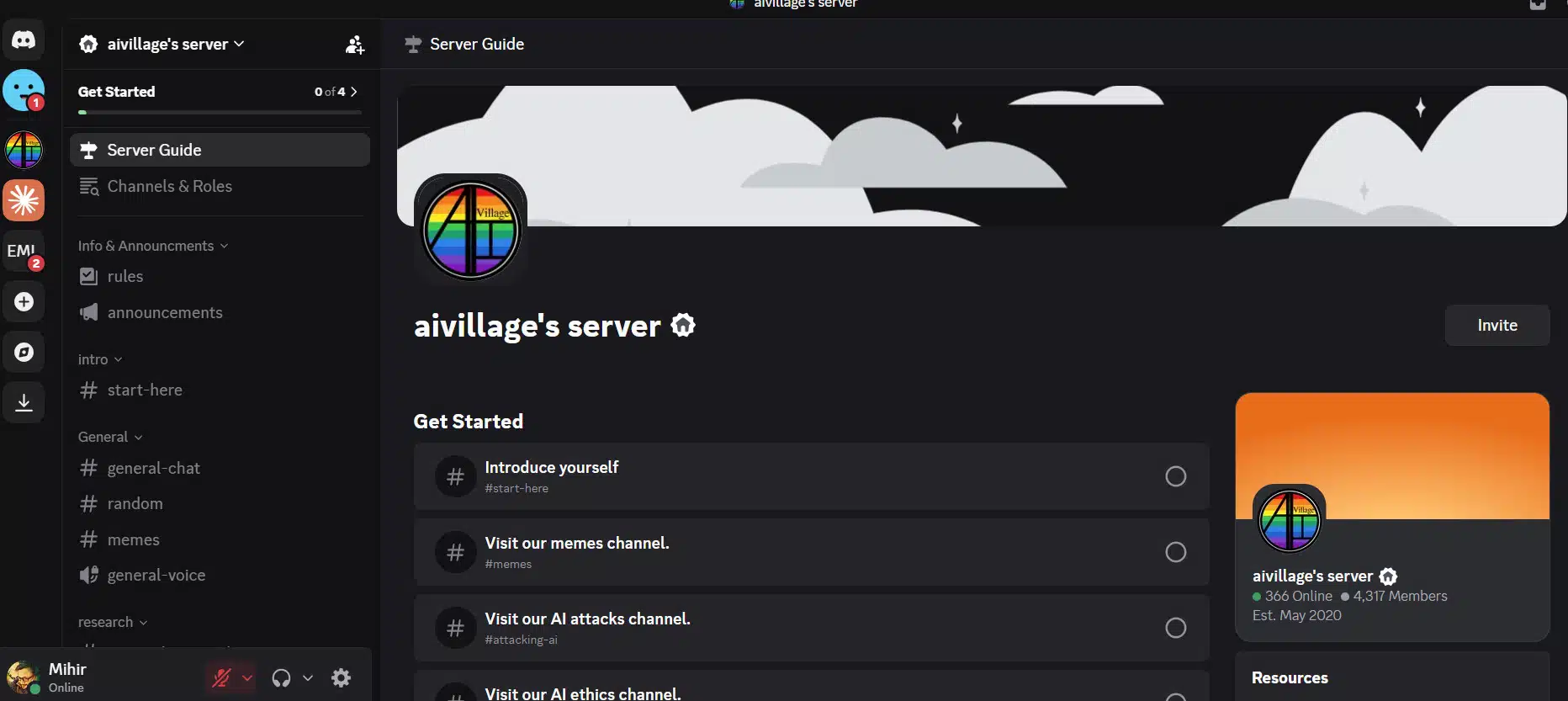
Members collaborate on projects that expose weaknesses in systems before bad actors find them. The community values practical knowledge over theory alone, so if AI security and AI ethics interest you, this is a great place to start.
10. DigitalOcean Community for AI Developers
The DigitalOcean Community gives AI developers a practical space to learn and grow. The platform hosts tutorials, code samples, and real-world projects that teach machine learning concepts, and members share their work with large language models and tools like DALL-E 3.
The community members answer questions fast and post solutions to common problems. You learn from people who build AI systems every day, and the atmosphere feels genuinely welcoming to beginners. Experienced developers help newcomers without making them feel rushed or judged.
What You Can Learn Here
- Forums covering everything from basic Python coding to advanced deep learning
- Guides on how members use Cerebras for faster model training
- Discussions on applying Dataquest course lessons to real projects
- Experiments with Midjourney, prompt engineering, and LLM development
DigitalOcean’s approach works because it combines learning resources with hands-on practice. You start by reading tutorials written in plain language, then write your own code using provided templates.
Developers share honest feedback about what worked and what failed, which helps you skip common mistakes. The community also connects you with people at organizations like First Movers AI Labs, and those connections often lead to collaboration. You build a network while building practical skills at the same time.
Tips for Engaging in AI Communities
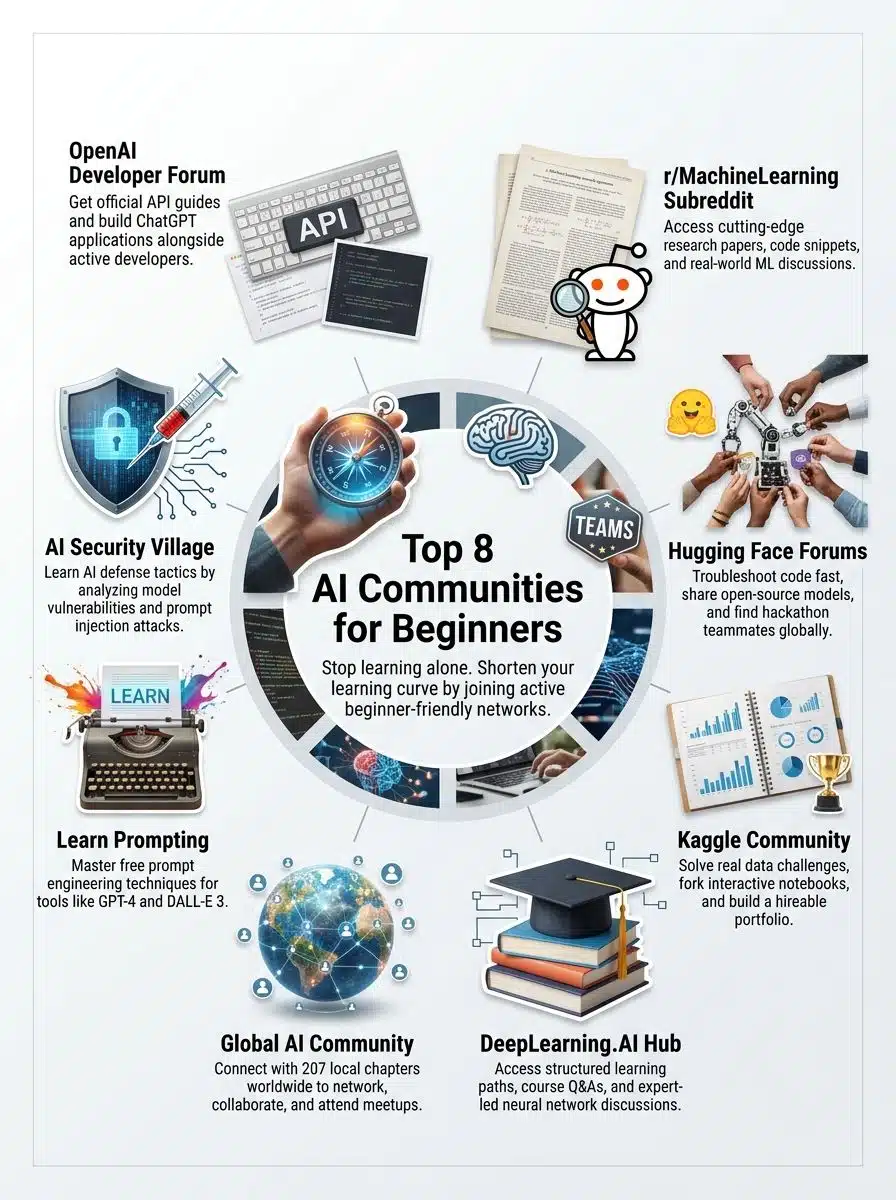
Getting involved in AI communities takes action, not just reading posts. You’ll grow much faster when you participate instead of watching from the sidelines.
Start Contributing
- Ask questions in Q&A channels to get direct answers from experienced members. People in these spaces enjoy helping newcomers.
- Share your project ideas and ask for feedback on your work. This builds your skills and shows others what you’re working on.
- Give constructive feedback on others’ projects and code. Your input helps them, and you learn by reviewing their approaches.
- Join hackathons and open-source projects to work alongside other developers on something real.
Stay Connected and Stay Smart
- Attend events and check community calendars regularly for webinars, workshops, and meetups covering LLM and DALL-E 3 applications.
- Follow community newsletters to stay informed about new resources and discussions.
- Read the community guidelines and FAQs before posting. Many common questions already have answers there.
- Check community legitimacy before investing time. Founders should stay active, content should feel current, and member success stories should look authentic.
- Reach out to members for collaboration or mentorship. Personal connections often lead to client work or partnerships.
Final Words
Your AI learning journey starts now, and these ten AI communities will speed up your progress. You’ll find support, real projects, and people who get what you’re trying to do.
The Global AI Community spans 78 countries, with free local events in 207 chapters. Women Build AI welcomes over 5,300 members into a space built for creators like you.
Pick one community that fits your goals, jump in, and start learning from people who are already building. The best time to join is today.