Twenty-five minutes can feel far more manageable than “work until this is finished.” That simple change in perspective explains much of the appeal behind the Pomodoro Technique. You choose one task, work on it for 25 minutes, take a short break, and begin again. The task gains a clear starting point and a stopping point, which can make procrastination easier to overcome.
The method is commonly reduced to its timer. Its original system goes further, covering daily planning, interruption management, effort estimation, and the tracking of completed sessions.
Research gives us a measured reason to take Pomodoro seriously. Planned breaks may reduce fatigue, and protected work intervals can limit avoidable task switching. The evidence does not show that 25 minutes of work followed by five minutes of rest is an ideal schedule for every person or task.
I see the classic 25/5 cycle as a useful place to begin. The real test is whether it helps you start sooner, stay with meaningful work, and return from breaks without losing momentum.
What Is the Pomodoro Technique?
The Pomodoro Technique is a time-management method developed by Francesco Cirillo while he was a university student in the late 1980s.
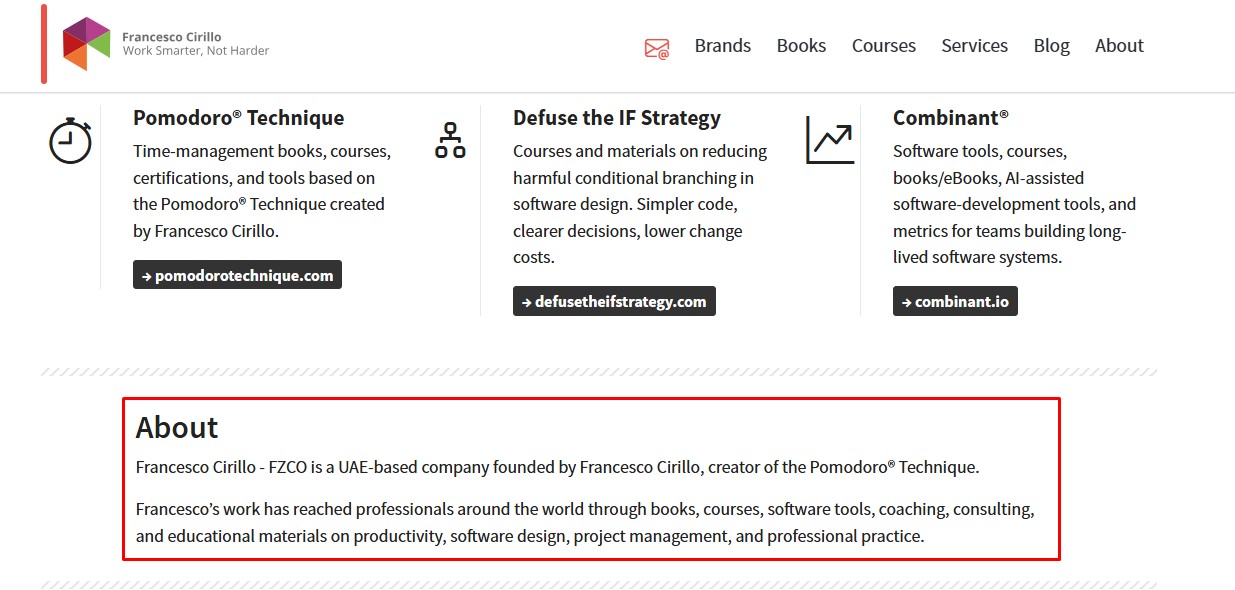
Cirillo originally used a tomato-shaped kitchen timer to organise his study sessions. Pomodoro means tomato in Italian, which gave the method its name.
Each timed work interval is called a Pomodoro. During that interval, you give one chosen task your attention and postpone avoidable distractions. A short break follows. After several completed intervals, you take a longer break.
The technique is widely associated with studying, but its use is much broader. Writing, research, editing, administration, revision, coding, planning, and repetitive tasks can all fit the format when they are divided into specific pieces of work.
Why the Pomodoro Technique Can Work
Pomodoro changes the shape of a work session. It reduces the commitment required to begin, protects one task for a limited period, and places breaks into the schedule before fatigue takes over. The original 25-minute interval is a practical structure rather than a scientifically established limit on human attention.
Starting Feels Less Demanding
“Prepare the presentation” gives you no clear sense of how much work lies ahead. A narrower instruction feels different: Draft the first three slides for 25 minutes.
The commitment now has an end point. You do not need enough motivation to complete the entire presentation. You only need enough willingness to start one defined step.
This is where I find Pomodoro most convincing. It does not require me to wait until I feel fully prepared or inspired. The timer creates a small agreement: begin now, stay with the task, and reassess when the interval ends.
It Limits Casual Task Switching
Many work sessions are disrupted through small, seemingly harmless switches. You check one message, open an unrelated tab, remember another task, and return several minutes later with part of your attention still elsewhere.
Research on attention residue suggests that attention may remain partly attached to a previous task after switching, especially when that task is unfinished.
A Pomodoro gives the selected task temporary priority. Distractions can still occur, but writing them down instead of immediately following them protects more of the work interval.
Breaks Are Decided in Advance
Without a plan, people handle breaks in very different ways. Some stop at the first uncomfortable moment. Others keep working until they are exhausted and no longer doing particularly good work.
A fixed schedule removes that repeated decision. You know when the break is coming, which can make it easier to stay with a difficult passage, calculation, or administrative task for a little longer.
A 2022 meta-analysis of micro-break research found that breaks of ten minutes or less increased vigour and reduced fatigue. The overall improvement in task performance was not statistically clear, particularly for demanding cognitive work.
In practical terms, a short break may help you feel less drained without guaranteeing better output. More complex work may eventually require a longer recovery period.
It Produces Better Planning Data
People frequently misjudge how long work will take because they think about the final task and overlook its hidden steps.
Tracking Pomodoros creates a rough history of focused effort. Over time, you may notice that:
- Research takes longer than drafting.
- Certain tasks require a full warm-up interval.
- Meetings leave less usable focus time than expected.
- Interruptions concentrate at particular times of day.
- Large assignments need to be divided much earlier.
Completed Pomodoros are useful evidence. They are poor trophies. A high session count means little if those sessions did not move important work forward.
What Research Says About Pomodoro’s Effectiveness
Direct research on the complete Pomodoro system remains limited. The available findings are mixed rather than uniformly positive.
| Research | Main finding | What it means in practice |
| 2023 study of 87 university students | Predetermined breaks were associated with less fatigue and distraction and greater concentration and motivation than self-regulated breaks. Task completion was similar, although the structured groups finished in less total time. | External structure may help people who delay breaks or allow them to become too long. |
| 2025 study of 94 students | Pomodoro, Flowtime, and self-regulated breaks produced no overall differences in productivity, task completion, or flow. Fatigue increased faster in the Pomodoro group during the session. | A fixed break schedule was not clearly superior. |
| 2025 scoping review | Most of the 32 included studies reported positive findings involving focus, fatigue, engagement, or time management. Only three were randomised trials, and no meta-analysis was conducted. | The results are encouraging, but the evidence base remains too limited for broad claims. |
| 2026 experiment with 176 students | Comprehension did not differ significantly between systematic short breaks and self-regulated breaks. The self-regulated group reported better energy, concentration, motivation, and mood. | People who manage their breaks well may prefer a flexible schedule. |
I would not read these findings as either proof that Pomodoro works for everyone or evidence that the technique has no value. They suggest that structured intervals can help some people regulate their work, while others function just as well, or feel better, with flexible breaks.
The quality of the activity also matters. A student can spend four carefully timed sessions passively rereading notes and retain very little. Pomodoro manages the session; learning still depends on strategies such as retrieval practice, explanation, practice questions, and spaced review.
Where Pomodoro Fits, and Where It Gets in the Way
Pomodoro is most useful when the main problem is getting started, staying with one task, or controlling how much time an open-ended activity consumes.
It tends to suit:
- Work that has been repeatedly postponed
- Drafting individual sections of an article or report
- Reading and reviewing research
- Practice questions and revision
- Email or administrative work completed in batches
- Repetitive tasks with a visible outcome
- Projects that can be divided into smaller steps
- Work periods in which interruptions can reasonably be postponed
The fixed 25-minute cycle becomes less helpful when a task requires a long mental setup or the timer repeatedly interrupts a productive train of thought. It is also difficult to follow in roles involving customers, patients, children, urgent requests, or frequent collaboration.
There is little value in protecting the timer at the expense of the work. If 25 minutes repeatedly ends just as you reach useful concentration, the interval needs to change.
Pomodoro also cannot compensate for insufficient sleep, chronic overwork, or an unrealistic workload. A timer may organise those problems temporarily, but it will not resolve them.
How to Set Up a Useful Pomodoro Session
Begin with a task that describes a visible action. “Work on the website” is too broad. “Rewrite the homepage introduction” tells you exactly where to begin.
Before starting:
- Remove or silence unnecessary notifications.
- Close tabs and applications unrelated to the task.
- Keep a small interruption list nearby.
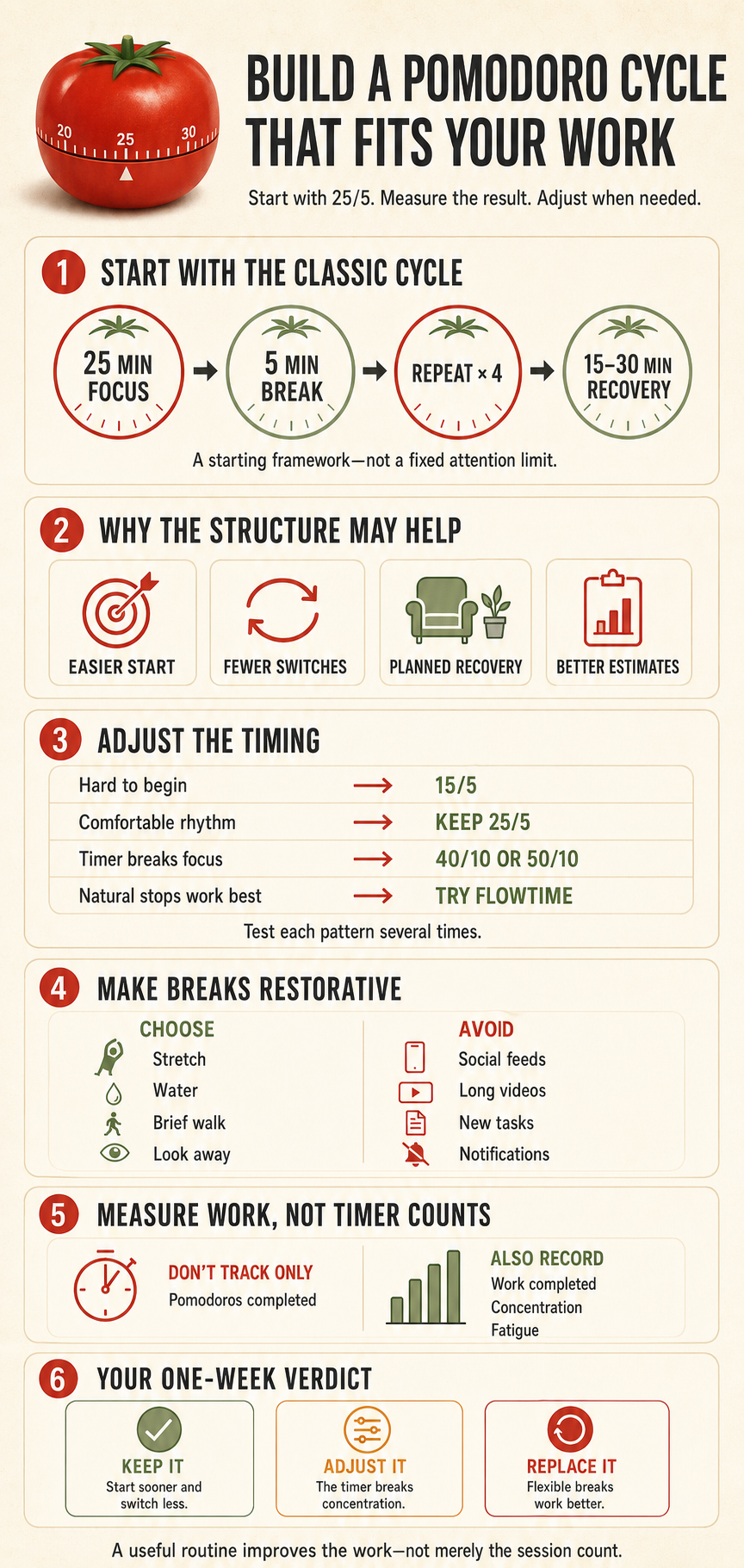
- Set the timer for 25 minutes.
- Begin without using the opening minutes for more planning.
If an unrelated thought appears, send an invoice, look up a book, reply to someone, write it down and return to the selected task. Deal with the list after the session or during a separate administrative block.
When the timer ends, mark the completed interval and leave yourself a brief note about where to resume. That small note can save several minutes of reorientation when the next session starts.
What to Do During the Break
A useful break reduces the demands created by the work. It does not need to produce anything.
Stand up, stretch, drink water, walk briefly, look away from the screen, or complete a simple physical task. If the work has involved sitting and reading, movement and visual distance will probably offer more relief than opening another screen.
Phone use deserves particular caution. In a controlled study involving 414 participants, people who used a phone during a mid-task break took longer and solved fewer problems afterward than participants in the other break conditions combined.
That single experiment cannot define every good break, but it is enough to make me keep social feeds out of a five-minute recovery period. They introduce new information, emotional cues, and several easy ways for a short break to become much longer.
When to Change the 25-Minute Interval
Start with 25/5 if you have never used the technique. It gives you a consistent baseline from which to judge the experience.
After several sessions, you may find that another pattern fits better:
- 15/5 for a task that feels unusually difficult to start
- 40/10 for writing, reading, or analytical work
- 50/10 for work with a longer setup period
- Flowtime for continuing until a natural stopping point and choosing the break according to the length and intensity of the session
Do not redesign the method after one difficult interval. Some discomfort comes from the work itself. Try the same timing several times and look for a pattern.
If the timer regularly interrupts useful concentration, lengthen the work interval. If attention disappears long before it rings, shorten it. If breaks repeatedly become difficult to end, adjust what you do during them before changing the work period.
Final Thoughts
The Pomodoro Technique is useful when work needs a clearer boundary. It can make a delayed task easier to begin, reduce casual switching, build breaks into the session, and expose unrealistic time estimates.
The classic 25/5 schedule will suit some people better than others. Try it long enough to notice a pattern, then adjust it according to the work you are actually doing.
A successful Pomodoro routine is not the one with the highest timer count. It is the one that helps you complete worthwhile work with less drift and a more realistic sense of where your time went.
Frequently Asked Questions on Pomodoro Technique
1. How many Pomodoros should I complete each day?
There is no ideal daily number. One set of four Pomodoros represents 100 minutes of focused work, plus the breaks, and is enough to test the method on a substantial task.
Plan Pomodoros around important work rather than setting an impressive quota. Six focused sessions with clear results may be more useful than 12 sessions divided among distractions and low-priority tasks.
2. Is the Pomodoro Technique effective for studying?
It can help students begin, control distractions, and avoid studying for long periods without a deliberate break. The timer does not determine whether the study method itself is effective.
Use Pomodoro sessions for active learning activities such as practice questions, retrieval from memory, explaining a concept aloud, or reviewing mistakes. Timed passive rereading is still passive rereading.
3. What should I do if someone interrupts a Pomodoro?
The classic method recommends recording and postponing avoidable interruptions. For an external request, briefly explain that you are occupied, agree on when you will respond, and return to the task.
If an urgent interruption ends the session, treat Pomodoro as incomplete. Recording the reason is more useful than pretending the interval was uninterrupted.
4. Can I pause a Pomodoro or stop when I finish early?
In the classic system, the interval is indivisible. If the task finishes early, the remaining time can be used to review the result, correct mistakes, organise notes, or prepare the next related step.
In everyday use, stopping early is not a failure when there is genuinely nothing useful left to do. The purpose is focused, meaningful work, not strict obedience to a timer.
5. Does the Pomodoro Technique work for ADHD?
Some people with ADHD may find the external timer, shorter task commitment, visible end point, and planned breaks useful. Others may find 25-minute intervals too long, too short, or disruptive when they enter a period of strong concentration.
There is not enough direct evidence to present Pomodoro as an ADHD treatment. It is a productivity strategy that can be adjusted and used alongside appropriate professional care. The CDC’s ADHD guidance also recommends breaking complicated work into shorter steps, reducing distractions, and using breaks during long tasks.