The discussion around Artificial Intelligence vs Natural Intelligence is usually framed as a competition. Which one is smarter? Which learns faster? Will machines eventually outperform people at everything? I do not think intelligence can be reduced to one ladder with humans on one side and machines on the other.
Artificial intelligence and natural intelligence developed in completely different ways. They process information differently, learn under different conditions, and fail for different reasons. AI can calculate, search, classify, and generate at a scale no person can match. Natural intelligence grows through a living body, sensory experience, emotion, relationships, culture, and years of interaction with the world.
The real question is not which intelligence wins. It is what kind of intelligence a task requires.
What Is the Difference Between Artificial and Natural Intelligence?
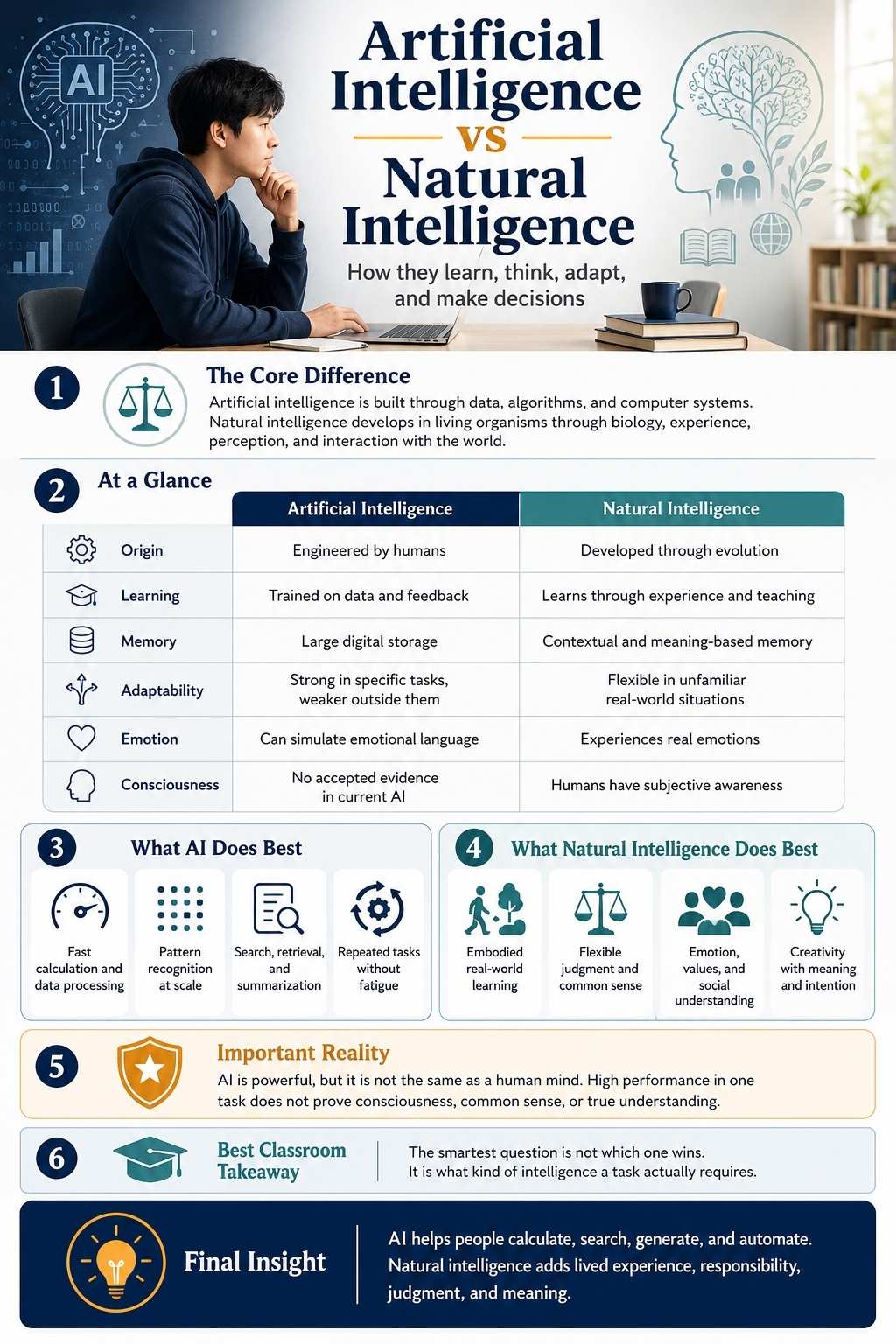
Artificial intelligence is created through software, algorithms, training data, and computer hardware. Natural intelligence develops in living systems through evolution, biological growth, perception, experience, and learning.
AI is especially strong at rapid calculation, large-scale pattern processing, and repeated digital tasks. Natural intelligence remains more closely connected to physical experience, flexible adaptation, emotion, social context, personal meaning, and responsibility.
What Is Artificial Intelligence?
Artificial intelligence is a broad field concerned with building computer systems that perform tasks associated with intelligence, including recognizing images, understanding language, learning from data, reasoning, predicting outcomes, and supporting decisions.
AI includes far more than chatbots. Examples include:
- Recommendation systems
- Fraud-detection software
- Navigation tools
- Image-recognition models
- Language models
- Industrial robots
- Generative AI
- Autonomous agents
Most current systems should not be confused with artificial general intelligence, or AGI. AGI generally refers to a hypothetical system capable of learning, reasoning, and applying knowledge across a broad range of unfamiliar tasks at a human level or beyond. There is no universally accepted AGI test, and experts do not fully agree on where the boundary should be drawn.
Current AI may look general because one model can write, code, translate, summarize, and answer questions. Its performance is still uneven, context-sensitive, and dependent on how it was trained and evaluated.
What Is Natural Intelligence?
Natural intelligence refers to the abilities that developed in living systems through evolution and allow organisms to respond usefully to their surroundings.
Human intelligence is one form of natural intelligence, but it is not the whole category. Cornell’s educational overview discusses intelligent responses across bacteria, plants, animals, immune systems, and groups such as insect colonies.
In ordinary comparisons, however, people usually mean human natural intelligence. That is the main focus here.
Human intelligence involves more than calculation or memory. It includes perception, movement, language, emotion, motivation, social learning, imagination, self-reflection, and the ability to connect decisions with personal consequences.
Artificial Intelligence vs Natural Intelligence at a Glance
| Area | Artificial Intelligence | Natural Intelligence |
| Origin | Designed and engineered by humans | Developed through biological evolution and growth |
| Physical basis | Software operating on computer hardware | Brain, nervous system, body, and senses |
| Learning | Training data, feedback, objectives, and interaction | Experience, teaching, perception, emotion, and social life |
| Speed | Extremely fast at calculations and repeated processing | Slower at raw computation but flexible in daily life |
| Memory | Large digital storage and precise retrieval | Selective, contextual, and connected to meaning |
| Adaptability | Strong within supported conditions but sometimes brittle outside them | Commonly adjusts to unfamiliar and incomplete situations |
| Embodiment | Usually digital; robots add limited physical interaction | Continuously connected to a living body and environment |
| Emotion | Can recognize and produce emotional language | Experiences emotion as part of motivation and judgment |
| Creativity | Generates new combinations from learned patterns | Connects ideas with intention, culture, values, and experience |
| Consciousness | No agreed evidence or test establishing it in current systems | Humans have subjective awareness and lived experience |
| Responsibility | Cannot independently carry moral accountability | Humans remain responsible for decisions and consequences |
What Separates Artificial Intelligence From Natural Intelligence
Artificial intelligence and natural intelligence differ in far more than speed or memory. They learn through different processes, rely on different physical systems, adapt to unfamiliar situations in different ways, and do not share the same relationship with emotion, consciousness, embodiment, or responsibility. The sections below explain these differences in practical terms.
AI Is Fast, but Its Intelligence Is Jagged
AI can be astonishingly capable in one area and unexpectedly weak in another.
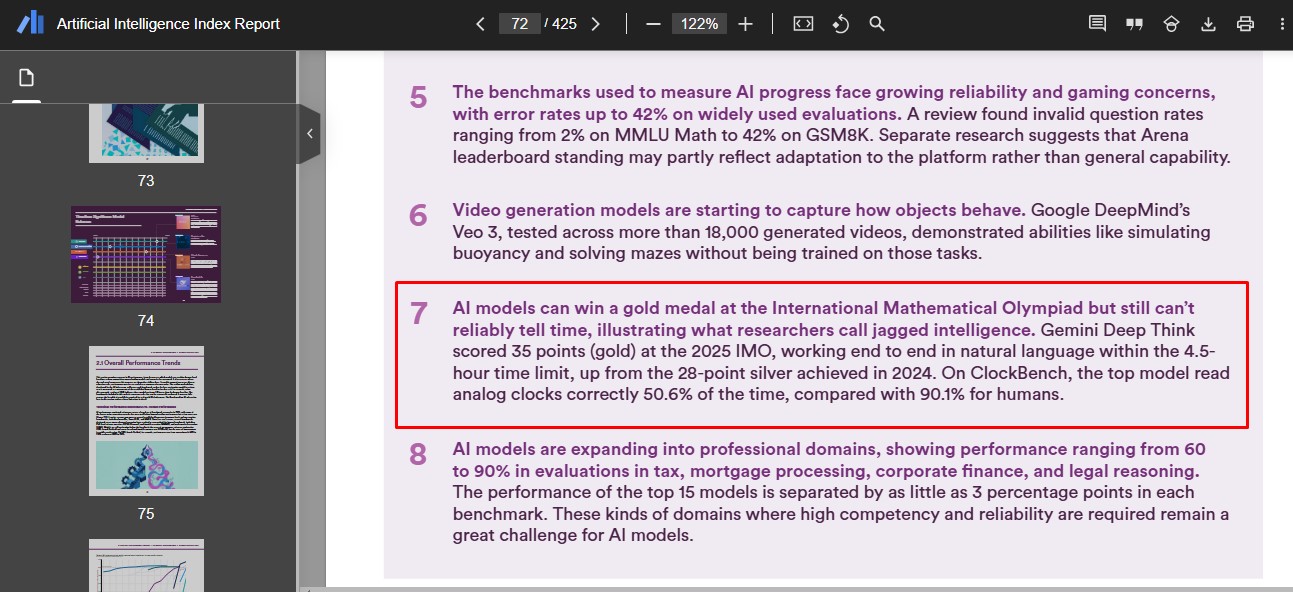
Stanford’s 2026 AI Index offers a useful example. An AI system achieved gold-medal performance at the 2025 International Mathematical Olympiad. Yet on a benchmark involving analog clocks, the leading model answered correctly only 50.6% of the time, compared with 90.1% for humans. Researchers describe this uneven profile as jagged intelligence.
That is more informative than declaring AI either smart or unintelligent. A model may solve difficult mathematics, generate usable code, or summarize hundreds of pages, then fail when wording changes slightly or a problem depends on ordinary physical context.
Humans are inconsistent too. We become tired, forget details, misread evidence, and let emotion or bias influence judgment. Our mistakes, however, often have different causes. AI failures can arise from gaps in training data, misleading statistical patterns, unfamiliar inputs, benchmark weaknesses, or changes in how a task is presented.
High performance in one area does not prove general understanding.
Natural Intelligence Develops Through a Body
Human intelligence is embodied. We learn through sight, sound, touch, movement, balance, discomfort, physical risk, and interaction with other people. A child does not understand “hot,” “heavy,” or “fragile” only by reading definitions. Those concepts become connected to sensation and action.
Most AI systems do not have this form of lived physical experience. Robots add cameras, sensors, and movement, yet ordinary homes remain difficult environments. Stanford reports that robotic systems completed only 12% of tested tasks in real households, despite reaching much higher success rates in controlled simulations.
A language model can explain how to lift a wet glass. A person directly handles its weight, slipperiness, temperature, position, and risk of breaking.
This does not mean machines can never improve at physical reasoning. It means fluent descriptions should not be mistaken for embodied experience.
AI Stores More; Human Memory Means More
Digital systems can store and retrieve volumes of information far beyond the capacity of one person. That is a genuine advantage. An AI-assisted system can search records, compare documents, and retrieve facts in seconds. Human memory is smaller and less exact. It is also tied to attention, relationships, emotion, identity, and personal history.
A person might forget the date of an important conversation but remember the atmosphere in the room, the feeling it produced, and how it changed a later choice. So I would not say that one side simply has “better memory.”
AI excels at scalable storage and retrieval. Human memory helps build a continuing sense of meaning and experience.
AI Creativity Is Real, but It Is Not the Whole Story
The claim that “humans create while AI only copies” is too simplistic. Generative AI can produce combinations that did not previously exist in exactly the same form. It can help brainstorm concepts, propose visual directions, write variations, and explore possibilities rapidly.
Research comparing thousands of human participants with large language models found that average human creativity was slightly higher, with humans showing greater variation and stronger performance at the most creative end of the distribution. Other studies have produced different results depending on the models and creativity tests used.
That mixed evidence tells us something important: creativity is difficult to reduce to a single benchmark. Human creativity is connected to intention. People create to communicate, persuade, remember, question, entertain, grieve, protest, or express who they are. The work belongs to a life and a culture.
AI can generate a moving image without having a memory attached to it. It can suggest a powerful sentence without caring whether the sentence is true or what happens after it is published.
The difference is not that AI can never produce novelty. It is that people still provide purpose, judgment, accountability, and meaning.
Emotional Language Does Not Prove Emotion
AI can identify emotional patterns and generate responses that sound compassionate, anxious, excited, or understanding.
A chatbot may say, “I understand why that upset you.” The sentence can be useful. It does not establish that the system felt concern.
Human emotions are connected to bodily states, memories, relationships, motivation, and consequences. Fear changes behavior. Grief affects attention and memory. Affection can shape trust, loyalty, and sacrifice.
This distinction matters because people naturally attribute minds and intentions to systems that use human-like language.
UNESCO’s AI competency framework therefore emphasizes human agency, critical thinking, ethics, transparency, accountability, and an understanding of AI’s limits. It argues that AI should support human development and decision-making rather than quietly replace them.
Is Artificial Intelligence Conscious?
There is no agreed scientific test showing that current AI systems possess subjective experience. They can discuss awareness, identity, pain, emotion, and personal goals because human-created material about those subjects appears in their training data. Producing convincing language about consciousness is not itself proof of consciousness.
The science of consciousness is still unsettled even when applied to biological minds. Researchers continue to debate the mechanisms that generate subjective awareness and how competing theories could be tested.
For that reason, I would avoid two absolute claims:
- Current chatbots are already conscious.
- Artificial consciousness will always be impossible.
Neither position has been established. The careful classroom answer is that current AI can display intelligent behavior without accepted evidence that it experiences the world internally.
AI Is Consistent, but It Can Scale Its Mistakes
People become tired, distracted, bored, and inconsistent. AI can repeat a digital task thousands of times without ordinary biological fatigue. That makes it valuable for monitoring, classification, calculation, document processing, and other high-volume work.
The danger is that one faulty system can reproduce the same problem at enormous scale.
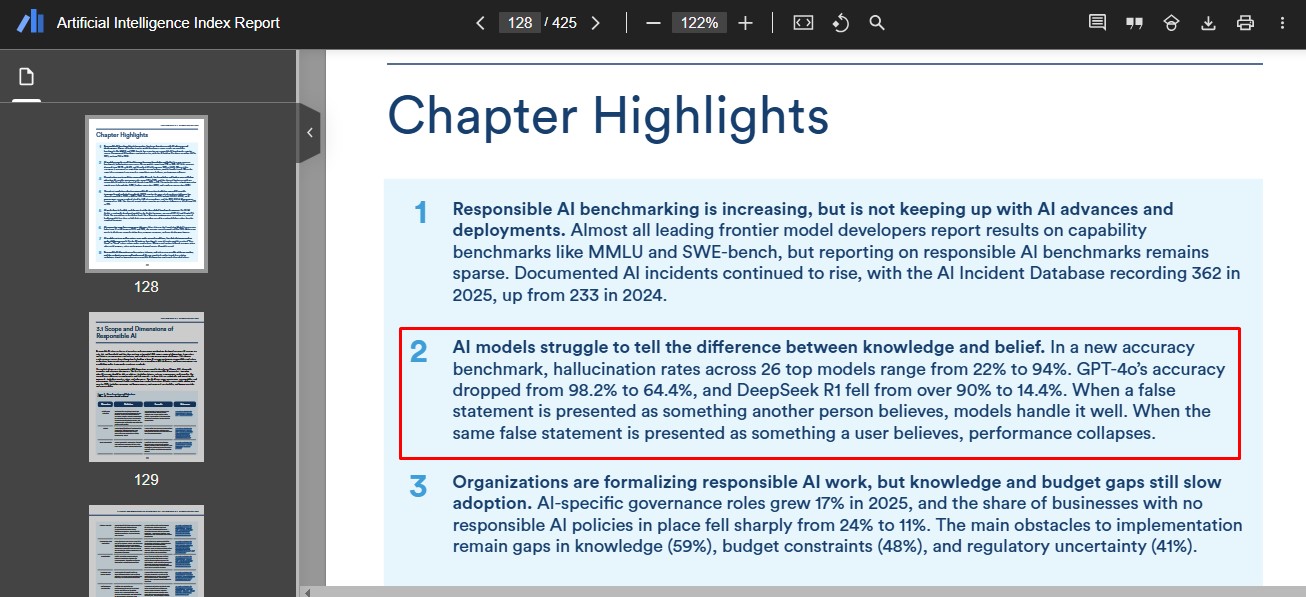
Stanford’s 2026 responsible-AI review reported hallucination rates ranging from 22% to 94% across 26 models on a benchmark designed to test how systems distinguish knowledge from belief. The exact figures depend on the benchmark, but the result is a reminder that fluent language is not guaranteed truth.
A person can make one careless decision. A deployed model can repeat a flawed decision across thousands of users before anyone notices. Consistency is useful only when the underlying process is reliable.
Neither Humans Nor AI Are Free From Bias
Human judgment is shaped by culture, experience, social influence, incentives, and mental shortcuts. AI can inherit bias through training data, labeling choices, model objectives, human feedback, evaluation methods, and the setting in which it is used.
A machine-generated result may appear neutral because it comes with numbers or technical language. That appearance does not make it fair.
AI can reproduce a hidden bias consistently. Humans can sometimes notice an unusual case and reconsider, though people can also defend prejudice and ignore evidence.
Neither form of intelligence deserves automatic trust. Important decisions require verification, transparency, representative evidence, oversight, and a clearly responsible person or institution.
The Human Brain Is Remarkably Efficient
The human brain performs perception, memory, language, movement, emotional regulation, and decision-making while using roughly 20 watts of power. Researchers describe biological brains as extraordinarily energy-efficient information-processing systems.
Large AI systems can require extensive computing infrastructure for training and operation. The comparison needs care. Brain power consumption and model-training energy are not equivalent measurements. Humans also depend on the rest of the body, years of growth, food, education, and social support.
The figure is useful because it highlights the efficiency of biological cognition, not because it proves that human intelligence is superior at every task.
What Artificial and Natural Intelligence Have in Common
These forms of intelligence are different, but they are not complete opposites.
Both can:
- Detect patterns
- Learn from information or feedback
- Make predictions
- Classify situations
- Solve problems
- Use stored knowledge
- Select actions
- Improve performance
- Produce errors
Similar results do not prove identical internal processes. A navigation system, a bird, and a person may all find a route. They do not necessarily represent distance, landmarks, risk, or purpose in the same way.
Can AI Replace Natural Intelligence?
AI can replace or automate particular tasks. It can classify documents, translate text, detect patterns, schedule work, summarize records, generate drafts, and support professional decisions. Replacing tasks is not the same as replacing natural intelligence as a whole.
AI still depends on human-created objectives, infrastructure, data, laws, evaluation, and deployment choices. Humans decide where the system is used and who bears the consequences when it fails.
Even collaboration does not automatically guarantee a better answer. A meta-analysis of 106 experiments found that human-AI teams performed better than humans alone on average, but generally performed worse than whichever participant, the human or the AI, was already best at the task. Creative tasks showed more benefit than decision-making tasks.
“Human plus AI” is not a magic formula. The result depends on the task, the quality of the system, the skill of the person, and how authority is divided.
What This Comparison Means for Students
Students should not memorize a simple list saying machines are fast and humans are emotional.
They should learn to ask better questions:
- What kind of intelligence does this task require?
- Is physical or social context important?
- What evidence supports the AI’s response?
- Where could the system fail?
- Who will verify the output?
- Who remains responsible for the decision?
A calculator may outperform a student at arithmetic. The student still needs to understand which calculation answers the problem.
An AI writing tool may produce a fluent essay. The learner still has to evaluate the argument, check the evidence, recognize missing context, and take responsibility for the final work. That is the core of AI literacy.
Intelligence Is Not a Single Competition
I do not think Artificial Intelligence vs Natural Intelligence needs a winner. AI extends what people can calculate, search, compare, automate, and generate. Natural intelligence brings embodied experience, flexible judgment, emotion, relationships, values, and responsibility.
AI is powerful partly because it is different from natural intelligence, not because it has perfectly reproduced it. The sensible future is not built on pretending machines are people or pretending people can ignore powerful machines.
It depends on understanding what each system can do, recognizing where it fails, and keeping human accountability attached to the outcome.
Frequently Asked Questions on Artificial Intelligence vs Natural Intelligence
1. Is Artificial Intelligence Smarter Than Natural Intelligence?
AI outperforms people in selected tasks involving calculation, large-scale retrieval, repeated processing, and statistical pattern analysis. Natural intelligence remains stronger across many tasks involving physical context, flexible adaptation, social meaning, and personal responsibility.
2. Is Human Intelligence a Form of Natural Intelligence?
Yes. Human intelligence is one form of natural intelligence. The broader term can also include intelligent and adaptive behavior in animals, plants, microorganisms, immune systems, and biological groups.
3. Does AI Think Like the Human Brain?
Not in any simple sense. Artificial neural networks were partly inspired by neuroscience, but current models are not digital replicas of human brains. They differ in structure, development, learning, memory, embodiment, and energy use.
4. Can AI Feel Emotions?
Current AI can recognize emotional patterns and generate emotionally appropriate language. There is no accepted evidence that it experiences emotions subjectively.
5. Can AI Become More Intelligent Than Humans?
AI already exceeds human performance in particular tasks. Whether it will achieve broad, reliable intelligence across unfamiliar domains remains uncertain, partly because AGI has no universally accepted definition or test.