Have you noticed how fast AI showed up in school life?
One week it felt like a novelty, and the next week teachers were using it to draft quizzes, students were using it for homework help, and district leaders were trying to write rules on the fly. That is why Artificial Intelligence In K-12 Schools sits at the center of so many school conversations right now.
The promise is easy to see. AI can help personalize practice, speed up routine work, and give teachers more time for actual teaching.
The worries are real too. Privacy, bias, accuracy, and academic integrity all matter, especially when the users are children.
I am going to walk you through both sides in plain language. We will look at where AI helps, where it can go wrong, and what smart school policy should include so readers can see the issue clearly.
Brief overview of AI integration in K-12 education
AI already touches instruction, operations, and family communication in U.S. schools. A July 2025 U.S. Department of Education letter said federal grant funds may be used for AI-based instructional materials, AI-enhanced tutoring, and educator training, as long as schools still follow existing legal and regulatory rules.
Use is growing from the ground up. RAND reported that 25% of surveyed U.S. teachers used AI tools for instructional planning or teaching during the 2023-2024 school year, and nearly 60% of principals said they used AI in their own jobs.
Students are moving even faster. Common Sense Media’s 2026 census found that 86% of U.S. kids ages 9 to 17 use or interact with AI, and 85% of AI users say they use it for schoolwork or homework.
Setting the stage for opportunities and challenges ahead
That mix of rapid adoption and uneven guidance explains the current tension in K-12 education. Schools want the gains from Education Technology and Machine Learning, but they also need clear lines around safety, fairness, and what work students should still do themselves.
The policy gap is part of the problem. RAND found that only 18% of principals said their school or district had provided some type of guidance on AI use during the 2023-2024 school year, which means many classrooms were making decisions before districts had shared rules.
For readers, the practical takeaway is simple: AI in schools should never be treated as just another app rollout. It needs instructional goals, staff training, vendor review, and student safeguards from day one.
The Promise of AI in K-12 Education
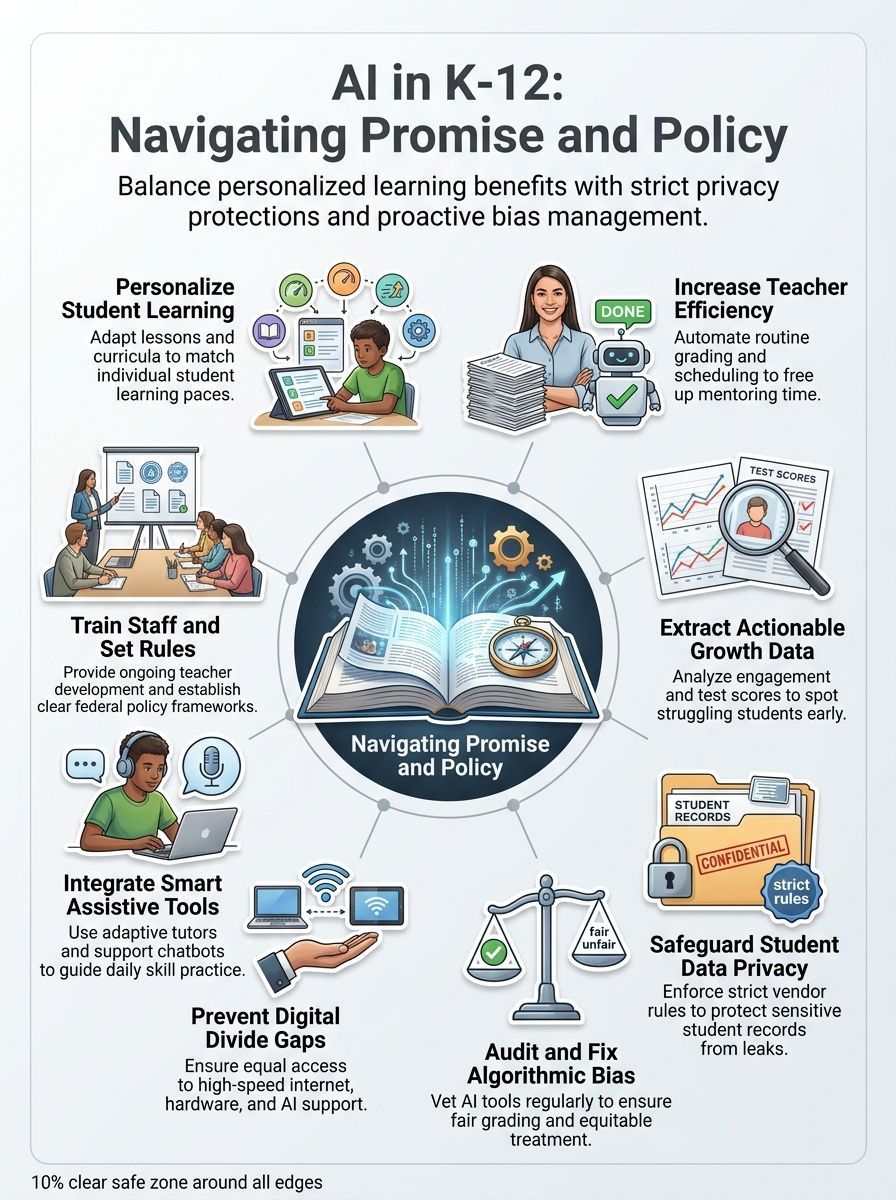
Artificial Intelligence in K-12 schools can help schools do three things better: personalize learning, cut routine workload, and spot student needs earlier. The best results show up when AI supports teachers instead of trying to replace their judgment.
Personalized learning experiences and adaptive curricula
Adaptive systems can adjust reading level, pacing, hints, and review questions based on a student’s answers. That gives students more chances to practice at the right level instead of moving lockstep through the same worksheet.
A July 2025 federal guidance letter specifically pointed to AI-powered instructional tools that adapt to learner needs in real time. For a school team, that means AI makes the most sense in areas like math practice, vocabulary review, and tutoring support, where fast feedback matters and a teacher can still monitor the results.
Named tools matter here because they show how the category works. Khanmigo is used as an AI tutor and writing support tool, while classroom-focused platforms like MagicSchool are built to help teachers create materials and supports faster. The practical difference is important: one tool may be better for guided student use, while another is better kept on the teacher side of the screen.
- Best fit: extra practice, feedback, and scaffolded support
- Needs oversight: open-ended answers, historical claims, and sensitive topics
- Red flag: any tool that gives students a finished answer with no explanation
Enhanced efficiency for teachers and administrators
Teacher time is where AI often shows value first. Gallup reported in 2025 that three in 10 teachers use AI weekly, and those teachers estimate the time savings add up to about six weeks a year.
That number matters because it changes how schools should think about Teacher Support. If AI can take on first-draft tasks like parent emails, quiz creation, rubric outlines, or lesson differentiation, teachers can spend more time conferencing with students and less time buried in admin work.
Principals are already there. RAND found that nearly 60% of principals reported using AI in their jobs, often for writing and communication tasks, so districts should write policy for office use too, not just classroom use.
Data-driven insights to support student growth
AI can help teachers notice patterns that are easy to miss in a busy week. A dashboard that flags missing assignments, sudden drops in quiz scores, or reading errors can help a teacher intervene earlier.
The value is not in the dashboard alone. The value comes from what a teacher does next, such as reteaching a concept, calling home, or moving a student into small-group help.
AI works best as an early-warning system, not as the final judge. Schools should treat alerts as prompts for human review, not automatic decisions about a child.
That point matters for Equity in Education too. If a school uses predictive tools, leaders should ask whether the system performs equally well for multilingual students, students with disabilities, and students in high-poverty schools before they rely on the results.
Pitfalls and Challenges of AI Implementation
AI can support learning, but weak implementation can create new problems faster than schools can fix them. In practice, the biggest Risks usually cluster around privacy, bias, and unequal access.
Data privacy, security, and ethical concerns
Schools handle some of the most sensitive data there is: names, grades, disability records, discipline records, writing samples, and family contact details. Once that information moves through an AI product, district leaders need to know what the vendor stores, who can access it, and whether the data is used to train future models.
The U.S. Department of Education’s student privacy office continues to remind districts that FERPA and related privacy rules still apply when schools use digital tools. The practical move is to review vendor terms, data retention, subcontractors, and deletion rights before any product reaches students.
The security side matters just as much. The Department of Education’s K-12 cybersecurity page, updated in March 2026, notes that cyber incidents in schools include data breaches and ransomware, and it cites CoSN reporting that more than 78% of education technology leaders say their schools are investing in monitoring, detection, and response. If a district adds AI tools without adding security review, it is creating a larger target.
| Question to ask a vendor | Why it matters |
|---|---|
| Does the product keep student prompts or files? | Stored data can become a privacy and breach risk. |
| Is student data used to train the model? | That can turn classroom work into future commercial training material. |
| Can the district delete data on request? | Schools need an exit plan before adoption. |
| Who else receives the data? | Subprocessors can widen exposure beyond the school contract. |
Potential biases in AI algorithms
Bias in AI often starts with training data and gets worse when schools assume the output is neutral. A model can misread dialect, overflag multilingual writing, or produce uneven feedback across student groups.
That is why bias testing cannot be a one-time box check. Schools should test sample assignments from different grade levels and student populations before they trust an AI grader, writing detector, or behavior alert system.
- Test student samples from multilingual learners
- Review outputs for special education accommodations
- Compare feedback across grade bands
- Require staff to override wrong or incomplete outputs
If a vendor cannot explain how the tool was evaluated for fairness, that is a procurement warning, not a minor detail.
Equity, access, and the risk of widening the digital divide
AI can help close gaps, but only if students can actually reach the tool and use it well. Access still depends on devices, broadband, teacher support, and the time to teach students how to question what the tool gives back.
RAND found lower AI use and less guidance in higher-poverty schools, which points to a real Digital Divide issue. If more affluent districts get training, pilots, and better vendor review while other districts get piecemeal access, AI may widen gaps instead of reducing them.
Schools should also think beyond access to devices. AI literacy matters just as much as login access, because a student who can prompt well, verify information, and revise weak output has an advantage over a student who simply copies what the bot says.
Practical Applications of AI in Schools
When schools use AI well, they aim it at specific problems instead of asking it to do everything. The strongest use cases in Education Technology tend to be tutoring, teacher workflow, and limited student support services.
Adaptive learning platforms and smart tutoring systems
AI tutoring systems can give immediate hints, targeted review, and practice that changes with student performance. That works well for subjects like math facts, algebra steps, grammar review, and reading comprehension checks.
The July 2025 federal guidance letter highlighted AI-enhanced high-impact tutoring and hybrid models where human tutors are supported by AI platforms. For districts, the key word is hybrid. A tutoring tool should extend human support, not replace the teacher or interventionist.
Well-known examples in this space include Khanmigo and Gauth-style academic helpers. The useful question is not which brand sounds smartest, it is whether the tool shows reasoning, keeps records safely, and lets adults review how students used it.
AI-powered grading, assessment, and feedback
This is where schools can gain time quickly, and where mistakes can hurt trust quickly too. AI can draft rubric comments, sort common errors, and suggest next steps, but teachers still need to review the output before it becomes a grade.
RAND found that among teachers who used AI, 64% used it for instructional planning, while only 36% reported introducing AI tools to students. That pattern makes sense. Planning support is lower risk than handing a grading or writing tool directly to students.
A safe school rule is to keep AI on the feedback side before the final-score side. Let it suggest comments, organize evidence, or surface missing standards, but require a teacher to approve anything that affects a report card.
If an AI tool cannot explain why it gave feedback, it should not be making high-stakes calls about student work.
Virtual assistants and chatbots for student support
Chatbots can help with simple tasks like deadline reminders, FAQ answers, course navigation, and translation support. Used that way, they can cut friction for students and families.
But schools need tighter rules here because students often treat chatbots like trusted guides. Common Sense Media’s 2026 census found that 37% of kids who use AI have used it to discuss feelings or personal problems, and one in four of those kids said AI sometimes understands them better than most people do.
That should change how districts design student-facing tools. Chatbots in schools should have narrow roles, clear escalation rules, and visible prompts that direct students to a counselor, nurse, teacher, or parent when the topic turns personal, medical, or safety-related.
Policy and Best Practices for Responsible AI Use
Good school policy does more than say yes or no to AI. It tells staff what tools are approved, what student use is allowed, what data can be shared, and when a human must step in.
Developing guidelines for ethical and equitable AI deployment
Start with use cases, not hype. A district should list the tasks it wants AI to support, such as lesson drafting, tutoring, translation, or family communication, and then write separate rules for each one.
A 2026 policy framework published in the Journal of Research on Technology in Education identified eight recurring K-12 policy areas: data privacy and security, ethical and responsible use, equitable access, academic integrity, human oversight, AI literacy, curriculum integration, and governance and review. That list is practical because it covers both classroom use and district operations.
- Human oversight: no final high-stakes decision should rest on AI alone
- Approved tools list: staff should know what is allowed and what is blocked
- Age-appropriate use: rules should differ for elementary, middle, and high school
- Review cycle: revisit policy at least once each school year
Protecting student data and ensuring transparency
Transparency means families and staff should not have to guess what a tool does with student work. The official privacy guidance for online educational services tells schools to understand how a service collects, uses, and transmits information before adoption.
That means districts should publish plain-language answers to a few basic questions:
- What data does the AI tool collect?
- Who can see that data?
- How long is it kept?
- Can parents review or challenge its use?
- What happens if the district stops using the tool?
For younger students, age rules matter too. FTC guidance on COPPA protects children under 13 in online data collection settings, and UNESCO’s long-cited education guidance set 13 as a minimum threshold for independent use of many generative AI tools. Even when a product is technically available, schools should still ask whether the use is developmentally appropriate.
Training and supporting educators for effective implementation
Teacher Training is where many AI plans succeed or fail. Teachers do not need to become engineers, but they do need practical help with prompting, fact-checking, privacy rules, bias checks, and redesigning assignments so students still do real thinking.
State education agencies have started building these supports. Massachusetts offers AI literacy resources and webinars for educators, while Delaware’s guidance includes sections on implementation, classroom practice, and professional learning. That is a useful model because it treats AI as both a teaching issue and a system issue.
A strong staff training plan should cover these topics first:
- how to verify AI output before using it in class
- how to protect student data and avoid risky prompts
- how to redesign assessments for authentic student work
- how to spot bias, misinformation, and overconfident errors
- how to explain allowed and not allowed use to students and families
Schools should also train principals, counselors, librarians, and office staff. AI use in K-12 education does not stop at the classroom door.
Final Thoughts
Artificial Intelligence In K-12 Schools is full of promise, but it asks adults to make careful choices.
AI can save teachers time, support tutoring, and help schools respond faster to student needs. At the same time, it can create Privacy risks, uneven access, weak feedback, and real problems with Bias if districts move too fast.
The path forward is not to ban every tool or approve every tool. It is to set policy first, train staff well, review vendors closely, and keep humans in charge of the parts of school life that shape trust, fairness, and student growth.
FAQs about Artificial Intelligence In K-12 Schools
1. What promise does artificial intelligence bring to K-12 schools?
AI can speed grading, tailor lessons, and help with assessment, so students get help where they lag. Teachers can use AI tools to analyze classroom data, and shape the curriculum to fit each child.
2. What pitfalls should K-12 leaders watch for?
AI can bake in bias, leak private student data, and give wrong answers, so schools must guard against harm. Overreliance can hollow out teaching, if adults step back too soon. Data security and fairness must guide decisions.
3. What policies should guide AI use in K-12 schools?
Set clear rules on data security, testing, teacher training, transparency, and who may use AI tools in classrooms.
4. How can teachers and parents use AI tools wisely day to day?
Treat AI like a power tool, not a magic wand, check its work, and talk about bias and privacy with students. If an answer smells fishy, ask a teacher, don’t let the robot do all the thinking.