If you have been wondering How AI And EdTech Are Reshaping Modern Education, you are seeing a real shift, not a passing trend.
Teachers are still stretched thin, students still learn at different speeds, and one-size-fits-all lessons still miss too many kids. The difference now is that schools finally have practical technology that can adapt, coach, and flag problems earlier.
Gallup reported in 2026 that six in 10 U.S. K-12 teachers used AI for work during the prior school year, and Stanford’s 2026 AI Index says four out of five U.S. high school and college students now use AI for schoolwork.
This guide keeps it simple. We’ll walk through the tools, the benefits, and the guardrails so you can see what actually helps learning and what still needs a very human touch.
Brief overview of AI and EdTech’s rising influence in education
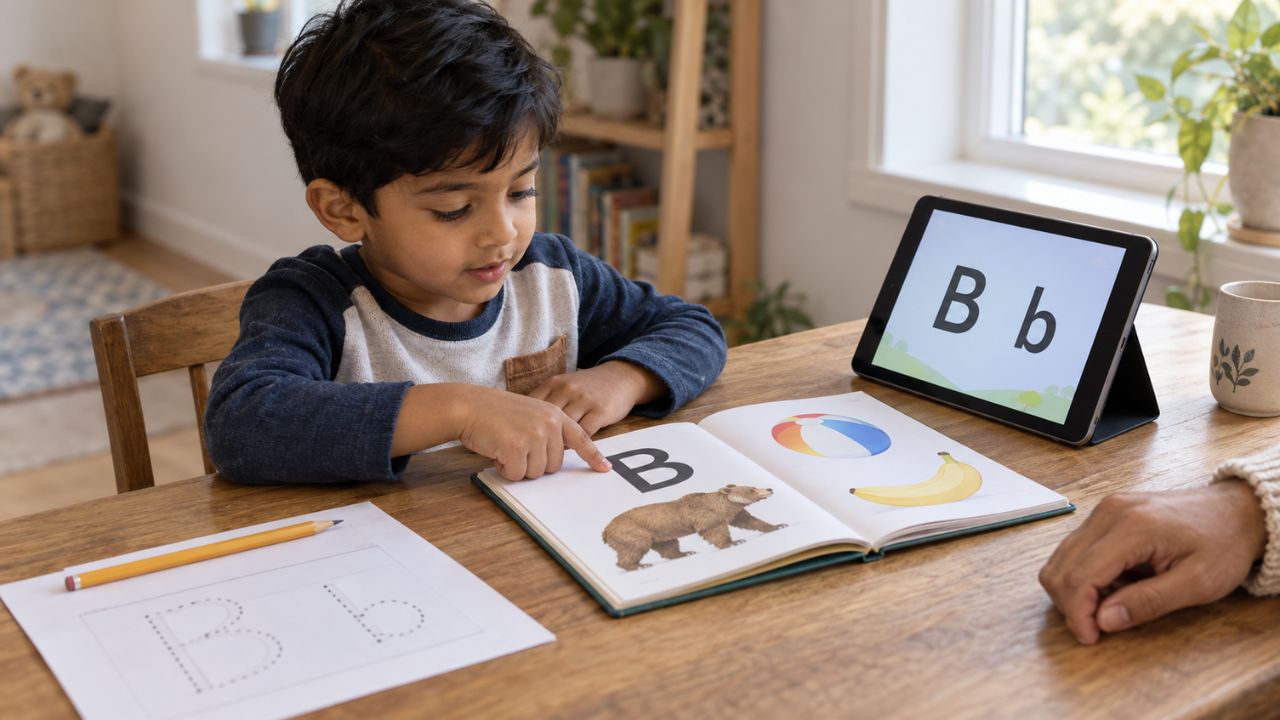
AI now sits behind many of the tools schools already use, from digital classroom platforms to tutoring apps and automated feedback systems. That matters because it turns ordinary software into something more responsive.
Instead of giving every student the same assignment in the same format, these systems can adjust reading level, pace, hints, and practice questions. Teachers get faster feedback loops, and students get more chances to work at the level they actually need.
The catch is that adoption is moving faster than school policy. Stanford’s 2026 AI Index says only half of middle and high schools have AI policies, and just 6% of teachers say those policies are clear.
The need for innovation in modern learning environments
Schools need better tools because classrooms are harder to teach evenly than they were a few years ago. A 2026 NWEA study found the spread of student achievement inside the same classroom is unusually wide, which means one lesson pace can leave some students bored and others lost.
That is where Educational Technology earns its place. Good AI tools can help with Personalized Learning, Adaptive Learning, faster Feedback, and cleaner Learning Analytics, while teachers keep control of instruction.
Innovation also has to be practical. The best tools are the ones that save time, improve access, and fit real classroom routines instead of creating one more dashboard nobody uses.
How AI And EdTech Are Reshaping Modern Education
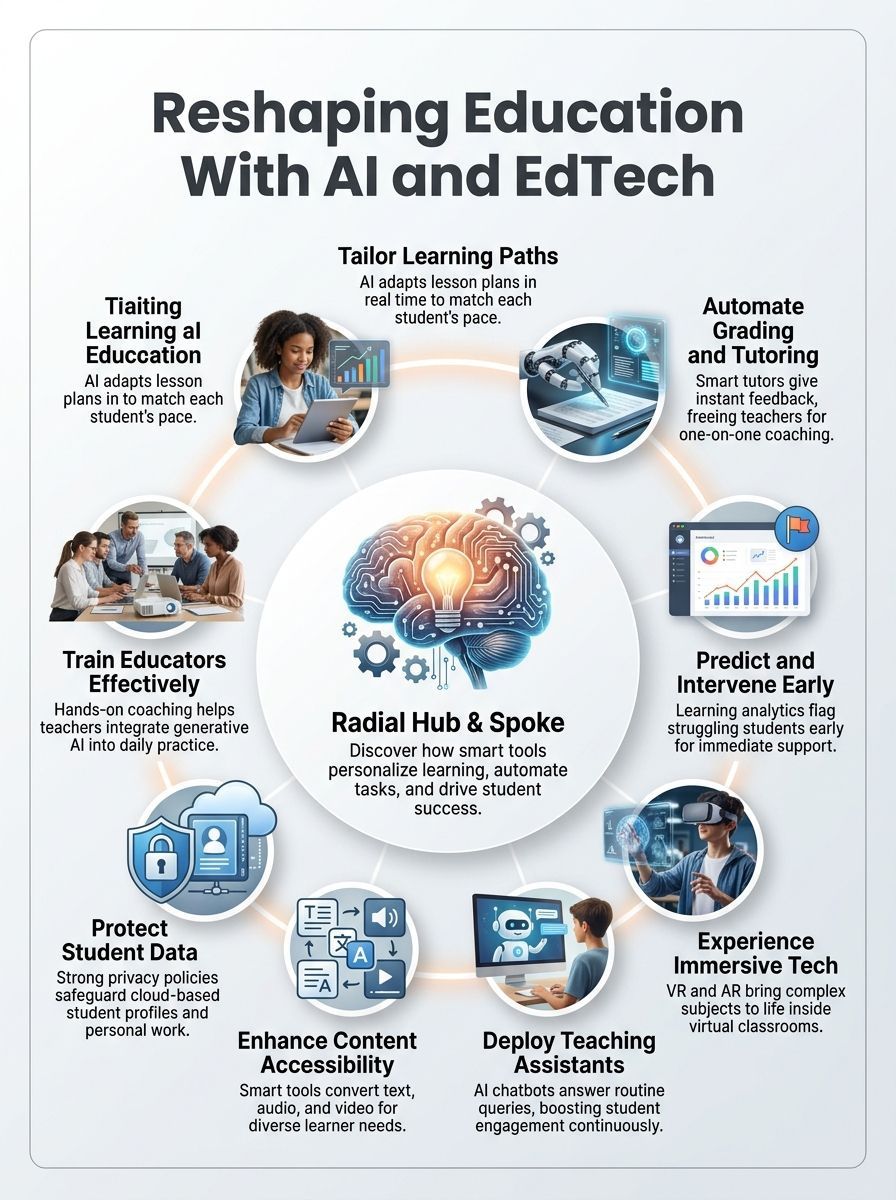
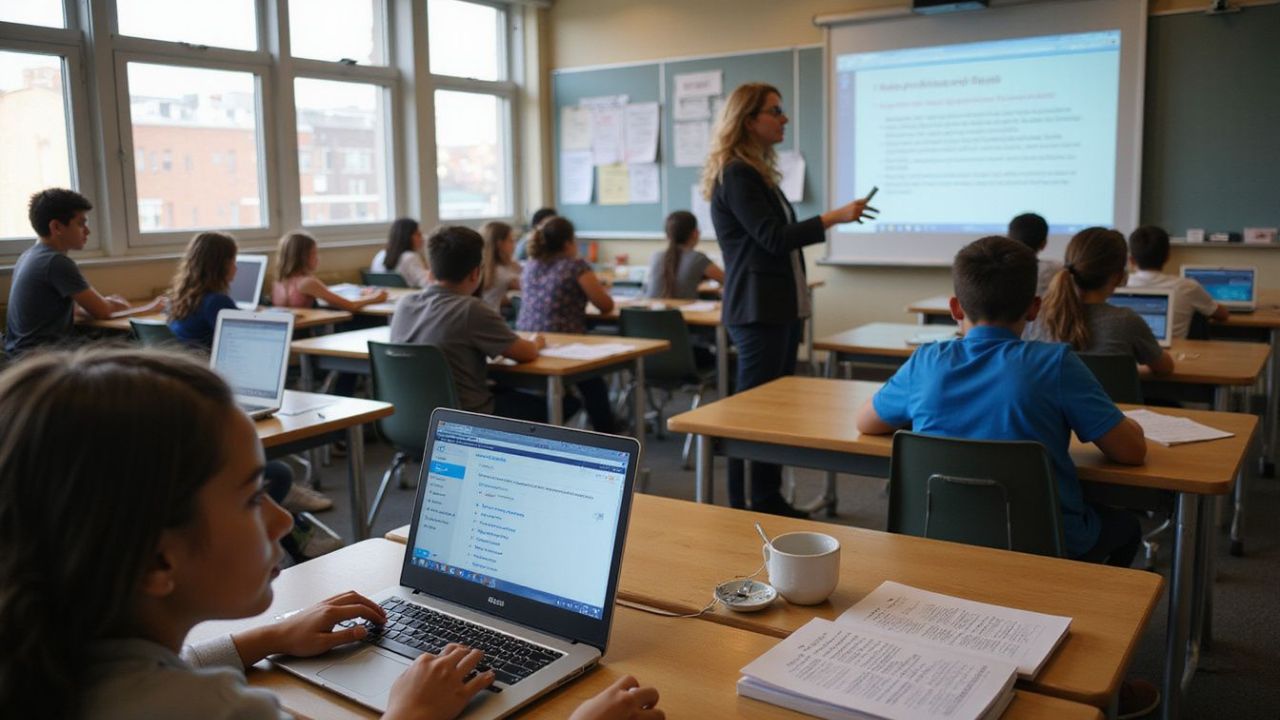
AI is changing education most when it helps teachers make better decisions faster. The strongest uses right now are not flashy gimmicks, they are tools that personalize practice, speed up low-stakes feedback, and surface students who need help sooner.
Adaptive learning systems and personalized instruction
Adaptive learning works by adjusting Content based on how a student performs from one task to the next. That makes Personalized Learning much more realistic in a busy Digital Classroom.
Tools like NWEA MAP Growth show why this matters. NWEA describes it as a computer-adaptive assessment that helps schools screen every student, place students more precisely, and report progress clearly across subjects and grade levels, including support for English and Spanish learners.
The strongest evidence base is still narrow. Stanford’s 2026 review found more than 800 AI-in-education papers, but only 20 high-quality causal studies, and a large share of that stronger evidence is concentrated in math.
- Use Adaptive Learning for practice, not autopilot. It shines when students need targeted repetition and quick hints.
- Let the teacher make the grouping call. AI can suggest next steps, but teachers still know when a student needs reteaching, a challenge task, or a confidence boost.
- Check whether the system explains its choices. If you cannot see why a student got a lesson path, it is harder to trust the recommendation.
Intelligent tutoring and automated grading
Smart Tutoring tools are most helpful when they coach step by step instead of giving away the answer. That keeps the focus on Learning, not shortcutting it.
Khan Academy says Khanmigo is free for U.S. teachers, which lowers the barrier for schools that want to test AI tutoring without a large first purchase. In product tests run from October 2025 to April 2026, Khan Academy reported a 6.1% improvement in next-item correctness after giving Khanmigo better access to structured learning-history signals.
Automated grading can also save real time. Gallup found teachers who use AI at least weekly estimate saving 5.9 hours per week, or about six weeks across a school year, which is why these tools are gaining ground in lesson prep, quiz writing, and routine feedback.
The safest move is to start with low-stakes work. Let AI handle exit tickets, quiz drafts, or first-pass rubric comments, then keep the teacher in charge of final writing grades, nuanced feedback, and any high-stakes decision.
Predictive analytics and early intervention for student success
Learning Analytics become powerful when they point to a next action. A chart alone does not help a student, but an early alert tied to a clear response often does.
PowerSchool’s Early Warning System shows how schools can do this with simple triggers. For example, a school can flag students with year-to-date attendance below 90% and more than five referral events, then filter those students for follow-up.
Canvas analytics and similar dashboards can also show which students are not engaging, not submitting, or slipping in progress. That gives teachers a better shot at intervening before a missing assignment turns into a lost quarter.
| Signal to watch | What a teacher or school can do next |
|---|---|
| Attendance dropping below a set threshold | Call home early, check for transportation or health issues, and offer make-up support |
| Repeated misses on the same skill | Regroup students for short reteaching and assign targeted Adaptive Learning practice |
| Low LMS activity | Check whether the issue is motivation, confusion, or access at home |
| Sudden change in behavior or referrals | Bring in counseling, family communication, or a student support team quickly |
EdTech Tools Revolutionizing the Classroom
There is no single tool that fixes everything. The better question is which tool solves a specific classroom problem with the least friction.
Learning Management Systems with smart features
A strong LMS is no longer just a place to post assignments. It is becoming the operating system for Online Learning, Feedback, progress tracking, and AI-assisted Curriculum Development.
Google announced in 2026 that Gemini features inside Google Classroom can help teachers create materials faster, record audio or video feedback, and tag assignments to U.S. learning standards so progress is easier to track. That is useful because it keeps the work inside a system teachers already know.
Canvas is pushing in a similar direction. Its K-12 offering now emphasizes embedded AI tools for faster grading and content creation, plus analytics dashboards that surface engagement, progress, and students who need attention.
- Look for standards alignment. It helps tie AI-generated activities back to what students are expected to learn.
- Look for built-in feedback tools. Audio and video comments can feel more personal than text alone.
- Look for usable analytics. If the dashboard is too complex, staff will ignore it.
Virtual and Augmented Reality for immersive experiences
VR and AR work best when students need to see, move, or simulate something that is hard to show on paper. Think lab safety, anatomy, geometry in space, or career training.
Platforms like ClassVR are built for schools, which matters more than it sounds. Teacher controls, locked-down student access, centralized device management, and curriculum-linked Content make classroom use much smoother than trying to adapt consumer headsets.
Prisms is another example with a clear classroom angle. During the 2024-25 school year, it reported use across more than 300 school districts in 35 states, serving more than 300,000 students with problem-based math and science experiences.
The pro move is to start small. Use immersive tech for one tough unit where visualization really matters, then measure whether Student Engagement and understanding improve before buying more hardware.
Chatbots and virtual teaching assistants
Chatbots are now part of daily school life, whether schools plan for them or not. The smartest schools treat them like calculators for language and research work: useful, but only with clear rules.
Pew found that 54% of U.S. teens use chatbots for schoolwork help. That makes school guidance essential, because students are already building habits on their own.
For teachers, virtual assistants can draft parent emails, make leveled reading questions, build rubrics, or suggest enrichment tasks. For students, they work best as guided practice partners, brainstorming helpers, or explanation tools.
| Tool | Best classroom use | Standout detail |
|---|---|---|
| Khanmigo | Teacher prep and guided tutoring | Free for U.S. teachers |
| Google Classroom with Gemini | Assignment creation and feedback | Supports audio, video, and standards-linked workflows |
| SchoolAI | District rollouts and classroom support | Listed as ESSA Level III validated and eligible for several federal funding streams |
| Brisk Teaching | Feedback inside everyday teacher workflows | Works inside common documents and supports native-language and voice-to-text activities |
Key Benefits of AI and EdTech Integration
When schools use these tools well, the gains are pretty straightforward: better Personalization, stronger Accessibility, quicker Feedback, and more informed teaching choices.
Personalized and engaging learning experiences
Students tend to engage more when work feels achievable but still challenging. AI helps by tightening that fit.
This matters because student use is already widespread. Stanford’s 2026 AI Index says four out of five U.S. high school and college students use AI for schoolwork, while Lumina and Gallup found 57% of college students use AI daily or weekly for coursework.
That does not mean every use is good. It means schools should teach students how to use AI for brainstorming, research support, revision, and practice, while keeping core thinking, discussion, and original explanation in human hands.
Greater accessibility for all students
Accessibility is one of the clearest wins in modern Educational Technology. A student who struggles with decoding, language load, or confidence can often participate more fully with the right support turned on.
Microsoft Learning Accelerators offer tools such as Reading Coach, Immersive Reader, and Search Coach. They help students practice reading fluency, break down text, and build better information-literacy habits instead of just hunting for quick answers.
Google for Education also bakes in practical support. Schools can use live captions in Meet and Slides, read-aloud tools, and flexible text presentation, while Canva Education adds translation, video captions, and an accessibility checker for classroom materials.
- For reading support: Turn on read-aloud, text spacing, and pronunciation help.
- For multilingual learners: Use translation and captioning to lower language barriers without lowering expectations.
- For student expression: Offer voice, video, and visual response options instead of forcing every answer into a written paragraph.
Data-driven decision making for educators
Good data does not replace teacher judgment. It sharpens it.
When dashboards are set up well, teachers can spot patterns in missing work, skill gaps, attendance, and pacing much sooner than they could with paper-only systems. That is especially helpful in Remote Learning, blended schedules, and large classes.
The best Learning Analytics answer one question clearly: what should I do for this student tomorrow?
In practice, that means choosing a few signals that lead to action. Too much data creates noise, and teachers do not need more noise.
Challenges and Considerations
AI and EdTech can improve teaching and Learning, but only if schools handle access, privacy, and staff support seriously. This is where strong planning matters as much as strong software.
Addressing the digital divide and technology access
Access has improved, but the gap is not gone. NCES reported in 2025 that 88% of public schools had a 1-to-1 device program for the 2024-25 school year, and 77% said high-speed internet was available across all school grounds and buildings.
That is good progress inside school walls. It still does not guarantee smooth Online Learning at home, especially for students who share devices, rely on unstable service, or do homework from a phone.
Usage patterns also show uneven dependence on AI. Pew found that one in five teens in households earning under $30,000 say they do all or most of their schoolwork with chatbot help, compared with 7% of teens in households earning $75,000 or more.
- Keep offline options ready. Printable packets, downloadable files, and make-up windows still matter.
- Loan hotspots as well as devices. A laptop without internet does not solve Remote Learning problems.
- Audit mobile use. If a tool works poorly on a phone, some students will be shut out even if they are technically connected.
Data privacy and student security concerns
Privacy cannot be an afterthought. Schools are asking students to learn through platforms that collect work samples, usage patterns, and sometimes sensitive personal data.
The U.S. Department of Education’s student privacy office provides a model terms-of-service checklist for reviewing how online tools collect, use, and share information. That is a good sign that schools should vet products before teachers are told to use them.
This is also a live risk, not a theoretical one. In June 2026, the Federal Trade Commission took action against Illuminate Education over failures to secure students’ personal data.
- Ask whether student data is used to train models.
- Ask how long data is stored and who can delete it.
- Ask what happens after a breach, including notice timing.
- Ask whether families can opt out or request access.
- Ask whether the tool is needed for instruction, or just convenient.
Training educators and overcoming resistance to new technology
Most teacher hesitation is not about fear of Technology. It is about being asked to use new systems without time, examples, or clear rules.
Gallup found in May 2026 that just 18% of U.S. K-12 teachers receive formal guidance on AI use. For one-on-one tutoring with AI, 69% say they receive no guidance at all.
There is movement in the right direction. CoSN reported that districts without AI guidelines dropped from 43% in 2025 to 21% in 2026, and 56% now have an acceptable-use policy for generative AI.
Training is also scaling up. ISTE+ASCD announced in February 2026 a partnership with Google to make AI literacy training available to six million U.S. educators.
- Start with three use cases. Lesson planning, low-stakes feedback, and differentiated materials are easier entry points than full AI tutoring.
- Write simple rules before rollout. Teachers need plain language on what is allowed, what needs review, and what is off-limits.
- Model one good workflow. Show staff exactly how a teacher can draft a quiz, check it, and post it in under ten minutes.
- Protect planning time. Training sticks better when teachers can try tools with their own materials, not generic examples.
- Review impact every grading period. Check whether the tool improved Feedback, Student Engagement, Accessibility, or time savings. If it did not, cut it.
- Teach students the rules too. Responsible use works best when expectations for research, writing, brainstorming, and citation are clear from day one.
Final Thoughts
So, what is the big picture on How AI And EdTech Are Reshaping Modern Education?
It is less about replacing teachers and more about giving them better leverage. AI can help with Personalized Learning, Adaptive Learning, faster Feedback, smarter Content delivery, and earlier intervention, while teachers stay in charge of relationships, judgment, and deep learning.
The most helpful tools already have clear use cases. Google Classroom is building tighter standards-based workflows, Microsoft is pushing Accessibility through Reading Coach and Immersive Reader, Khanmigo is testing how guided tutoring can improve practice quality, and platforms like Canvas, NWEA, and PowerSchool are turning data into more usable classroom signals.
At the same time, schools cannot skip the hard parts. Policy still trails student behavior, privacy still needs stronger safeguards, and professional development still has to catch up with day-to-day classroom reality.
If schools focus on Innovation that is practical, safe, and easy to use, this shift can be a real Transformation for Learning. The winners will be the schools that use AI to support human teaching, widen Accessibility, strengthen Skills, and make the Digital Classroom work better for every student.
FAQs about How AI And EdTech Are Reshaping Modern Education
1. What are AI and EdTech doing to modern education?
AI and EdTech tailor lessons to each student, using personalized learning and adaptive learning tools. They speed up grading, help with curriculum design, and provide learning analytics so teachers spot gaps fast.
2. Will AI replace teachers?
No, AI is a sidekick that handles routine work and boosts teacher support, letting teachers focus on students.
3. Is student data safe with EdTech?
It can be, I get it, privacy worries are real, but that depends on the tool and the rules. Schools should pick platforms with strong privacy, secure storage, and clear consent. Read the terms and watch apps that ask for too much data.
4. How do AI and EdTech help in remote and blended learning?
They power online learning, add accessibility features, and give instant feedback. Adaptive systems change practice to fit each learner, and flexible assessments help students stay on track whether remote or in class.