Have you ever pasted a document into an AI tool and gotten a reply that felt off, almost like the model suddenly changed sides? That is the moment prompt injection stops feeling theoretical.
I care about prompt injection defense because indirect attacks do not start with a loud, obvious command. They hide inside files, emails, webpages, chat history, and tool output, then wait for your LLM to treat hostile text like trusted instructions.
In this guide, I will walk through the practical moves that harden an LLM application: input validation, structured prompts, output checks, least-privilege tool access, and testing that reflects how attacks really happen in production.
Understanding Prompt Injection Attacks
I think of a prompt injection attack as instruction smuggling. The attacker hides a command inside content your model is supposed to read, then counts on the language model to confuse data with control.
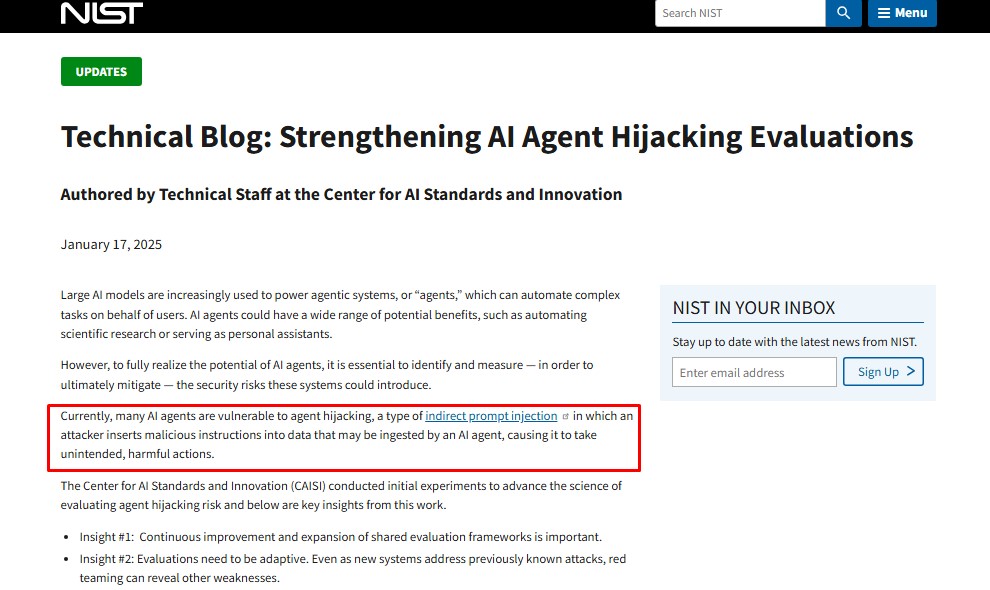
NIST noted in January 2025 that many AI agents remain vulnerable to agent hijacking for exactly this reason: there is still no clean boundary between trusted internal instructions and untrusted external data. As of the OWASP 2025 Top 10 for LLM applications, prompt injection still sits at LLM01, which tells me this is a core design problem, not a fringe bug.
How Indirect Attacks Differ from Direct Attacks
I separate direct and indirect prompt injection attacks by one simple question: who placed the malicious instruction in front of the model? If it came straight from the user, that is direct. If it came through a document, website, email, plug-in, or tool result, that is indirect.
| Aspect | Direct attack | Indirect attack |
| Entry path | The attacker sends the malicious prompt to the model directly. | The model encounters the payload inside external content it was asked to process. |
| Visibility | Usually obvious in chat logs and request traces. | Often buried in HTML, comments, attachments, hidden text, or retrieved context. |
| Persistence | Often a one-shot attempt. | Can persist across memory, retrieval caches, tool outputs, or multi-turn conversations. |
| Impact | Can change behavior or expose instructions. | Can trigger unauthorized actions, leak data, poison future sessions, or chain through tools. |
| Best defense focus | Input filtering, refusal training, and role separation. | Content isolation, provenance tracking, output sanitization, tool scoping, and runtime monitoring. |
Google reported in April 2026 that real prompt injections on the public web were already showing up in several categories, including SEO manipulation, AI-agent deterrence, exfiltration experiments, and destructive pranks. That matters because it means indirect prompt injection is no longer just a lab demo.
Common Techniques Used in Indirect Prompt Injection
The hard part is not spotting the phrase “ignore all previous instructions.” The hard part is catching the same idea after it has been disguised, split apart, or delayed until turn six.
Encoding and Obfuscation
Attackers rarely hand you a clean payload. OWASP’s prevention guidance calls out Base64, hex, invisible Unicode characters, and even rendered white text in math or markup blocks as common ways to hide malicious input from shallow filters.
My rule is simple: decode first, inspect second. If I scan only the pretty version of the text, I miss the form the model may actually read.
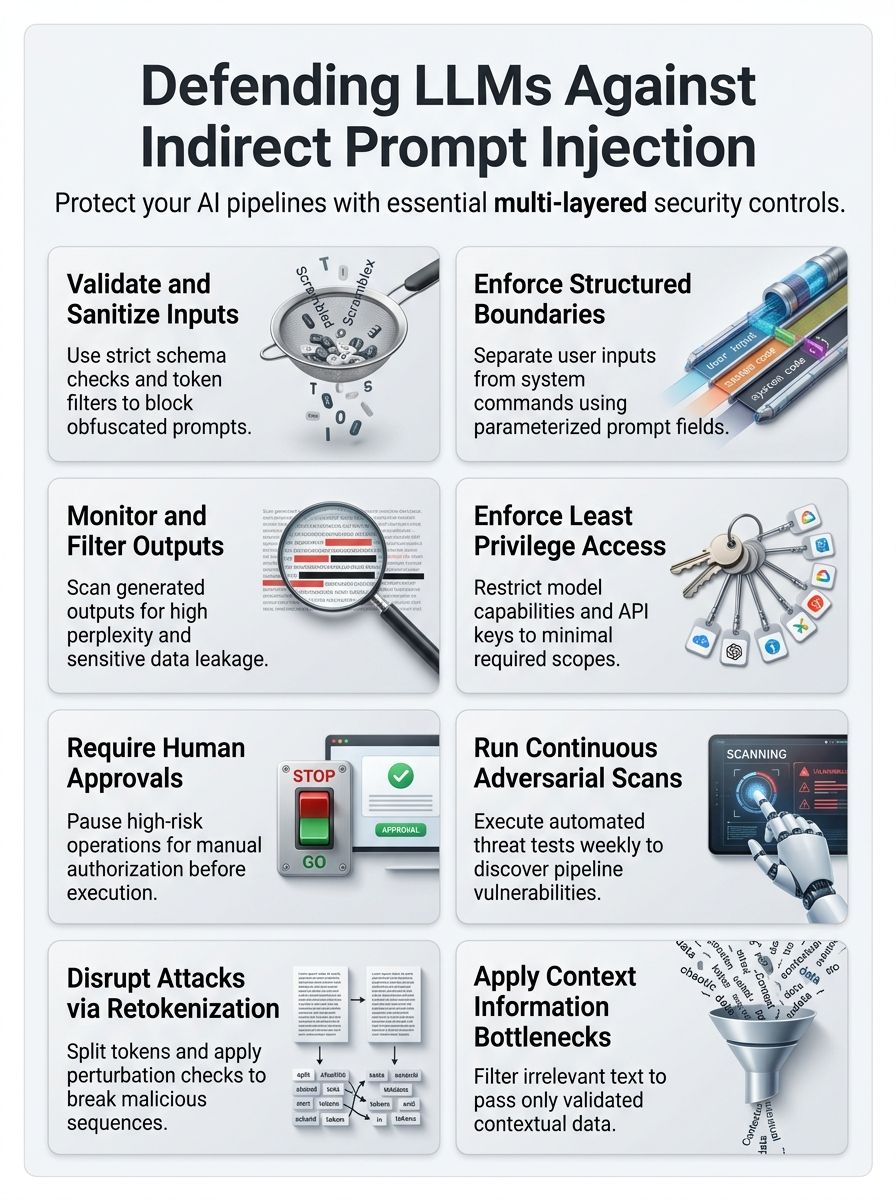
- Normalize text early: collapse whitespace, strip invisible characters, and standardize Unicode before the prompt reaches the LLM.
- Decode suspicious blobs: if an upload or tool result looks encoded, convert it to plain text and scan that version too.
- Sanitize remote content: clean code comments, document metadata, and suspicious markup before retrieval puts them into context.
- Set size limits: long payloads, repeated tokens, and dense symbol patterns deserve a higher-risk path or quarantine.
Typoglycemia-Based Attacks
Typoglycemia attacks scramble the middle letters of sensitive words while keeping the first and last letters intact. Humans still read the word, and language models often do too, which lets strings like “ignroe” or “revael” slip past brittle keyword filters.
The practical fix is fuzzy matching, not exact matching. If my filter only blocks perfect spellings, it is protecting the log file more than the model.
OWASP’s cheat sheet points to string-similarity methods such as Levenshtein and Jaro-Winkler for this reason. In practice, a small edit-distance threshold on high-risk terms like “ignore,” “bypass,” “override,” “reveal,” and “delete” catches far more attack variants than a plain blocklist.
Multi-Turn and Persistent Attacks
Some of the most effective attacks do not look dangerous in any single message. Microsoft’s work on the Crescendo pattern showed why keyword filtering can fail here: each step looks harmless by itself, but the sequence changes the model’s state and intent over time.
I treat long conversations, memory stores, and retrieval layers as part of the attack surface. If a poisoned instruction can survive into the next turn, it can become tomorrow’s “trusted context.”
- Track provenance: label whether content came from the system, the user, a tool, memory, or a remote document.
- Re-screen stored context: scan chat history, notes, and retrieved chunks again before replaying them into a new prompt.
- Watch for plan drift: compare the model’s current objective with the original user task, especially in agent workflows.
- Expire risky memory: do not let low-trust context live forever in caches or conversation summaries.
Key Risks of Indirect Prompt Injection
Indirect prompt injection is dangerous because it does not just distort an answer. It can push an AI system to read the wrong data, trust the wrong source, or take the wrong action with the right permissions.
Compromised System Integrity
When a model can browse, call tools, or trigger workflows, a successful injection attempt can change what the system does, not just what it says. That is the point where an AI bug starts behaving like an application security incident.
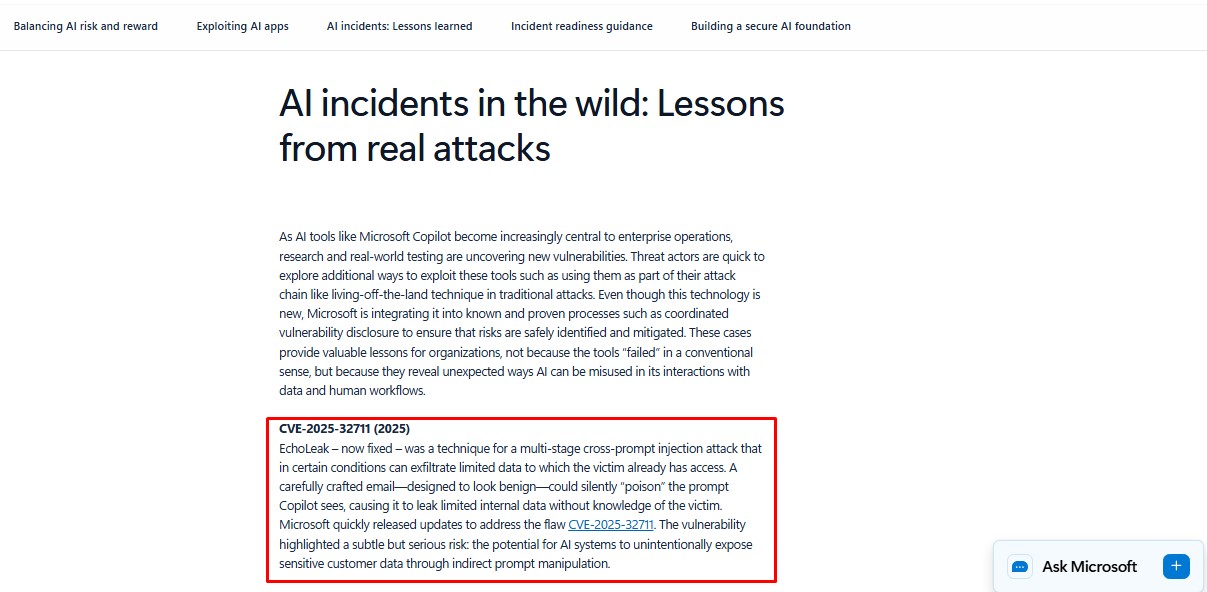
In Microsoft’s Security Insider write-up, EchoLeak, now fixed and tracked as CVE-2025-32711, showed how a carefully crafted email could poison the prompt seen by Microsoft 365 Copilot and leak limited internal data the victim already had access to. For me, the lesson is clear: any tool with write access, message-sending power, or system reach needs tighter boundaries than a read-only summarizer.
- Fence high-impact tools: isolate email, purchase, database-write, and file-delete actions behind extra checks.
- Parameterize tool calls: send fixed fields to downstream systems so the model cannot reshape the command structure.
- Log intent and action separately: I want a record of what the user asked, what the model proposed, and what the system actually executed.
Data theft is usually the business risk that gets executive attention, and for good reason. Once a model can access customer records, internal docs, or API-backed tools, an indirect prompt injection attack can turn a harmless request into a quiet extraction path.
OpenAI’s guidance for safer agents stresses limiting access to only the data needed for the task and requiring confirmation before consequential actions such as sending an email or completing a purchase. I also lock down credentials: unique API keys per team member, server-side key storage, environment variables instead of hard-coded secrets, and regular key rotation make exfiltration much harder to monetize.
Core Defense Strategies Against Indirect Prompt Injection
I do not trust a single guardrail here. The strongest setups layer deterministic filters, structured prompt design, output controls, access restrictions, and human review where the blast radius is high.
Input Validation and Sanitization
Input validation and sanitization are still the front door. They will not catch every clever prompt injection technique, but they remove a huge amount of cheap attacker leverage before the model ever sees it.
Google’s April 2026 security write-up is useful here because it highlights fast deterministic defenses, including user confirmation, URL sanitization, tool-chaining policies, and quick regex-based point fixes while slower model updates catch up. That is the balance I want in production: fast controls first, smarter controls next.
- Enforce schemas: validate type, length, required fields, and allowed character sets for every user input and upload.
- Normalize before scoring: strip invisible characters, decode encodings, and flatten weird spacing before pattern checks run.
- Separate trusted and untrusted channels: user input, retrieved text, tool output, and system instructions should never share the same unlabeled field.
- Quarantine suspicious content: long encoded blobs, repeated escape markers, or prompt-like phrases should move to review, not the model.
- Store rejected samples: failed inputs become next week’s regression tests and red-team cases.
Structured Prompts with Clear Boundaries
This is the defense I reach for when a workflow truly matters. The 2025 StruQ paper from UC Berkeley treated prompts and data more like prepared statements in database security, and that framing is exactly right.
Instead of concatenating everything into one giant string, I keep system instructions, user fields, retrieved context, and tool arguments in separate slots with explicit labels. Once the model sees “data to process” instead of “more instructions,” its room to get manipulated shrinks.
| Prompt design choice | Why it helps | Practical effect |
| Separate system instructions from user data | Clarifies what the model should obey. | Reduces accidental instruction override. |
| Use fixed tool-call fields | Stops freeform text from reshaping command structure. | Lowers the chance of unauthorized downstream actions. |
| Mark external content as untrusted | Gives the model a clearer trust boundary. | Makes indirect prompt injection easier to ignore. |
StruQ cut tested manual attack success to under 2% on Llama and Mistral, and on Llama it pushed Tree-of-Attacks with Pruning from 97% down to 9%, with little or no utility loss. That is why I see structured prompts as architecture, not copywriting.
Output Monitoring and Filtering
Bad input is only half the problem. A poisoned model can still produce dangerous output, including leaked system instructions, exposed secrets, unsafe HTML or Markdown, and tool arguments that should never be executed as-is.
NVIDIA’s AI Red Team has been blunt on this point for years: treat all LLM output as potentially malicious. I agree, especially once the response is headed into a browser, a plug-in, a shell, or another service.
- Scan for leakage patterns: system-prompt fragments, API keys, numbered instructions, and odd permission requests should trigger a hold.
- Strip active content: sanitize HTML, Markdown, and generated links before rendering them in a user interface.
- Validate tool arguments: never pass raw model text directly into code execution, SQL, email, or admin actions.
- Quarantine risky responses: high-risk outputs should pause for review instead of flowing to customers or back-end systems.
Advanced Defensive Measures
Once the basics are in place, I look for controls that shrink blast radius even when the prompt filter misses. That is where least privilege, approval gates, and adversarial testing start paying for themselves.
Least Privilege Principle
Microsoft’s March 2026 guidance recommends giving agents only the minimal, short-lived privileges needed to complete a task. That sounds simple, but it changes the economics of an attack: even if the model is manipulated, it cannot do much with weak credentials and narrow scopes.
- Use read-only by default: if a job only needs retrieval, do not hand it write permissions.
- Issue short-lived credentials: temporary tokens reduce the value of a stolen session.
- Scope tools tightly: a research agent should not inherit finance, admin, or messaging permissions.
- Split sensitive workflows: keep privileged LLMs and high-risk tools in a separate, more heavily monitored lane.
Human-in-the-Loop (HITL) Approvals
I still want a person in the loop for actions that can move money, delete data, contact outsiders, or change records. OpenAI now highlights confirmations before consequential actions for the same reason: the last safe checkpoint is often the user or operator who can see that something feels wrong.
LangChain makes this operational with HumanInTheLoopMiddleware. In the current docs, a team can require approval for tools like send_email or delete_database while auto-approving safer actions like search, which is exactly the kind of policy split I like to see.
- Pause on destructive or external-facing tool calls.
- Show the human the original task, proposed action, and affected data.
- Record approval, rejection, or edit for audit and future training.
Continuous Adversarial Testing
If I only test for one-shot jailbreaks, I get a false sense of security. Real prompt injection defense needs weekly or release-based testing across uploads, retrieval, tool output, memory, and multi-turn behavior.
Google’s April 2026 security blog explains why automated red teaming matters at scale, and the same post says its Simula pipeline boosted synthetic attack-data generation by 75%. That is a strong reminder to keep feeding new variants into your evaluation set instead of testing the same stale prompts forever.
| What I test | Example failure | What I learn |
| Encoded input | Base64 or hidden Unicode slips past filters. | Whether normalization works before inference. |
| Retrieved content | A poisoned document overrides the task. | Whether trust labels and retrieval sanitization hold up. |
| Multi-turn flows | A harmless sequence becomes a harmful plan. | Whether drift detection catches state manipulation. |
| Tool execution | The model proposes an unsafe write or outbound message. | Whether approval gates and parameter checks stop it. |
The 2025 Task Shield paper is worth watching too. On the AgentDojo benchmark, it reduced attack success to 2.07% on GPT-4o while preserving 69.79% task utility, which is a good example of a defense that aims to keep the task useful instead of simply refusing everything.
Leveraging Framework-Specific Implementations
Good security gets easier when the framework already gives you the right hooks. I like to use those built-in controls before I invent custom plumbing.
OpenAI API Best Practices
OpenAI’s March 2026 instruction-hierarchy work makes an important point: the trust order is system > developer > user > tool. If my app design blurs those layers, I am making prompt injection easier than it needs to be.
- Preserve message roles: keep system, developer, user, and tool content in separate fields instead of merging them.
- Use a safety identifier: OpenAI’s current API guidance says the safety_identifier parameter can help abuse monitoring and give teams more actionable feedback.
- Keep keys server-side: never deploy API keys in browsers or mobile apps, and do not commit them to repositories.
- Rotate and segment credentials: unique keys and least-privilege permissions limit the damage of a leaked secret.
- Ask for explicit confirmation on risky actions: broad autonomous instructions create more room for hidden malicious content to redirect the agent.
LangChain Security Features
LangChain’s current guardrails system is useful because it lets me place checks before the agent starts, after it finishes, and around model or tool calls. That is a better fit for indirect attacks than a single front-end filter.
- Use deterministic guardrails first: regex, keyword checks, and policy rules are fast and cheap.
- Add model-based guardrails second: they catch nuanced cases that rules miss, though they cost more and run slower.
- Protect sensitive data with PIIMiddleware: the built-in strategies include redact, mask, hash, and block for items such as emails, credit cards, IP addresses, MAC addresses, and URLs.
- Pause sensitive tools with middleware: approval hooks for actions like sending email or deleting data are easy wins.
- Stack controls instead of picking one: LangChain explicitly supports layered middleware, which lines up well with defense in depth.
Future of Prompt Injection Defense
I do not expect a magical filter to solve prompt injection. The more realistic future is better model training, stronger tool isolation, faster runtime detection, and cleaner boundaries between instructions and data.
AI Security Innovations
OpenAI’s March 2026 instruction-hierarchy results are a good example of where defenses are improving. In its published benchmark tables, performance on System <> User Conflict rose from 84% to 95%, and Developer <> User Conflict rose from 83% to 95% after instruction-hierarchy training.
Microsoft’s Spotlighting work matters too. In Microsoft’s published security blog, the technique pushed indirect attack success from above 20% to below the threshold of detection with minimal effect on model performance, which is exactly the kind of tradeoff I want in a real product.
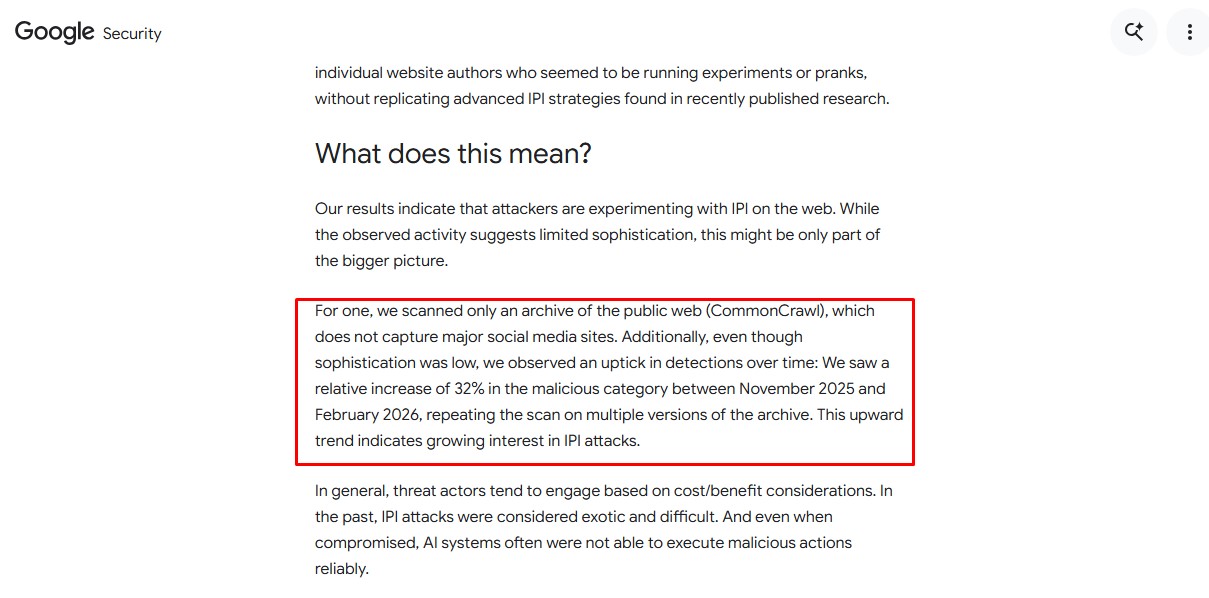
At the same time, Google observed a 32% relative increase in malicious prompt-injection detections on the public web between November 2025 and February 2026. That tells me the defense side is improving, but the attacker side is getting more interested too.
Building Resilient LLM Systems
Resilient systems assume some prompt injection attempts will get through. The design goal is containment, visibility, and recovery, not wishful thinking.
- Isolate untrusted content: label it, constrain it, and keep it out of privileged planning paths when possible.
- Constrain actions: plan drift detection, tool-chain analysis, and policy checks matter more once the model becomes agentic.
- Prefer reversible operations: read, draft, and suggest are safer defaults than send, buy, delete, or publish.
- Keep recovery simple: strong logs, approval checkpoints, and clean rollback paths turn a bad output into a manageable incident.
That is the architecture shift I keep coming back to. A strong prompt helps, but a strong system prompt alone is not a security boundary.
Final Thoughts
For me, prompt injection defense comes down to a clear stack of habits: validate input, separate instructions from data, monitor output, restrict tool access, and test your LLM the way attackers actually probe it.
Small changes can move the needle fast. Start with schema checks, remote-content sanitization, structured prompts, and human approval on any high-impact action.
Then keep going. Measure attack success, add fresh adversarial cases, tighten what the model can touch, and treat prompt injection as an ongoing security program, not a one-time prompt engineering fix.
Frequently Asked Questions on Prompt Injection Defense
1. What is prompt injection and why should I care?
Prompt injection is a trick that hides bad commands in user text, it can fool a model. It is a Vulnerability (computer security) that can make a system leak data or act wrong.
2. How do I defend my model pipeline?
Use Defense in depth (computing), add filters, checks, and rate limits, test each part. Protect each step of your Pipeline (computing), do not trust one gate.
3. Can obfuscation stop these attacks, and how do strings matter?
Obfuscation (software) can slow an attacker, but it can also hide bad input, so do not rely on it alone. Watch how a Llama (language model) or other system reads a String (computer science), hidden tokens can slip past filters.
4. What practical steps should developers take now?
Sanitize inputs, log odd prompts, and drop risky content before it hits the model. Run red team drills, add post-output checks, and roll back fast if you spot a problem.