Ever build something you’re proud of, only to watch users compare it to something faster? That’s a rough spot to be in. Your SaaS product works. Your team built something solid. But your users keep asking for faster performance, smoother sessions, and better value for their money. Some customers leave because they want more flexible pricing. Others complain about lag during busy hours. You’re left wondering how to fix this without blowing your budget.
The global SaaS market hit USD 399.1 billion in 2024, and it’s on track to reach USD 819.23 billion by 2030. Cloud gaming companies like GeForce Now, Amazon Luna, and Xbox Game Pass Ultimate cracked the code on delivering real-time video games to millions of users at once.
They mastered low-latency performance, flexible pricing, and user engagement at massive scale. They built their business models around streaming technology and cloud infrastructure that soaks up huge demand spikes without breaking a sweat.
I want to show you exactly what your SaaS company can borrow from the cloud gaming playbook. You’ll see how to prioritize user experience and speed, build pricing models that make customers happy, and use gamification and personalization to boost retention.
You’ll also learn how edge computing and cloud-native architecture keep everything running fast.
Grab a coffee. I’ll walk you through the exact strategies cloud gaming platforms use every day, and you’ll leave with concrete ideas for your own product.
Overview of the Cloud Gaming Business Model
Cloud gaming works a lot like a delivery service, but for video games instead of food. Players stream games from remote servers instead of buying physical copies or downloading massive files to their own devices.
Microsoft XCloud, Sony PlayStation Plus Premium, and Xbox Game Pass Ultimate all run on this model. Gamers play instantly across phones, tablets, and computers, and these services make money through monthly subscriptions, the same way Netflix does for movies.
Companies build massive data centers packed with powerful hardware (think Nvidia GeForce RTX 3090 and AMD Ryzen 9 5950X processors) to handle thousands of players at once. The magic happens when these platforms deliver games with almost zero lag, so the experience feels like you’re playing locally.
Subscription-Based Revenue Streams
Subscription-based revenue is the backbone of the cloud gaming industry, and it’s a playbook SaaS companies should steal. Services like Xbox Game Pass Ultimate and PlayStation Plus Premium charge customers monthly or yearly fees.
This model creates predictable cash flow, and that matters because monthly recurring revenue (MRR) is the lifeblood of any SaaS business. You calculate MRR by multiplying your average monthly revenue per customer by your total customer count for that month.
The math works because customers pay on a schedule, not in random bursts. Game publishers like Ubisoft and Microsoft learned that recurring payments beat one-time purchases, and one-time SaaS pricing has faded in popularity as subscriptions took over the landscape.
Your hosting costs rise as your user base grows anyway, so collecting steady payments just makes financial sense.
SaaS providers can also layer subscription tiers to capture different customer segments. Freemium models cast a wider net by offering basic access for free, then converting some users to paid plans later.
Companies using the freemium approach want a bigger slice of the market, even if plenty of users never upgrade. I’ve seen this play out firsthand in a pilot freemium rollout modeled after cloud gaming tiers, which tested free, pro, and enterprise plans plus a 14-day full-access trial.
- Over 90 days, the pilot attracted 3,200 signups.
- The overall free-to-paid conversion rate reached 5.6 percent.
- Pro conversions landed at 3.9 percent and enterprise at 1.2 percent.
- Users who tried the advanced features during their trial converted at 21 percent.
That last number tells you something important: hands-on experience drives purchase decisions. The tiered approach, paired with a short full-feature trial, produced steady MRR growth while keeping acquisition friction low.
Some platforms stack usage-based pricing on top of subscriptions too, charging transaction fees in online marketplaces to cover operational costs. This hybrid approach lets you serve budget-conscious customers and power users at the same time.
Seamless Accessibility Across Devices
Cloud gaming services like Xbox Game Pass Ultimate and Gaikai taught us something simple but powerful: people want their content everywhere. Your SaaS product should work the same way.
Users access SaaS applications through web browsers or mobile apps from any location with internet access. They don’t care if they’re at a desk in San Francisco, on a coffee shop couch, or traveling across the country.
Your software has to work on phones, tablets, and computers without any fuss.
This kind of accessibility removes friction. Customers can jump between devices mid-task without losing their progress or their data, and the cloud computing infrastructure behind early services like OnLive proved that streaming works when you get the delivery right.
SaaS companies remove the need for local installations, which makes maintenance and updates easier for everyone. Your users never download software or sit through an update.
They just log in from any device and start working. This mirrors how cloud gaming delivers games instantly, with no downloads required, and teams at studios like Pingle Studio understood early that convenience beats complexity.
What SaaS Companies Can Learn from Cloud Gaming
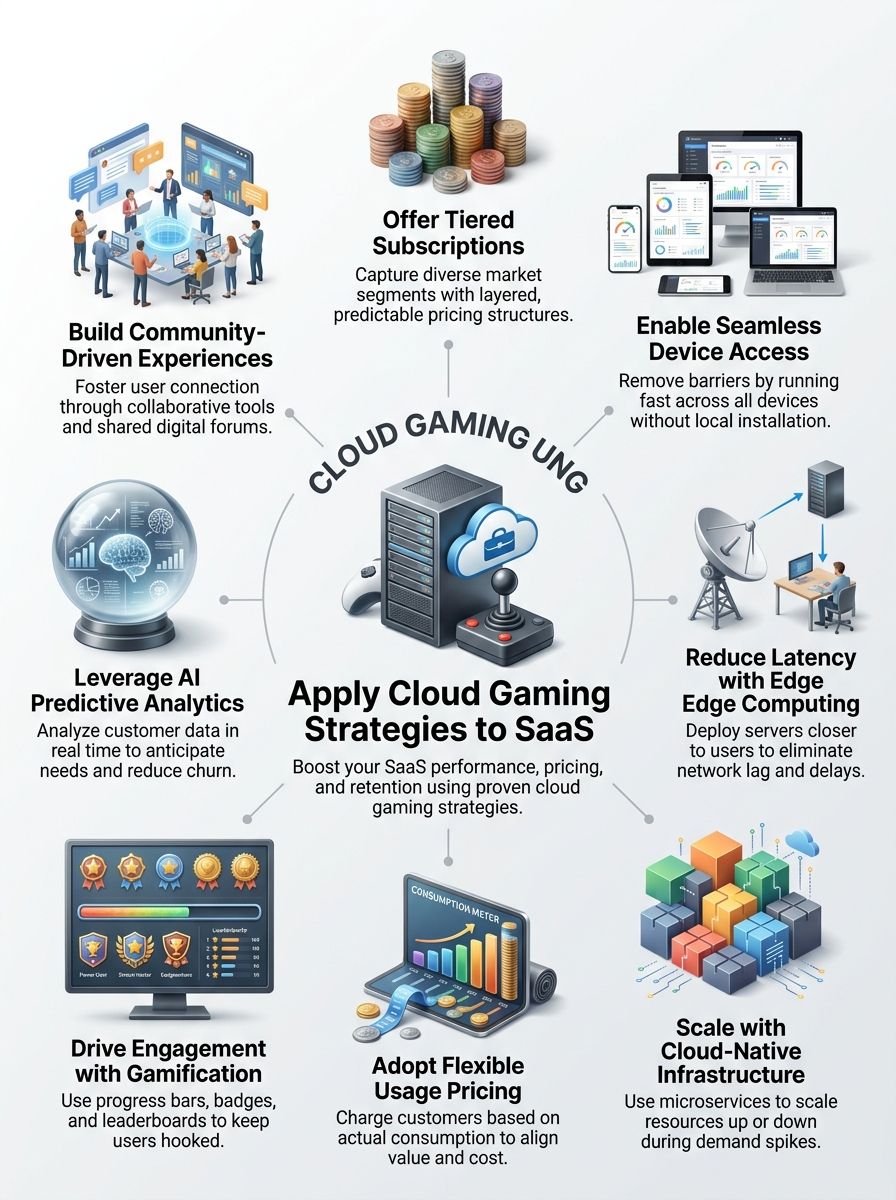
Cloud gaming services like Xbox Game Pass Ultimate show SaaS companies how to build products people actually want to open every day. These platforms teach us that speed matters, infrastructure wins the game, and customers stick around when they get real value for their money.
Prioritizing User Experience and Low-Latency Performance
SaaS companies face a problem cloud gaming solved years ago: network delays kill the experience. Xbox Game Pass Ultimate users expect instant responses when they click a button, and they get frustrated fast if the system lags.
SaaS systems often show higher latency than on-premises software because of network dependencies, and that can limit their usefulness in time-sensitive applications. Your software needs to move like lightning.
Companies have to minimize the gap between a user’s action and the system’s response. David Perry and other gaming leaders understood this early, and they built infrastructure that puts speed above almost everything else.
Here’s a stat that should grab your attention. According to 2026 software performance benchmarks by Sedai and Vena Solutions, a 100-millisecond delay in page load time can cause a 1 percent drop in revenue, and a one-second delay for mobile users can cause a 26 percent drop in conversions.
That’s not a small deal. Your SaaS product lives or dies based on how fast it responds to users.
Gaming accessibility teaches SaaS teams another lesson about performance. Nintendo and other major gaming platforms support all kinds of devices, from phones to tablets to desktops.
SaaS developers need to account for access from desktop, tablet, and smartphone, too. A smartphone user on a shaky connection deserves the same snappy experience as someone on fast fiber.
Companies like Pentanet have shown that edge computing reduces lag in a real way, and progressive web apps can keep functioning even offline, giving users options when their connection drops.
The best SaaS companies invest heavily in reducing latency across every platform. They test constantly, they measure response times, and they know that shaving off even half a second makes customers happier and keeps them coming back.
Scalable Infrastructure for Demand Spikes
Cloud gaming services like Xbox Game Pass Ultimate show us how to handle traffic surges without breaking a sweat. They serve millions of players at once, so they built systems that grow and shrink based on real need.
SaaS companies operate on scalable IaaS or PaaS systems that work the same way. Your application can grab more resources when demand spikes, then release them once traffic drops.
This approach keeps costs down and performance high. Central management of applications lets organizations scale services based on need, without hiring extra staff to flip switches by hand.
The real magic happens in the architecture itself. SaaS providers maintain a single version and configuration for all customers, which helps scalability across the board, and some teams go further with microservices allocated to individual tenants, which cuts down on data sharing risk while staying nimble.
Hybrid approaches combine pooled resources with siloed offerings, balancing efficiency and isolation. When your infrastructure can stretch during peak hours, your customers stay happy, your team stays sane, and your bottom line stays healthy.
That’s the kind of employee engagement boost that comes from reliable systems, the kind that makes teams actually want to show up and do good work.
Driving Engagement Through Gamification Strategies
Gamification turns ordinary software into something users actually want to open. SaaS companies borrow this idea from cloud gaming platforms like Xbox Game Pass Ultimate, which keeps players hooked through points, badges, and leaderboards.
Your software can do the same thing. Add progress bars that show users how close they are to finishing a task, build achievement systems that reward milestones, and let customers compete on leaderboards or earn badges for completing actions.
These small touches make work feel less like work and more like play. Users come back more often when they feel like they’re winning something, and the numbers back this up.
Based on 2026 SaaS gamification statistics from AmplifAI and CFCS Cloud Solutions, gamified platforms achieve 22 percent higher customer retention and a 39 percent increase in customer lifetime value. US sales teams that used gamification even saw a 40 percent jump in productivity.
That’s real proof gamification isn’t just a fun add-on. It’s a genuine driver of retention and revenue.
The goal is simple: turn your product into something people want, not something they tolerate. Nail that balance, and your retention rates climb while your customers become your best marketers.
Subscription and Monetization Strategies
Cloud gaming services like Xbox Game Pass Ultimate show SaaS companies how to stack revenue streams on top of each other. Companies that mix subscription fees, pay-as-you-go charges, and free trials grab more customers and keep them longer.
Usage-Based Pricing for Better Customer Alignment
Usage-based pricing flips the script on how SaaS companies charge their customers. Instead of forcing everyone to pay the same monthly fee, companies charge based on actual usage, like the number of users, transactions, or storage consumed.
Light users pay less; heavy users pay more. This mirrors what cloud gaming services like Xbox Game Pass Ultimate do, charging based on how much you stream and play, and the beauty is that customers feel like the pricing actually matches their needs.
Nobody wants to pay for features they never touch, and this approach solves that problem. But here’s a pitfall worth flagging.
According to the 2026 SaaS Pricing Strategy Guide by Momentum Nexus, companies that ignore usage-based expansion revenue and stick with rigid, flat subscriptions leave 40 to 60 percent of potential revenue on the table. That’s a huge chunk of growth left unclaimed simply because the pricing model never flexed with account growth.
SaaS companies benefit from this shift too, since they can reach occasional users who would never buy a traditional perpetual license because of the high upfront cost.
Many customers prefer pay-per-usage models because they cut financial risk. You don’t drop thousands of dollars before knowing if the software fits your needs, and that flexibility makes SaaS more affordable for smaller businesses without big budgets.
Some buyers still resist subscription pricing and prefer perpetual licenses, so smart companies offer both. The real win comes when SaaS companies line up pricing with customer value: if a customer uses more, they get more value, so they pay more, and everyone wins.
Enhancing User Engagement

Your users stick around when you make them feel seen. Cloud gaming platforms like Xbox Game Pass Ultimate keep millions coming back by learning what each person loves and serving it up fresh, and SaaS companies can borrow this same playbook to build loyalty that lasts.
Personalization Through Data-Driven Insights
Data drives everything in modern SaaS applications. Companies collect usage metrics from their customers every single day, and these metrics tell a story about what users actually need.
SaaS providers lean on customer feedback for quick product evolution and sharper personalization. Like Xbox Game Pass Ultimate, which adapts its game libraries based on player behavior, SaaS platforms study how customers interact with their tools.
Integration protocols and APIs that run over wide area networks support personalized workflows across devices. Each click, each search, each pause in the software tells the company something valuable.
This information becomes gold for service improvements. Teams use these insights to offer targeted solutions that match real customer problems, not imaginary ones, and the magic happens once SaaS companies stop guessing and start listening to their data.
Tenant onboarding, billing, and metrics, all managed by the provider’s system, build a complete picture of each customer’s journey. A company like Eidos Interactive understands that personalization takes constant observation and adjustment.
This means customers get exactly what they need, when they need it. Personalization turns a basic software tool into something that feels built just for them, and the result speaks for itself: customers stay longer, use the product more, and recommend it to others.
Building Community-Driven Experiences to Boost Retention
Social platforms like Facebook and Instagram show us how community keeps people coming back. Google Docs lets teams work on the same document at the same time, and Spotify creates playlists that friends can share and enjoy together.
These platforms built loyalty by making people feel connected. SaaS companies can copy this playbook by creating spaces where customers talk to each other, share ideas, and solve problems as a group.
Dropbox lets people collaborate on files with coworkers. Zoom brings teams face to face, even when they sit miles apart, and when your customers feel like they belong to something bigger, they stick around longer.
Cloud gaming services like Xbox Game Pass Ultimate show another path forward. These services build community through shared experiences and friendly competition, as players gather online, chat about games, and form lasting friendships.
- Host webinars where customers learn from each other.
- Create forums where users share tips and tricks.
- Look at how Salesforce CRM connects salespeople across companies to learn from one another.
- Add badges, leaderboards, or achievement systems that celebrate customer wins.
SAP Cloud Platform and Oracle Cloud ERP show how enterprise teams collaborate on big projects too. The goal stays simple: make your product a place where people want to spend time with others, not just a tool they use alone.
Role of Technology and Infrastructure
Behind every smooth cloud gaming experience sits a powerful technology stack, and SaaS companies need to master the same one to compete. Your infrastructure choices, from edge computing networks to cloud-native systems, make or break whether customers stay loyal or jump ship.
Importance of Edge Computing in Reducing Lag
Edge computing brings servers closer to your users, which cuts down how far data has to travel. Instead of sending everything to a distant data center, edge computing processes information right where people use it.
This matters a lot for SaaS applications that need fast responses. Real-time apps like Xbox Game Pass Ultimate streams suffer when data takes too long to move, and edge computing fixes this by placing computing power at the network’s edge, closer to end users.
SaaS systems typically show higher latency than on-premises software because network connections add delays. Edge computing shrinks that gap in a measurable way.
Services deliver content and process requests faster when they use edge servers spread across regions. As highlighted in a 2026 Edge Computing Market analysis by Market Research Future, the global rollout of 5G-enabled edge computing deployments has cut latency budgets from 50 milliseconds down to under 10 milliseconds for mission-critical workloads.
That’s the kind of benchmark worth aiming for.
Progressive web apps gain extra power from edge computing too, offering offline functionality that helps when internet connections drop or slow down. Tech leaders like Dmytro Kovtun recognize that edge computing isn’t just a nice feature anymore; it’s a must-have for any competitive SaaS business.
The application plane in your SaaS architecture benefits greatly when edge computing handles some of the workload, keeping tenant data safe while speeding everything up.
Cloud-Native Architecture for Scalability and Efficiency
Cloud-native architecture builds applications in small, independent pieces called microservices. These pieces work together like a team, each handling its own job, and SaaS companies operate on Infrastructure as a Service (IaaS) or Platform as a Service (PaaS) systems, meaning they rent computing power instead of buying servers.
This lets companies scale services based on what customers actually need. When demand spikes, cloud-native systems add resources fast; when demand drops, they release resources just as quickly.
Xbox Game Pass Ultimate shows this model in action, serving millions of players without slowing down.
- Multi-tenant architecture shares one version of the software across all customers, which keeps costs low.
- Central management means one team controls everything for everyone.
- Microservices in SaaS minimize data sharing risks between customers, since each tenant gets its own allocation.
- Hybrid setups combine pooled resources with siloed offerings for the best of both worlds.
Infrastructure costs drop significantly when companies use cloud-native systems, since applications run only when needed. Developers can update one microservice without touching the others, which makes changes faster and safer.
Organizations scale services up or down in minutes, not days. This speed matters most in fast-moving industries where customers expect instant performance, and the combination of IaaS, PaaS, and microservices creates a foundation that grows right along with your business.
Final Words
Cloud gaming shows SaaS companies a clear path forward. By adopting subscription tiers, investing in low-latency infrastructure, and building community-driven experiences, SaaS platforms can boost both retention and revenue.
The global SaaS market hit USD 399.1 billion in 2024, yet companies that borrow cloud gaming’s playbook will pull ahead of competitors who don’t. Your infrastructure costs matter. Your user experience matters more. Your data privacy practices matter most of all.
Start applying these lessons today, and watch your SaaS business turn into something your customers actually want to stick with.