
Want a side hustle that keeps paying you next month, too? That is why Top 10 Side Hustle Projects That Will Generate MRR In 2027 matters so much, because Monthly Recurring Revenue gives you a steadier path than chasing one-off gigs.
The good news is that you do not need a giant team to build MRR Monthly Recurring Revenue. You need a simple offer, a clear niche, and a way to turn first-time buyers into subscribers.
In this guide, I will walk you through 10 practical ideas, what each one costs in time and money, and the fastest ways to land your first paying customers. Grab the one that fits your skills, and let’s go step by step.
What is MRR (Monthly Recurring Revenue)?
MRR, or Monthly Recurring Revenue, is the income you collect every month from repeat payments. Think software subscriptions, memberships, retainers, paid communities, course subscriptions, and product libraries that people keep paying for because they keep getting value.
Businesses love MRR because it makes cash flow easier to predict. For you, that means less stress, better planning, and a side hustle that can grow without restarting from zero every month.
A simple example helps. If 50 subscribers pay you $29 a month, your MRR is $1,450. If 5 cancel and 10 new people join, your next-month MRR rises to $1,595. That is why retention matters just as much as sales.
The strongest MRR side hustles usually combine three things: a narrow niche, a repeat problem, and a monthly delivery model. That can be done through freelancing retainers, subscription model offers, digital products with regular updates, or white-label software.
In the latest update from HighLevel, its entry pricing starts at $97 a month, with an unlimited account at $297 a month, which is why white-label SaaS reselling can make sense if you already serve small business clients. You can package software access with setup, support, and light consulting instead of trying to sell software alone.
MRR gets easier to grow when your offer solves an ongoing problem, such as lead follow-up, content publishing, customer support, or training that needs regular updates.
- Good MRR fit: services or tools people need every month
- Weak MRR fit: one-time projects with no ongoing support
- Best upgrade path: start with a service, then add templates, software, or a membership
That is also why freelancing is still such a strong base. Upwork reported in 2025 that 28% of U.S. knowledge workers were freelancing or working independently, generating $1.5 trillion in earnings in 2024. The practical takeaway is simple: demand is already there, so your job is to turn project work into recurring contracts.
Top 10 Side Hustle Projects to Generate MRR in 2027
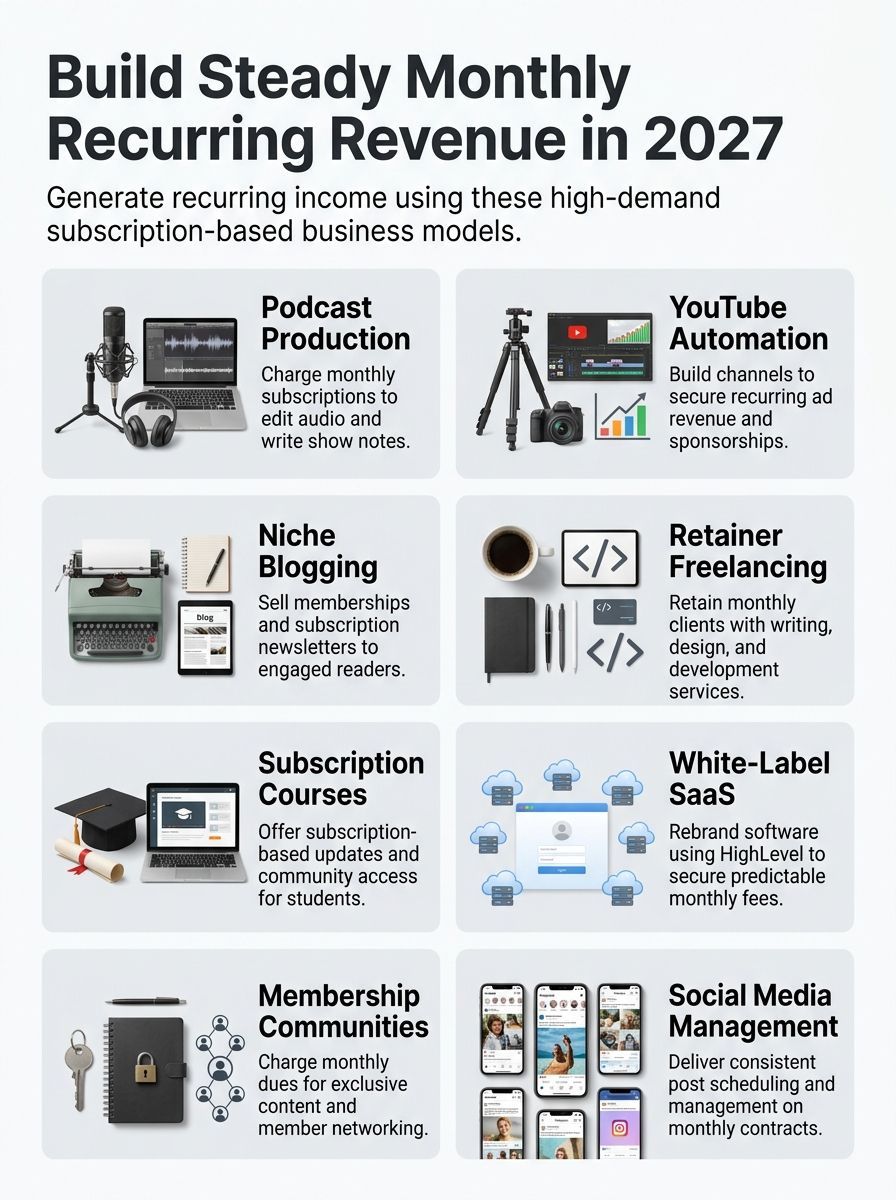
These are the 10 side hustle ideas I would look at first if your goal is steady Monthly Recurring Revenue, not random cash spikes. Some start faster, some scale bigger, but all of them can be shaped into subscription services, retainers, or memberships.
| Project | How MRR happens | Best for | Speed to first revenue |
|---|---|---|---|
| Podcast production | Monthly editing and publishing retainers | Editors, writers, operators | Fast |
| YouTube automation | Ads, sponsors, memberships, affiliate income | Researchers, editors, creators | Medium |
| Niche blog | Paid newsletter, memberships, affiliate marketing | Writers and niche experts | Medium |
| Freelancing services | Monthly retainers | Writers, designers, marketers, developers | Fast |
| Online courses | Subscription access or membership bundles | Teachers, coaches, experts | Medium |
| Affiliate marketing | Recurring SaaS commissions | Content creators with audience | Medium |
| Mobile app or SaaS | Monthly subscriptions | Builders and technical founders | Slow to medium |
| Membership community | Monthly dues | Community-led creators | Medium |
| Digital products | Asset library subscriptions | Designers, operators, educators | Fast |
| Social media management | Monthly service plans | Marketers and content creators | Fast |
Launch a Podcast Production Service
Podcast production works well as a side hustle because the client need repeats every week. One business podcast can turn into recurring work for editing, show notes, clips, thumbnails, publishing, and guest coordination.
Spotify for Creators now shows plays based on 30 seconds of listening or watching, plus updated trend and audience tools. That matters because you can pitch a monthly service around metrics the client can actually follow, instead of vague promises about “visibility.”
- Create 3 tiers, such as audio only, audio plus clips, and full production
- Bundle transcripts, titles, and short-form video into the monthly fee
- Report one number each month, such as plays, downloads, or returning audience
- Offer a 60-day pilot so the client can test without a huge commitment
A smart add-on is software resale. If you use HighLevel or another client portal, you can combine production with scheduling, lead capture, and email follow-up, which makes your retainer stickier.
Start a YouTube Automation Channel
A YouTube automation channel can build MRR, but only if you treat it like a media asset, not a quick hack. Your recurring revenue can come from ads, channel memberships, sponsors, digital products, or affiliate marketing tied to the topic.
YouTube’s official rules still set the clearest milestones. For full ad revenue sharing, you generally need 1,000 subscribers plus 4,000 valid public watch hours in the last 12 months, or 10 million valid public Shorts views in 90 days. That tells you exactly why niche choice and publishing consistency matter so much.
The most common mistake is spreading too wide. A narrow topic like budget meal prep, local real estate leads, or beginner credit repair gives you better odds of attracting subscribers who also buy something later.
If a channel cannot support one simple paid offer, it is usually too broad for reliable MRR.
You can also turn the channel into a service funnel. A finance explainer channel can sell spreadsheet templates. A home service channel can feed social media management or lead-generation retainers. That is how content creation becomes an actual business.
Build and Monetize a Niche Blog
A niche blog is still one of the cleanest ways to build passive income because one article can attract readers for months. The key is to pair traffic with an email list and then move your best readers into a paid offer.
MailerLite’s 2026 benchmark report put the median email open rate at 43.46% across 3.6 million campaigns. So if your list is opening far below that, fix the subject lines and topic match before you launch a paid newsletter or membership.
Here is the part many competitors skip: you do not need massive traffic first. You need a focused audience with a real problem and a paid next step.
- Write content around one expensive pain point
- Offer a free lead magnet that matches the paid offer
- Launch a low-priced paid newsletter or resource vault
- Add one affiliate offer that solves the same problem
If you want a newsletter-first model, beehiiv’s 2026 pricing system scales by active subscriber count, which is a reminder to keep your list clean and engaged. Bigger is nice, but a smaller list with buyers is better for MRR.
One practical path is a free list, a paid tier, and a simple upsell. That combination gives you subscribers, monthly cash flow, and occasional spikes from digital products without relying on ad revenue alone.
Offer Freelancing Services (Writing, Design, etc.)
Freelancing is still one of the fastest ways to start a side hustle with MRR because businesses already understand monthly retainers. Writing, design, development, email marketing, SEO, paid ads, and automation all fit this model.
Upwork’s 2025 Future Workforce Index found that more than one in four U.S. knowledge workers, 28%, now freelance or work independently. That is a useful signal for readers: this is not a fringe path anymore, and buyers are already used to hiring independent specialists.
| Service | Strong retainer angle | Easy add-on |
|---|---|---|
| Writing | Monthly blog or newsletter package | SEO briefs and repurposing |
| Design | Ongoing creative support | Template library |
| Development | Site maintenance or CRO | Hosting or audits |
| Marketing | Campaign management | Dashboard reporting |
A good rule is to sell outcomes, not hours. “Four blog posts a month plus distribution” is easier to renew than “10 hours of writing.”
In my experience, the easiest upgrade is this: win one project, then pitch a maintenance plan before the project ends. That simple move is how one-off work becomes Monthly Recurring Revenue.
Create and Sell Online Courses
Online courses are great for MRR when you stop treating them like a one-time purchase. The better model is ongoing access, regular updates, group Q and A, office hours, or a members-only resource hub.
Teachable supports free, one-time, payment-plan, and subscription pricing, with recurring schedules ranging from weekly to annual. That gives you flexibility to test a low-friction monthly offer before you invest in a full-scale academy.
Kajabi’s current pricing page lists its Basic plan at $143 a month when billed annually, with 5 products and 2,500 contacts included. For readers, the point is not the exact tool choice. The point is to match your platform cost to the number of subscribers you realistically expect in the first six months.
- Start with one course on one problem
- Include templates, checklists, or coaching calls to justify a subscription
- Refresh lessons quarterly so subscribers keep seeing new value
- Turn student questions into future modules and bonus content
The usual pitfall is building too much before you sell. A waitlist, a pre-sale, or a live beta version is much safer than recording 40 lessons no one asked for.
Start an Affiliate Marketing Business
Affiliate marketing becomes far more reliable when you focus on recurring software commissions instead of random product links. Subscription tools often pay monthly as long as the customer stays active, which is exactly what you want if your goal is MRR.
The best fit is a business with audience trust already built through a blog, newsletter, YouTube channel, or podcast. Then every piece of content keeps working for you after it is published.
The most effective setup is usually simple: one niche, one audience, and a small stack of offers you actually understand. A cluttered page full of links usually converts worse than a focused recommendation.
Recurring affiliate income works best when the software is part of your own process, because your content becomes more specific and more credible.
A strong example is promoting tools for email marketing, course hosting, scheduling, or CRM management if you already teach or serve creators and small businesses. That way, affiliate marketing supports your main side hustle instead of competing with it.
Develop a Mobile App or SaaS Product
A mobile app or micro-SaaS has the highest MRR ceiling on this list, but it also asks for the most patience. You need ongoing value, steady support, and a problem people are willing to pay to solve every month.
One reason this path is attractive in the U.S. is the app marketplace math. Apple’s Small Business Program lists a reduced 15% commission for paid apps and in-app purchases if a qualifying developer stays at or below $1 million in proceeds in the prior calendar year. For a small builder, that leaves more room to reinvest in product support and growth.
You do not need a huge product to start. The best side hustle version is usually a narrow tool that saves time, reduces errors, or organizes a messy workflow for one type of user.
- Pick one job to be done, such as appointment reminders or invoice follow-up
- Charge monthly from day one, even if the price starts low
- Interview early users every month to reduce churn
- Keep setup lightweight so customers get value fast
If building from scratch feels too heavy, white-label SaaS reselling is the lighter entry point. HighLevel’s agency plans are designed around unlimited users or sub-accounts at higher tiers, which is why many service businesses use it to add software revenue without hiring a full product team.
Open a Subscription-Based Membership Community
A membership community can produce some of the healthiest MRR because people often stay for access, accountability, and peer support, not just content. That makes it harder to copy than a plain course or template pack.
Patreon’s current creator fee overview says creators who published after August 4, 2025 are on its standard 10% platform fee. That is a useful benchmark if you want a quick-start membership without building your own stack first.
You can keep the community simple. Give members one clear reason to stay each month, such as office hours, feedback, expert breakdowns, job leads, accountability threads, or resource drops.
| Community angle | Why subscribers stay | Best monthly add-on |
|---|---|---|
| Career growth | Peer support and live advice | Templates and workshops |
| Creator education | Fresh tactics and critique | Course library |
| Local business help | Shared wins and vendor tips | Toolkits and office hours |
The common mistake is stuffing the community with too much. A smaller promise that gets delivered every week beats a huge promise that goes quiet after month two.
Create and Sell Digital Products (E-books, Templates, etc.)
Digital products are easy to start, but the real MRR play is not a single e-book sale. It is a library model, where subscribers pay monthly for fresh templates, swipe files, prompts, dashboards, checklists, or mini trainings.
This works especially well if you already freelance. The assets you build for clients often become the first version of your product line. A reporting template, client onboarding checklist, caption pack, or budget tracker can all become part of a subscription vault.
Kajabi, Teachable, and Patreon all support recurring access in different ways, so your decision should come down to what you are selling. If you need a course-plus-community setup, Kajabi is stronger. If you want a simpler creator storefront, Patreon or Teachable can be lighter to start.
- Launch with 10 to 20 genuinely useful assets
- Add new files on a schedule, such as weekly or monthly
- Group products by audience, not by file type
- Bundle a low-priced template with a higher-value service upsell
The pitfall here is generic product ideas. A “business template pack” is weak. A “weekly cash-flow dashboard for solo service businesses” is far easier to sell because the buyer can picture the result.
Start a Social Media Management Service
Social media management is one of the clearest side hustles for MRR because most clients need content every month. You can package strategy, posting, community replies, ad support, and reporting into a recurring plan.
The smartest version of this offer is narrow. Instead of “I manage social media,” try “I manage Instagram and short-form video for dentists” or “I run LinkedIn content for B2B founders.” The tighter the promise, the easier it is to attract subscribers and referrals.
AI tools help with drafting and repurposing, but clients still pay for judgment, brand voice, and consistency. Upwork’s research on AI and freelance work points in the same direction: the advantage is in human and AI collaboration, not AI alone.
You can also make this offer more durable by adding software, analytics, or lead follow-up. That is where white-label SaaS and content creation fit together nicely.
If your service directly leads to booked calls, leads, or sales conversations, clients are much more likely to stay on a monthly retainer.
How to Choose the Right Side Hustle for You
Choosing the right Side hustle matters more than chasing the loudest trend. You want something that fits your skills, your schedule, and your tolerance for sales, delivery, and patience.
The goal is not to pick the perfect model on day one. The goal is to pick a model you can test quickly, improve with real feedback, and turn into recurring income without burning out.
Identify your skills and interests
Start with what you can already do well enough to help someone this month. That gives you a faster path to your first subscribers and helps you avoid spending months “getting ready.”
- List your strongest skill, such as writing, editing, coding, design, sales, or teaching.
- Match it to a recurring format, like a retainer, a membership, or a product subscription.
- Choose a market you understand or enjoy following, because content creation and sales get easier when you know the buyer’s language.
- Pick one outcome people will pay for repeatedly, such as more leads, faster content, cleaner systems, or better training.
- Ignore business models that look exciting but rely on skills you do not want to practice every week.
- Use freelancing first if you want speed, and use digital products or courses if you want leverage later.
Assess the market demand
Before you invest real time, check whether buyers already spend money in the niche. You are looking for proof of pain, not just proof of interest.
- Search for businesses already selling similar services, memberships, or software.
- Scan freelance marketplaces for repeat requests in writing, design, automation, social media management, and website work.
- Study how competitors price entry offers, monthly retainers, and premium tiers.
- Look for recurring affiliate programs if you plan to use a blog, podcast, or YouTube channel.
- Validate course or membership ideas with a waitlist, survey, or pre-sale before building everything.
- Pay extra attention to churn risk. A fun idea with weak retention is not a strong MRR business.
- Choose a niche where buyers need help every month, not just during a short seasonal spike.
Evaluate the required time and investment
Every side hustle makes a different trade. Some are fast to sell but slower to scale. Others take more setup but can turn into stronger passive income later.
| Model | Time to launch | Upfront cost | MRR potential |
|---|---|---|---|
| Freelancing | Low | Low | Strong |
| Digital products | Low to medium | Low | Medium to strong |
| Online courses | Medium | Medium | Strong |
| Membership community | Medium | Low to medium | Strong |
| Mobile app or SaaS | High | Medium to high | Very strong |
| White-label SaaS | Medium | Medium | Strong |
If you only have five to eight hours a week, a service or small product bundle is usually the safest place to start. If you have more time, or you already have an audience, then courses, communities, and Subscription Services can scale better.
Tips for Growing MRR with Your Side Hustle
Once you have your first customers, your job changes. At that point, growth comes from keeping subscribers, improving the offer, and adding smart upsells without making the business messy.
Focus on customer retention
Retention is where MRR really compounds. It is much easier to keep a happy customer than to replace one every month.
Patreon now uses subscription billing as the standard model, and creators still on legacy per-creation billing must switch by November 1, 2026. That shift says a lot: predictable billing is better for the business and easier for members to understand.
- Give new customers a fast win in the first 7 days
- Set one clear expectation for what they get each month
- Send a short progress update so the value stays visible
- Ask why people cancel, then improve the offer from those answers
The most overlooked step is onboarding. If buyers get confused in week one, churn rises before your product or service gets a fair chance.
Diversify your income streams
One revenue stream is fine to start. Two or three related streams make the side hustle far safer.
A freelancer can add templates. A blogger can add affiliate marketing. A course creator can add a membership. A social media manager can add white-label SaaS access or reporting dashboards. The trick is to stack offers that serve the same audience, so each one helps sell the others.
The cleanest income stack is usually service first, then product, then subscription.
This matters because different offers play different roles. Services bring quick cash. Digital products lift margin. Memberships and subscriptions smooth out your Monthly Recurring Revenue.
Invest in automation and scalability
Automation protects your time, which protects your margins. If you do the same admin work by hand every week, your side hustle will start to feel like a second job very quickly.
Spotify for Creators says most analytics update every 15 minutes, while some metrics can take up to 48 hours to refresh. That is a good reminder to build dashboards and reporting around the numbers that matter, then review them on a schedule instead of checking everything all day.
- Automate billing, reminders, and onboarding emails.
- Use templates for proposals, reports, and recurring deliverables.
- Repurpose long-form content into posts, clips, and email sequences.
- Track churn, average revenue per customer, and upgrade rates every month.
- Document repeat tasks early so you can outsource parts later.
You do not need fancy systems at the start. You just need a setup that makes delivery consistent, keeps subscribers informed, and gives you more time to sell.
Final Thoughts
Top 10 Side Hustle Projects That Will Generate MRR In 2027 gives you plenty of options, but the best one is the one you can actually launch and improve. Start with a side hustle that fits your skills, package it around a repeat problem, and focus on getting a few loyal subscribers first.
Freelancing, online courses, content creation, digital products, affiliate marketing, and subscription services can all grow into real MRR Monthly Recurring Revenue. Keep the offer simple, track churn, and build one smart upgrade at a time.
That is how a small side hustle turns into steady passive income, stronger cash flow, and real financial independence.
FAQs about Top Side Hustle Projects
1. What side hustle projects will generate MRR in 2027?
Look for subscription models, like membership sites, software products, content subscriptions, coaching retainers, and online courses, these projects can generate steady MRR when you serve a hungry niche.
2. How fast can I start to generate MRR from a side hustle in 2027?
You might see small recurring sales in weeks, but steady MRR usually takes 3 to 12 months, so move fast, test ideas, and double down on what works.
3. Do I need tech skills to launch these MRR projects?
No, not always, some projects need help, yet you can use no-code tools, templates, or hire a freelancer, and still launch a software product or membership without heavy coding.
4. How do I pick a side hustle that will keep MRR, not just spark and fade?
Choose a niche with real pain, offer a paid plan or subscription, focus on customer retention, do market research, ask customers, and tweak the offer until it sticks.