
Refreshing Old Content for SEO is the highest-ROI lever you can pull, because traffic decay is a slow bleed. That definitive guide you published two years ago simply slips a few spots a month. Soon, your top listicle gets outclassed by a sharper competitor.
Impressions might hold steady in Search Console, but clicks vanish. The core advice might be solid, but outdated examples, dead links, or ancient UI screenshots drag the whole piece down.
Stop relying on cosmetic tweaks. Slapping today’s date on a post after changing three words isn’t a strategy. It’s a gimmick that Google’s own documentation specifically calls out. Instead, ask the harder question: does this page genuinely deserve to rank?
That answer dictates the next move. Fixing it doesn’t always mean a total rewrite. Sometimes you just need to merge overlapping posts, clear out technical debt, or bite the bullet and 301 redirect the URL. The goal isn’t tricking crawlers; it’s making the asset useful again.
Why Refreshing Old Content for SEO Still Works
Churning out net-new articles always feels productive. You get a clean brief, a fresh keyword target, and something shiny to share on social media. But if you’re running an established site, your biggest growth opportunities are likely collecting dust in your archives.
Older URLs have history. They’ve accumulated backlinks, behavioral data, social shares, and topical relevance that a brand-new post has to build from scratch. When you refresh a decaying page, you’re taking an asset that already has a head start and simply removing the friction holding it back.
I usually flag a page for an overhaul if traffic is bleeding out, impressions are high but the CTR is abysmal, or it’s permanently stuck on Page 2. Sometimes it’s just a matter of fixing mismatched search intent or resolving keyword cannibalization.
Ironically, your worst-performing pages aren’t always the best candidates. Look for existing proof of demand. If an article has solid backlinks but the information is completely obsolete, updating it protects equity you’d otherwise have to spend thousands of dollars to rebuild. On the flip side, some pages are better left dead. If a topic is no longer relevant to your business, let it go. Triage always comes before editing.
Start With a Content Audit, Not a Rewrite
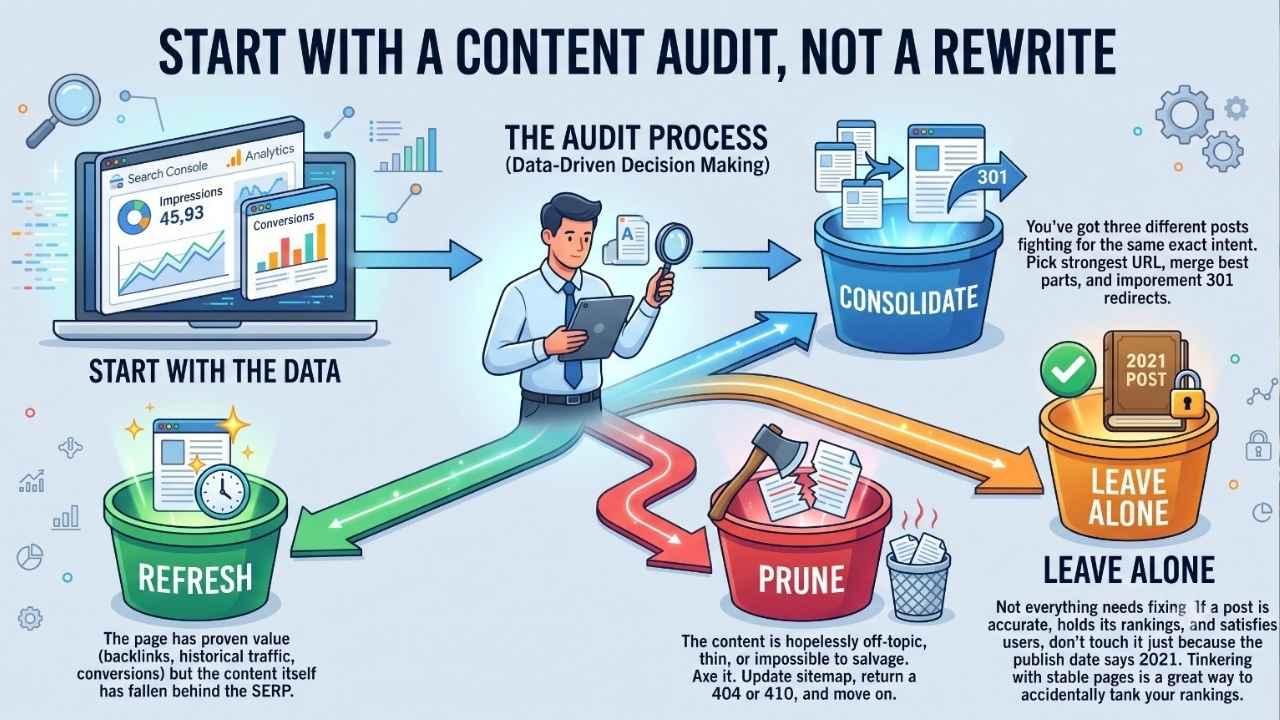
Whenever I tackle a content audit, jumping straight into the CMS editor is the last thing I do. If you just start rewriting blindly, you’re going to end up with a messy, directionless draft.
Start with the data.
Pull up Search Console to see exactly how users are finding the page today, then cross-reference with Analytics to see if it’s actually driving meaningful business outcomes like leads or revenue. Once you have the numbers, force every URL into one of four buckets:
- Refresh The page has proven value (backlinks, historical traffic, conversions) but the content itself has fallen behind the SERP.
- Consolidate You’ve got three different posts fighting for the same exact intent. Pick the strongest URL, merge the best parts of all three into it, and implement 301 redirects for the losers. Google’s canonicalization guidelines heavily encourage this to consolidate ranking signals.
- Prune The content is hopelessly off-topic, thin, or impossible to salvage. Axe it. Update your sitemap, return a 404 or 410, and move on.
- Leave Alone Not everything needs fixing. If a post is accurate, holds its rankings, and satisfies users, don’t touch it just because the publish date says 2021. Tinkering with stable pages is a great way to accidentally tank your rankings.
The Difference Between Freshness and Usefulness
Far too many marketers confuse a recent publish date with actual SEO value. Changing a timestamp doesn’t fix a shallow, unoriginal article.
Yes, Google’s systems reward freshness—but only when the query demands it. An evergreen framework doesn’t need to be rewritten every six months just to look recent. When dealing with content decay, you’re usually looking at one of three distinct issues:
- Factual decay: The software pricing changed, the law was updated, or the tool you recommended shut down.
- Intent decay: The topic is the same, but searchers now want a downloadable template instead of a 2,000-word philosophical essay.
- Competitive decay: Your page is fine, but a competitor simply built a better one with custom graphics, expert quotes, and interactive calculators.
A serious refresh often tackles all three at once.
How I Choose Which Old Pages to Refresh First
If you run a large publication, your backlog of decaying content is probably massive. Don’t prioritize based on age. Prioritize based on upside.
I look for pages that used to drive massive traffic but have slowly slipped. They’ve proven their worth; you just need to figure out why they lost their edge. Pages hovering between positions 5 and 20 are absolute goldmines—they usually don’t need a total teardown, just better intent alignment or cleaner structure.
I also prioritize low-traffic pages that have historically driven high revenue or lead volume, and hub pages that anchor a critical topic cluster. Stop treating your content audit like a pure traffic-chasing exercise. Protect your revenue and authority first.
My Refreshing Old Content for SEO Workflow
To keep from ruining what already works, you need a repeatable process.
- Identify current search intent Google the primary keyword and actually look at the SERP. Don’t copy the competitors, but figure out what format Google is currently rewarding. If the top five results are comparison tables and your post is a giant wall of text, you know exactly what needs to change.
- Compare queries against the page GSC query data tells you what your page has accidentally become. If you wrote a “content strategy guide” but it’s ranking for “SEO audit checklist,” you either need to lean into that new intent or tighten your focus.
- Preserve the winners Do not casually gut a page. Figure out which specific headers or examples are currently earning featured snippets or backlinks, and ring-fence them.
- Gut the dead weight Strip out obsolete examples, dead links, and those fluffy, 300-word introductory paragraphs that say absolutely nothing. Addition by subtraction is real.
- Add missing value Don’t just make the post longer to hit arbitrary word counts. Add expert insights, missing steps, or clearer formatting that actually helps a user complete a task.
- Tighten the packaging Rewrite boring meta descriptions and weak headlines. Ensure your H2s and H3s make the piece highly scannable.
- Overhaul internal links Point newer posts to your freshly updated URL, and update the links inside the post to ensure they point to your most current, relevant hub pages.
- Handle the technicals Only update the “last updated” date if the changes were substantial. Double-check your schema, ensure the URL is in your sitemap, and verify any redirects.
- Force a recrawl Hit the “Request Indexing” button in Search Console, then step away. Give Google time to process the changes before you obsess over the metrics.
What Most People Get Wrong About Refreshing Old Content for SEO
People usually screw this up by optimizing purely for the algorithm. They tweak a headline, sprinkle in LSI keywords, update the year from “2024” to “2026,” and wonder why traffic stays flat. That’s window dressing.
Completely rewriting a successful post from scratch is just as dangerous, as you risk destroying the historical signals that kept it afloat. Another trap is keyword bloat—cramming in irrelevant sections just because an SEO tool suggested them. Finally, be patient. Judging a major content overhaul after 72 hours is going to give you terrible data.
Refresh, Rewrite, Merge, or Delete? How I Decide
Don’t let sentimentality dictate your strategy.
If the core intent holds up, refresh the facts and formatting. If the piece targets a great keyword but the writing is awful, rewrite it entirely. If you have five weak posts cannibalizing each other, merge them into a single definitive guide and redirect the rest. And if a post is hopelessly outdated—especially regarding sensitive financial, legal, or medical info—delete it or noindex it immediately.
How to Refresh Different Types of Old Content
A software review doesn’t age the same way a theoretical framework does.
For evergreen guides, focus on structural shifts in how people search the topic. Listicles decay incredibly fast, so ruthlessly verify product availability, pricing, and features. For how-to tutorials, test your own instructions—if the platform interface changed, you need fresh screenshots.
Not every opinion piece needs an update; sometimes it’s best to leave it as a historical snapshot and simply add an editor’s note linking to your latest analysis. If you’re managing a publisher archive, the goal isn’t to revive every single old news clipping, but to clean up the taxonomy and prevent thin pages from diluting your overall site quality.
Content Refresh SEO in the AI Search Era
With search engines increasingly relying on generative AI to summarize results, mediocre legacy content is a massive liability. Google’s guidance explicitly states that core quality systems still apply to AI overviews.
If your refreshed page just parrots the same five points everyone else makes, it’s going to get swallowed whole by an AI summary. You have to introduce real information gain. Swap generic advice for first-hand process notes, expert commentary, or proprietary data. Whether you’re running a high-volume digital publication or trying to salvage technical debt on a SaaS site, fixing the pages that already have authority is always faster than starting from scratch.
A Practical Refresh Checklist I Actually Use
Before hitting ‘update,’ make sure you’ve stripped out the outdated examples, protected the sections that are already driving clicks, and actually added unique value. Ask yourself if the headings make the piece scannable and if you’ve resolved any glaring cannibalization issues. Ensure the date change is justified by the volume of edits, check your schema, and finally, set a calendar reminder to review the performance data in 30 to 60 days. The job isn’t done until you verify the results.
How I Measure Whether a Content Refresh Worked
Stop judging the success of an update by how much you like the new draft. Measure it in stages.
First, check server logs or Search Console to ensure Google actually crawled and indexed the new version. Next, look for query movement—are you picking up impressions for new, highly relevant long-tail terms? If impressions are surging but clicks remain flat, you probably need to rewrite the title tag.
Most importantly, look at engagement. Traffic is a vanity metric if users immediately bounce. Look for improvements in scroll depth, time on page, and actual conversions. Often, a strong refresh on a core hub page will lift the performance of surrounding cluster URLs through better internal linking.
The Bottom Line
Updating legacy content is a growth engine, not a housekeeping chore.
Your archives are packed with assets that possess something new drafts don’t: historical authority and proven demand. You don’t need to save every page, but identifying the ones where a better structure, sharper intent match, and real usefulness can move the needle is how you turn a forgotten library into a sustainable traffic machine.
Frequently Asked Questions About Refreshing Old Content for SEO
1. What does refreshing old content for SEO mean?
Refreshing old content for SEO means improving an existing page so it becomes more accurate, useful, and aligned with current search intent. It can include updating facts, fixing broken links, improving headings, adding missing sections, refreshing examples, strengthening internal links, and removing outdated information.
2. Why is refreshing old content important for SEO growth?
Old content can lose rankings, clicks, and relevance over time. Refreshing it helps recover lost traffic, protect existing backlinks, improve click-through rates, and make the page more useful for readers. It is often faster than creating a brand-new page because the URL may already have search history and authority.
3. How often should old content be refreshed?
There is no fixed schedule for every page. High-value pages should be reviewed every few months, especially if they drive traffic, leads, sales, or topical authority. Evergreen pages may need lighter updates, while tool lists, product reviews, legal topics, software guides, and statistics-heavy articles may need more frequent checks.
4. Which pages should I refresh first?
Start with pages that already show opportunity. Good candidates include pages with declining traffic, strong impressions but low clicks, rankings stuck between positions 5 and 20, valuable backlinks, outdated examples, or direct revenue and lead-generation value. Do not refresh pages only because they are old.
5. Is changing the publish date enough to improve rankings?
No. Changing the publish date without meaningful updates is a cosmetic change, not a real SEO refresh. The page should actually become more useful through updated information, better structure, stronger examples, improved intent match, and cleaner internal linking.
6. Should I rewrite old content completely?
Not always. A full rewrite is only needed when the content is too weak, outdated, or poorly structured to fix with smaller edits. If the page already has strong sections, rankings, links, or examples, preserve what works and improve the weaker parts instead of replacing everything.
7. What is the difference between refreshing, merging, and deleting content?
Refreshing means improving a useful existing page. Merging means combining overlapping pages into one stronger URL when they compete for the same intent. Deleting or noindexing is for pages that no longer serve users, attract irrelevant traffic, or cannot be updated responsibly.
8. How do I know if a content refresh worked?
Track performance after Google has had time to crawl and reassess the page. Look at impressions, clicks, rankings, CTR, engagement, conversions, and related cluster performance. A successful refresh should improve the page’s usefulness first, then show measurable SEO or business gains over time.