
Choosing between an LMS and an LXP sounds simple until you start talking to vendors. One platform promises reliable compliance records. Another promises personalized learning, AI recommendations, social discovery, skills intelligence, and a better employee experience. Then a third product claims to do all of it from one dashboard. The acronyms stop being helpful surprisingly quickly.
The basic LMS vs LXP difference is still useful: a learning management system is primarily designed to administer and record structured learning, while a learning experience platform is primarily designed to help people discover and personalize learning. But the market no longer fits neatly into those two boxes.
Modern LMS products increasingly include skills profiles, recommendations, learning paths, mobile access, and learner-facing discovery tools. LXPs increasingly include assignments, structured programs, reporting, and integrations with formal training systems. Current vendors themselves now describe LMS and LXP capabilities as overlapping or integrated rather than strictly separate.
In this article, I’ll compare LMS vs LXP features, uses, benefits, limitations, integrations, and costs to decide which learning platform your organization needs.
What Is an LMS?
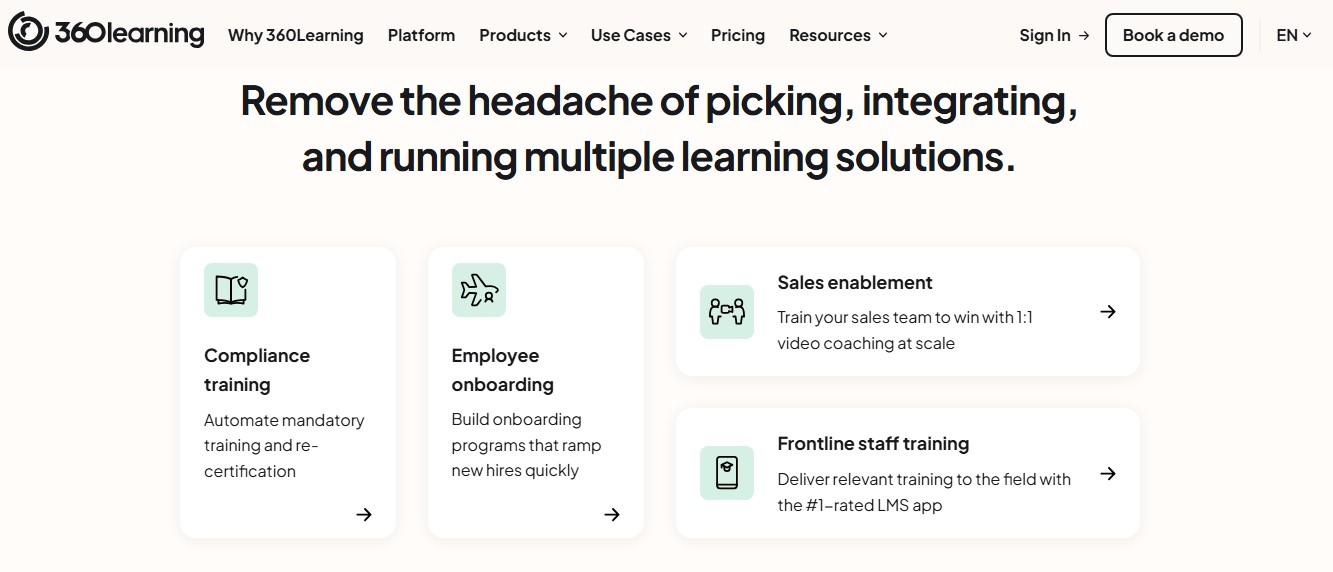
An LMS, or learning management system, is software used to create, assign, deliver, administer, track, and report formal learning. Its job is to keep organized learning organized.
An LMS commonly supports:
- Employee onboarding
- Mandatory compliance training
- Assessments and passing scores
- Certifications and renewal dates
- Structured learning paths
- Instructor-led sessions
- Attendance records
- Reminders and overdue notices
- Course catalogs
- Audit and completion reports
- Customer, partner, or franchise training
The system is usually built around an organizational requirement. Someone needs to complete a course, pass an assessment, attend a session, or maintain a certification. The LMS records whether that happened and allows an administrator to prove it later.
Current LMS definitions from enterprise learning vendors continue to emphasize creating, delivering, tracking, and managing structured training. Formal records, compliance, certification, reporting, and administrator control remain central strengths even as newer personalization features are added.
In practical terms, an LMS answers questions such as:
- Who was assigned this training?
- Who finished it?
- Who failed the assessment?
- Whose certificate expires next month?
- Can we produce a reliable record during an audit?
That administrative role may not sound exciting, but it is essential in many organizations. A safety-critical company cannot replace a completion record with a recommendation feed. A regulated employer still needs to demonstrate that the right employees received the right training at the right time.
What Is an LXP?
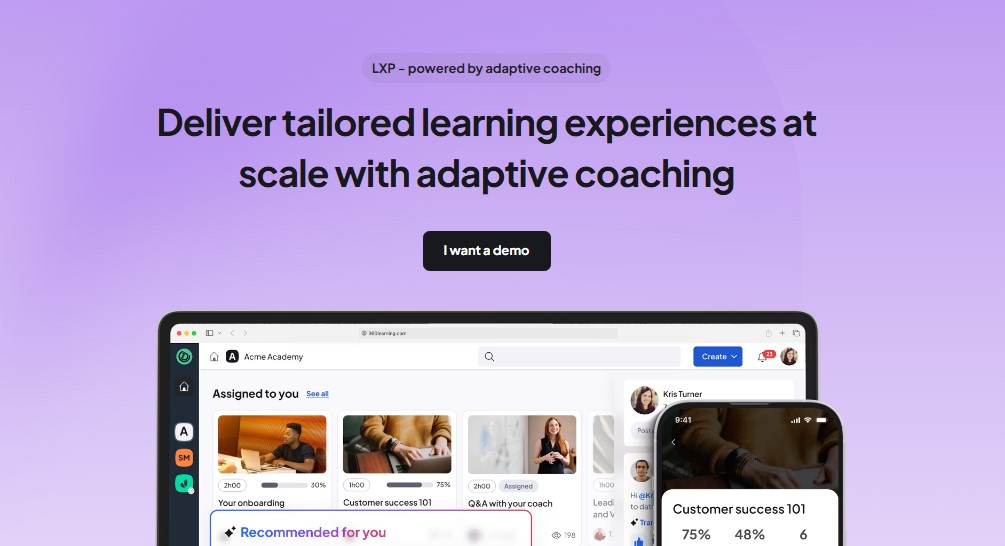
An LXP, or learning experience platform, is a learner-focused system designed to help people find, organize, and engage with learning from several sources. Instead of concentrating mainly on what the organization assigns, an LXP pays more attention to what the learner may need next.
Typical LXP capabilities include:
- Personalized content recommendations
- Skills-based learning suggestions
- Content from internal and external libraries
- Videos, articles, podcasts, books, courses, and events
- Search and content discovery
- Social and peer learning
- User-generated resources
- Learning communities
- Career and skills pathways
- Saved content and personal learning plans
- Engagement and skills analytics
Degreed describes an LXP as a user-focused access point for formal and informal learning, combining courses with resources such as articles, videos, podcasts, and books. Its framing emphasizes personalization, social learning, analytics, and employee-directed development rather than only top-down administration.
The LXP therefore answers a different set of questions:
- What should I learn next?
- Which resources match my role or career goal?
- Can I find useful material without waiting for an assignment?
- What are colleagues recommending?
- Which skills could help me move into another role?
- Can I reach learning from several providers in one place?
An LXP is often described as the “front door” to a company’s broader learning environment. It may sit above an existing LMS, bringing together formal courses, external libraries, internal resources, communities, and skills data into one employee-facing experience.
LMS vs LXP: The Main Difference
The shortest useful explanation is:
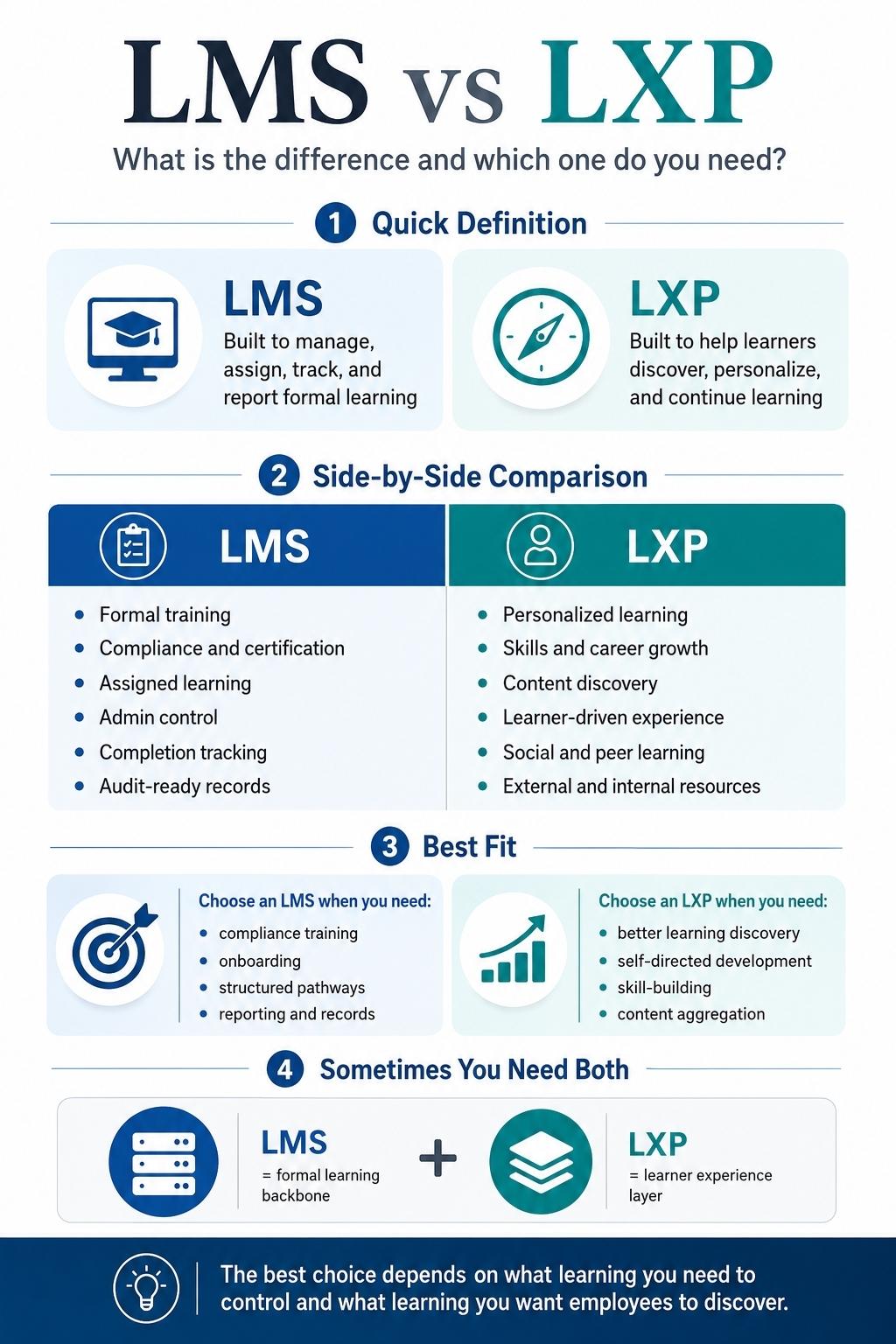
An LMS manages required learning. An LXP enables broader learning.
That is not an absolute rule, but it captures the difference in emphasis.
| Area | LMS | LXP |
| Primary purpose | Administer, deliver, and record structured learning | Help people discover and personalize learning |
| Main orientation | Organization and administrator | Learner and employee experience |
| Typical learning model | Assigned and structured | Self-directed and exploratory |
| Common content | Courses, assessments, programs, certifications | Courses plus articles, videos, podcasts, communities, and external content |
| Content control | Centrally governed | Curated, aggregated, recommended, and sometimes user-generated |
| Strongest use | Compliance, consistency, records, and formal training | Discovery, engagement, skills growth, and continuous learning |
| Typical metrics | Assignment, completion, score, certification, overdue status | Search, viewing, saving, recommendations, skills activity, repeat engagement |
| Main weakness | Can feel rigid and administrator-led | Can become cluttered, weakly governed, or disconnected from real performance |
| System role | Administrative system and record keeper | Experience, discovery, and engagement layer |
The table reflects the traditional distinction between the categories. Current platforms increasingly cross these boundaries, so buyers should evaluate actual workflows rather than relying on the label attached to the product.
Push Learning vs Pull Learning
Another common way to explain LMS vs LXP is through “push” and “pull.”
An LMS often pushes learning
The company decides what employees must complete, who receives it, when it is due, and how completion will be measured. This model works well for onboarding, regulation, product certification, security awareness, safety procedures, and standardized role training.
An LXP encourages employees to pull learning
People search for what they need, follow an interest, explore recommendations, join a community, or build a pathway around a skill or career goal. The distinction is useful, but it should not be treated as a technical law.
Modern LMS products may offer personalized recommendations and voluntary catalogs. LXPs may allow administrators to assign pathways and structured development programs. Push and pull now exist on both sides; what changes is which one the platform was primarily designed to support.
Why the Difference Matters More Now
Organizations are not comparing these platforms in a stable skills environment.
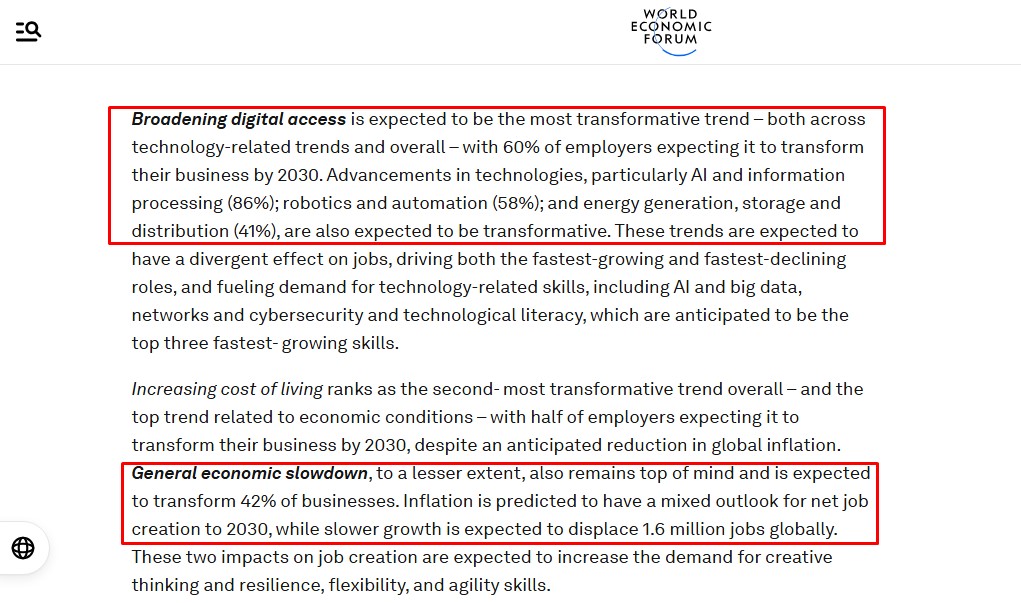
The World Economic Forum’s Future of Jobs Report 2025 found that employers expect 39% of workers’ existing skills to change or become outdated between 2025 and 2030. Skill gaps were identified by 63% of surveyed employers as a major barrier to business transformation, and 85% said they planned to prioritize workforce upskilling.
That creates two simultaneous learning needs:
- Controlled learning: Organizations still need consistent onboarding, compliance, safety, process, and role training.
- Adaptive learning: Employees need ways to build new skills, follow career goals, respond to changing jobs, and find relevant information without waiting for a formal course to be assigned.
An LMS is usually stronger at the first job. An LXP was designed around the second.
This also explains why learner motivation matters. LinkedIn’s 2024 Workplace Learning Report found that users who set career goals spent four times as much time learning as those who did not. LinkedIn based that finding on observed activity within a specific cohort rather than a general claim about every workplace learner, but it still illustrates how strongly learning can be tied to visible career direction.
An LXP can make that connection easier by linking content with roles, interests, and skills. The technology cannot create meaningful career opportunities on its own, but it can make development easier to navigate.
The Categories Are Blurring
Many older comparison articles present the LMS as a dull course warehouse and the LXP as its intelligent replacement. That description has aged badly.
Modern LMS products can include:
- AI-powered content recommendations
- Skills profiles
- Personalized learning paths
- Career-development tools
- Social learning
- Mobile learning
- Richer search and discovery
- Internal and external content
LXPs may now include:
- Assignments
- Structured pathways
- Reporting
- Administrator controls
- Assessment support
- Formal content connections
- LMS integrations
- Compliance visibility
Cornerstone’s 2026 comparison says modern LMS platforms increasingly include LXP-style recommendations, skills paths, and discovery. The company also markets integrated LMS and LXP functions rather than positioning one as a universal replacement for the other.
Vendor material naturally reflects what each company sells, so it should not be treated as independent proof that every platform has reached feature parity. It does, however, show where the market is moving.
The acronym tells you where a product came from. It may not tell you everything it can do now.
When an LMS Is the Better Choice
An LMS should remain the priority when the organization needs strong control over formal learning.
It is usually the better starting point when you need to:
- Assign mandatory courses
- Manage certifications
- Retain audit-ready records
- Send recurring reminders
- Administer assessments
- Track instructor-led sessions
- Standardize onboarding
- Manage training across branches or locations
- Report by role, team, or regulatory group
- Train customers, dealers, contractors, or partners
Consider a manufacturing company with annual safety certifications.
It must know which workers completed the required training, whether they passed, when the certification expires, and who is currently allowed to operate particular equipment. Employees may also benefit from self-directed learning, but the formal record cannot be optional.
The same logic applies in healthcare, financial services, transport, government, energy, construction, and other environments where training has legal, safety, or operational consequences.
An LMS is also often enough for smaller organizations. A capable modern LMS may provide structured paths, search, mobile access, recommendations, and a voluntary catalog without the added expense and governance work of a separate LXP.
When an LXP Adds Real Value
An LXP becomes more useful when the company already has plenty of learning material but employees cannot find or connect it.
Common signs include:
- Several content subscriptions with no single point of access
- Courses scattered across multiple systems
- Weak voluntary participation
- Poor search and discovery
- Growing emphasis on skills and careers
- Demand for social or peer learning
- Employees learning through resources outside the LMS
- Duplicated content across departments
- No clear route from a skill need to relevant resources
An LXP can give employees one place to search across formal courses, videos, articles, podcasts, communities, and other resources. It can also use role, skills, interests, and activity data to improve recommendations.
That can solve a genuine discovery problem. It does not solve every learning problem. An attractive interface will not help much if employees have no time to learn. Recommendations will not create career progression when internal opportunities are unclear. Social learning will not grow when managers discourage people from stepping away from immediate tasks.
A platform can remove friction. It cannot manufacture a learning culture by itself.
The LXP Content-Landfill Problem
One of the main selling points of an LXP is that it can bring together a large amount of content. That strength can turn into a weakness.
A company may connect several course libraries, internal documents, recorded webinars, videos, articles, and employee contributions. The catalog grows rapidly. Employees now have one place to search, but they face thousands of results, duplicated courses, outdated resources, and conflicting advice. The organization has solved the access problem and created a curation problem.
A useful LXP needs content governance behind it:
- Clear rules about trusted sources
- Owners for important topic areas
- Consistent skills and content tagging
- Review dates
- Archiving procedures
- Controls for user-generated material
- Removal of duplicates
- Monitoring of recommendation quality
AI recommendations do not remove that responsibility. They depend on the quality of the content, metadata, skills taxonomy, role information, and user data feeding the system. Badly tagged content does not become relevant because an algorithm recommended it.
Completion and Engagement Are Not the Same as Learning
LMS dashboards often emphasize completion, scores, attendance, and certification. LXP dashboards may emphasize searches, views, likes, saves, shares, recommendations, and time spent learning.
Both sets of metrics can be useful. Neither proves that work improved.
A completed course does not tell you whether the employee can perform the task. A saved article does not show that the learner understood it. A high number of logins may reflect an attractive platform without demonstrating better judgment, fewer mistakes, or faster proficiency.
A 2025 systematic review of workplace e-learning transfer found that the research field still lacks a broadly agreed method for measuring whether online learning transfers into workplace performance. Among the 31 documents included in the review, self-reporting was the most common measurement approach, which the authors noted is vulnerable to bias.
This leads to one of the most important points in the comparison:
An LMS can show that learning was completed. An LXP can show that learning was explored. Neither automatically shows that performance changed.
That requires evidence outside the platform.
Does an LXP Replace an LMS?
Usually, not by default. An LXP may offer a much better front-end experience while still depending on an LMS underneath for formal administration.
Removing the LMS without checking every workflow can create gaps in:
- Certification history
- Recurring assignments
- Compliance reports
- Attendance
- Assessment records
- Instructor scheduling
- Historical transcripts
- Customer or partner learning
- Audit trails
An LXP can replace an LMS only when the selected product genuinely supports all the formal workflows, records, permissions, reports, and integrations the organization requires. Do not make that decision from a feature list.
Test real scenarios, such as:
- Can an auditor retrieve the required record?
- Can a manager see upcoming certification expiry?
- Can a course be reassigned annually?
- Can historical records be migrated accurately?
- Can instructor-led attendance be reconciled?
- Can external learners be managed separately?
If the answer is unclear during procurement, it will not become clearer after implementation.
When Using Both Makes Sense
Using both can be sensible when an organization has two mature needs.
Formal learning that must be controlled
This includes:
- Compliance
- Certification
- Structured onboarding
- Role-based curricula
- Regulatory training
- Official learning records
Continuous learning that should be discovered
This includes:
- Skills development
- Career learning
- External content
- Peer recommendations
- Communities
- Voluntary exploration
- Learning in the flow of work
In that arrangement, the LMS may remain the formal system of record while the LXP becomes the employee-facing discovery layer. That approach works only when the experience feels connected.
Employees should not have to search two separate catalogs, maintain two learning profiles, or guess which platform holds the official version of a course. Administrators should not spend their time reconciling duplicate records and reports.
Using both products should reduce fragmentation, not give it a new interface.
Integrated Platform or Separate Products?
Many organizations eventually face a second decision: buy one integrated platform or connect best-of-breed tools.
One integrated suite
A single vendor provides LMS and LXP capabilities. The appeal is obvious. Identity, content, profiles, reporting, and support may be easier to manage. Employees receive one interface, while administrators work with fewer integrations and contracts.
The compromise is that one or more capabilities may be less advanced than a specialist product. The company also becomes more dependent on one vendor’s pricing, roadmap, skills model, data architecture, and product decisions.
Separate LMS and LXP products
A best-of-breed approach allows the organization to select a strong formal learning system and a separate employee-experience layer.
This may produce better functionality in each area and more freedom to change individual components later.
It also creates more integration work. Identity matching, duplicate catalogs, data ownership, reporting consistency, search, recommendations, and user navigation all require careful design. The better option depends less on fashion than on internal capability.
An organization with a strong technology team, mature data governance, complex learning requirements, and several content providers may justify a connected ecosystem. A smaller team may gain more from a simpler integrated product that is slightly less specialized but much easier to run.
LMS, LXP, and LRS Are Different Things
Learning technology discussions become even more confusing when an LRS enters the picture. An LRS is a learning record store. It receives and stores activity data, commonly through the Experience API, or xAPI.
The Advanced Distributed Learning Initiative describes xAPI as a specification for capturing, storing, retrieving, and exchanging data from learning activities. An LRS implements the server-side requirements that store and retrieve those records, including activity from different learning technologies.
The three systems therefore have different core roles:
- LMS: Manages courses, assignments, programs, and official records.
- LXP: Helps users discover and engage with learning from different sources.
- LRS: Stores activity data from different learning experiences and systems.
A product may contain more than one of these capabilities. That does not make the terms interchangeable.
An LRS is not normally the employee-facing learning portal. An LXP is not automatically an audit-grade record system. An LMS may record what happens inside its courses without capturing informal activity elsewhere.
Where LTI and Other Integrations Fit
Integrations matter because few learning systems operate alone. The Learning Tools Interoperability standard, maintained by 1EdTech, is designed to connect external learning tools with a learning platform securely. It can support user access, roles, assignments, content, rosters, and grade exchange without requiring a completely separate login and custom integration for every tool.
Standards such as LTI and xAPI can reduce some integration work, but a standards logo should not end the technical review.
Buyers still need to ask:
- Which version is supported?
- Is the implementation certified?
- What data moves between systems?
- Which platform owns the record?
- How are duplicate users handled?
- Can data be exported?
- What happens when a supplier is replaced?
- How are consent, privacy, and retention managed?
A platform may technically “integrate” while still producing a poor employee experience or incomplete reporting.
How to Choose Between an LMS and an LXP
Begin with the learning problem, not the product demonstration.
Choose an LMS first when:
- Formal training is the main requirement
- Compliance and certification are important
- Records must be audit-ready
- Learning is mostly assigned
- Administration and reporting need improvement
- You have a smaller or more controlled content environment
- Your current priority is consistent onboarding or role training
Add or prioritize an LXP when:
- Employees struggle to find learning
- Content is spread across many providers
- Voluntary development is strategically important
- The organization is building a skills or career framework
- People need more informal and self-directed learning
- Social discovery and peer contribution matter
- The LMS already handles formal requirements adequately
Consider an integrated platform when:
- You need both functions but want fewer systems
- Internal integration capacity is limited
- One vendor can demonstrate the required depth in both areas
- Data and user experience matter more than having the most advanced specialist feature
Use separate products when:
- Requirements are complex
- Specialist capabilities matter
- You already have a strong LMS worth keeping
- You can manage integration and governance properly
- Data portability and avoiding vendor lock-in are priorities
A Practical LMS vs LXP Buying Checklist
A product demonstration can make almost any system look simple. A better evaluation uses your own workflows, data, content, and users.
1. Formal learning
Can the system assign, remind, assess, certify, expire, reassign, and report at the required level?
2. Discovery
Can an employee find one useful resource without knowing its exact title or provider?
3. Skills
Does the platform connect content to roles and capabilities? Can employees and managers correct inaccurate skill profiles?
4. Content governance
Who can publish, approve, recommend, tag, update, and remove material?
5. Recommendations
What data drives personalization? Can administrators understand why content is being recommended?
6. Integrations
How does the system connect with HR, identity, collaboration, content, analytics, and talent platforms?
7. Data ownership
Can the organization export learning histories, skills data, content metadata, and activity records in a usable form?
8. Accessibility
Does it support relevant accessibility requirements, languages, mobile devices, frontline workers, and weaker connections?
9. Administration
How much manual work is required after implementation? A polished employee homepage can hide a heavy administrative burden.
10. Total cost
Include implementation, migration, integration, content subscriptions, configuration, support, internal staffing, governance, and future replacement. The subscription price is only one part of the decision.
Metrics Worth Tracking
Different platforms need different measures, but the best reporting eventually leaves the platform and reaches the workplace.
Useful LMS metrics
- Mandatory completion
- Overdue training
- Assessment results
- Certification status
- Audit readiness
- Onboarding progress
- Administration time
- Training errors and exceptions
Useful LXP metrics
- Search success
- Voluntary participation
- Repeat use
- Recommended-content engagement
- Skills-path progress
- Content quality ratings
- Contribution and community activity
- Alignment with career goals
More meaningful business measures
- Time to proficiency
- Error reduction
- Safety outcomes
- Service quality
- Manager-observed behavior
- Verified skill improvement
- Internal movement into priority roles
- Performance following learning
- Reduced operational or compliance risk
The final group matters most. A company can have excellent learning-platform statistics and weak workplace results. The technology should support the learning strategy, not become the strategy.
Final Thoughts: Do You Need an LMS or an LXP?
For many organizations, an LMS remains the foundation. It handles the formal work that cannot be left to personal choice: onboarding, certification, required programs, assessment, and reliable records.
An LXP becomes valuable when the learning challenge moves beyond assignment. It can help employees navigate a scattered content environment, connect learning with skills and careers, and take more ownership of their development.
Some organizations need one. Many need capabilities from both. A smaller business may get everything it requires from a modern LMS. A large company with several content providers, complex skills goals, and a mature learning function may need an integrated ecosystem.
The right decision does not come from deciding which acronym represents the future. It comes from being honest about the problem.
When you can figure out which learning must happen, or, should be discovered, or which records must be retained, or which skills matter to the business, or what should employees be able to do differently afterward?
Once those questions are clear, the LMS vs LXP decision becomes far easier.
Frequently Asked Questions on LMS vs LXP
1. What is the main difference between an LMS and an LXP?
An LMS is primarily designed to assign, deliver, administer, and record structured learning. An LXP is primarily designed to help learners discover personalized formal and informal resources from different sources.
2. Can an LXP replace an LMS?
It can replace an LMS only when it supports all required formal workflows, including assignments, certification, assessment, reporting, audit records, and historical data. Many organizations use an LXP alongside an LMS instead.
3. Is an LMS only useful for compliance training?
No. LMS platforms can support onboarding, professional development, customer education, instructor-led learning, assessments, and structured role pathways. Compliance is simply one of their strongest and most common use cases.
4. Does an LXP use artificial intelligence?
Many LXPs use AI to recommend content based on roles, interests, skills, goals, and previous activity. Recommendation quality still depends on good content, reliable metadata, accurate profiles, and sensible governance.
5. Can a small business benefit from an LXP?
A small business can benefit when learning is scattered and self-directed development is important. However, a modern LMS may already provide enough discovery and personalization at a lower operational cost.
6. Which is better: LMS or LXP?
Neither category is universally better. An LMS is usually stronger for controlled learning and reliable records. An LXP is usually stronger for discovery, personalization, and continuous development. The right choice depends on the organization’s learning model, compliance needs, skills strategy, integrations, and budget.