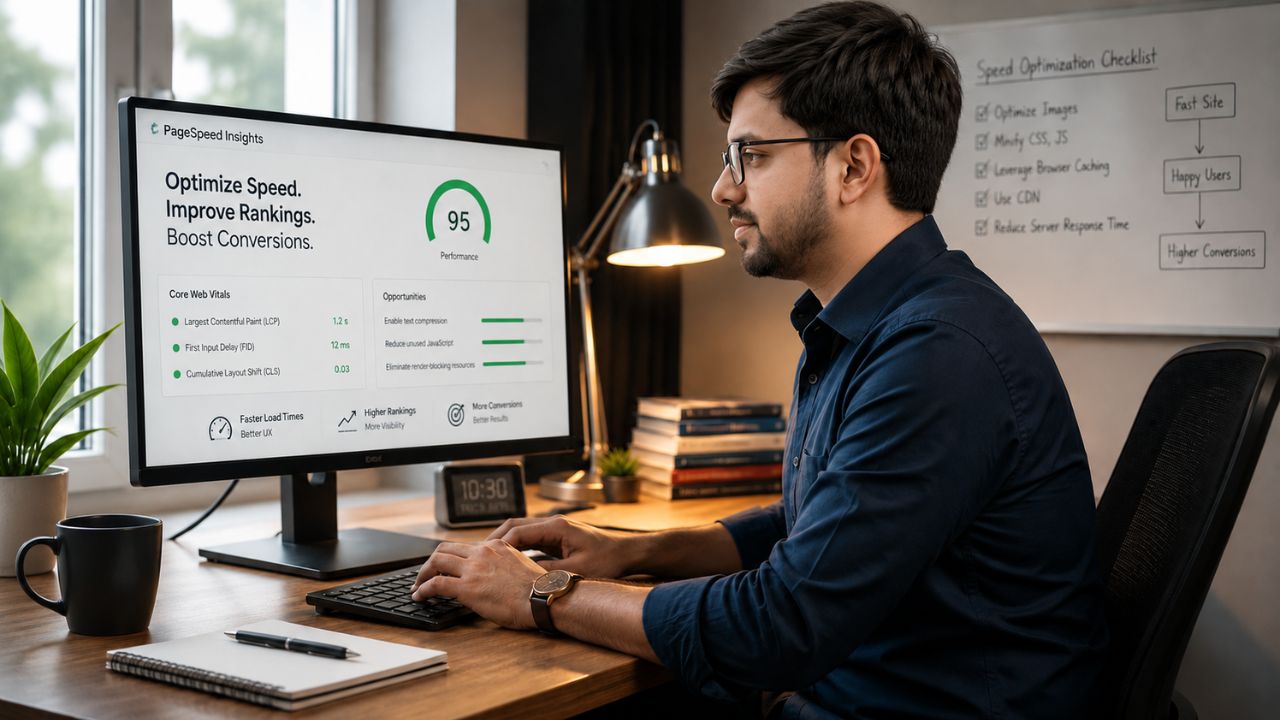
Ever publish a post, wait a week, and see almost no movement? If that sounds familiar, these 9 SEO Tactics For Blogs can help you turn quiet posts into pages that earn real Organic traffic.
Good blog SEO is less about repeating keywords and more about matching Search Intent, tightening structure, and fixing the small signals search engines actually use.
We are going to walk through keyword research, headings, meta tags, visuals, linking, mobile cleanup, and sharing, in plain steps you can use right away.
Conduct Comprehensive Keyword Research, the First of the 9 SEO Tactics For Blogs
Start your Keyword research with data from the tools closest to real search behavior. Google Search Console is great for pages you already own, Google Keyword Planner helps you size demand, and Google Trends helps you spot wording shifts before you build a full Content Plan.
If your audience is in the United States, set your research tools to the United States before you choose a phrase. That one filter can change which wording looks strongest, especially for service terms, seasonal phrases, and product names.
| Tool | Best use | Why it helps your blog |
|---|---|---|
| Google Search Console | Find real queries already showing your pages | Its Performance report shows clicks, impressions, average CTR, and average position, so you can spot posts with high impressions but weak click-through potential. |
| Google Keyword Planner | Estimate search volume and forecast demand | It lets you compare topics before you spend time writing a full post series. |
| Google Trends | Compare phrasing and rising topics | It highlights related and rising searches, which is useful when you want fresher angles for Evergreen content updates. |
A simple workflow works well. Pull your top queries from Search Console, group them by intent, then check each group in Keyword Planner and Trends before you write. That gives you a cleaner Keyword strategy than guessing from volume alone.
- Target one primary phrase and two to four closely related secondary phrases.
- Separate informational terms from comparison or buying terms, because each needs a different page format.
- Look for high-impression queries with low CTR, those are often your fastest Content Optimization wins.
- Use Trends to catch rising wording before you lock your headline and subheadings.
Address Common Reader Inquiries
The easiest way to match Search intent is to answer the exact questions readers already ask. Posts that open with a direct answer often feel more useful right away, and that helps both readers and search engines understand the page.
If you have access to Search Console Insights, it can group similar queries together and show what is trending up or down. That makes it easier to see whether readers want a how-to guide, a comparison, a checklist, or a definition.
- Check your top query groups and turn each major question into a heading.
- Use Google Trends related searches to find follow-up questions you have not covered yet.
- Review support emails, chat logs, and sales calls for repeated wording. Those phrases often make strong subheadings.
- Answer the main question in the first few sentences, then expand with examples, steps, or common mistakes.
This approach strengthens your Blog Strategy because you stop publishing broad posts and start publishing pages that solve one clear problem at a time.
Organize Your Blog with Clear Headings
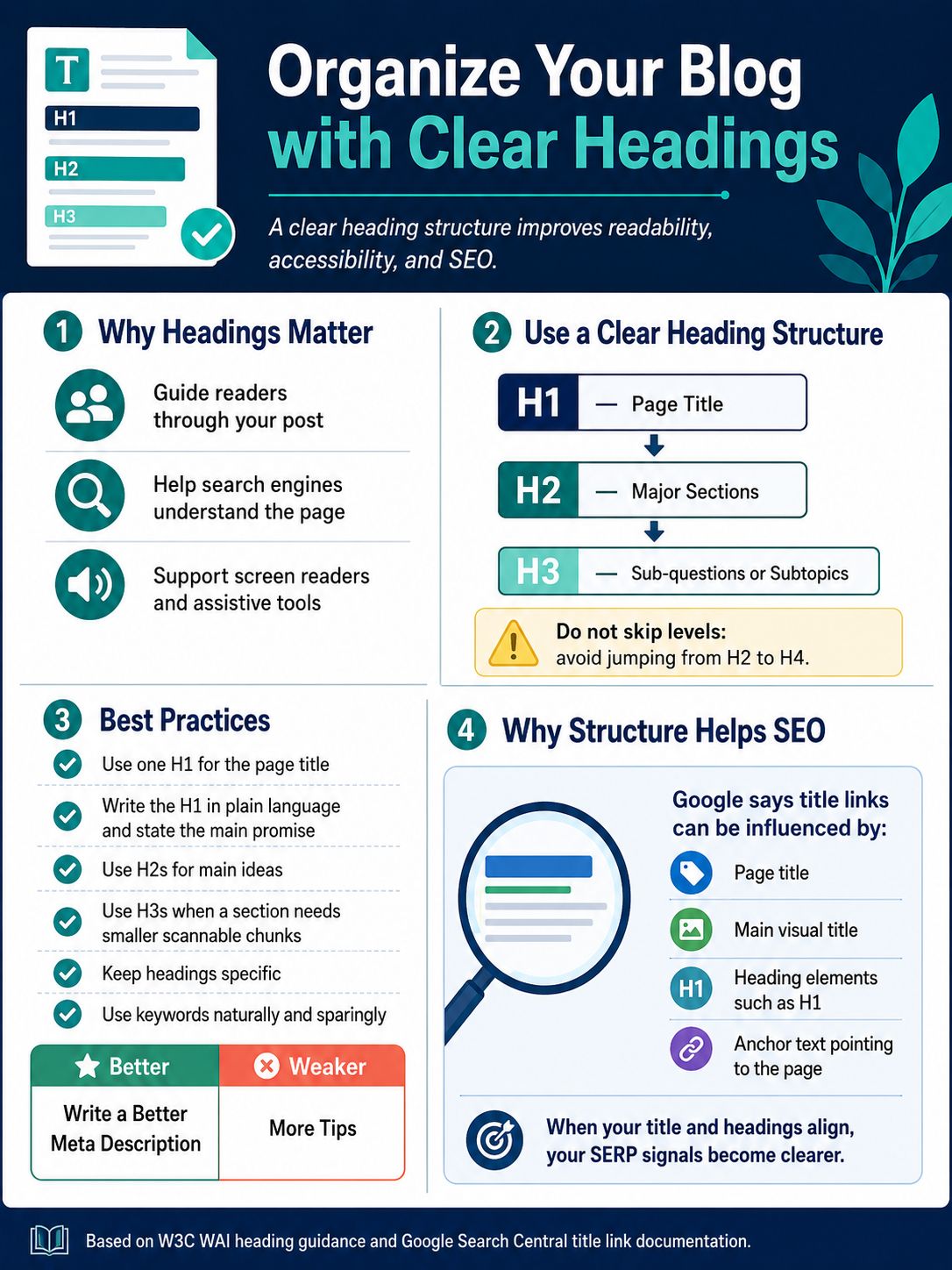
Headings guide readers through your post and give search engines a cleaner map of the page. They also help screen readers and other assistive tools move through content faster.
W3C guidance says headings should be nested by rank, so an H2 should lead into another H2 or a child H3, not jump straight to H4. That structure keeps your outline clear and avoids confusion.
- Use one H1 for the page title. Your H1 should state the main promise of the article in plain language.
- Use H2s for major sections. Each H2 should cover one main idea, such as Meta tags, Link building, or Onpage SEO.
- Use H3s for sub-questions. If a section has several moving parts, break it into smaller chunks readers can scan quickly.
- Do not skip heading levels. Clean nesting helps accessibility and makes your post easier to edit later.
- Keep headings specific. “Write a Better Meta Description” is stronger than “More Tips.”
- Use keywords sparingly in headings. One or two natural placements are enough for most posts.
There is another upside here. Google says title links can be influenced by the page title, the main visual title, heading elements such as H1s, and anchor text pointing to the page. So when your title and headings agree, your SERP Rankings signals become much cleaner.
Prioritize Readability for Better Engagement
Readability is a ranking helper because it improves how people use your page. If readers can scan the post, find the answer, and keep moving, your content feels more trustworthy.
W3C writing guidance is simple and useful: write in short, clear sentences and paragraphs. That advice works for SEO because it reduces friction, especially on phones.
- Keep one idea per paragraph.
- Break long explanations into lists after three or four related points.
- Define technical terms the first time you use them.
- Move the answer higher on the page so readers do not have to hunt for it.
- Read the section out loud. If you run out of breath, split it.
Tools like Yoast SEO can flag long sentences and difficult words, but your own editing still matters more. A clear sentence almost always beats a clever one in SEO writing.
Good readability also supports User engagement. People are more likely to stay, scroll, and visit a second page when the first page is easy to process.
Implement Engaging and Accessible Language
Accessible language does not mean bland writing. It means your message lands fast, even for a busy reader on a small screen.
Use everyday words, active verbs, and direct instructions. If you need an acronym, spell it out once first, then use the short version after that.
| Weak phrasing | Better phrasing | Why it works |
|---|---|---|
| Utilize strategic implementation | Use a simple plan | Shorter words are easier to scan. |
| Optimize content for enhanced discoverability | Make the post easier to find | The meaning is clearer right away. |
| CTR | Click-through rate, then CTR | Readers understand the term on first use. |
Clear language helps your Content marketing because more readers can act on what you wrote. It also supports accessibility goals that often get skipped in ordinary blog drafts.
If a sentence sounds like a brochure, rewrite it like advice you would give to one real person.
Use Relevant Visuals and Optimize Alt Text
Visuals should explain something, not just fill space. A chart, screenshot, comparison image, or annotated example can often replace a long paragraph and improve both readability and Organic Traffic from image search.
Google’s image guidance treats alt text as the most important image attribute for understanding the subject of an image. The best alt text describes the image clearly first, then uses a keyword only if it fits naturally.
| Visual task | What to do | Why it matters |
|---|---|---|
| Informative image | Write concise alt text that explains the key detail | It helps search engines and screen readers understand the image. |
| Decorative image | Use empty alt text if the image adds no information | This prevents screen readers from announcing useless clutter. |
| Large photo or hero image | Compress it and use a modern format such as WebP | WebP files are often smaller than comparable PNG or JPEG files, which helps page speed. |
| Any image in the layout | Set width and height | This helps prevent layout shifts on mobile screens. |
- Use screenshots for step-by-step instructions.
- Use charts when a comparison matters more than a description.
- Do not lazy-load the main hero image if it is the first big element readers need to see.
- Keep file names descriptive before upload so your media library stays organized.
Images also affect speed. Since images are often the largest contentful element on a page, faster image delivery can directly help your page feel useful sooner.
Craft Effective Meta Titles and Descriptions
Your title tag and meta description are your search result pitch. They do not replace page quality, but they strongly influence whether someone clicks.
Google generates title links automatically and can pull from your title element, the main on-page title, heading elements such as H1, prominent text, and even anchor text from links. That is why your title, H1, and opening paragraph should all point to the same promise.
- Lead with the main topic. Put your primary keyword early if it still sounds natural.
- Keep titles tight. Many editors aim for about 50 to 60 characters, but clarity matters more than chasing a perfect count.
- Write a unique description for each page. A strong meta description usually works well around 120 to 156 characters.
- Match the page exactly. Google may use your meta description when it better describes the page, but it can also generate a different snippet from page content.
- Refresh outdated dates. Google lists obsolete title elements as a common issue, especially on recurring yearly pages.
After you update a title, give it a little time. Google notes that changes to title-link sources may take a few days to a few weeks to appear after the page is recrawled and reprocessed.
Enhance Credibility with Strategic Linking
Strategic linking is about helping readers move through your site with less effort. It also helps search engines discover related pages and understand which pieces matter most.
Google’s link guidance says every page you care about should have a link from at least one other page on your site. That means orphan posts, pages with no internal links pointing to them, are a problem you should fix early.
| Link type | Best use | What to watch for |
|---|---|---|
| Internal links | Guide readers to related posts, services, and next steps | Use concise anchor text that tells readers what they will get. |
| External links | Support facts, definitions, and claims that need proof | Link only where the source adds real trust or context. |
| Backlinks | Earn authority from other sites over time | Do not buy them or join link schemes. |
Search Console’s Links report can help you audit which pages get the most internal links and which pages attract the most Backlinks. Use that data to strengthen weaker posts that deserve more visibility.
Avoid shortcuts here. Google says buying links or taking part in manipulative link schemes violates its spam policies, so clean contextual links beat shady volume every time.
Ensure Mobile Optimization for Your Blog
Mobile cleanup is no longer optional. Google uses the mobile version of a site’s content for indexing and ranking, so weak phone usability can hold back your Search engine ranking even if the desktop page looks fine.
Responsive design is usually the safest path because it serves the same HTML on the same URL while adapting the layout to screen size. That keeps your content, headings, and internal links consistent across devices.
| Metric | Good target | Practical fix |
|---|---|---|
| LCP | 2.5 seconds or less | Compress large images, reduce heavy scripts, and make the main content load sooner. |
| INP | 200 milliseconds or less | Trim unused plugins, popups, and scripts that block interaction. |
| CLS | 0.1 or less | Set image dimensions and reserve space for embeds, banners, and forms. |
- Check that the mobile page includes the same core copy as desktop.
- Use short paragraphs and obvious subheadings so readers can scan with one thumb.
- Test forms, menus, and buttons on a real phone, not just a desktop preview.
- Review pages in PageSpeed Insights or Lighthouse so you can find the slowest elements instead of guessing.
Many blog pages fail mobile tests because of simple things like oversized images, sticky widgets, and aggressive popups. Fixing those often improves both usability and Traffic generation.
Strategize Content Sharing Across Platforms
Publishing is only half the job. Smart sharing gives a new post early visibility, helps you attract links, and shows you which channels support your Digital Marketing goals.
Google Analytics recommends a complete UTM setup when you tag campaign links. If you tag one parameter, you should also set the main ones consistently, especially source, medium, campaign, and ID, so your reports do not split the same campaign into messy variations.
- Rewrite the headline for each platform. A blog title and an email subject line should not sound identical.
- Tag every shared link consistently. Keep names lowercase and standardized so reports stay clean.
- Check the Traffic acquisition report in GA4. This tells you which sources actually send engaged visitors, not just clicks.
- Reshare evergreen posts on a schedule. Update the hook, image, and first sentence instead of reposting the same blurb.
- Match the asset to the channel. Use a quick graphic for social, a stronger summary for email, and a more detailed hook for community posts.
- Promote winners, not every post equally. If one page gets traction, give it another round of distribution while interest is still warm.
This is where Blog promotion becomes measurable. Once you can see which channel drives engaged sessions, you can stop spreading effort thin and invest in the shares that lead to more subscribers, links, and returning readers.
Final Thoughts
These 9 SEO Tactics For Blogs work best as one system: stronger Keyword research, cleaner structure, sharper Meta tags, better visuals, smarter linking, and faster mobile pages all support each other.
Start with one post, improve its search intent, headings, snippet, and internal links, then watch clicks, impressions, and Organic traffic in Search Console and Analytics. Small fixes build momentum.
FAQs on SEO Tactics For Blogs
1. What are the best 9 SEO tactics for blogs?
Pick nine strong SEO tactics for blogs: keyword research, quality content, page tags, specific search phrases, inside links, external links, page speed, phone-friendly design, and analytics; these work together like a neon sign for your site.
2. How do I use keyword research to boost blog posts?
Do keyword research to find real search terms, then use them in titles, headers, and body text. Target specific search phrases with low competition, and build helpful content around them.
Page tags, like clear titles and descriptions, tell search engines what your page is about. Inside links act like signposts on a trail, they help readers and bots find more pages and raise engagement.
4. How fast should my blog load, and does phone-friendly design matter?
Aim for quick page speed, slow pages lose readers and rank. Make your site phone-friendly, many readers browse on phones. Use analytics to find slow spots, and fix them.