Somewhere along the way, startup culture confused a founder’s empty bank account with moral superiority. I have heard the story too many times. A founder skips salary for months. They put software bills on a personal credit card. They answer customer emails at 2 a.m. because hiring support would “kill runway.”
They delay a developer hire, patch the product themselves, miss family dinners, stop sleeping properly, and still describe the whole thing with a weird little smile: “We are bootstrapped.” As if that word makes the suffering strategic.
This is why we need to stop romanticizing bootstrapping. Not because bootstrapping is bad. It is not. Bootstrapping can build disciplined, customer-focused, resilient companies. Some of the best businesses are built that way. I respect founders who grow carefully, avoid vanity spending, keep ownership, and let customers rather than investors decide whether the product deserves to exist.
But I do not respect the mythology around it. The myth says real founders suffer quietly. Real founders do not need outside money. Real founders keep control at all costs. Real founders do not complain about pressure because pressure proves seriousness. That is not strategy. That is startup folklore with a Stripe account.
Why We Need to Stop Romanticizing Bootstrapping
Bootstrapping started as a practical financing choice. It became a personality test. That is the problem.
There is nothing wrong with choosing to build without venture capital. For many businesses, it is the smarter path. A niche SaaS product, a profitable service company, a creator-led software business, a local business, a product with steady margins, or a company that does not need winner-takes-most scale may be healthier without VC pressure.
I am not arguing that every founder should raise money. That would be lazy. What I am arguing is that startup culture has become too comfortable turning underfunding into virtue. It praises founders for surviving on fumes, then acts shocked when the same founders burn out, make desperate decisions, underpay themselves, hire too late, ship slowly, and carry business risk inside their own bodies.
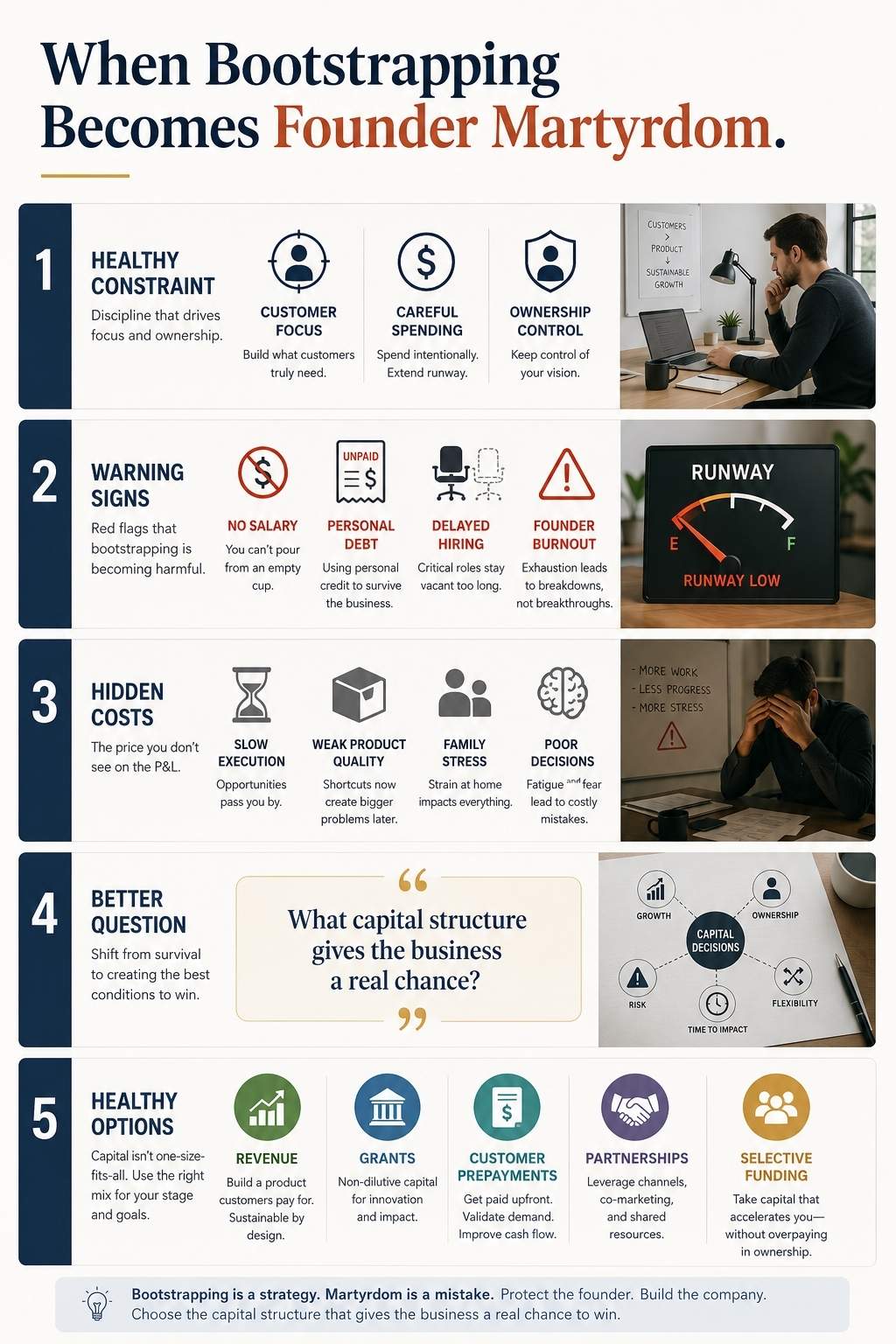
There is a difference between being lean and being starved. Lean means you are intentional. Starved means every decision is made from fear. Lean means you cut waste. Starved means you cut muscle.
Lean means the business has discipline. Starved means the founder has no oxygen left and calls that discipline because it sounds better on a podcast. That difference matters.
The Bootstrap Critique Nobody Wants to Hear
Here is my basic bootstrap critique: bootstrapping is often sold as freedom, but for many founders it is just personal financial exposure with better branding.
The public version sounds clean. No investors. No dilution. No board pressure. No one telling you how fast to grow. You own your company. You make your own decisions. The private version can look very different.
Personal savings disappear. Credit cards carry balances. Founder salary becomes optional. A spouse’s income quietly supports the company. Parents help with rent. A founder with no dependents takes risks that a founder with children cannot. Someone with prior exits, consulting income, a strong network, or family wealth gets to call their cushion “grit.”
That is why I get uncomfortable when people give bootstrapping advice like everyone starts from the same floor. They do not.
Some founders bootstrap because they are disciplined. Some bootstrap because they are excluded from capital. Some bootstrap because they do not want VC incentives. Some bootstrap because no investor would take their call. Some bootstrap because their business does not fit the venture model. Some bootstrap because they have no other option.
Those are different realities. Startup culture often smashes them into one heroic story. “Built without funding” sounds inspiring until you ask what funded the founder while the business could not. That question usually makes the room quieter.
Bootstrapping Often Hides Privilege
I do not trust bootstrap worship when it refuses to talk about privilege. A founder with a year of savings is not taking the same risk as a founder with two months of rent left. A founder whose partner covers household expenses is not in the same position as a founder supporting parents, children, or siblings. A founder with a network of early customers has a different runway from someone building from the outside.
This does not make successful bootstrapped founders fake. It makes their story incomplete.
The internet loves the founder who says, “I started with nothing.” Sometimes that is true. Often, it means “I started with no institutional funding,” which is not the same thing. There may still have been savings, reputation, a professional network, a laptop, health insurance, a safe home, a second income, a country with payment infrastructure, or simply the ability to fail without total collapse.
Those things matter. When we ignore them, bootstrapping becomes a moral lecture aimed at founders who may already be carrying more risk than the success-story founder ever had to carry. I hate that. I hate advice that turns someone else’s cushion into your character flaw.
Hardcore Bootstrap Problems Start When Constraint Becomes Starvation
Founders love to say constraint creates creativity. Sometimes it does. A small team can move faster. Limited money can sharpen priorities. Customer revenue can keep the company honest. Not having a giant war chest can prevent stupid hiring, lazy positioning, and expensive distractions. But constraint has a breaking point.
At some point, the lack of money stops making you creative and starts making you sloppy. You do not hire the right person, so you keep doing work you are bad at. You do not invest in marketing, so your product stays invisible. You do not fix technical debt, so the product becomes fragile. You do not pay for proper legal, finance, security, or compliance support, so small risks become expensive later.
These are hardcore bootstrap problems, and they are rarely glamorous. They look like a founder doing sales in the morning, customer support in the afternoon, product management at night, bookkeeping on Sunday, and strategy whenever their brain has five minutes left. They look like a company that appears efficient from the outside because the founder is absorbing all the chaos inside.
That is not always discipline. Sometimes it is just under-resourcing with motivational language on top. Some startups are not lean. They are malnourished.
Bootstrap Suffering Is Not a Business Model
The line I keep coming back to is simple: if a business only works because the founder is unpaid, underslept, and permanently anxious, the business is not efficient. It is being subsidized by a human nervous system.
That is not a cute metaphor. It is the actual operating model of too many early-stage companies.
Founder exhaustion can hide inside good-looking numbers. Revenue can grow while the founder deteriorates. Customers can be happy while the founder’s health collapses. A product can ship while relationships suffer. The company can look “scrappy” while the person behind it is quietly losing their ability to think clearly. This is where bootstrap suffering becomes dangerous.
Startup culture loves to measure runway in months of cash. It is worse at measuring mental runway. But mental runway is real. When a founder runs out of attention, sleep, confidence, patience, and emotional stability, the company becomes fragile even if the bank account still has a few months left.
And bootstrapping can make that worse because there is less slack. Every bad month feels personal. Every lost customer feels like rent. Every delayed payment becomes a body-level event. Every hiring decision feels impossible because cash is tight and the founder is already overloaded.
I do not want to romanticize that. I want to name it. Pain is not proof that the business is working. Sometimes pain is proof that the business is being carried in the least sustainable way possible.

The Internet Only Shows the Founders Who Survived It
Bootstrapping has a survivorship-bias problem. We hear from the founders who made it.
We hear from the founder who kept ownership and sold the company. The founder who reached profitability with no outside money. The founder who built a SaaS business from a bedroom and now tells everyone not to raise. The founder who says investors are unnecessary because customers funded everything. Those stories are valuable. They are also incomplete as advice.
We do not hear as much from the founders who bootstrapped until their savings vanished. The founders who shut down quietly. The founders who missed the market window because they could not hire. The founders who lost confidence after two years of grinding. The founders who had to take a job and never posted the final update.
Failure is less shareable. That distorts the lesson. A bootstrapped success story is not automatically a universal strategy. It is one outcome shaped by market timing, founder skill, personal runway, customer access, category, pricing, distribution, luck, and sometimes hidden support.
When people turn those stories into commandments, they make other founders feel weak for needing capital, help, rest, or a different model. That is not inspiration. That is bad pattern matching.
Raising Money Is Not Always Selling Out
The anti-VC purity crowd can be just as annoying as the raise-at-all-costs crowd. No, venture capital is not for every company. VC can distort incentives. It can push founders toward growth rates the market does not justify. It can create pressure to chase scale, hire too fast, overspend, dilute too much, and build a company whose exit expectations do not match the founder’s original goal.
I understand why many founders avoid it. But raising money is not automatically selling out. Sometimes capital buys survival. Sometimes it buys speed. Sometimes it buys senior talent, distribution, compliance support, product quality, inventory, enterprise trust, or time to reach a market before a better-funded competitor does. Sometimes dilution is less dangerous than slow suffocation.
A founder who raises a thoughtful angel round is not morally weaker than a founder who maxes out personal credit cards.
A founder who takes revenue-based financing to smooth cash flow is not less serious than a founder who delays salary for a year. A founder who uses grants, customer prepayments, strategic partnerships, or a small seed round is not betraying the startup gods. Capital is a tool. The minute it becomes identity, founders start making decisions for the wrong audience.
The Funding Market Is Unequal, So “Just Bootstrap” Can Be Lazy Advice
There is another layer people do not like discussing. The funding market is not neutral.
Capital flows toward people and categories investors already understand. It flows toward networks, geographies, patterns, credentials, and markets that feel legible. Right now, a lot of money is also being pulled toward AI and large, obvious narratives. That does not mean every non-AI founder should sulk. It means the market is uneven, and we should stop pretending every founder is choosing from the same menu.
Many founders are not bootstrapping because they read a philosophy thread and decided ownership was sacred. They are bootstrapping because capital did not show up. That distinction matters.
When the market overlooks a founder, telling them to celebrate being underfunded can become cruel. It turns exclusion into a lifestyle brand. It tells people to clap for the constraint that may be slowing them down. I would rather be honest.
Some founders bootstrap because it fits the business. Some bootstrap because it is the only door open. Those founders deserve support, not lectures about how suffering builds character.
AI Has Made Bootstrapping Easier, Not Effortless
AI has changed the bootstrap conversation, but not as much as LinkedIn wants to pretend. Yes, founders can do more with fewer people now. They can build prototypes faster, write copy faster, research customers faster, automate workflows, create content, generate code, summarize calls, build simple internal tools, and test ideas without hiring a full team immediately.
That is real. I like that part. I like anything that lowers the cost of starting and gives more people a chance to build. But “AI makes bootstrapping easy” is becoming the new lazy take.
AI does not magically solve distribution. It does not create trust. It does not close enterprise deals by itself. It does not replace industry relationships, compliance work, manufacturing, customer support, inventory management, onboarding, security, legal risk, cash flow, or founder judgment.
Tools reduce friction. They do not remove reality. A founder with better tools can still be underfunded. A solo founder with AI can still be lonely. A product can be built faster and still struggle to sell. The new stack may reduce the cost of starting, but it does not erase the cost of enduring.
That is where the bootstrapping myth keeps getting updated without getting wiser.
Bootstrap Martyrdom Can Poison the Team Later
One thing I do not think we discuss enough is what happens when founder suffering becomes company culture.
A founder who survives by ignoring boundaries may later expect employees to do the same. They may call chaos “urgency.” They may call low pay “belief.” They may call unclear roles “ownership.” They may tell the team, “We are still bootstrapped,” as if that excuses everything from bad planning to chronic overwork.
That is how bootstrap pain gets passed down. It starts as founder sacrifice. Then it becomes workplace expectation.
The company stays lean, but people pay for it with their evenings, health, and patience. Everyone is told they are building something special. Maybe they are. But special does not pay rent, prevent burnout, or replace a sustainable operating system.
A founder can choose personal sacrifice. Employees should not be tricked into inheriting it. This is another reason I want us to stop treating bootstrapping like a moral achievement by default. A funding choice can be smart. A culture of permanent scarcity is not.
What Healthy Bootstrapping Actually Looks Like
Healthy bootstrapping is not heroic suffering. It is intentional constraint.
To me, healthy bootstrapping looks boring in the best possible way. The founder knows the runway. Pricing supports the business. Customer revenue matters early. Hiring is careful but not endlessly delayed. The founder pays themselves as soon as the business can responsibly support it. Rest is not treated like weakness. Delegation is not treated like luxury. Outside capital is not treated like moral contamination. Healthy bootstrapping has rules.
It asks: how long can I safely do this? What happens if revenue drops? Which role am I pretending to cover badly? What decision am I delaying because I am proud, not because it is wise? What would change if I stopped treating capital as identity?
That last question matters. Some founders need to raise. Some should not. Some should build slowly. Some need speed. Some should stay small and profitable. Some should take a strategic check. Some should never touch venture capital. Some should use debt carefully. Some should build through customer prepayments, consulting revenue, licensing, grants, or partnerships.
There is no single holy path. There is only the path that fits the business without destroying the founder.
Choose Capital Like Strategy, Not Identity
This is where I land: bootstrapping deserves respect when it creates focus. It deserves criticism when it becomes a religion of founder suffering. The founder’s job is not to prove they can suffer beautifully. The founder’s job is to build something durable.
Sometimes that means bootstrapping. Sometimes it means raising. Sometimes it means staying small. Sometimes it means taking a boring loan instead of chasing a glamorous round. Sometimes it means saying no to investors. Sometimes it means admitting that the company is undercapitalized and pride is now the bottleneck.
I want founders to keep ownership when it makes sense. I want them to avoid dumb dilution. I want them to care about customers early. I want them to build companies with discipline, not bloated machines held together by investor money and vibes. But I also want founders to stop confusing pain with proof.
We need to stop romanticizing bootstrapping because the romance hides too much: personal debt, privilege, burnout, slow execution, weak hiring, family strain, mental-health damage, and business models that only work because the founder is absorbing costs nobody wants to count.
Bootstrapping is not the villain. The villain is the startup culture that looks at avoidable suffering and calls it grit.
So build lean if lean is right. Raise if the business needs capital. Stay independent if independence serves the mission. Take money if money buys the company a real chance. But do not turn your funding choice into a costume for martyrdom.
A startup is not better because the founder suffers more. A startup is better when it can survive without consuming the person who built it.