
Referral growth sounds simple build a good product, ask users to share it, and wait for new customers. In real SaaS work, it is rarely that easy. Happy users may like your product but forget to mention it.
They may not know who to refer. They may not understand the reward. They may not want to risk recommending something unless the product feels reliable. That is why referral tactics SaaS teams use need more structure than a basic “invite a friend” button. A good referral system makes sharing easy, timely, useful, and trustworthy. It gives the referrer a clear reason to share and gives the new user a clear reason to try.
This guide covers practical referral tactics for SaaS teams, especially bootstrapped founders and small teams. Each tactic is built around real customer behavior, simple workflows, and low-cost execution.
Why Referral Marketing Still Works for SaaS in 2026
Referral marketing works because SaaS buying is full of risk. A buyer is not just choosing software. They are choosing a workflow, a vendor, a migration path, a price commitment, and sometimes a tool their whole team must adopt. That is why recommendations from trusted peers still carry more weight than polished ads. In 2026, word of mouth SaaS growth is also shaped by AI search, review platforms, private communities, LinkedIn conversations, Slack groups, newsletters, and founder-led content.
A referral may start as a private message, a review mention, a shared template, a partner recommendation, or a customer saying, “We use this and it works.” The best SaaS referral programs do not depend on luck. They identify the right users, ask at the right moment, give the right reward, and make sharing almost effortless.
| 2026 Referral Reality | What It Means for SaaS Teams | Practical Response |
| Buyers research across many places | Referrals may happen before a site visit | Build trust signals everywhere |
| AI answers influence shortlists | Reviews and public proof matter more | Encourage visible customer advocacy |
| Users are careful with recommendations | They do not want to risk their reputation | Make the product reliable before asking |
| Private communities influence decisions | Word of mouth often happens quietly | Equip users with simple shareable assets |
| Paid acquisition is more expensive | Referrals can lower acquisition pressure | Build referral loops into product moments |
| Generic rewards are easy to ignore | Users need relevant motivation | Match rewards to customer value |
The mistake many SaaS teams make is launching a referral program too early. If users are not activated, not retained, or not confident, they will not refer well. A referral program on top of a weak product only spreads weak experiences faster. The better order is simple.
First, make sure users reach value. Second, identify the users who are actually happy. Third, create a referral offer that fits the product. Fourth, place referral prompts around moments of success. Fifth, measure the full path from share to paid customer. Referral growth is not just a marketing campaign. It is a customer experience system.
1. Ask for Referrals After a Clear Product Win
The best time to ask for a referral is not right after signup. At that moment, the user barely knows whether the product is useful. The better time is after a clear product win. This could be after the user completes onboarding, invites their team, finishes a first project, saves time, publishes something, connects an integration, or upgrades because the product solved a real problem.
I have seen referral prompts fail simply because they appeared too early. The user had no emotional reason to share yet. When the ask appears after a win, the user understands the value and can explain it to someone else. That makes the referral feel natural, not forced.
| Referral Moment | Why It Works | Example Prompt |
| User completes onboarding | They just reached the first success point | “Know another team setting this up?” |
| User saves or exports a result | The value is visible | “Share this workflow with a teammate.” |
| User invites teammates | Collaboration value is already active | “Invite another workspace and both teams get a bonus.” |
| User gives positive feedback | They have already expressed satisfaction | “Would you recommend this to one founder?” |
| User upgrades | They trust the product enough to pay | “Refer a friend and unlock account credit.” |
| User reaches usage milestone | The habit is forming | “You have completed 10 workflows. Want to share this setup?” |
A strong referral ask should feel connected to the action the user just completed. For example, if a project management SaaS user finishes a successful sprint report, the referral prompt should not say, “Invite friends.” It should say, “Know another team that needs cleaner sprint reporting?” That small wording change matters because it gives the user a person to think of.
Timing also matters inside email. A plain-text email after a successful milestone can work better than a generic monthly referral newsletter. The email can say, “You just finished your first client approval workflow. If you know another small agency fighting email approvals, here is a simple invite link.” That feels relevant. It also respects the user’s context.
2. Use Two-Sided Rewards That Help Both People
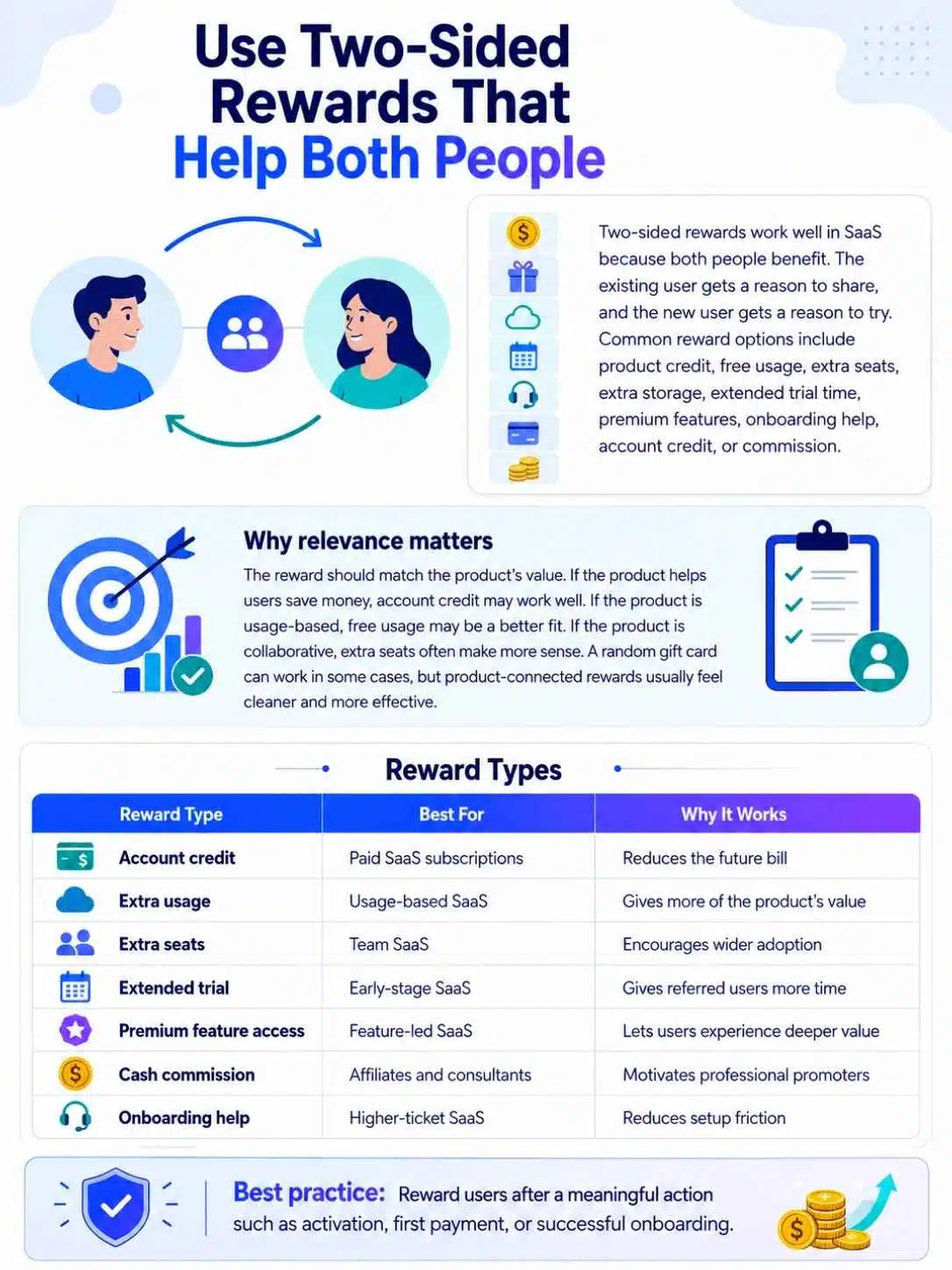
Two-sided rewards work well in SaaS because they reduce friction for both sides. The existing user gets a reason to share. The new user gets a reason to try. This is why many well-known referral systems give value to both the referrer and the referred customer. The reward can be product credit, free usage, extra seats, extra storage, extended trial time, premium features, onboarding help, account credit, or commission.
The key is relevance. A reward should match the product’s value. If the product helps users save money, account credit may work. If the product is usage-based, free usage may work. If the product is collaborative, extra seats may work. A random gift card can work in some cases, but product-connected rewards often feel cleaner.
| Reward Type | Best For | Why It Works |
| Account credit | Paid SaaS subscriptions | Reduces future bill |
| Extra usage | Usage-based SaaS | Gives more of the product value |
| Extra seats | Team SaaS | Encourages more adoption |
| Extended trial | Early-stage SaaS | Gives referred users more time |
| Premium feature access | Feature-led SaaS | Lets users experience deeper value |
| Cash commission | Affiliates and consultants | Motivates professional promoters |
| Onboarding help | Higher-ticket SaaS | Reduces setup friction |
The reward should be easy to understand in one sentence. If the user needs to read a long policy to understand the benefit, the program will underperform. A simple offer might be, “Give 1 month, get 1 month,” or “Invite a team and both accounts get $50 credit after the first paid month.” The qualification rule should also be clear.
Does the reward trigger after signup, activation, trial completion, first payment, or retention for a certain period? In SaaS, I usually prefer rewarding after a meaningful action, not just after signup. Otherwise, you may pay for low-quality leads that never activate. The best reward structure protects both growth and quality.
3. Make the Referral Message Easy to Copy, Personalize, and Send
Many SaaS referral programs fail because the sharing step is awkward. The user clicks “refer,” sees a generic link, and has to invent the message alone. Most people will not do that. A better system gives users a short, natural message they can copy, edit, and send. The wording should not sound like an ad.
It should sound like something a real person would say to a peer. This is especially important in B2B SaaS, where the referrer’s reputation matters. Nobody wants to send a pushy promotional message to a colleague. The message should explain who the product is for, what problem it solves, and why the person might care.
| Message Element | Why It Matters | Better Example |
| Personal opening | Makes it feel human | “Thought this might be useful for your team.” |
| Clear problem | Helps recipient understand fit | “It helps keep client approvals out of email threads.” |
| Short proof | Adds confidence | “We used it for our last two projects.” |
| Simple benefit | Explains value fast | “It made feedback easier to track.” |
| Low-pressure CTA | Reduces resistance | “Worth trying if approvals are slowing you down.” |
| Referral link | Makes action easy | “Here is the invite link.” |
A good referral message should be short enough for LinkedIn DM, email, Slack, or WhatsApp. For example: “Hey, I thought this might help your team. We have been using it to manage client approvals without chasing email threads. It is simple and saves us a lot of back-and-forth. Here is my invite link if you want to try it.”
That sounds far better than “Join this amazing platform and unlock productivity.” Also give users different versions by audience. A founder might refer differently than a customer success manager. An agency owner might need client-focused wording. A developer might want technical clarity. Simple message templates can increase sharing because they remove the hardest part: starting from a blank page.
4. Build Referral Prompts Into Product Sharing Moments
The strongest referral tactics SaaS teams use are often hidden inside product behavior. If your product naturally creates shareable moments, use them. Collaboration tools can prompt invites when users create a workspace. Reporting tools can add referral prompts after users share a report.
Design tools can encourage sharing when someone exports or presents a file. Scheduling tools can place referral options after a successful booking flow. A referral prompt works better when it appears near a natural sharing action. It feels like part of the workflow, not a random marketing pop-up.
| Product Moment | Referral Opportunity | Example |
| User creates a workspace | Invite another team or collaborator | “Invite another team and earn credit.” |
| User shares a report | Recommend the tool to another operator | “Know someone who builds reports manually?” |
| User exports a file | Encourage peer sharing | “Share this tool with a teammate.” |
| User invites clients | Encourage agency referrals | “Refer another agency and both get a bonus.” |
| User completes a project | Ask after success | “Help another team finish faster.” |
| User sends a public link | Add optional product-led sharing | “Powered by” style referral option |
This tactic is close to viral SaaS growth, but it needs to be handled carefully. Product-led sharing should help the user first. If it only helps your company, users will resist it. For example, a public “powered by” badge may work for some free tools, but it can annoy paid B2B users if it feels forced. A better approach is to give users control.
Let them decide whether to show public branding, invite others, or share a template. If your product has a free plan, a subtle referral or invite loop can work well. If your product serves enterprise teams, referral prompts may need to be more private and professional. The best product referral loops feel useful, not sneaky.
5. Create a Customer Advocacy List Before Launching a Big Program
Not every happy user is equally likely to refer. Some users love the product but have no audience. Some have a large network but weak product usage. Some are power users with strong trust among peers. A smart SaaS team should build a customer advocacy list before launching a bigger referral campaign.
This list should include people who have used the product successfully, replied positively, left good feedback, joined webinars, shared posts, participated in communities, or referred informally before. I like this because it prevents the team from blasting referral asks to everyone. You start with the people most likely to care.
| Advocacy Signal | What It Shows | Possible Referral Ask |
| High usage | User gets real value | “Know another team with this workflow?” |
| Positive support reply | User is satisfied | “Would you share this with one peer?” |
| Public praise | User is comfortable recommending | “Can we give you a referral link?” |
| Community activity | User has influence | “Would this help your group?” |
| Case study interest | User has a clear story | “Can we turn this into a referral asset?” |
| Team expansion | Product is spreading internally | “Want to invite another department?” |
Start small. Choose 20 to 50 users who have clear positive signals. Send personal messages instead of automated campaigns. Ask what kind of referral would feel natural to them. Some may prefer account credit. Some may prefer no reward but want a customer story. Some may be consultants who want affiliate commissions.
Some may simply be willing to introduce you to one team. This early group will teach you what reward, wording, and qualification rules make sense. A referral program should not be designed only in a spreadsheet. It should be shaped by real customer behavior.
6. Use Partner, Affiliate, and Consultant Referrals Separately
SaaS teams often mix customer referrals, affiliate referrals, and partner referrals into one messy program. That creates confusion. These groups behave differently. A happy customer may refer one or two peers because they like the product. An affiliate may promote the tool to an audience for commission.
A consultant may recommend it to clients because it fits their implementation work. An agency partner may bring multiple accounts if the product helps their service delivery. These motions need different rewards, tracking, messaging, and support. Treating them as one program makes reporting weak and expectations unclear.
| Referral Type | Who Refers | Best Reward | Best Use Case |
| Customer referral | Existing users | Account credit, free usage, extra months | Peer-to-peer recommendation |
| Affiliate referral | Creators, educators, reviewers | Commission | Audience-based promotion |
| Consultant referral | Advisors and implementation experts | Commission or partner fee | Client recommendations |
| Agency referral | Service providers | Revenue share or client benefit | Multi-client SaaS adoption |
| Integration partner | Complementary software | Co-marketing or partner deal | Shared user base growth |
| Community partner | Niche community owner | Sponsorship, reward, or value exchange | Trusted niche audience |
For a small SaaS team, I would start with customer referrals first. They are usually closest to product value. Once that works, add affiliates or partners carefully. Affiliate programs can bring volume, but they can also bring low-quality traffic if the incentives are too loose. Partner referrals can be powerful, but they need enablement.
Partners need demo assets, onboarding guides, comparison notes, use-case pages, and clear qualification rules. If a consultant refers your product and the client has a poor onboarding experience, that consultant may stop recommending you. Treat referral partners like a sales channel with trust on the line.
7. Turn Reviews, Case Studies, and Templates Into Referral Assets
A referral is easier when the referrer has something useful to send. Do not make users explain everything from scratch. Give them assets. These can include short case studies, one-page explainers, ROI examples, product demo videos, comparison pages, templates, checklists, or industry-specific landing pages.
This is especially useful for B2B SaaS because the referred person may need to evaluate the tool before signing up. A referral link alone is often not enough. A useful resource gives context and makes the recommendation feel more helpful.
| Referral Asset | Best Use | Why It Helps |
| Short case study | Peer recommendation | Shows real outcome |
| One-page explainer | Cold referral | Makes product value clear |
| Demo video | Workflow-heavy SaaS | Shows how the product works |
| Template | Practical sharing | Gives value before signup |
| Comparison page | Competitive buyer | Helps decision-making |
| ROI calculator | Budget-sensitive buyer | Connects product to business value |
| Review collection | Trust-building | Shows outside validation |
For example, if a customer wants to refer your onboarding SaaS to another founder, give them a simple page called “How small SaaS teams reduce onboarding drop-off.” Include a short explanation, a real workflow, proof, and a trial CTA. The user can send that page without writing a long message.
This is where content and referrals connect. Strong content makes word of mouth easier. If you already have customer proof, turn it into referral material. If you have a strong template, add a referral path after the download. If you have a great demo video, give users a version they can share privately. The easier you make it to explain the product, the more referrals you can earn.
8. Measure Referral Quality, Not Just Referral Volume
A referral program can look successful on the surface and still fail. You may get many signups, but if they do not activate, pay, retain, or fit your target customer profile, the program is not working well. This is why SaaS referral programs need quality metrics. Track the full journey from referral share to signup, activation, conversion, retention, expansion, and payback.
Also track the referrer source. One customer may bring three excellent leads. Another affiliate may bring 500 weak signups. Volume alone can mislead you. Referral quality matters more than referral noise.
| Metric | What It Shows | Why It Matters |
| Referral shares | How often users share | Measures program visibility |
| Referral clicks | Whether the message creates interest | Shows message quality |
| Signup rate | Whether the offer is clear | Shows landing page fit |
| Activation rate | Whether referred users reach value | Shows lead quality |
| Paid conversion | Whether referrals become revenue | Shows business impact |
| Retention | Whether referrals stay | Shows true customer fit |
| Reward cost | What the program costs | Protects margins |
| Referrer quality | Who sends strong leads | Helps build advocacy |
A simple referral dashboard can start in a spreadsheet. Track referrer, referred account, date, source, signup, activation, payment, reward, and retention status. If the program grows, use referral or affiliate software that connects with billing. The important point is to avoid rewarding weak activity too early.
If you reward only for signups, people may send unqualified users. If you reward after first payment, quality improves. If your churn is high, you may reward after the user stays active for 30 or 60 days. The right rule depends on your sales cycle and product model. A self-serve SaaS may reward after paid conversion. A higher-ticket B2B SaaS may reward after a qualified demo or closed deal.
A Practical 30-Day SaaS Referral Plan
A referral system should start small. Do not launch a complicated program with 10 reward types, partner tiers, and automation before you know what users will share. The first 30 days should focus on learning.
Identify happy users, test referral wording, choose a simple reward, create one landing page, and track the results manually if needed. This early version helps you avoid building a program nobody wants to use. A small but active referral loop is better than a polished referral page that sits untouched.
| Week | Main Goal | Actions | Output |
| Week 1 | Find referral-ready users | Review usage, feedback, testimonials, support replies, and upgrades | Advocacy shortlist |
| Week 2 | Build the offer | Choose reward, qualification rule, referral landing page, and message templates | Simple referral offer |
| Week 3 | Test with real users | Personally invite 20 to 50 happy users to refer | First referral feedback |
| Week 4 | Measure and improve | Track clicks, signups, activation, conversion, and user comments | Better referral workflow |
In week one, do not ask everyone. Find users who have already shown value. In week two, build a simple offer that can be explained in one sentence. In week three, send personal messages and ask for feedback. Do not only ask them to share. Ask whether the reward feels useful, whether the message sounds natural, and whether they know someone who fits.
In week four, study quality. If people click but do not sign up, improve the landing page. If users want to share but do not know what to say, improve templates. If referred users sign up but do not activate, improve onboarding. This process turns referrals into a learning system, not just a growth trick.
Best Referral Rewards for SaaS Teams
The best referral reward depends on the product, customer type, price point, and buying behavior. A low-cost self-serve SaaS can often use account credit or free months. A usage-based product can give extra usage. A collaborative product can give extra seats. A consultant-driven B2B product may need commission or partner revenue share.
A premium SaaS may offer onboarding support, account review, or strategic consultation. The reward should feel valuable without damaging margins. It should also attract the right people. A reward that is too broad may bring poor-fit users. A reward tied to product value usually brings better alignment.
| Reward | Best Fit | Risk |
| Free month | Subscription SaaS | May attract users who only want discounts |
| Account credit | Paid SaaS | Needs clear billing logic |
| Extra usage | Usage-based SaaS | Must protect infrastructure cost |
| Extra seats | Team SaaS | Works only if team expansion is valuable |
| Premium feature access | Feature-led SaaS | Users may churn after reward ends |
| Cash commission | Affiliates and consultants | Can attract low-quality promotion |
| Onboarding session | Higher-ticket SaaS | Requires team time |
| Donation or community reward | Mission-driven products | May not motivate every user |
A reward should never be more attractive than the product itself. If people refer only for the reward, quality drops. The best reward makes a happy user more likely to act on an existing recommendation impulse. Also think about fraud. Any reward system can be abused if the rules are too loose.
Add basic checks, such as rewarding after a qualified event, limiting self-referrals, reviewing suspicious patterns, and making terms clear. For B2B SaaS, the cleanest rewards are often account credit, free months, partner commission, or added usage after the referred customer becomes active.
Common Mistakes That Make SaaS Referral Programs Fail
Referral programs usually fail for practical reasons. The product is not ready. The reward is unclear. The referral ask comes too early. The message sounds robotic. The landing page does not explain the product. The referred user signs up but never activates. The team measures clicks but not revenue.
Another common mistake is assuming that happy customers will automatically refer. Many satisfied users never share because nobody asks them, the timing is wrong, or they do not know who would benefit. Referral growth needs reminders, assets, and easy sharing.
| Mistake | Why It Hurts | Better Approach |
| Asking too early | Users have not felt value yet | Ask after product wins |
| Rewarding only signups | Brings weak leads | Reward activation or paid conversion |
| Using vague messages | Users do not know what to send | Provide natural templates |
| Ignoring onboarding | Referred users drop off | Improve first-win experience |
| Treating all referrers the same | Different referrers need different rewards | Separate customers, affiliates, and partners |
| Hiding referral program | Users forget it exists | Add prompts in success moments |
| Measuring only volume | Misses poor lead quality | Track activation, revenue, and retention |
The most damaging mistake is building a referral program before the product has retention. Referrals amplify what already exists. If users love the product, referrals can spread trust. If users are confused, referrals spread confusion.
Before asking for referrals, check whether users are returning, completing core actions, inviting teammates, upgrading, and giving positive feedback. If those signals are weak, fix activation first. Referral tactics SaaS teams use should support a strong product experience, not cover up a weak one.
Best Tools for Managing SaaS Referral Programs
Small SaaS teams can start manually with spreadsheets, unique links, coupon codes, and simple email tracking. But as referrals grow, manual tracking becomes messy. You need to know who referred whom, when the referred user converted, what reward is owed, whether the payment was refunded, and whether the referral is qualified.
Referral and affiliate software helps automate this. The right tool depends on whether you want customer referrals, affiliate programs, partner programs, or all of them. If you use Stripe, Paddle, or subscription billing, choose tools that connect cleanly with your revenue data.
| Tool Type | Best For | What to Look For |
| Simple manual tracking | Early testing | Referral source, signup, activation, payment |
| Customer referral software | User-to-user referrals | Invite links, reward rules, fraud controls |
| Affiliate software | Creator and consultant referrals | Commission tracking, dashboards, payouts |
| Partner platform | Larger partner ecosystems | Partner onboarding, co-selling, enablement |
| Billing-connected tool | Subscription SaaS | Revenue tracking, refunds, upgrades, downgrades |
| CRM-connected workflow | Sales-led SaaS | Lead source, deal stage, closed-won attribution |
Tools such as Rewardful, FirstPromoter, and PartnerStack are commonly positioned around SaaS affiliate, referral, and partner workflows. That does not mean every small team needs them on day one. If you have fewer than 20 referrals per month, a simple manual system may be enough while you test the offer.
Once you start dealing with commissions, refunds, partner tiers, recurring revenue, or multiple referrer types, software becomes more useful. The buying rule is simple: do not pay for referral infrastructure before you know the referral motion works. Test the behavior first. Automate after the signal is real.
How Referral Tactics Support SaaS Growth?
Referral tactics work best when they connect with the rest of the growth system. A strong onboarding experience creates happy users. Happy users create referrals. Good landing pages convert referred traffic. Useful templates give people something to share. Reviews and case studies make referrals easier to trust.
Email reminders keep the program visible. Product-led moments make sharing natural. Analytics show which referral sources produce the best customers. This is why referrals should not sit alone as a side campaign. They should be part of the customer journey.
| Growth Area | Referral Connection |
| Activation | Users refer more after reaching value |
| Retention | Long-term users create stronger word of mouth |
| Content | Case studies and templates make sharing easier |
| Product-led growth | Invites and shared assets create natural loops |
| Sales | Warm introductions reduce trust barriers |
| Customer success | Happy customers become advocates |
| Reviews | Public proof strengthens referral confidence |
| Partnerships | Consultants and agencies can refer repeatedly |
This can support Growth Tactics for Bootstrapped SaaS because referral growth connects with product value, customer trust, and low-cost acquisition. A SaaS referral program is not just a reward page.
It is a system that turns customer success into customer-led distribution. When built properly, it can reduce reliance on paid ads, improve lead quality, and create warmer conversations. But it only works when the product is worth recommending.
Final Thoughts
Referral growth is powerful because it starts with trust. A cold ad has to earn attention from zero. A referral arrives with context, familiarity, and borrowed credibility. That is why referral tactics SaaS teams use can become a strong low-cost growth channel when the product already delivers value.
Start with happy users. Ask after real product wins. Offer rewards that make sense. Give people messages and assets they can share easily. Build referral prompts into natural product moments. Separate customer referrals from affiliates and partners. Track quality, not just volume. Most importantly, fix activation before trying to scale referrals.
A referral program should not feel like a gimmick. It should feel like a natural next step for users who already believe the product is useful.
Frequently Asked Questions (FAQs) About Referral Tactics for SaaS
What are the best referral tactics SaaS teams should use?
The best referral tactics SaaS teams should use include asking after product wins, offering two-sided rewards, providing copy-ready messages, placing prompts inside natural sharing moments, building a customer advocacy list, separating customer and partner referrals, creating referral assets, and tracking referral quality.
What makes SaaS referral programs work?
SaaS referral programs work when users already trust the product, the reward is clear, the sharing process is simple, and the referred user gets value quickly. The best programs are connected to customer success, not just marketing.
What is the best reward for a SaaS referral program?
The best reward depends on the product. Account credit, free months, extra usage, extra seats, premium feature access, onboarding help, and commissions can all work. Product-connected rewards usually fit SaaS better than random gifts.
When should a SaaS team ask for referrals?
A SaaS team should ask for referrals after a clear product win. Good moments include onboarding completion, upgrade, positive feedback, usage milestone, successful project completion, or team expansion. Asking too early usually reduces referral quality.
How do you create word of mouth SaaS growth?
Word of mouth SaaS growth comes from a product people trust, clear positioning, strong onboarding, visible proof, useful content, and easy sharing. Referral programs can support word of mouth, but they cannot replace a good customer experience.
Can SaaS referral programs work for B2B products?
Yes. B2B SaaS referral programs can work very well, but they often need more trust and clarity than consumer programs. B2B users care about reputation, fit, security, price, onboarding, and team adoption. The referral message must feel professional and low-pressure.
Viral SaaS growth happens when users naturally bring in more users through product usage, invites, shared outputs, public links, collaboration, or referrals. It works best when sharing is tied to the product’s core value, not forced promotion.
How should SaaS teams measure referral success?
SaaS teams should measure referral shares, clicks, signups, activation rate, paid conversion, retention, reward cost, and revenue by referral source. Referral volume alone is not enough. Quality matters more than raw signups.