
Cold outreach usually breaks before the first email is written.
The problem is often the list, the timing, the offer, or the lack of a clear reason to contact that account now. Better subject lines can help, but they cannot rescue a campaign aimed at the wrong people with a vague message.
The cold outreach tactics SaaS teams should care about are the ones that improve relevance. A good outbound campaign makes the buyer feel, “This is related to something we are actually dealing with.” A weak one feels like another vendor asking for time.
This list is ordered by practical impact. The first tactics shape the campaign foundation: who you contact, why they may care, and how you frame the problem. Later tactics improve response quality, sequencing, proof, and deliverability.
How to Prioritize Cold Outreach Tactics SaaS Teams Can Actually Use
Outbound touches more than copywriting. It involves contact data, email infrastructure, privacy rules, platform terms, CRM hygiene, and sales follow-up. A strong campaign can still fail if the sending setup is weak or if replies are handled slowly.
For SaaS teams selling into the US, UK, Canada, Australia, and Europe, build around a cautious working standard: identify the sender clearly, contact relevant business prospects, avoid deceptive subject lines, make opt-out simple, honor opt-outs, and avoid harvested or automated data practices that create legal or platform risk.
The rules are not identical across markets. US CAN-SPAM covers commercial email and does not exclude B2B messages. Canada’s CASL has stricter consent expectations for commercial electronic messages received in Canada. UK rules distinguish between corporate subscribers and individual subscribers, while UK GDPR can still apply when personal data is processed. Australia’s spam guidance focuses on consent, sender identification, unsubscribe handling, and address-harvesting restrictions. Gmail also has sender requirements that matter for deliverability, especially for teams sending to personal Gmail accounts at scale.
This is not a legal manual. It is a practical warning: outbound should be built properly before volume is increased.
1. Build the ICP Around Buying Triggers, Not Only Company Size
A broad ICP can sound reasonable and still be useless for outreach.
“B2B SaaS companies with 50–500 employees” is a market description. It is not a reason to reply.
A better ICP connects the account to a visible business event. For example:
- A SaaS company hiring implementation managers may have onboarding pressure.
- A product-led company hiring enterprise account executives may be moving upmarket.
- A cybersecurity startup entering Europe may be dealing with compliance, localization, or procurement changes.
- A company advertising RevOps roles may be cleaning up reporting, ownership, and handoff problems.
These are not guaranteed problems. They are working hypotheses. That distinction matters because good outbound does not pretend to know the buyer’s internal situation. It makes a careful, relevant observation and gives the buyer an easy way to confirm or reject it.
This is the highest-impact tactic because it improves every step after it. A weak list forces an SDR to fake relevance. A strong list gives the message a real starting point.
Start smaller than feels comfortable. One segment. One trigger. One pain. A campaign to 300 well-matched accounts will usually teach more than a generic send to 10,000 contacts.
2. Use Signal-Based Prospecting Instead of Static Lead Lists
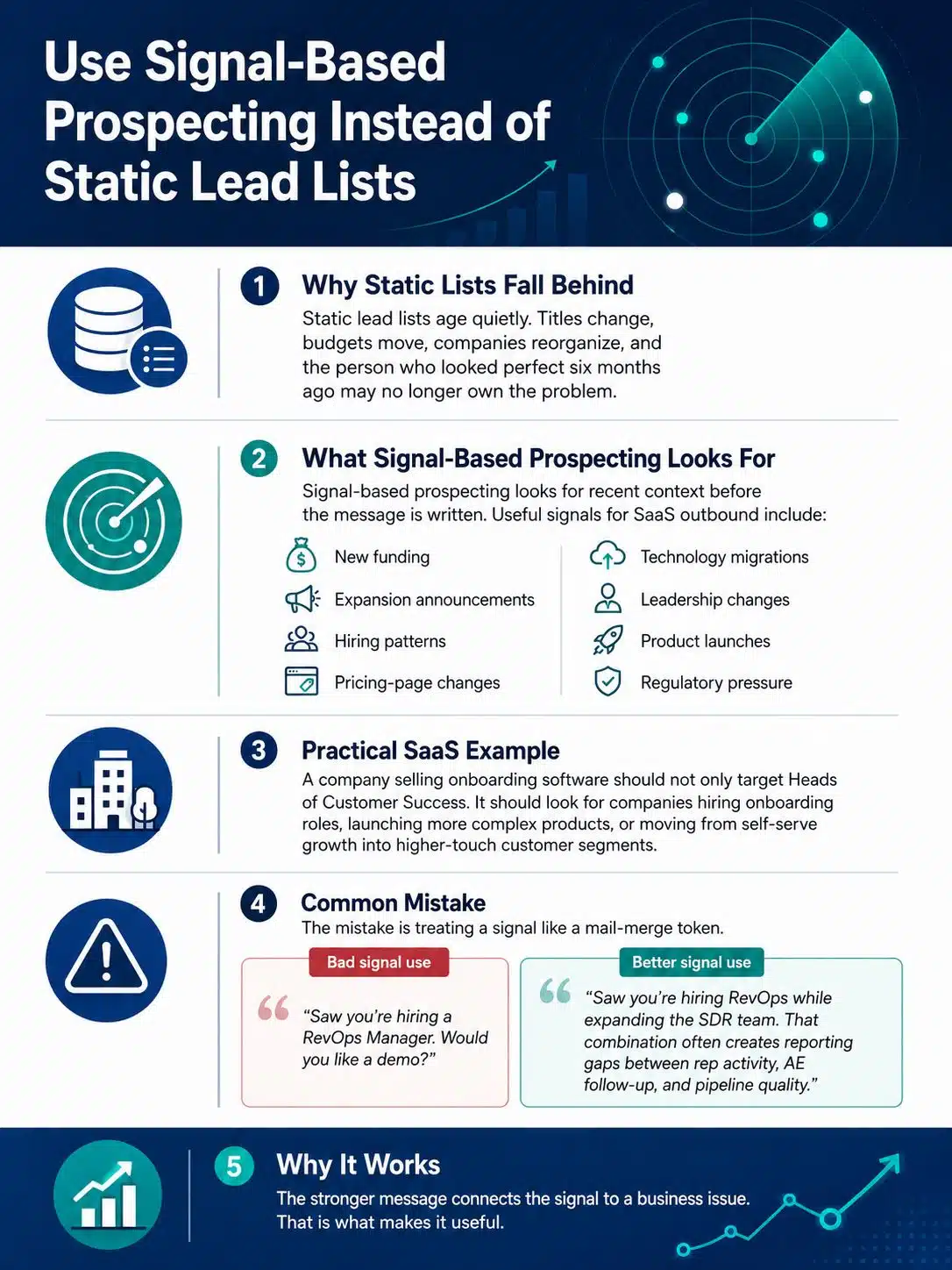
Static lead lists age quietly. Titles change, budgets move, companies reorganize, and the person who looked perfect six months ago may no longer own the problem.
Signal-based prospecting looks for recent context before the message is written. Useful signals for SaaS outbound include new funding, expansion announcements, hiring patterns, pricing-page changes, technology migrations, leadership changes, product launches, or regulatory pressure.
A company selling onboarding software, for instance, should not only target Heads of Customer Success. It should look for companies hiring onboarding roles, launching more complex products, or moving from self-serve growth into higher-touch customer segments.
The mistake is treating a signal like a mail-merge token.
Bad signal use:
“Saw you’re hiring a RevOps Manager. Would you like a demo?”
Better signal use:
“Saw you’re hiring RevOps while expanding the SDR team. That combination often creates reporting gaps between rep activity, AE follow-up, and pipeline quality.”
The second version connects the signal to a business issue. That is what makes it useful.
3. Write the First Line From Business Context, Not Flattery
Flattery is one of the easiest ways to make a cold email sound fake.
“Loved your recent post” can work if the message actually discusses the post. “Huge fan of what you’re building” usually sounds like a template.
A better first line is plain and specific:
“Acme’s new enterprise plan and open RevOps role suggest the team may be formalizing sales handoffs.”
That line is not trying to be charming. It gives the reader a reason to continue.
The word “suggest” is doing important work. It keeps the message honest. You are not claiming to know the company’s internal priorities. You are making a reasonable observation based on public context.
For SaaS outreach, that tone is stronger than praise. Buyers do not need admiration from strangers. They need relevance.
4. Lead With the Problem Before the Product
Many SaaS cold emails explain the product too early.
“We help SaaS companies grow pipeline with an AI-powered revenue platform” may be clear to the sender, but it asks the buyer to do too much work. What problem does it solve? Why now? Why this company?
A stronger opener names a situation the buyer may recognize:
“Teams moving from founder-led sales to a dedicated SDR motion often run into messy account ownership, inconsistent follow-up, and unclear CRM notes.”
That gives the prospect something concrete to react to.
This matters most in crowded categories: CRM, sales engagement, analytics, customer success, AI tools, HR software, finance operations, cybersecurity, and project management. Buyers have heard every broad platform claim. A sharper problem statement has a better chance because it speaks to work already happening inside the business.
The product still matters. It just should not arrive before the pain is clear.
5. Personalize at the Account Level Before the Contact Level
Contact-level personalization gets too much credit.
Mentioning someone’s podcast, university, or LinkedIn activity may help, but it rarely fixes weak targeting. For B2B SaaS, account-level personalization is usually more valuable because the buying decision comes from a company problem.
A useful account hypothesis might be:
“Your team appears to be expanding outbound in North America while still hiring for sales operations. That often creates reporting gaps between SDR activity, AE follow-up, and pipeline quality.”
From there, adjust the angle by role:
- VP Sales: rep consistency, pipeline quality, missed follow-up
- RevOps: CRM hygiene, routing, reporting, attribution
- Founder: speed, focus, and predictable revenue
- Finance leader: acquisition efficiency and waste in the funnel
This approach takes more thought than inserting a compliment. It also scales better because one account insight can support several stakeholder-specific messages.
A good test: if the opening line could be sent to 500 companies without changing much, it is not real personalization.
6. Make the CTA Smaller and More Specific
The first cold email rarely earns a full product demo. It may earn curiosity, clarification, or permission to send something useful.
“Are you free for a quick 30-minute demo?” asks for too much when the buyer has not yet agreed that the problem matters.
Smaller CTAs work better when they match the stage of the conversation:
- “Worth sending over a two-minute breakdown?”
- “Is this owned by RevOps or Sales on your side?”
- “Would a short teardown of the handoff flow be useful?”
- “Should I send the checklist we use for this?”
- “Open to a brief call next week if this is already on the roadmap?”
The CTA should not hide the sales intent. Buyers know why vendors reach out. The point is to make the next step feel reasonable.
For a high-intent account, a direct meeting ask may be fine. For a colder account, a smaller step often creates a cleaner reply.
7. Build Sequences Around Buyer Behavior, Not Repetition
A sequence is not six versions of “just checking in.”
Busy buyers behave unevenly. One person reads the first email and replies later. Another forwards it internally. Another checks the sender’s LinkedIn profile. Another ignores email but answers a short call. Some need a different angle because the first message was relevant but not urgent.
A practical SaaS sequence might look like this:
- First email: account-specific problem
- Light LinkedIn touch: no pitch
- Second email: sharper use case or stakeholder angle
- Call: brief, respectful, and not over-scripted
- Third email: useful asset, teardown, checklist, or benchmark
- Close-out email: polite, clear, and opt-out friendly
Do not add touches just to hit a sequence length. Each touch should add something: new context, a better example, a useful resource, or a simpler reply path.
Enterprise accounts can justify more manual work. Lower-priced SaaS offers usually need a tighter motion because the economics do not support heavy research for every prospect.
8. Use LinkedIn as a Trust Channel, Not a Spam Channel
LinkedIn can support SaaS outbound, but it is often misused.
The best use is not mass pitching. It is credibility. A complete profile, relevant posts, thoughtful comments, and a calm connection request can make an email feel less anonymous.
Avoid the habits that make prospects suspicious:
- Sending the pitch immediately after a connection is accepted
- Using the same connection note for every prospect
- Leaving generic comments on dozens of posts
- Scraping contacts or automating profile activity
- Treating LinkedIn DMs as a second spam folder
LinkedIn restricts third-party tools and extensions that scrape, modify, or automate activity on the platform. That matters for outbound teams because some “growth hacks” create account risk and damage trust.
For most SaaS teams, LinkedIn should support the email motion. It can warm familiarity, show credibility, and give the prospect a way to check who is contacting them. It should not replace relevance.
9. Write for the Buying Committee, Not One Persona
Many SaaS products are not bought by one person.
A VP Sales, RevOps lead, CFO, Head of Customer Success, Product leader, and Engineering manager may all care about the same tool for different reasons. Sending the same message to each person wastes that reality.
For example, a product analytics company could frame the same core offer differently:
- Product cares about feature adoption and roadmap decisions.
- Customer Success cares about churn risk and expansion signals.
- Sales cares about product-qualified leads and expansion timing.
- Finance cares about retention and revenue quality.
- Engineering cares about instrumentation effort and data reliability.
That does not mean creating five unrelated campaigns. Keep the account hypothesis consistent. Change the business reason by stakeholder.
This also helps with internal forwarding. A good cold email may not get an immediate “yes.” It may get passed to the person who owns the problem. Make that forward easy by writing something specific enough to be useful inside the company.
10. Use Proof That Reduces Risk, Not Decorative Social Proof
“Trusted by leading teams” is weak proof. So is “used by fast-growing companies” unless the buyer can see why it matters.
Useful proof helps the prospect judge risk.
For SaaS outreach, that may include:
- A named customer, only when permission allows it
- A case study from a similar company size or market
- A before-and-after workflow example
- A security, compliance, or integration detail that removes a blocker
- A customer category when names cannot be shared
- A clear explanation of the operational problem solved
Be careful with numbers. Do not turn one customer result into a promise for every prospect. Do not imply the buyer will get the same outcome unless the evidence supports it.
A modest, specific proof line is often better than a dramatic one:
“Teams at this stage usually are not short on SDR activity. They are short on clean handoffs and reliable follow-up reporting.”
Use that kind of line only if your team can honestly support it. Vague proof is forgettable. Inflated proof creates mistrust.
11. Offer a Useful Asset Instead of Asking for a Demo Every Time
Some buyers are not ready for a demo, but they may engage with something useful.
That asset does not need to be complicated. It does need to be relevant.
Useful outbound assets can include:
- A short teardown of the prospect’s onboarding flow
- A benchmark checklist
- A migration planning worksheet
- A security questionnaire guide
- A cost or time calculator
- A one-page workflow comparison
- A short account-specific video, if it is actually specific
The asset should not be a brochure with a better title. If the whole document is really a product pitch, buyers will notice.
This tactic is especially useful for complex SaaS products where the buyer first needs to understand the cost of the problem. It also gives SDRs a better follow-up than “bumping this up.”
One warning: do not overproduce assets for weak accounts. A custom teardown is useful for high-value targets. For smaller accounts, a reusable checklist or short Loom-style walkthrough may be more realistic.
12. Test Campaign Hypotheses, Not Only Subject Lines
Subject-line testing is easy, so teams do too much of it.
Open rates matter, but they are not the same as pipeline. A better subject line cannot fix poor timing, weak targeting, or an offer the buyer does not care about.
More useful tests ask:
- Which buying trigger produces better replies?
- Which job title understands the pain fastest?
- Which pain angle creates better demos?
- Which CTA produces a useful reply?
- Which segment moves from reply to opportunity?
Keep tests clean. If the list, message, CTA, timing, and proof point all change at once, the result will be hard to interpret.
Smaller teams should also avoid overreading tiny samples. If a campaign receives only a few replies, read them carefully before making broad decisions. Sometimes the best feedback is not in the dashboard. It is in the wording of the replies.
13. Treat Deliverability as Part of the Sales Strategy
Deliverability is not only a technical concern. It decides whether the campaign gets a fair chance.
For SaaS teams, the basics are not optional:
- Authenticate sending domains.
- Use clean, relevant contact lists.
- Avoid sudden sending spikes.
- Remove invalid contacts quickly.
- Keep subject lines honest.
- Make unsubscribing easy.
- Review bounce, complaint, reply, and unsubscribe trends.
Gmail’s current sender guidance includes authentication expectations, additional rules for high-volume senders to personal Gmail accounts, TLS transmission, spam-rate guidance, and unsubscribe expectations for marketing or subscribed messages. These details can change, so teams should check current documentation before scaling.
Aggressive outbound often becomes self-defeating. Teams buy broad lists, rotate domains carelessly, send too fast, and treat unsubscribes like a nuisance. Even decent copy struggles when the sending system damages trust.
The best cold outreach tactics SaaS teams use protect the channel as much as they improve persuasion.
What to Try First
If outbound is underperforming, do not start by rewriting every email.
Start with the list. Pick one SaaS segment where the pain is visible, recent, and tied to a business event. Build the campaign around that trigger. Write one clear account hypothesis. Use a smaller CTA. Add one useful asset or proof point. Then judge replies by quality, not only by volume.
Good outbound should feel like a relevant business note from someone who did the work before pressing send. That is the standard worth building toward.
FAQs about Cold Outreach Tactics SaaS
How many touches should a SaaS cold outreach sequence include?
There is no fixed number that works for every SaaS company. A low-ticket product with a broad audience usually needs a shorter sequence because the deal economics cannot support heavy manual work. Enterprise SaaS outreach can justify more touches if each message adds new value.
Are cold emails legal for B2B SaaS companies?
They can be, but the rules vary by country, recipient type, consent basis, and data source. SaaS teams selling globally should check the rules for each target market before scaling. Identification, opt-out handling, consent, personal-data processing, and list sourcing all matter.
What should a SaaS cold email include?
A strong SaaS cold email usually needs a relevant account signal, a clear business problem, a short credibility point, one simple offer, and an easy way to reply or opt out. It should not try to explain the full product in the first message.
Should SaaS teams use AI for cold outreach?
AI can help draft variations, summarize account research, and prepare role-specific angles. It should not invent personalization, fake proof, or send unchecked messages at scale. Use it to speed up preparation, then review the facts, tone, and relevance before sending.