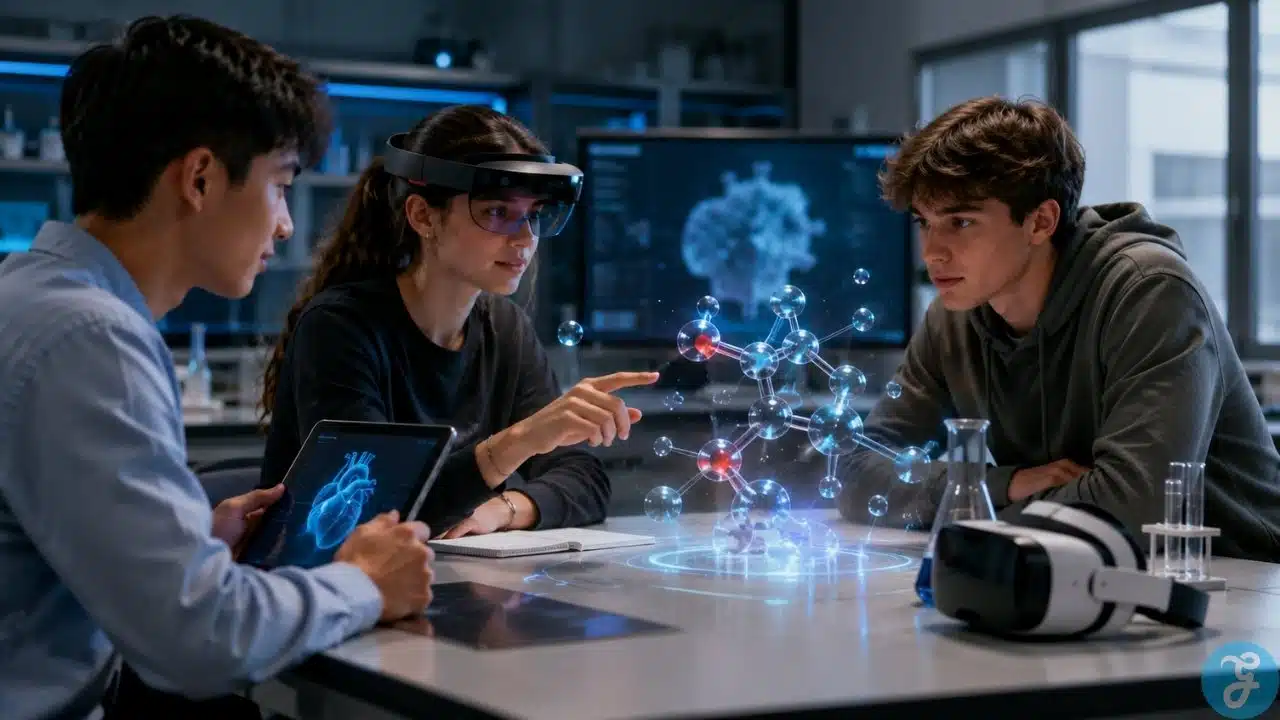
A real lab teaches students through risk, friction, failure, and repetition. The problem is that real labs are expensive, crowded, time-limited, and sometimes impossible to access. That is why 3D Simulations & Virtual Labs are becoming one of the most practical parts of modern EdTech: they let learners test, repeat, explore, break things safely, and build confidence before they touch the real equipment.
Our Selection Criteria
For this list, the country decision came before the company selection. I compared the United States, Denmark, and India because all three have credible activity in virtual labs, simulation-based learning, immersive STEM education, and XR-powered training. Then I filtered the company list to include only U.S.-based SMEs, startups, or specialist education technology companies with clear relevance to 3D simulation, virtual labs, spatial learning, immersive training, or interactive virtual practice.
The companies were selected using these criteria:
- Headquartered, incorporated, or operationally rooted in the United States.
- SME, startup, private company, specialist EdTech provider, or SME-scale public education technology company.
- Clear connection to 3D simulations, virtual labs, XR learning, VR training, interactive anatomy, healthcare simulation, STEM labs, or skills-based simulation.
- Publicly visible website, company profile, contact path, product page, or credible third-party verification.
- Useful for K-12 schools, higher education, workforce training, healthcare education, STEM programs, or technical training.
- Excluded generic LMS tools, basic video-course companies, large Big Tech platforms, and companies where simulation was only a minor feature.
Why the United States and not Denmark or India?
Denmark has one of the world’s best-known virtual lab companies through Labster, and India has a growing set of simulation and XR education providers. However, the United States wins this list because it has more verified SME-scale companies across K-12 STEM, higher education labs, healthcare training, workforce simulations, virtual anatomy, and immersive technical training.
Here is how the country comparison shaped the final decision:
| Country Considered | Strength in 3D Simulations & Virtual Labs | SME/Startup Depth | Final Assessment |
|---|---|---|---|
| United States | Strong across STEM labs, VR training, virtual anatomy, healthcare simulations, and workforce skill labs | Deepest visible pool of verified U.S.-based SMEs and startups | Selected |
| Denmark | Very strong virtual lab reputation, especially because of Labster | Strong quality, but smaller country-level company depth for a top 10 SME list | Not selected |
| India | Fast-growing XR and simulation education market | Promising, but more mixed across services, training simulators, and broader EdTech | Not selected |
10 U.S. EdTech SMEs Building 3D Simulations & Virtual Labs for Practical Learning
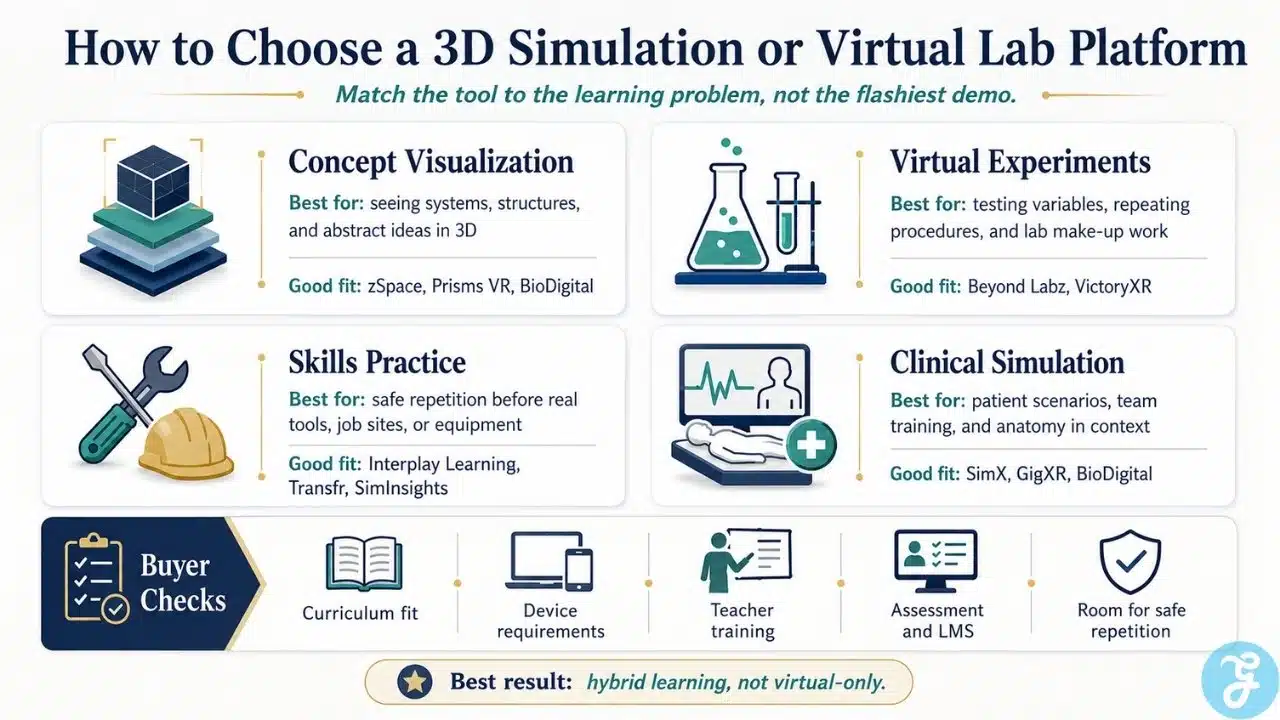
The U.S. market is not built around one type of virtual lab. Some companies help students explore science concepts in 3D. Some let learners practice trades before entering a job site. Others recreate hospitals, patients, anatomy labs, or technical systems in immersive environments. That variety makes the market useful, but it also means buyers need to choose based on the learning problem, not the flashiest demo.
1. zSpace
Headquarters: San Jose, California, United States
Website: zspace.com
Email: support@zspace.com
zSpace builds AR and VR learning systems for STEM, CTE, career readiness, and technical education. Its strongest value is that students can interact with 3D models and simulations without relying only on headsets, which can make classroom deployment more manageable. The platform supports virtual experiments, science visualization, technical training, and hands-on exploration of concepts that are hard, expensive, or unsafe to recreate physically. For schools building immersive STEM labs, zSpace is one of the most established U.S. names.
Best Feature/For:
- Best for schools and technical centers building immersive STEM and CTE labs.
- Strong for 3D visualization, hands-on virtual experiments, and career readiness programs.
Why We Chose It:
- Clear U.S. education technology roots.
- Strong connection to 3D learning, AR, VR, and STEM simulation.
- Useful for K-12, higher education, and workforce training environments.
- More classroom-ready than many headset-only immersive learning tools.
Things to consider:
- Hardware and implementation costs should be reviewed carefully.
- Teachers need training to turn 3D exploration into measurable learning.
2. VictoryXR
Headquarters: Davenport, Iowa, United States
Website: victoryxr.com
Email: Info@VictoryXR.com
VictoryXR creates immersive education products, including virtual classrooms, 3D learning environments, and VR simulation labs. Its VXRLabs and classroom simulation products are especially relevant for schools and colleges that want safe, repeatable science and anatomy experiences. The company’s approach is more structured than a one-off VR demo because it packages content, classroom environments, and learning use cases together. For institutions exploring virtual campuses or simulation labs, VictoryXR is a serious U.S. contender.
Best Feature/For:
- Best for schools and colleges building immersive VR classrooms and simulation labs.
- Strong for science labs, anatomy, virtual campuses, and spatial learning environments.
Why We Chose It:
- Strong U.S. immersive education company profile.
- Offers simulation lab products, not just generic VR content.
- Serves K-12, higher education, and homeschool learning contexts.
- Useful for institutions that want packaged immersive learning experiences.
Things to consider:
- Schools should check device requirements and content alignment before rollout.
- The strongest results come when VR is tied to a clear instructional sequence.
3. Beyond Labz
Headquarters: Provo, Utah, United States
Website: beyondlabz.com
Email: support@beyondlabz.com
Beyond Labz is one of the most direct fits for this list because it specializes in open-ended virtual science labs. Its products cover chemistry, organic chemistry, biology, and physics, giving students a way to experiment, repeat procedures, troubleshoot mistakes, and work through lab activities without needing physical lab time. The platform is especially useful for higher education, remote lab access, lab makeups, and institutions dealing with limited equipment or scheduling constraints. It stands out because it focuses on the actual lab workflow, not just animated science content.
Best Feature/For:
- Best for virtual chemistry, biology, organic chemistry, and physics labs.
- Strong for colleges, secondary schools, remote courses, and lab makeup work.
Why We Chose It:
- Direct virtual lab specialization.
- Supports open-ended lab workflows instead of only guided demonstrations.
- Fits higher education and STEM course needs clearly.
- U.S.-based SME profile with a focused virtual lab product.
Things to consider:
- Some learners may still need physical lab exposure for equipment confidence.
- Instructors should design assignments that require reasoning, not just clicking through.
4. Prisms VR
Headquarters: San Francisco, California, United States
Website: prismsvr.com
Email: hello@prismsvr.com
Prisms VR focuses on spatial learning for math and STEM, helping students understand abstract concepts through immersive experiences. Instead of starting with formulas on a page, Prisms builds from physical, visual, and embodied experiences so students can feel the logic behind the concept. That makes it useful for learners who struggle with traditional symbolic instruction. Its strongest fit is middle and high school STEM, where students often need a bridge between real-world intuition and formal math or science language.
Best Feature/For:
- Best for immersive math and STEM simulations.
- Strong for grades 7-12 learners who need visual, spatial, and experiential concept support.
Why We Chose It:
- U.S.-based EdTech startup with clear spatial learning focus.
- Strong alignment with math and science learning.
- Uses VR to make abstract concepts more physically understandable.
- Good fit for schools trying to improve STEM engagement and comprehension.
Things to consider:
- It works best when teachers guide reflection after the immersive experience.
- Schools should check device availability and classroom management fit.
5. SimInsights
Headquarters: Lake Forest, California, United States
Website: siminsights.com
Email: info@siminsights.com
SimInsights builds immersive AI-powered AR and VR training solutions for education and enterprise learning. Its HyperSkill and Skillful products support simulation creation, publishing, evaluation, and career exploration across multiple industries. The company is relevant because it gives organizations a way to create or deploy immersive simulations without always starting from scratch. For schools, workforce programs, and universities that want flexible simulation-based training, SimInsights brings both authoring tools and simulation content into one ecosystem.
Best Feature/For:
- Best for institutions that want to create, deploy, and evaluate immersive simulations.
- Strong for career exploration, STEM, healthcare, manufacturing, and skills training.
Why We Chose It:
- U.S.-based simulation and immersive learning company.
- Strong focus on AI-powered AR/VR training.
- Provides authoring and simulation catalog capabilities.
- Useful for organizations needing custom or scalable immersive learning content.
Things to consider:
- Buyers should clarify whether they need ready-made simulations, authoring tools, or custom development.
- Teams need internal ownership to keep simulations current and useful.
6. Transfr
Headquarters: New York, New York, United States
Website: transfrinc.com
Email: info@transfrvr.com
Transfr builds immersive VR training and career exploration solutions for workforce education. Its simulations help learners experience job tasks, career pathways, and hands-on skills before entering real workplaces. While it is not a traditional science lab company, it fits this list because it turns practical skill training into repeatable virtual practice. For secondary education, post-secondary programs, workforce boards, and nonprofits, Transfr is one of the strongest U.S. options for simulation-based career readiness.
Best Feature/For:
- Best for workforce development and career exploration simulations.
- Strong for schools, colleges, nonprofits, and job-training programs.
Why We Chose It:
- U.S.-based immersive workforce education company.
- Strong product fit for simulation-based career training.
- Helps learners practice job scenarios safely before real placement.
- Useful for programs trying to connect education with employability.
Things to consider:
- It is stronger for career readiness than traditional academic science labs.
- Program leaders should evaluate whether the simulation catalog matches local labor needs.
7. Interplay Learning
Headquarters: Austin, Texas, United States
Website: interplaylearning.com
Email: support@interplaylearning.com
Interplay Learning provides online and VR training for skilled trades, including HVAC, plumbing, electrical, solar, and facilities maintenance. Its strongest value is in field-like 3D simulations that let learners practice procedures before handling real equipment or job-site problems. This makes it highly relevant for technical education, apprenticeships, employer training, and career programs. Interplay shows where virtual labs are moving outside biology and chemistry into practical workforce learning.
Best Feature/For:
- Best for skilled trades training through 3D and VR simulations.
- Strong for HVAC, electrical, plumbing, solar, and facilities maintenance programs.
Why We Chose It:
- U.S.-based EdTech and workforce training company.
- Clear 3D simulation and VR training specialization.
- Strong fit for technical education and employer-led upskilling.
- Helps reduce risk before learners work on real systems.
Things to consider:
- It is trade-focused, so it will not fit general science lab needs.
- Programs should pair simulation work with supervised hands-on practice.
8. BioDigital
Headquarters: New York, New York, United States
Website: biodigital.com
Email: support@biodigital.com
BioDigital creates an interactive 3D human anatomy, disease, and treatment visualization platform. It is not a full wet-lab simulator, but it functions like a virtual anatomy and health education environment for medical educators, clinical trainers, and students. Its value is in making complex body systems visible, searchable, customizable, and easier to teach through 3D interaction. For health science courses that need anatomy exploration without constant access to cadavers or physical models, BioDigital is a strong U.S. pick.
Best Feature/For:
- Best for interactive 3D anatomy, disease, and treatment education.
- Strong for medical education, nursing, health science, and patient education teams.
Why We Chose It:
- U.S.-based company with a dedicated 3D human platform.
- Strong relevance to virtual anatomy learning.
- Useful for instructors who need customizable 3D visual content.
- Bridges classroom, anatomy lab, LMS, and presentation workflows.
Things to consider:
- It is more visualization-focused than procedure simulation-focused.
- Instructors should connect 3D exploration to assessments and clinical reasoning.
9. SimX
Headquarters: San Francisco, California, United States
Website: simxvr.com
Email: customersupport@simxvr.com
SimX builds VR medical simulation software for nurses, physicians, EMS teams, military medical learners, and healthcare institutions. Its platform offers virtual patient encounters, immersive environments, multiplayer training, and customizable simulation scenarios. It is a strong fit for medical and clinical education because it lets teams practice high-risk or low-frequency events without waiting for those cases to appear in real life. For healthcare educators, SimX is one of the clearest U.S. examples of a virtual clinical lab.
Best Feature/For:
- Best for VR medical simulation and virtual patient encounters.
- Strong for nursing schools, hospitals, EMS programs, and military medical training.
Why We Chose It:
- U.S.-based healthcare simulation company.
- Strong connection to immersive virtual patient training.
- Supports team-based practice and repeated clinical scenarios.
- Useful for building judgment before real patient encounters.
Things to consider:
- Medical simulation requires strong facilitation, not just headset access.
- Institutions should check scenario fit, privacy, and implementation support.
10. GigXR
Headquarters: Santa Monica, California, United States
Website: gigxr.com
Email: support@gigxr.com
GigXR develops holographic and mixed reality healthcare training applications for higher education, medical education, and enterprise learning. Its platform includes immersive applications such as holographic patients and anatomy learning tools that can support clinical reasoning and simulation-based education. The company is especially relevant where educators need realistic visual cues, repeatable patient scenarios, or mixed reality alternatives to expensive physical simulation resources. GigXR belongs on this list because it shows how virtual labs are becoming more collaborative, holographic, and healthcare-specific.
Best Feature/For:
- Best for holographic healthcare training and mixed reality clinical learning.
- Strong for nursing, medical, and healthcare education programs.
Why We Chose It:
- U.S.-based immersive learning provider.
- Clear focus on healthcare training through XR applications.
- Offers patient and anatomy simulation experiences.
- Useful for institutions looking beyond traditional mannequins and cadavers.
Things to consider:
- Mixed reality implementation can require technical support and faculty preparation.
- Buyers should evaluate device compatibility and total classroom workflow.
An Overview Of United States 3D Simulations & Virtual Labs
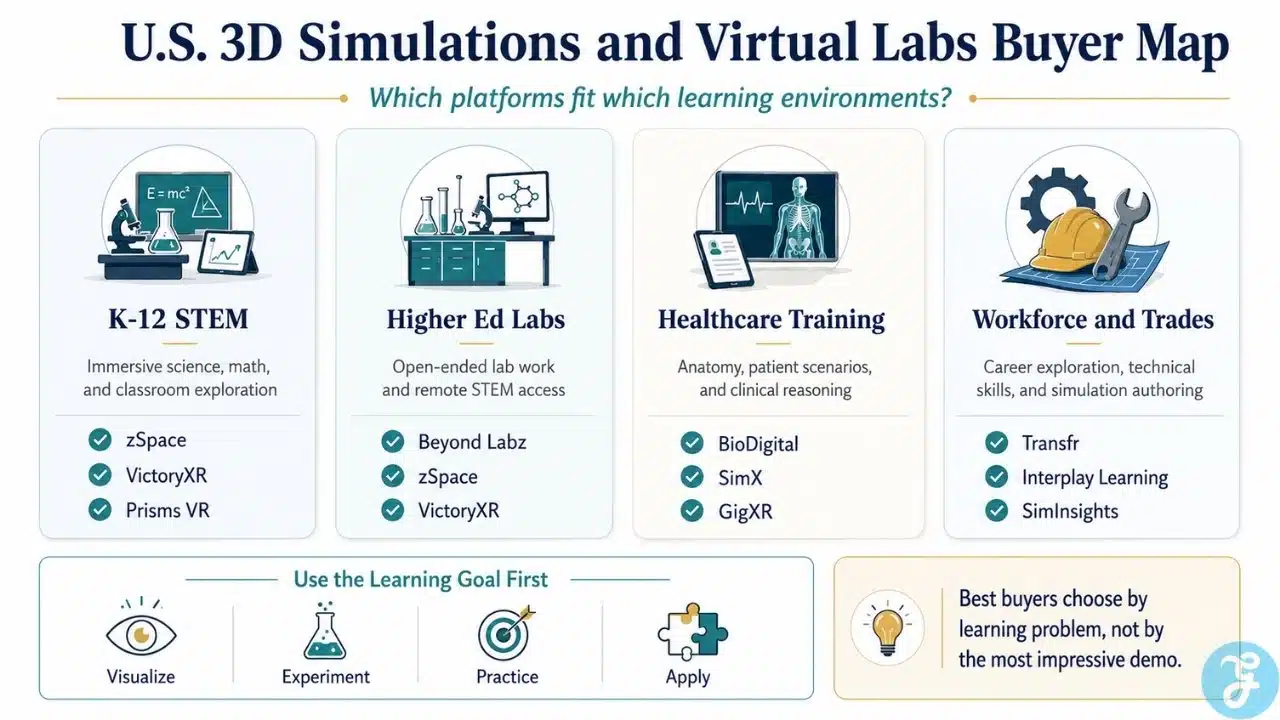
The United States is strong in this niche because it has more than one kind of simulation company. Some vendors solve classroom STEM access. Others solve healthcare practice, trades training, anatomy visualization, or workforce readiness. That breadth is useful, but it also means a buyer can easily choose the wrong tool if they only chase the most impressive demo.
Overview Comparison Table
The comparison below shows where each company fits best, so readers can match the product to the learning problem rather than treating every immersive platform as the same thing.
| Company | Best Fit | Core Strength | Strongest Buyer Type |
| zSpace | STEM and CTE labs | AR/VR 3D learning stations and simulations | Schools, technical centers, colleges |
| VictoryXR | Immersive classrooms | VR simulation labs and spatial learning environments | K-12, higher education, homeschool groups |
| Beyond Labz | Science virtual labs | Open-ended chemistry, biology, organic chemistry, and physics labs | Colleges, secondary schools, remote STEM courses |
| Prisms VR | STEM concept learning | Spatial math and science simulations | Middle and high schools |
| SimInsights | Simulation authoring and catalog | AI-powered AR/VR training and simulation creation | Schools, universities, workforce programs |
| Transfr | Career exploration | VR workforce simulations and job training | Secondary, post-secondary, workforce development |
| Interplay Learning | Skilled trades | 3D and VR simulations for trades training | Technical education, employers, apprenticeships |
| BioDigital | Anatomy education | Interactive 3D human body visualization | Medical, nursing, and health science educators |
| SimX | Medical simulation | VR patient encounters and clinical team training | Hospitals, nursing schools, EMS programs |
| GigXR | Holographic healthcare labs | Mixed reality patients, anatomy, and clinical learning | Medical schools, nursing programs, healthcare training teams |
Our Top 3 Picks and Why?
The best pick depends on the buyer’s setting. A high school science department, a medical school, and a workforce training provider are not shopping for the same kind of lab.
| Rank | Pick | Why It Stands Out |
| 1 | Beyond Labz | Best pure virtual lab pick because its product is built around open-ended science experiments, not just 3D visualization. |
| 2 | zSpace | Best classroom-ready immersive STEM pick because it combines hardware, content, and 3D interaction for schools. |
| 3 | SimX | Best healthcare simulation pick because it gives clinical learners repeatable VR patient encounters and team-based practice. |
What 3D Simulations & Virtual Labs Buyers Should Notice
The most important difference is whether the platform teaches a concept, simulates a procedure, or lets students experiment. A 3D anatomy platform may be excellent for visualization but weak for hands-on lab reasoning. A VR career simulator may build confidence for job tasks but will not replace chemistry labs. A true virtual lab must let learners make decisions, test variables, see consequences, and try again.
Why are 3D Simulations & Virtual Labs Booming in the United States
3D Simulations & Virtual Labs are booming in the United States because schools, colleges, and training providers are under pressure to do more with limited time, space, equipment, and faculty capacity. Physical labs remain important, but they are expensive to run, hard to scale, and difficult to access equally across districts or programs. Virtual labs help institutions add practice time without needing another building, another lab bench, or another set of consumables.
What’s their secret sauce?
The secret sauce is safe repetition. Students can fail a chemistry procedure, reset a virtual patient encounter, repeat an HVAC diagnostic, revisit a 3D anatomy model, or practice a dangerous job task without putting themselves or others at risk. That matters because learning often comes from doing something wrong and understanding why.
The stronger U.S. companies also understand that simulation cannot be only visual. It needs feedback, data, instructor visibility, assessment, curriculum alignment, and a reason to return. A beautiful 3D model may impress students once. A well-designed virtual lab helps them think, test, improve, and explain what happened.
The Future Lab Will Be Hybrid, Not Fully Virtual
My honest view is that virtual labs are powerful, but they should not be sold as a magical replacement for physical learning. A student can master a simulation and still feel awkward when holding real equipment. A nursing learner can handle a virtual patient well and still need practice with human emotion, pressure, and clinical messiness. The uncomfortable truth is that some institutions may buy immersive tools because they look innovative, not because they have a clear teaching plan.
The future of 3D Simulations & Virtual Labs in the United States will likely be hybrid. Students will prepare in virtual environments, make early mistakes safely, build conceptual confidence, and then apply that learning in physical labs, clinics, job sites, or workshops. That is where the real value lives.
The winners will not be the companies with the shiniest headset demo. They will be the companies that help teachers teach better, help students practice more honestly, and help institutions expand access without lowering standards. A virtual lab should not remove reality from learning. It should prepare students to meet reality with more skill.
Frequently Asked Questions (FAQs) About 3D Simulations & Virtual Labs
What are 3D Simulations & Virtual Labs?
3D Simulations & Virtual Labs are digital learning environments where students can explore concepts, run experiments, practice skills, or complete training scenarios in interactive 3D spaces. They may use web platforms, desktops, VR headsets, AR devices, or mixed reality tools.
Why was the United States selected for this list?
The United States was selected because it has the strongest visible pool of verified companies across virtual science labs, immersive STEM education, healthcare simulation, skilled trades training, and 3D anatomy platforms. Denmark and India are strong, but the U.S. has more company depth for a full top 10 SME list.
Can virtual labs replace physical labs?
Not fully. Virtual labs are excellent for preparation, repetition, access, and safe failure, but physical labs still matter for tactile skills, equipment handling, real-world uncertainty, and professional confidence.
Which platform is best for science labs?
Beyond Labz is one of the strongest pure virtual science lab options because it focuses on chemistry, biology, organic chemistry, and physics lab workflows. zSpace and VictoryXR are stronger when the buyer wants broader immersive STEM and 3D classroom experiences.
What should schools check before buying a virtual lab platform?
Schools should check curriculum alignment, device requirements, accessibility, teacher training, assessment tools, LMS integration, support quality, and whether students can make meaningful choices inside the simulation. The best demo should show learning value, not just visual effects.