When you hear “July 4,” the immediate image that flashes into the minds of millions is fireworks, summer barbecues, and the American Declaration of Independence. It is undeniably a cornerstone date in Western history. However, looking at the fourth of July through a singular, geographically limited lens causes us to miss a massive, intricate tapestry of global history.
This specific date has been a magnet for paradigm-shifting moments across the globe. It is the day humanity discovered the “God particle,” the day one of the most horrific genocides of the 20th century was finally halted in Africa, and the day the legal machinery for the partition of the Indian subcontinent was set into motion. It has witnessed the birth of brilliant scientists and the eerie, synchronized deaths of founding fathers.
If you want to truly understand the historical weight of this day, we need to travel across continents and centuries. Here is your comprehensive, in-depth guide to everything that makes July 4 a monumental day in human history.
Quick Glance: Major Global Events on July 4
| Year | Region | Historical Event |
| 1054 | China | Astronomers observe a massive supernova (SN 1054) creating the Crab Nebula. |
| 1776 | United States | The Declaration of Independence is formally adopted. |
| 1943 | Russia / Germany | The Battle of Kursk, the largest tank battle in history, begins. |
| 1946 | Philippines | The nation gains full independence from the United States. |
| 1947 | United Kingdom / India | The Indian Independence Bill is presented to the British Parliament. |
| 1994 | Rwanda | The Rwandan Patriotic Front captures Kigali, ending the genocide. |
| 2012 | Switzerland | CERN announces the discovery of a particle consistent with the Higgs boson. |
Historical Events: The Bangalee & Indian Subcontinent Sphere
South Asia has a rich, complex, and often turbulent history. July 4 stands out as a day of significant legal, cultural, and industrial milestones for Bangladesh, India, and the broader region.
The Blueprint for Partition (1947)
On July 4, 1947, the British government introduced the Indian Independence Bill into the House of Commons. This wasn’t just a standard piece of administrative paperwork; it was the legal death knell of the British Raj and the birth certificate of two new nations. The bill outlined the framework to partition British India into two independent dominions: India and Pakistan (which included East Bengal, the territory that would eventually fight for its own independence to become Bangladesh).
The introduction of this bill set a ticking clock. In just over a month, the borders would be drawn by Cyril Radcliffe, leading to one of the largest and most tragic mass migrations in human history. The demographic and geopolitical realities of modern South Asia were essentially legally cemented on this day.
A Turning Point for Labor Rights in Bangladesh (2013)
Fast forward to the modern era. Following the heartbreaking Rana Plaza building collapse in Dhaka, Bangladesh, which claimed over 1,100 lives, the global garment industry faced a reckoning. By July 4, 2013, the implementation and widespread signing of the Accord on Fire and Building Safety in Bangladesh was in full swing.
This legally binding agreement between major global apparel brands, international trade unions, and Bangladeshi worker organizations fundamentally changed the supply chain. It enforced independent safety inspections and public reporting, proving that international solidarity could force structural change in industrial safety.
The Apatani Tribe’s Dree Festival
In the northeastern Indian state of Arunachal Pradesh, July 4 marks the beginning of the pre-celebration rituals for the Dree Festival. Celebrated primarily by the Apatani tribe, this is a vibrant agricultural festival. Rituals and prayers are offered to four major deities—Tamu, Harniang, Metii, and Danyi—to seek a bountiful harvest, protection from pests, and the overall prosperity of humanity. It is a beautiful reminder of the deep, enduring connection between indigenous cultures and the agricultural rhythms of the earth.
Global Historical Events: Beyond Borders
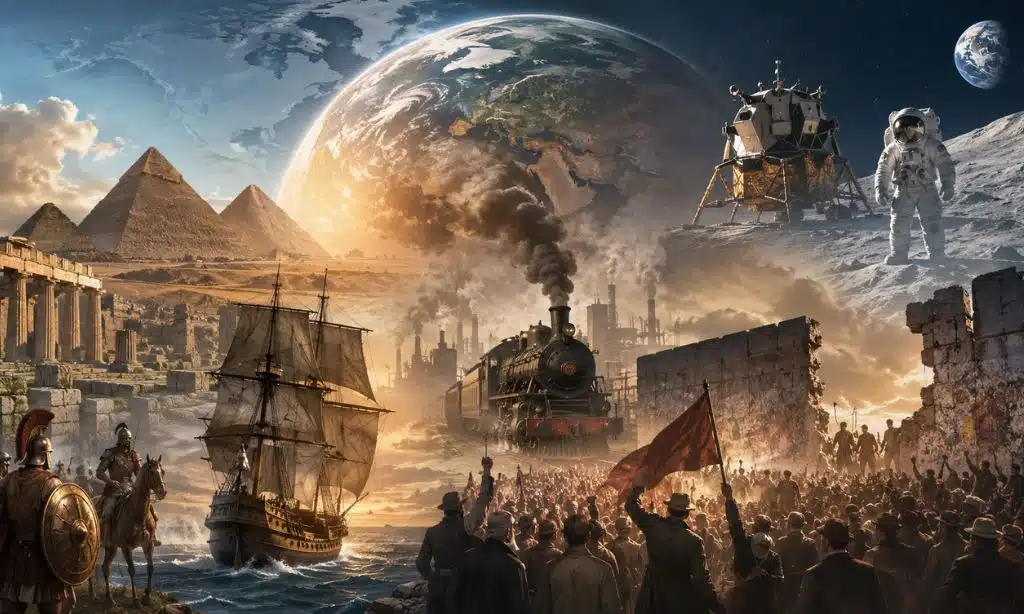
Outside of South Asia, the fourth of July has been the backdrop for the rise and fall of empires, groundbreaking scientific discoveries, and the end of devastating conflicts.
United States: The Declaration of Independence (1776)
While the Continental Congress actually voted to declare independence from Great Britain on July 2, it was on July 4, 1776, that the final wording of the Declaration of Independence was formally adopted. Drafted primarily by Thomas Jefferson, this document didn’t just sever political ties with King George III; it introduced a philosophical framework that would inspire democratic movements worldwide. The assertion that “all men are created equal” and endowed with “unalienable Rights” became a revolutionary template, later echoing in the French Declaration of the Rights of Man and the Haitian Revolution.
Rwanda: The End of the Genocide (1994)
For the East African nation of Rwanda, July 4 is celebrated as Liberation Day (Kwibohora). In 1994, the country was engulfed in a horrifying genocide where an estimated 800,000 Tutsis and moderate Hutus were systematically murdered by Hutu extremists in just 100 days.
On July 4, the Rwandan Patriotic Front (RPF), led by Paul Kagame, finally captured the capital city of Kigali. This military victory effectively toppled the genocidal regime and brought the slaughter to a halt. Today, Liberation Day is a somber but hopeful holiday in Rwanda, focusing on national healing, rebuilding, and the incredible economic and social rebirth the country has achieved in the decades since.
Europe: The Battle of Kursk (1943)
In the theater of World War II, July 4, 1943, marked the preliminary clashes of what would become the Battle of Kursk (Operation Citadel) on the Eastern Front. Nazi Germany launched a massive offensive against Soviet forces, hoping to regain momentum after their catastrophic defeat at Stalingrad.
What unfolded was the largest tank battle in the history of warfare. The Soviets, having gathered immense intelligence, heavily fortified their positions and absorbed the German armored spearheads. The resulting Soviet victory permanently crippled the German Panzer forces. From Kursk onward, the German army was in a state of continuous retreat across the Eastern Front until the fall of Berlin.
Switzerland: The “God Particle” is Found (2012)
Shifting from destruction to creation, July 4, 2012, is one of the most important dates in modern physics. Scientists at the European Organization for Nuclear Research (CERN) in Geneva held a press conference to announce that their Large Hadron Collider had detected a particle strongly matching the predicted properties of the Higgs boson.
Often dubbed the “God particle” (much to the chagrin of many physicists), the Higgs boson was the missing puzzle piece in the Standard Model of particle physics. Its discovery proved the existence of the Higgs field, an invisible energy field that exists throughout the universe and gives other fundamental particles their mass. Without it, atoms couldn’t form, and the universe as we know it would not exist.
Philippines: Full Independence (1946)
July 4 is also deeply significant in Southeast Asia. On this day in 1946, the Treaty of Manila was signed, officially recognizing the absolute independence of the Republic of the Philippines. The island nation had endured over 300 years of Spanish colonial rule, followed by a transition of power to the United States after the Spanish-American War, and a brutal occupation by the Japanese Empire during WWII. July 4 marked the end of foreign rule, though the country later moved its primary Independence Day to June 12 to honor its original 1898 declaration against Spain. Today, July 4 is celebrated as Philippine Republic Day and Filipino-American Friendship Day.
Notable Births That Shaped Our World
Throughout history, July 4 has brought us revolutionaries, groundbreaking scientists, political leaders, and cultural icons.
Quick Glance: Famous Birthdays on July 4
| Name | Year | Nationality | Legacy / Claim to Fame |
| George Everest | 1790 | British | Geographer; Mount Everest is named in his honor. |
| Giuseppe Garibaldi | 1807 | Italian | Military general and key figure in the unification of Italy. |
| Henrietta Swan Leavitt | 1868 | American | Astronomer whose work unlocked the scale of the universe. |
| Calvin Coolidge | 1872 | American | 30th President of the United States. |
| Gulzarilal Nanda | 1898 | Indian | Interim Prime Minister of India; Bharat Ratna recipient. |
| Bill Withers | 1938 | American | Soul singer-songwriter (Ain’t No Sunshine, Lean on Me). |
| Post Malone | 1995 | American | Chart-topping contemporary singer, rapper, and songwriter. |
Henrietta Swan Leavitt (1868)
While Edwin Hubble often gets the credit for discovering that the universe is expanding, he couldn’t have done it without Henrietta Swan Leavitt. Born on July 4, 1868, Leavitt worked as a “computer” at the Harvard College Observatory. She discovered a relationship between the luminosity and the period of Cepheid variable stars. This breakthrough gave astronomers the first “standard candle” with which they could measure the distance to far-off galaxies. Her work fundamentally shifted our understanding of the scale of the cosmos.
Giuseppe Garibaldi (1807)
Born in Nice (then part of the French Empire), Giuseppe Garibaldi became one of the greatest military leaders and popular heroes of the 19th century. Known as the “Hero of the Two Worlds” due to his military exploits in South America and Europe, Garibaldi was the central driving force behind the Risorgimento—the political and social movement that united the various states of the Italian peninsula into a single nation of Italy.
Gulzarilal Nanda (1898)
A crucial figure in post-independence Indian politics, Gulzarilal Nanda was a fierce advocate for labor rights and an economist. He holds a unique place in history for stepping in as the interim Prime Minister of India during two critical national crises: the sudden death of Jawaharlal Nehru in 1964, and the sudden death of Lal Bahadur Shastri in 1966. His steady hand during these transitional periods earned him immense respect, and he was awarded the Bharat Ratna in 1997.
Bill Withers (1938)
On a cultural note, American music was forever enriched by the birth of Bill Withers. Despite starting his music career relatively late (he was making airplane parts for the Navy before hitting it big), Withers wrote and recorded some of the most enduring, emotionally resonant soul and R&B songs of the 20th century. Anthems like Lean on Me, Ain’t No Sunshine, and Lovely Day remain staples of global pop culture.
The Departed Legends: Notable Deaths
The historical irony and weight of July 4 are perhaps most evident when looking at those who took their final breath on this day.
Quick Glance: Famous Deaths on July 4
| Name | Year | Nationality | Legacy / Cause of Death |
| Thomas Jefferson | 1826 | American | 3rd US President & primary author of the Declaration. |
| John Adams | 1826 | American | 2nd US President & crucial figure in American independence. |
| James Monroe | 1831 | American | 5th US President; author of the Monroe Doctrine. |
| Swami Vivekananda | 1902 | Indian | Hindu monk who introduced Vedanta to the West. |
| Marie Curie | 1934 | Polish-French | Physicist/chemist; died of aplastic anemia from radiation. |
| Barry White | 2003 | American | Iconic soul, R&B singer, and composer. |
| Abbas Kiarostami | 2016 | Iranian | Palme d’Or-winning film director and screenwriter. |
The “Presidential Curse” of July 4
One of the most astonishing coincidences in recorded history occurred on July 4, 1826—exactly 50 years to the day after the adoption of the Declaration of Independence. On this golden anniversary, both John Adams (the 2nd US President) and Thomas Jefferson (the 3rd US President) passed away within hours of each other.
The two men had a complex relationship; they were fellow revolutionaries and friends, became bitter political rivals, and eventually reconciled through a profound exchange of letters in their twilight years. Adams’ last words were reportedly, “Thomas Jefferson survives,” unaware that Jefferson had died a few hours earlier at his Monticello estate. As if that wasn’t strange enough, exactly five years later on July 4, 1831, the 5th US President, James Monroe, also passed away, sealing the date’s mystical association with America’s founding fathers.
Swami Vivekananda (1902)
In the East, July 4 marks the passing of one of India’s most influential spiritual leaders. Swami Vivekananda died at the young age of 39 in Belur Math, Bengal. As the chief disciple of the mystic Ramakrishna, Vivekananda was instrumental in the revival of Hinduism in modern India. More globally, he is credited with introducing the Indian philosophies of Vedanta and Yoga to the Western world, most notably through his electrifying, barrier-breaking speech at the Parliament of the World’s Religions in Chicago in 1893. His legacy of spiritual universalism continues to inspire millions.
Marie Curie (1934)
A towering giant of science, Marie Curie gave her life to her work. She remains the only person to ever win a Nobel Prize in two different scientific fields (Physics and Chemistry). Her relentless research into radioactivity led to the discovery of the elements polonium and radium, and she developed mobile radiography units to treat wounded soldiers during World War I. Tragically, the very phenomena she discovered took her life; she died on July 4, 1934, from aplastic anemia, a direct result of decades of prolonged exposure to unshielded radiation.
Abbas Kiarostami (2016)
Global cinema lost a master on July 4, 2016. Abbas Kiarostami, an Iranian film director, screenwriter, and poet, was a leading figure in the Iranian New Wave. Known for blurring the lines between fiction and documentary, and for his deeply humanist approach, Kiarostami’s work (Taste of Cherry, Close-Up) won international acclaim, including the prestigious Palme d’Or at the Cannes Film Festival.
Fascinating Trivia: Did You Know?
To wrap up this journey through time, here are a few lesser-known facts about July 4 that provide a different flavor to the day:
-
Alice in Wonderland was Born on a Boat: On July 4, 1862, an Oxford mathematician named Charles Lutwidge Dodgson took a rowboat trip up the River Thames with three young sisters. To entertain them, he improvised a fantastical story about a girl who falls down a rabbit hole. The girl’s name was Alice Liddell. Dodgson later wrote the story down under the pen name Lewis Carroll, giving the world Alice’s Adventures in Wonderland.
-
The Earth is Furthest from the Sun: Due to the elliptical shape of Earth’s orbit, our planet reaches “aphelion”—the point in its orbit where it is farthest away from the Sun—around July 4 every year. Despite being further away, the Northern Hemisphere experiences summer due to the tilt of the Earth’s axis.
-
The Luckiest Man Speech: On July 4, 1939, baseball icon Lou Gehrig stood at home plate in Yankee Stadium. Forced to retire due to a devastating diagnosis of ALS (now commonly known as Lou Gehrig’s disease), he addressed a weeping crowd. Instead of expressing sorrow, he delivered one of the most famous speeches in sports history, declaring, “Today, I consider myself the luckiest man on the face of the earth.”
Final Thoughts: A Microcosm of Human History
History rarely confines itself to a single narrative, and July 4 is a perfect testament to this reality. What is celebrated as the birth of a democratic experiment in the West simultaneously echoes as a day of liberation and survival in Rwanda, a day of profound loss for the scientific community with the passing of Marie Curie, and a day of revolutionary beginnings and shifting borders for the Indian subcontinent.
From the ancient skies of Song Dynasty China where astronomers first spotted the supernova that created the Crab Nebula, to the underground laboratories of Switzerland where the fundamental building blocks of the universe were confirmed, this date serves as a unique cross-section of human achievement, struggle, and transformation.
By looking at July 4 through a global lens, we gain a much richer understanding of our shared past. It reminds us that history is an interconnected web where political decrees, scientific breakthroughs, cultural milestones, and personal legacies happen concurrently, shaping the modern world. Recognizing the massive, worldwide footprint of this day ensures that the diverse, monumental stories of our global heritage—both celebrated and solemn—continue to be honored and understood.