Most people think about air quality only when something smells wrong. Smoke from cooking. Dust in sunlight. A musty basement. Pollen season. Wildfire haze. Pet dander. A bedroom that feels dry in winter. A bathroom that never fully dries. A stuffy office where everyone gets sleepy after lunch. That is the problem with indoor air. You often feel it before you understand it.
The best air quality wellness devices do not magically make a home healthy. They also do not replace cleaning, ventilation, moisture control, medical care, or fixing the source of a problem. But the right device can help you see what is happening, reduce certain airborne particles, manage humidity, and make better decisions about the rooms where your family actually spends time.
In this guide, I compared 13 air quality and wellness devices worth considering, from air purifiers and home air quality monitors to dehumidifiers, humidifiers, CO2 monitors, radon monitors, and practical indoor air gadgets.
What Counts as an Air Quality Wellness Device?
An air quality wellness device should do one of three things. It should either remove something from the air, measure something important about the air, or control a condition that affects indoor air quality.
That means an air purifier can be useful because it filters particles such as dust, pollen, smoke, and pet dander. A CO2 monitor can be useful because it helps you understand ventilation patterns. A radon monitor can alert you to a serious invisible gas risk. A dehumidifier can reduce moisture conditions that support mold growth. A humidifier can make dry indoor air more comfortable when used carefully.
The key phrase is “used carefully.”
A device is not useful just because it has an app, glowing screen, or wellness branding. It needs to solve a real indoor air problem. It also needs to fit the room size, maintenance routine, noise tolerance, filter cost, and household risk.
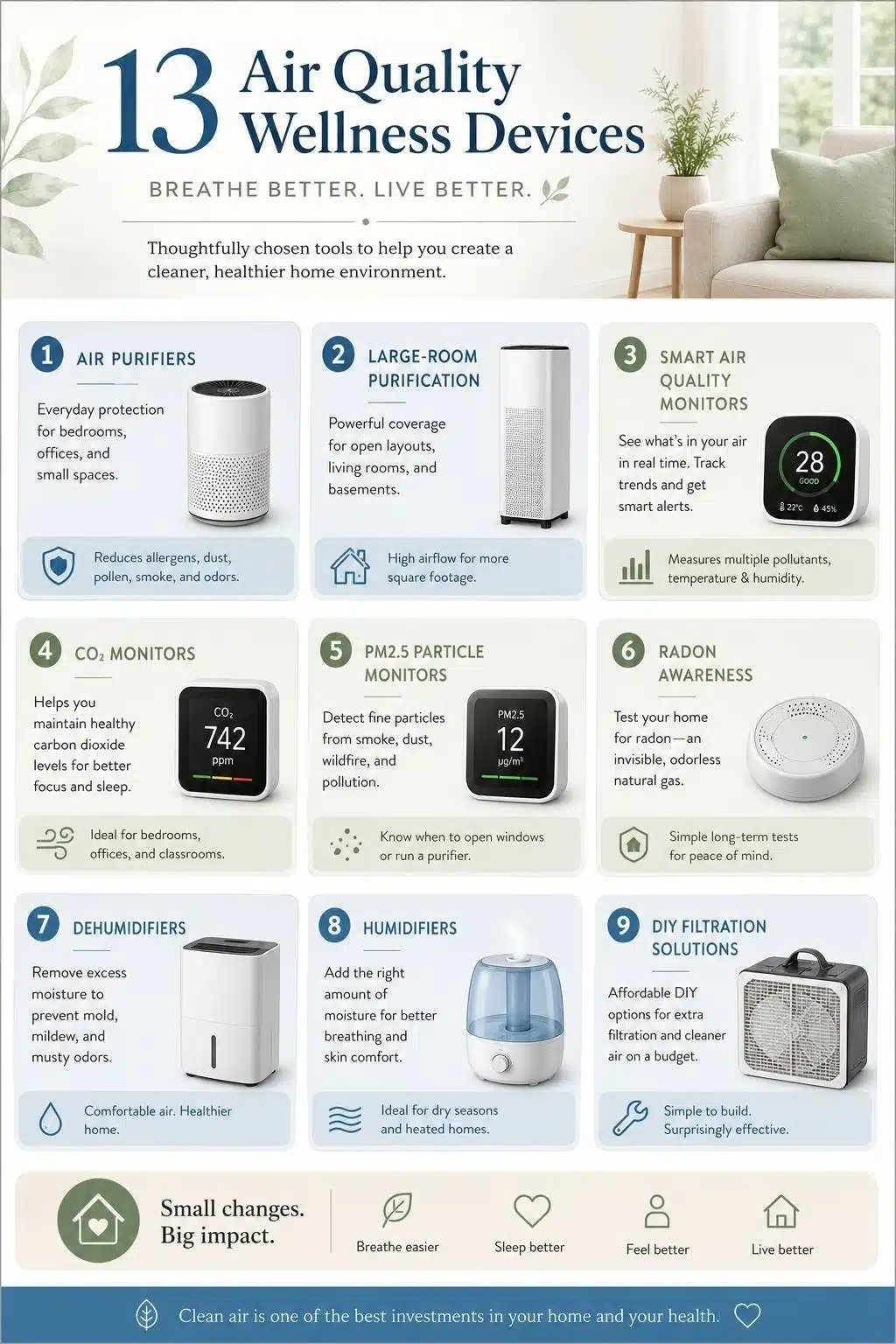
13 Air Quality Wellness Devices Worth Considering
These are not ranked as one universal “best” list. Air quality is too situational for that. A pet owner in a city apartment, a family in a wildfire-prone area, a homeowner with a damp basement, and a parent worried about classroom-style ventilation do not need the same device.
1. Coway Airmega Mighty AP-1512HH
The Coway Airmega Mighty AP-1512HH is one of the most practical air purifiers for bedrooms, offices, and medium-sized rooms.
Its appeal is not flashy design or a long list of wellness promises. It is a straightforward purifier with a pre-filter, deodorization filter, True HEPA filter, and an optional ionizer feature. It is designed for rooms up to about 361 square feet, which makes it more realistic for bedrooms than giant “whole home” claims.
This is a good fit for households dealing with dust, pollen, pet dander, or general particle concerns in a single room. It is also useful for people who want something simple enough to run daily without depending on an app.
The one caution is the ionizer. Many users prefer leaving ionizing features off and relying on mechanical filtration. If you are buying an air purifier for family wellness, filtration should matter more than extra electronic cleaning modes.
Best practical use case: A bedroom or home office where you want reliable particle filtration without paying premium smart-device prices.
Worth considering: Filter replacement cost, noise on higher settings, and whether the room size actually matches the purifier’s CADR.
2. Blueair Blue Pure 211i Max
The Blueair Blue Pure 211i Max is a better fit for larger rooms, open living areas, and homes where airflow matters.
Blueair’s 211i Max uses the company’s HEPASilent filtration approach and is positioned for larger spaces than compact bedroom units. It also has smart controls and a fabric pre-filter design that can help catch larger particles before they reach the main filter.
This is the kind of purifier that makes sense when a small bedroom purifier would be underpowered. If your main concern is a living room, open-plan apartment, pet-heavy space, or wildfire smoke season preparation, airflow becomes more important than style.
It is still not a cure-all. No portable purifier fixes mold behind a wall, removes all gases, or replaces good ventilation when outdoor air is safe. But for particle reduction in a large lived-in room, this belongs on the shortlist.
Best practical use case: Large living rooms, pet areas, and open spaces where a small purifier would not move enough air.
Worth considering: Replacement filter cost, noise at higher speeds, and whether you prefer Blueair’s filtration approach over traditional HEPA-only marketing.
3. Levoit Core 300S-P
The Levoit Core 300S-P is a compact smart air purifier for people who want app control, schedules, voice assistant compatibility, and a smaller footprint.
It is often a good fit for bedrooms, nurseries, small offices, and apartments where space is limited. The official product page lists a CADR of 141 CFM and app-based control through VeSync. It also includes auto mode and low-noise operation claims, which matter if the device will run near a bed.
This is not the most powerful purifier in the list. It should not be treated like a large-room smoke solution. Its strength is convenience in a smaller space.
It is also a reminder that smart features are only useful when the base air-cleaning performance fits the room. A weak purifier with a good app is still weak. A properly sized purifier with simple controls can be better than an undersized smart model.
Best practical use case: Small bedrooms, dorm rooms, compact home offices, and app-friendly households.
Worth considering: Room size, filter type, filter replacement schedule, and whether the purifier can run quietly enough overnight.
4. Dyson Purifier Big+Quiet Formaldehyde
The Dyson Purifier Big+Quiet Formaldehyde is for people who want a premium device with built-in sensing, a sealed filtration design, and strong app-visible air quality feedback.
Dyson lists HEPA-H13, activated carbon, and SCO filtration for particles and gases including formaldehyde. It also reports live air quality data through sensors and the MyDyson app. That makes it more than a basic purifier. It is part air cleaner, part monitor, part premium home appliance.
This device makes the most sense for users who value design, quiet operation, and real-time readings. It may also appeal to households concerned about VOCs, odors, and formaldehyde from furniture, renovations, or indoor materials.
The price is the obvious drawback. You can buy powerful particle filtration for less. So the better question is not whether Dyson is impressive. The question is whether you need the extra monitoring, formaldehyde-focused filtration, and premium design enough to pay for it.
Best practical use case: Large rooms where premium design, quiet operation, sensing, and gas-focused filtration matter.
Worth considering: Cost, replacement filter timing, and whether a less expensive CADR-focused purifier would solve your main problem.
5. IQAir HealthPro Plus XE
The IQAir HealthPro Plus XE is a premium air purifier for households that care more about serious filtration than compact design.
IQAir positions this model with HyperHEPA filtration, V5-Cell filtration for gases and odors, smart air monitoring, Wi-Fi app integration, and coverage up to 1,125 square feet. It is one of the more expensive options, but it is aimed at users who want high-end particle filtration plus odor and gas support.
This is not the purifier for someone who wants a tiny device tucked behind a nightstand. It is larger, heavier, and more expensive. But for families dealing with recurring smoke, allergens, dust, odors, or sensitive indoor air concerns, it may justify the cost.
The practical buying question is simple: do you need premium filtration in one important space, or would two smaller purifiers placed in key rooms serve your home better?
Best practical use case: Premium filtration for larger rooms, smoke-prone homes, odor concerns, or high-sensitivity households.
Worth considering: Upfront price, filter costs, weight, room placement, and whether you need gas/odor filtration in addition to particle filtration.
6. Airthings View Plus
The Airthings View Plus is one of the strongest home air quality monitors for people who want broad indoor air visibility.
It tracks radon, PM2.5, CO2, VOCs, temperature, humidity, and air pressure. That combination matters because indoor air quality is not just one number. A purifier may reduce particles while humidity remains too high. A room may smell fine while CO2 climbs because ventilation is poor. A basement may feel clean while radon is the more serious hidden issue.
The View Plus is especially useful for homeowners who want to understand long-term patterns. Radon, humidity, and VOC readings are more meaningful when observed over time, not judged from one quick glance.
This is a monitor, not a fixer. If radon is high, you need proper testing confirmation and mitigation. If humidity is high, you need moisture control. If CO2 is high, you need ventilation changes. The device helps you see the problem; it does not solve it alone.
Best practical use case: Homeowners who want one monitor for radon, particles, CO2, VOCs, humidity, and temperature.
Worth considering: Sensor interpretation, long-term trends, and whether you are willing to act on the readings.
7. Aranet4 Home
The Aranet4 Home is a focused CO2 monitor, and that focus is its strength. CO2 does not tell you everything about indoor air. It does not measure particles, radon, mold, or VOCs. But in occupied rooms, it can help show whether ventilation is keeping up with people breathing in that space.
That makes Aranet4 useful in bedrooms, classrooms, home offices, meeting rooms, and small shared spaces. If CO2 rises quickly and stays high, that often means the room needs more fresh air, better ventilation habits, or a rethink of occupancy.
The Aranet4 Home uses an e-ink display and is known for portability and long battery life. It is easier to use than many multi-sensor devices because the question is direct: is this room getting enough ventilation right now?
Best practical use case: Tracking ventilation in bedrooms, offices, classrooms, and shared rooms.
Worth considering: CO2 is a ventilation clue, not a complete air quality score. Pair it with particle monitoring or filtration when needed.
8. PurpleAir Zen
PurpleAir Zen is useful for households that care about real-time particle pollution, especially PM2.5.
PM2.5 matters because fine particles can come from wildfire smoke, traffic pollution, cooking smoke, candles, fireplaces, and outdoor pollution that leaks indoors. A particle monitor helps you see when air quality changes instead of guessing by smell.
PurpleAir’s sensors measure particulate pollution along with environmental readings such as temperature, humidity, and pressure. The Zen can support indoor or outdoor-style awareness depending on setup and use case.
This device is especially helpful during wildfire season or in urban areas where outdoor air changes quickly. It can help you decide when to close windows, run an air purifier higher, or avoid indoor particle sources.
The limitation is that consumer-grade sensors need interpretation. A number on a screen is not a diagnosis. It is a signal that should guide practical behavior.
Best practical use case: Tracking PM2.5 from wildfire smoke, outdoor pollution, cooking, or indoor particle sources.
Worth considering: Placement, calibration expectations, humidity effects, and whether you need indoor readings, outdoor readings, or both.
9. Midea Cube 20-Pint Smart Dehumidifier
A dehumidifier is not usually marketed as a wellness gadget, but it can be one of the most important home air quality devices in a damp room.
The Midea Cube 20-Pint Smart Dehumidifier is designed for spaces up to 1,500 square feet and removes up to 20 pints per day. It also supports continuous drainage with an included hose, which is useful if you do not want to empty a bucket every day.
This device makes sense for small basements, bathrooms, laundry rooms, damp bedrooms, and spaces where humidity regularly climbs above a healthy range. High humidity can support mold growth, dust mites, musty odors, and general discomfort.
A dehumidifier does not fix a leak. If moisture is coming from a roof problem, plumbing issue, foundation leak, or poor ventilation, the source still needs attention. But for seasonal humidity or manageable dampness, a dehumidifier can make a real difference.
Best practical use case: Small to medium damp rooms where humidity control matters more than air filtration.
Worth considering: Drainage setup, noise, tank size, energy use, and whether the moisture source needs repair.
10. Frigidaire 50-Pint Built-In Pump Dehumidifier
The Frigidaire 50-Pint Built-In Pump Dehumidifier is for bigger moisture problems.
It is ENERGY STAR certified and designed for higher-capacity moisture removal. The built-in pump is the key advantage. If you need to move water upward to a sink, drain, or utility area, a pump can be much more convenient than manually emptying a bucket or relying on gravity drainage.
This belongs in the article because indoor air quality is not just about particles. Moisture is one of the major drivers of indoor air problems. A basement that smells musty may need dehumidification more urgently than another air purifier.
The best buyer for this device is someone with a damp basement, high-humidity utility room, or larger space where smaller units cannot keep up.
Best practical use case: Larger damp rooms, basements, and spaces where continuous pumped drainage is helpful.
Worth considering: Pump reliability, hose placement, filter cleaning, operating temperature, and whether structural moisture repairs are needed.
11. Levoit OasisMist 1000S
The Levoit OasisMist 1000S is a smart humidifier for larger dry rooms. It is designed for 300 to 600 square feet, has a large tank, supports app control, and includes auto mode for maintaining a preferred humidity level. That can be useful in winter, dry climates, or heated rooms where indoor air becomes uncomfortable.
Humidifiers are different from air purifiers. They do not clean particle pollution. They add moisture. That can help comfort when air is too dry, but over-humidifying a room can create new problems.
The goal is balance. If indoor humidity is already high, do not add more moisture. If your room sits around 20% to 25% in winter, a humidifier can make the space feel less dry. The device becomes useful when paired with a hygrometer or built-in humidity reading.
Best practical use case: Dry bedrooms or living areas where humidity is consistently too low.
Worth considering: Cleaning routine, mineral dust risk with ultrasonic humidifiers, water quality, and avoiding humidity above the recommended range.
12. Vornado EVDC300 Evaporative Humidifier
The Vornado EVDC300 is a good alternative for people who prefer evaporative humidification over ultrasonic mist.
Evaporative humidifiers use a wick and fan to add moisture to the air. They are often less likely to over-humidify than ultrasonic models because evaporation naturally slows as humidity rises. The EVDC300 also uses an energy-efficient DC motor and built-in humidity control.
This is a practical choice for bedrooms, offices, and smaller living spaces where dry air is the main problem. It is not the strongest large-room humidifier, but it is a sensible device for people who want steady moisture control without a dramatic visible mist plume.
Like all humidifiers, it needs cleaning. A neglected humidifier can become part of the air quality problem instead of the solution.
Best practical use case: Bedrooms and offices that need moderate humidity support during dry seasons.
Worth considering: Wick replacement, tank cleaning, room size expectations, and actual humidity readings.
13. Corsi-Rosenthal Box
A Corsi-Rosenthal Box is a DIY air cleaning device made with MERV 13 filters, a box fan, tape, and cardboard.
It belongs on this list because not every useful indoor air gadget has to be expensive or app-connected. During wildfire smoke events, classrooms, workshops, and budget-conscious households often need more particle filtration than they can afford through premium purifiers alone.
The main advantage is high filtration area for the money. The main caution is safety and build quality. Use a newer box fan, follow manufacturer instructions, avoid damaged fans, do not use extension cords carelessly, and do not leave children unattended around the fan. This is not a polished consumer appliance. It is a practical DIY device that must be built and used responsibly.
It is also not a gas or odor solution. It is mainly about particles. For VOCs, radon, carbon monoxide, and moisture problems, you need other strategies.
Best practical use case: Budget particle filtration for smoke, dust, and shared spaces where commercial purifier costs are too high.
Worth considering: Fan safety, filter quality, noise, placement, and supervision.
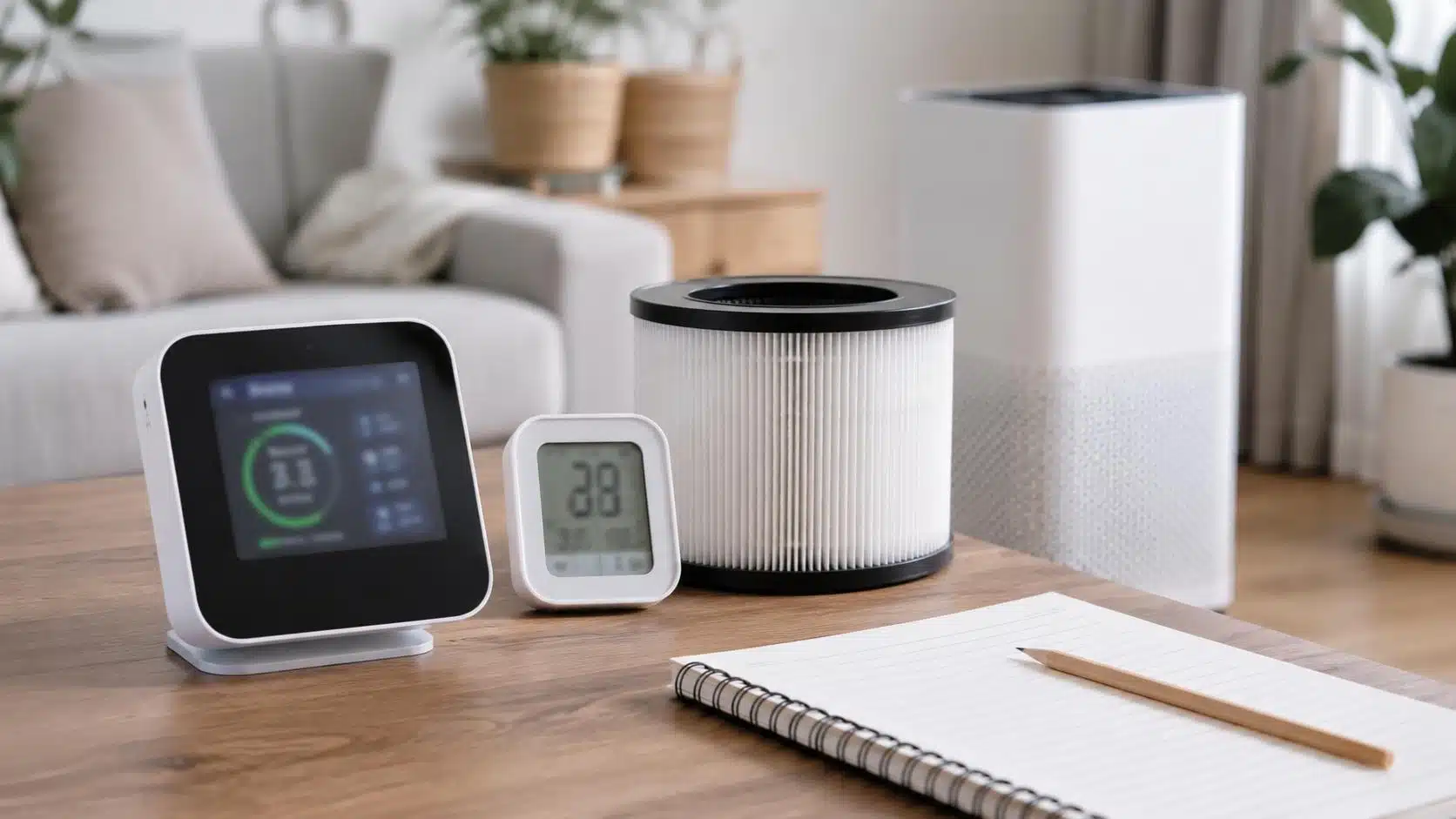
Quick Comparison: 13 Air Quality and Wellness Devices
| Device | Best For | Main Function |
| Coway Airmega Mighty AP-1512HH | Bedrooms and medium rooms | Particle filtration |
| Blueair Blue Pure 211i Max | Large living spaces | High-airflow purification |
| Levoit Core 300S-P | Small to medium smart rooms | App-connected air purification |
| Dyson Purifier Big+Quiet Formaldehyde | Premium large-room monitoring and purification | HEPA, carbon, and formaldehyde-focused filtration |
| IQAir HealthPro Plus XE | Premium filtration for particles and odors | HyperHEPA and gas/odor filtration |
| Airthings View Plus | Whole-home air awareness | Radon, PM2.5, CO2, VOC, humidity, temperature |
| Aranet4 Home | Ventilation decisions | CO2 monitoring |
| PurpleAir Zen | Particle tracking | PM2.5 and air pollution monitoring |
| Midea Cube 20-Pint Smart Dehumidifier | Damp bedrooms, small basements, bathrooms | Moisture removal |
| Frigidaire 50-Pint Built-In Pump Dehumidifier | Larger damp spaces | High-capacity moisture removal |
| Levoit OasisMist 1000S | Dry large rooms | Smart humidification |
| Vornado EVDC300 | Bedrooms and offices | Evaporative humidity control |
| Corsi-Rosenthal Box | Budget particle filtration | DIY MERV 13 box fan filter |
Best Air Quality Device by Home Problem
| Home Problem | Best Device Type |
| Dust, pollen, pet dander | Properly sized air purifier |
| Wildfire smoke particles | High-CADR purifier or Corsi-Rosenthal Box |
| Stuffy rooms | CO2 monitor plus ventilation changes |
| Damp basement | Dehumidifier |
| Dry winter bedroom | Humidifier |
| Radon concern | Radon monitor or radon test kit |
| Cooking particles | Range hood, ventilation, and particle monitor |
| VOC concerns | Source reduction, ventilation, carbon filtration, and VOC-aware monitor |
| Moldy smell | Moisture repair and dehumidification before air purification |
What to Check Before Buying Indoor Air Gadgets
The most important buying rule is simple: match the device to the problem. Do not buy a purifier when the real issue is humidity. Do not buy a humidifier when the room is already damp. Do not buy an air quality monitor if you will ignore the readings. Do not buy a premium VOC device when the real solution is removing scented products, improving ventilation, or airing out new furniture.
For air purifiers, check CADR, room size, filter type, noise, energy use, and replacement filter cost. For monitors, check which sensors are included and how readings should be interpreted. For humidifiers and dehumidifiers, check room size, cleaning needs, drainage, tank capacity, and whether the device can maintain a reasonable humidity range.
Also be careful with wellness language. “Cleaner air” is a practical goal. “Detoxing your home” is marketing. “Medical-grade” can be vague. “Kills everything in the air” should make you skeptical. A good device should explain what it measures or filters, not just promise better living.
Devices I Would Avoid for Most Homes
I would avoid ozone generators for occupied homes. Ozone is a lung irritant, and devices marketed as ozone air cleaners can create a new air quality problem while claiming to solve one.
I would also be cautious with purifier features that sound impressive but are hard to verify, such as vague ionization, plasma, energized oxygen, or photocatalytic claims without clear safety certification and test data. If a purifier has a good mechanical filter and an optional electronic feature, many cautious users prefer leaving the electronic feature off.
Avoid underpowered mini purifiers for full rooms. A tiny desk purifier may move too little air to matter in a bedroom or living room. Avoid humidifiers you cannot clean easily. Avoid dehumidifiers that are too small for a wet basement. Avoid monitors that show many numbers but give no useful way to act.
Good indoor air is not about buying the most futuristic gadget. It is about choosing the right intervention.
How to Use Air Quality Wellness Devices Better
Placement matters. Air purifiers need open airflow, not a corner blocked by furniture. Dehumidifiers need enough clearance and a workable drainage setup. Humidifiers should not blow mist directly onto walls, bedding, electronics, or wood furniture. CO2 monitors should sit at breathing height in occupied rooms, not directly beside a window or vent.
Maintenance matters even more. A purifier with a clogged filter is weaker. A dirty humidifier is risky. A dehumidifier with a neglected tank can smell. A monitor with poor placement can mislead you.
The best routine is simple: monitor first when possible, fix sources where you can, ventilate when outdoor air is good, filter particles where needed, and control humidity year-round.
Wrapping Up
The best air quality wellness devices are not the ones with the most dramatic marketing. They are the ones that help you solve a specific indoor air problem.
Use air purifiers for particles. Use monitors to understand what is happening. Use CO2 readings to improve ventilation habits. Use dehumidifiers when moisture is too high. Use humidifiers when air is genuinely too dry. Use radon testing seriously. Use DIY filtration carefully when budget or smoke season demands it.
A healthier home is not built by one gadget.
It comes from fewer pollution sources, better ventilation, proper filtration, balanced humidity, and devices that earn their place by doing a clear job.
Frequently Asked Questions About Air Quality Wellness Devices
1. What are the best air quality wellness devices for most homes?
The most useful air quality wellness devices for many homes are a properly sized air purifier, a humidity monitor, a dehumidifier for damp areas, a humidifier for very dry rooms, and a CO2 or multi-sensor air quality monitor. The right choice depends on whether your main problem is particles, moisture, ventilation, radon, VOCs, or dryness.
2. Do air purifiers really improve home air quality?
Air purifiers can improve home air quality by reducing airborne particles such as dust, pollen, pet dander, smoke particles, and some fine particulate matter. They work best when matched to room size, run consistently, placed correctly, and maintained with clean filters. They do not fix every indoor air problem.
3. What should I look for in an air purifier?
Look for CADR matched to the room size, strong particle filtration, realistic noise levels, affordable replacement filters, energy efficiency, and clear maintenance instructions. Be cautious with vague claims about ionization, ozone, or “chemical-free purification” unless safety and performance are clearly documented.
4. Are home air quality monitors worth it?
Home air quality monitors are worth it when they help you take action. CO2 monitors can guide ventilation. PM2.5 monitors can show particle spikes from smoke or cooking. Radon monitors can reveal a serious invisible risk. VOC sensors can show trends, though consumer VOC readings should be interpreted carefully.
5. Should I buy a humidifier or dehumidifier?
Buy a humidifier if indoor air is consistently too dry, especially in winter. Buy a dehumidifier if humidity is too high, there is condensation, musty odor, or dampness. Many homes need different devices in different seasons or rooms. Use a humidity reading instead of guessing.
6. Can air quality devices replace cleaning and ventilation?
No. Air quality devices support cleaning and ventilation; they do not replace them. Source control still matters. Reduce smoke, dust, dampness, fragrances, chemical fumes, and poor ventilation first. Then use devices to filter, measure, or balance the air more effectively.