
Getting a child to read is rarely just about handing them a book. It is about attention, confidence, habit, and the small emotional win that makes them want to open the next page. That is why Gamified Reading Apps have become such an important part of the U.S. EdTech market: they turn reading from a passive assignment into a guided, rewarding, interactive experience.
Our Selection Criteria
This list started with the country decision. I compared the United States, India, and the United Kingdom because they have strong EdTech ecosystems and visible activity in education gamification. Then I narrowed the research to companies that could be verified as U.S.-based SMEs, startups, private EdTech companies, or nonprofit-style specialist organizations with real reading, literacy, early learning, rewards, quests, badges, challenges, voice support, or game-like engagement built into the product.
The companies were selected using these filters:
- Headquartered, incorporated, or operationally rooted in the United States.
- SME, startup, private EdTech company, or specialist education organization rather than a Big Tech product.
- Clear relevance to reading, phonics, fluency, comprehension, digital libraries, reading challenges, or early literacy.
- Evidence of gamification, play-based learning, rewards, badges, quests, challenges, interactive stories, adaptive journeys, or reading motivation tools.
- Publicly visible website, app listing, contact path, company profile, or credible third-party verification.
- Useful for parents, schools, libraries, teachers, tutors, homeschoolers, or early literacy programs.
- Excluded generic ebook readers, adult reading habit trackers, public-company language apps, and tools where reading was only a minor side feature.
Why the United States and not India or the United Kingdom?
India has a large education-gamification startup base, and the U.K. has several strong literacy and reading-game companies. But the United States had the strongest fit for this specific list because it has a deeper mix of early literacy apps, school reading platforms, AI reading coaches, gamified digital libraries, reading challenge systems, and long-running phonics products.
Here is how the country comparison shaped the final decision:
| Country Considered | Strength in Education Gamification | Fit for SME Gamified Reading Apps | Final Assessment |
|---|---|---|---|
| United States | Largest visible company base in education gamification, strong K-12 EdTech, library-tech, and early literacy market | Strongest mix of verified gamified reading, phonics, AI reading coach, and reading challenge companies | Selected |
| India | Large gamification-in-education startup base and mobile-first learning demand | Strong, but many companies are broader test-prep, math, coding, or language platforms rather than reading-specific apps | Not selected |
| United Kingdom | Strong literacy and dyslexia-focused reading app ecosystem | High-quality niche companies, but smaller visible company depth for a U.S.-style top 10 SME list | Not selected |
10 U.S. EdTech SMEs Building Gamified Reading Apps That Keep Children Reading
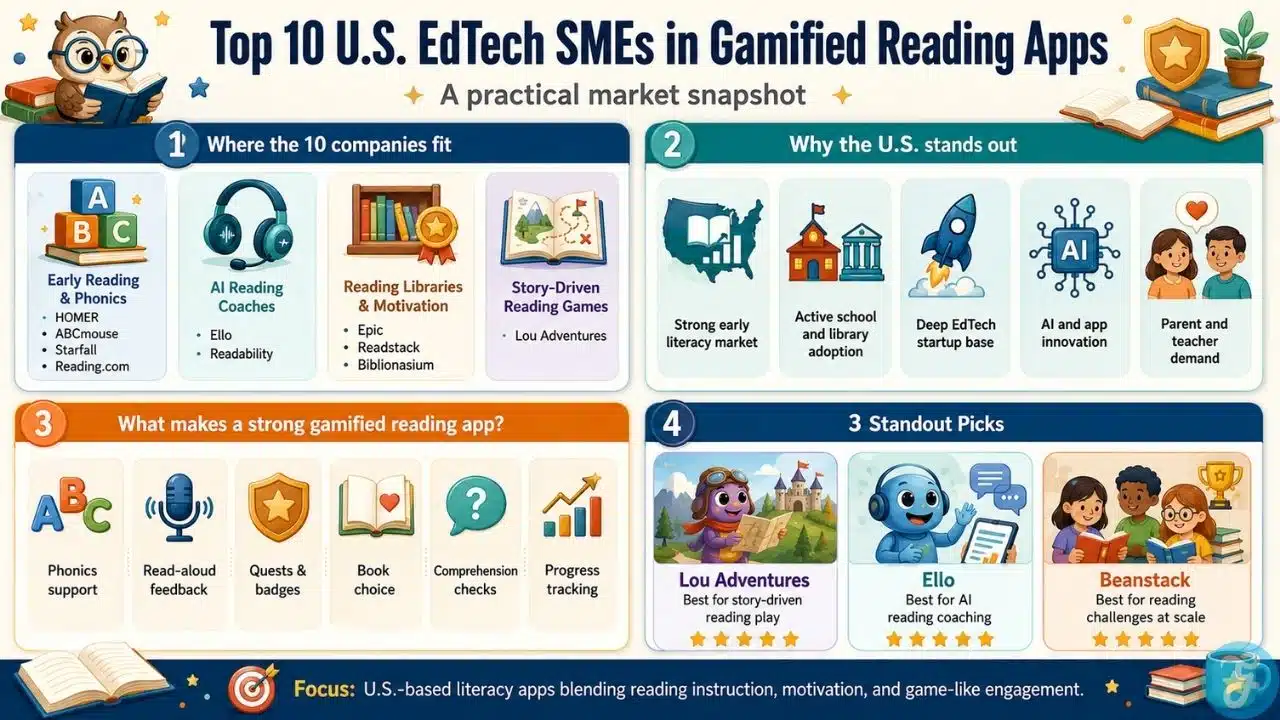
The U.S. market is not made up of one type of reading app. Some tools teach phonics through play. Some use AI to listen while children read. Some reward reading habits with badges and challenges. Others use digital libraries, book clubs, mascots, quests, and classroom tracking to make reading feel less like a chore.
1. HOMER by Begin
Headquarters: New York, New York, United States
Website: learnwithhomer.com
Email: support@learnwithhomer.com
HOMER is one of the strongest early literacy apps in the U.S. market because it blends personalized reading paths with playful activities for children ages 2 to 8. The product is not just a digital worksheet stack; it uses interests, age, skill level, stories, songs, and “I did it” moments to keep children moving through the learning journey. Its biggest strength is emotional design. It understands that young readers need confidence as much as phonics instruction.
Best Feature/For:
- Best for early readers who need personalized, play-based reading support.
- Strong for parents who want a structured but child-friendly literacy app.
Why We Chose It:
- Built around early literacy and reading confidence.
- Uses personalized learning paths based on age, level, and interests.
- Offers a polished app experience for young children.
- U.S.-based private EdTech brand under Begin.
Things to consider:
- It is best for early learners, not older struggling readers.
- Parents should still read with children instead of using the app as a full substitute.
2. ABCmouse by Age of Learning
Headquarters: Glendale, California, United States
Website: abcmouse.com
Email: support@abcmouse.com
ABCmouse is a broad early learning platform, but reading and language arts are major parts of its value. It uses games, songs, puzzles, read-to-me books, phonics activities, and interactive learning paths to make early literacy feel playful. The platform’s strength is scale: it gives families and teachers a large activity library instead of a narrow reading-only tool. For young children who need variety to stay engaged, that breadth can be useful.
Best Feature/For:
- Best for preschool through early elementary learners who need reading plus broader foundational learning.
- Strong for families looking for a large library of games, books, songs, and activities.
Why We Chose It:
- Strong U.S. EdTech company profile.
- Includes phonics, read-along books, vocabulary, comprehension, and reading fluency support.
- Uses game-like activities to keep children engaged.
- Widely used by families and classrooms.
Things to consider:
- It is not reading-only, so families wanting focused literacy intervention may need a narrower tool.
- The large content library can feel overwhelming without parent or teacher guidance.
3. Epic
Headquarters: Redwood City, California, United States
Website: getepic.com
Email: support@getepic.com
Epic is a digital reading platform for children that combines a large library with badges, quizzes, reading buddies, and teacher tools. Its gamification is not about turning every book into a cartoon game; it uses rewards and discovery mechanics to make reading feel more self-directed. That matters because many children do not hate reading; they hate being told what to read with no sense of choice. Epic’s strongest feature is giving children a safe reading space where exploration and motivation work together.
Best Feature/For:
- Best for schools and families that want a large digital library with reading motivation tools.
- Strong for students who need choice, badges, quizzes, and reading habit support.
Why We Chose It:
- Clear kids’ reading platform with U.S. roots.
- Uses badges, quizzes, reading buddies, and recommendations.
- Strong school and family use case.
- Helps connect reading choice with progress tracking.
Things to consider:
- Gamification can reward speed if adults do not check comprehension.
- It is better as a reading engagement layer than a full phonics instruction program.
4. Ello
Headquarters: San Francisco, California, United States
Website: ello.com
Email: support@ello.com
Ello is an AI reading coach that listens to children read and helps them when they get stuck. Its gamified side comes through quests, stars, prize-store mechanics, book unlocking, and motivational feedback that keeps practice moving. Unlike basic reading apps, Ello tries to recreate part of the one-on-one reading tutor experience inside an app. For children who need feedback while reading aloud, that makes it one of the more interesting U.S. literacy startups.
Best Feature/For:
- Best for K-3 readers who need an AI reading buddy that listens and coaches.
- Strong for families looking for guided read-aloud practice.
Why We Chose It:
- U.S.-based AI reading startup with a clear literacy mission.
- Uses speech recognition and reading feedback.
- Includes quest-style engagement and reward mechanics.
- Strong fit for children who need practice, encouragement, and correction.
Things to consider:
- AI listening tools should be tested for accuracy with different accents and speech patterns.
- Parents should review privacy policies carefully because voice data is sensitive.
5. Reading.com
Headquarters: San Juan, Puerto Rico, United States
Website: reading.com
Email: support@reading.com
Reading.com is a phonics and reading app built around parent-child co-play rather than fully independent screen time. Its lessons include songs, sound stories, tracing, sliders, word reading, books, and games that help children build decoding skills step by step. The product’s strongest angle is that it does not pretend a young child should learn to read alone. It uses interactivity to guide the adult and child together, which can make early reading less stressful.
Best Feature/For:
- Best for parents teaching children to read through structured co-play.
- Strong for phonics, blending, tracing, and early decodable reading.
Why We Chose It:
- Clear reading-first product identity.
- Uses interactive lesson mechanics and games.
- Good fit for homeschoolers and parents doing direct reading practice.
- Public app listing and contact details are easy to verify.
Things to consider:
- It works best when an adult participates.
- Families looking for independent practice may prefer a different app.
6. Readability
Headquarters: Long Beach, California, United States
Website: readabilitytutor.com
Email: support@readabilitytutor.com
Readability is an AI-powered reading tutor for K-6 students that listens while children read, corrects mistakes, asks questions, and tracks progress. It is more tutor-like than game-like, but its progress dashboard, rewards, library, and encouragement features make it relevant to gamified reading. Its biggest strength is fluency and comprehension support for children who need active feedback. For families dealing with reading struggle, that can be more valuable than flashy points and avatars.
Best Feature/For:
- Best for children who need reading fluency, vocabulary, and comprehension support.
- Strong for parents seeking AI-guided reading practice outside school hours.
Why We Chose It:
- U.S.-based reading app company with public support contact and address.
- Uses AI voice feedback to support reading aloud.
- Includes progress tracking and reward-oriented practice features.
- Useful for struggling readers, ELL students, and children needing confidence.
Things to consider:
- It is not a pure game, so children expecting a game world may need motivation.
- Voice-data and reading-recording policies should be reviewed before use.
7. Starfall
Headquarters: Boulder, Colorado, United States
Website: starfall.com
Email: helpdesk@starfall.com
Starfall is one of the longest-running U.S. reading-game platforms, built around phonics, exploration, songs, books, games, and positive reinforcement. It is now operated by the Starfall Education Foundation, a nonprofit organization, but it fits the SME profile because of its focused team size and specialist literacy mission. Its reading content feels simple compared with newer AI tools, but that simplicity is part of the appeal. Starfall does not bury children under dashboards; it gives them playful pathways into letters, sounds, words, and stories.
Best Feature/For:
- Best for early phonics, foundational reading, and playful practice.
- Strong for preschool, kindergarten, and early elementary classrooms.
Why We Chose It:
- Proven U.S. literacy platform with a long public history.
- Specializes in reading through games, books, songs, and interactive activities.
- Low-cost and widely accessible.
- Strong fit for children who need multisensory early literacy practice.
Things to consider:
- It may feel less modern than newer app-first products.
- Teachers may need to guide activity selection so students do not wander aimlessly.
8. Beanstack by Zoobean
Headquarters: Arlington, Virginia, United States
Website: beanstack.com
Email: contact@beanstack.com
Beanstack is a reading challenge and reading log platform used by libraries, schools, and communities. It is one of the clearest examples of reading gamification because it uses challenges, badges, streaks, reading logs, progress tracking, and community programs to motivate readers. Beanstack does not teach phonics the way a tutor app does. Instead, it solves a different problem: how to build reading habit and participation at scale.
Best Feature/For:
- Best for schools and libraries running reading challenges.
- Strong for summer reading, classroom reading culture, and community literacy programs.
Why We Chose It:
- Strong U.S. SME profile.
- Uses gamification directly through badges, challenges, logs, and streaks.
- Works for libraries, districts, schools, and families.
- Helps turn reading into a visible community habit.
Things to consider:
- It motivates reading behavior more than it teaches reading skills directly.
- Strong program design matters; badges alone will not create deep reading.
9. Biblionasium
Headquarters: New York, New York, United States
Website: biblionasium.com
Email: contact@Biblionasium.com
Biblionasium is often described as a kid-safe reading community where children can log books, build virtual bookshelves, review titles, recommend books, and participate in reading challenges. Its gamified value is more social than flashy: it gives students a reason to talk about books, track progress, and feel seen as readers. For classrooms and libraries, that kind of social reading motivation can be powerful. It makes reading less private, less invisible, and less lonely.
Best Feature/For:
- Best for safe social reading, book reviews, and classroom reading logs.
- Strong for teachers and librarians who want students to share reading recommendations.
Why We Chose It:
- U.S.-based literacy platform with verified New York contact details.
- Includes virtual rewards and reading challenges.
- Encourages book discovery through peer-style recommendations.
- Useful for classroom reading culture and independent reading programs.
Things to consider:
- It is stronger for engagement and tracking than direct reading instruction.
- Teachers need to moderate and guide the community experience.
10. Lou Adventures by Sparkstone
Headquarters: Newton, Massachusetts, United States
Website: louadventures.com
Email: lou@louadventures.com
Lou Adventures is one of the most directly game-like reading apps on this list. Children read, answer questions out loud, solve mysteries, follow a talking dog companion, and move through interactive adventure stories. The app uses speech recognition and game-based storytelling to support comprehension, especially for grades 2-4. It stands out because the reading itself becomes part of solving the game, not just a task children do before they get a reward.
Best Feature/For:
- Best for children who need reading comprehension practice inside a story-driven game.
- Strong for reluctant readers who respond to mysteries, quests, and companion characters.
Why We Chose It:
- Directly blends reading comprehension with gameplay.
- Uses speech recognition and interactive story mechanics.
- U.S.-based app from Sparkstone Investments LLC.
- Strong fit for children who need reading practice to feel like an adventure.
Things to consider:
- It is currently strongest for a narrower age band than broad K-12 platforms.
- Families should check device compatibility and subscription details before use.
An Overview Of United States Gamified Reading Apps for Literacy Growth
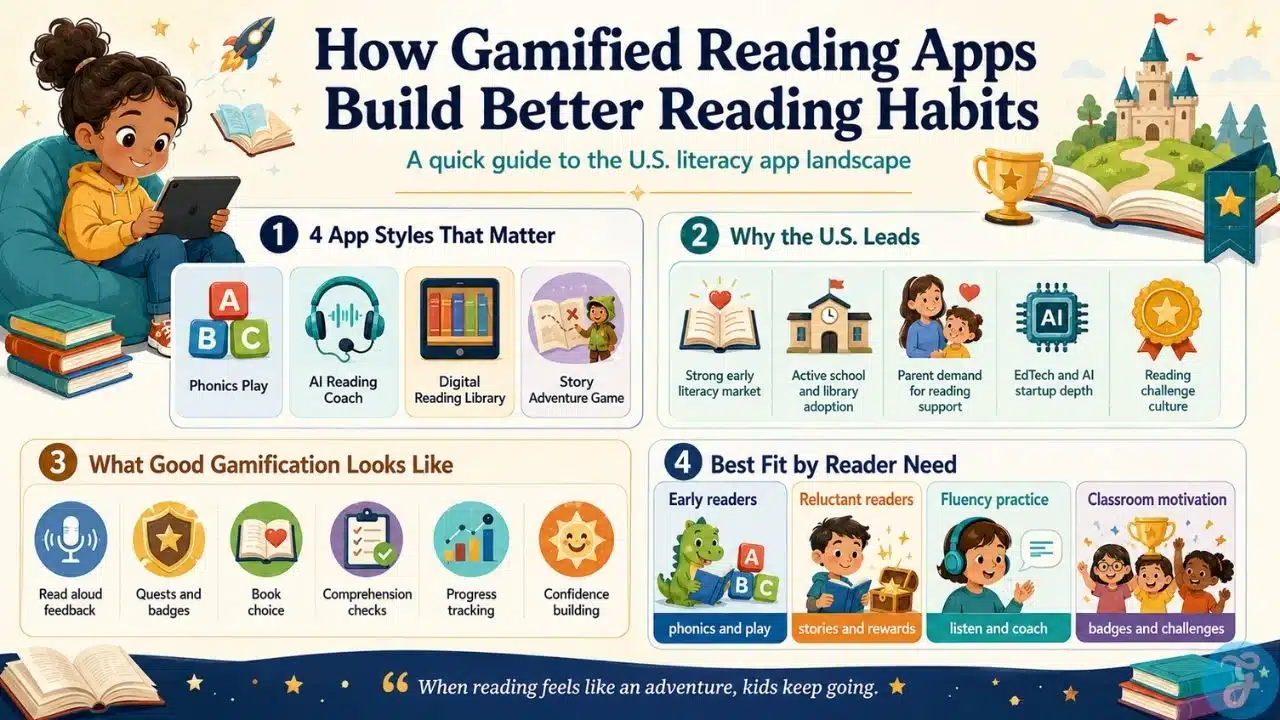
The U.S. market is strong because it covers several reading problems at once. Some tools help children learn phonics. Some help them read aloud with feedback. Some give teachers and librarians reading challenge systems. Others build reading confidence through quests, badges, characters, and social recommendation loops.
Overview Comparison Table
The comparison below separates the companies by their strongest reading use case so buyers do not confuse a reading tutor with a reading challenge platform.
| Company | Best Fit | Core Strength | Strongest Buyer Type |
| HOMER | Early literacy at home | Personalized play-based reading paths | Parents of ages 2-8 |
| ABCmouse | Broad early learning | Games, books, songs, phonics, and early reading activities | Families, preschool, early elementary |
| Epic | Digital reading library | Books, badges, quizzes, reading buddies, and discovery | Schools, libraries, families |
| Ello | AI reading coach | Read-aloud listening, quests, stars, and feedback | Parents, K-3 readers |
| Reading.com | Parent-child phonics | Co-play lessons, sound work, tracing, and decodable books | Homeschoolers, parents |
| Readability | AI reading tutor | Fluency, comprehension, correction, and progress tracking | Parents, struggling readers, schools |
| Starfall | Foundational reading games | Phonics, songs, books, and multisensory play | Early classrooms, families |
| Beanstack | Reading challenges | Badges, streaks, reading logs, and community programs | Libraries, districts, schools |
| Biblionasium | Social reading | Safe book reviews, logs, recommendations, and virtual rewards | Teachers, librarians |
| Lou Adventures | Reading adventure game | Mystery-based reading comprehension and speech recognition | Grades 2-4 readers, families |
Our Top 3 Picks and Why?
The strongest pick depends on whether the reader needs phonics instruction, reading motivation, or comprehension practice. For this ranking, I prioritized direct gamification, reading specificity, and practical use for children.
| Rank | Pick | Why It Stands Out |
| 1 | Lou Adventures | Best pure gamified reading experience because the reading is built into the mystery-game mechanic. |
| 2 | Ello | Best AI-powered reading coach because it combines read-aloud support with quests, stars, and feedback. |
| 3 | Beanstack | Best reading motivation platform because it uses challenges, badges, logs, and streaks at school and library scale. |
Why are Gamified Reading Apps Booming in the United States
Gamified Reading Apps are booming in the United States because the reading problem is both academic and emotional. Many children are behind in fluency, vocabulary, comprehension, or confidence, but the deeper issue is often motivation. A child who feels like reading means failure will avoid reading long before a test score proves there is a problem.
What’s special about them?
The best U.S. reading apps are not relying on rewards alone. They combine several useful layers: decodable content, interactive books, read-aloud support, AI listening, badges, quests, book choice, comprehension checks, reading logs, and teacher or parent dashboards. That mix helps adults see progress while giving children a reason to keep going.
The real secret is that good gamification lowers the emotional cost of practice. A badge cannot teach phonics by itself. A quest cannot fix comprehension alone. But when the learning design is sound, game mechanics can make repetition feel less punishing and progress feel more visible.
The Reward Should Never Become the Reading
My honest view is that gamified reading can help children, but only when the game serves the reading. The uncomfortable truth is that some platforms make children better at collecting badges than understanding books. A child can chase a streak, skim a passage, click through a quiz, and still avoid the deeper work of reading.
The future of Gamified Reading Apps in the United States will probably split into three lanes. AI reading coaches will help children practice aloud. Game-like comprehension apps will turn stories into interactive challenges. Library and classroom platforms will keep using badges, reading logs, and community programs to build habit at scale.
The winners will not be the loudest apps or the brightest screens. They will be the ones that make children read more, understand better, and feel less afraid of trying again. Reading should feel rewarding, yes. But the reward should point children back to the page, not pull them away from it.
Frequently Asked Questions (FAQs) About Gamified Reading Apps
What are Gamified Reading Apps?
Gamified Reading Apps are literacy tools that use game-like elements such as points, badges, quests, challenges, characters, streaks, or rewards to make reading practice more engaging. The best ones combine motivation with real reading instruction or comprehension support.
Why was the United States selected for this list?
The United States was selected because it has the strongest visible base of education gamification companies and a deep pool of reading-focused EdTech platforms. It also has strong demand from parents, schools, libraries, and early literacy programs.
Are gamified reading apps good for struggling readers?
They can be helpful when they reduce frustration and provide meaningful practice. For struggling readers, the strongest options are usually apps that include feedback, phonics support, comprehension checks, or adult visibility, not just badges.
Can gamification make reading worse?
Yes, if the child focuses only on earning rewards and rushes through the reading. Parents and teachers should use quizzes, discussion, read-aloud checks, and book conversations to make sure comprehension stays central.
What should parents or schools check before choosing one?
They should check age fit, reading level, privacy policies, whether the app teaches or only motivates, how progress is tracked, and whether children actually understand what they read. A good app should make reading easier to practice, not easier to fake.