
Grants and non-dilutive funding sound like the cleanest money a startup can raise. No equity gone. No investor breathing down your neck. No board seat. No valuation argument. Just capital that lets you build.
That is the attractive version. The real version is slower, pickier, more paperwork-heavy, and much less forgiving than founders expect.
Non-dilutive startup funding can be powerful when it fits the company. A research-heavy startup can use SBIR or STTR money to de-risk technical work before raising venture capital. A climate hardware company can use government funding to push a prototype closer to commercialization. A biotech founder can stretch runway without selling another chunk of the cap table. A software startup with qualified R&D work may pull real value from tax credits.
But chasing every grant, competition, and government program can also become founder theater. The team spends three months writing applications, the product barely moves, and the company ends up with a folder full of rejected proposals instead of customers.
Grants and non-dilutive funding are not magic. They are tools. Use them when they match the company’s stage, technical risk, and funding timeline. Ignore them when they become a distraction from the work that actually proves the business.
What Grants and Non-Dilutive Funding Actually Mean for Startups
Grants and non-dilutive funding give a startup capital or financial benefit without requiring the founder to sell ownership in the company at that moment.
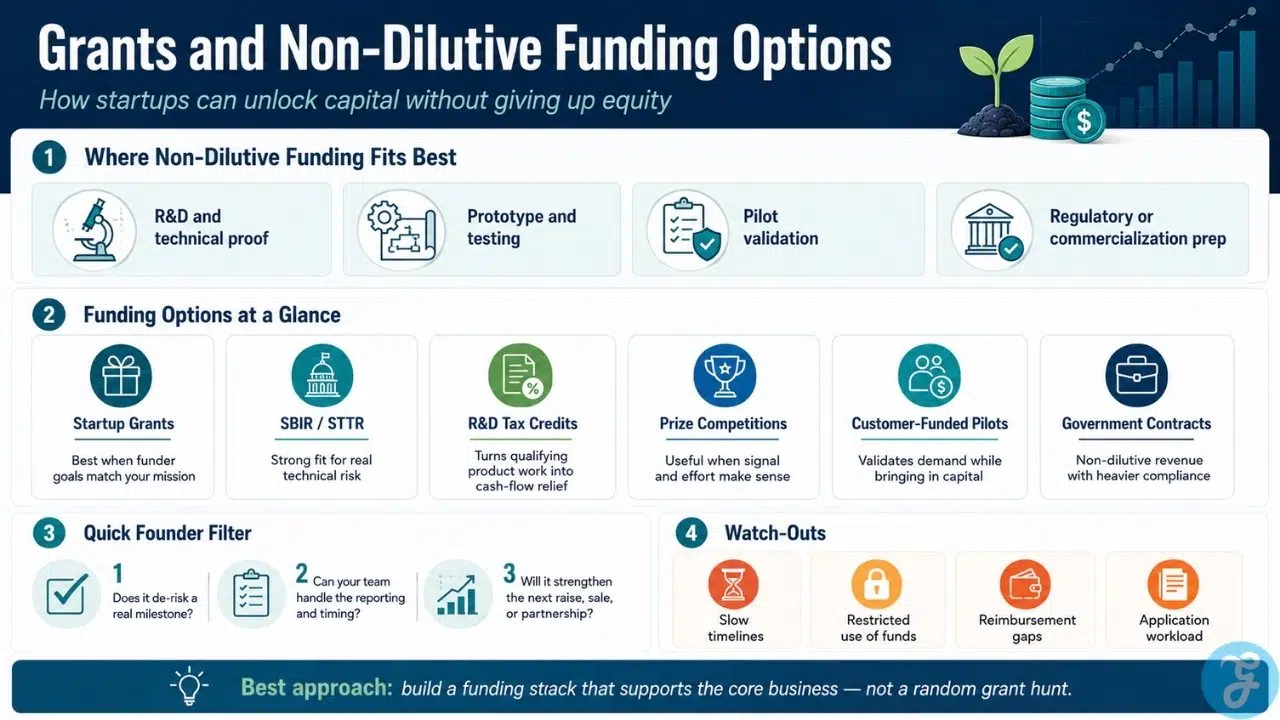
That category includes startup grants, SBIR/STTR awards, research funding, tax credits, prize competitions, government contracts, customer prepayments, pilot funding, corporate innovation programs, and some forms of debt or revenue-based financing.
The keyword is “non-dilutive,” not “free.”
A grant may restrict how the money can be spent. A tax credit only helps if the company qualifies and has the right expenses. A government contract may create reporting obligations. A prize competition may cost months of founder time. A customer prepayment may create delivery pressure. Debt preserves equity but still has to be repaid.
Founders get into trouble when they treat all non-dilutive money as harmless. It is not harmless if it slows the company down, forces the roadmap toward someone else’s agenda, creates compliance work the team cannot handle, or gives a false sense of progress.
The better question is not “Can we get non-dilutive funding?” It is “Will this money help us prove something the next capital source will care about?”
Startup Grants Are Real, but Most Are Not for Starting Any Business
Startup grants attract founders because the phrase sounds simple. Apply, win, build. In practice, most serious grant money is tied to a purpose.
That purpose may be research and development, climate innovation, defense technology, health innovation, agriculture, energy, education, manufacturing, regional economic development, or underrepresented founder support. The funder is not trying to help any random company exist. They are trying to solve a specific problem, support a policy goal, commercialize research, or strengthen an ecosystem.
That distinction matters.
A founder building a basic local service business will struggle to find meaningful government grant money just because the business is new. A founder building a hard-science diagnostic tool, novel battery material, robotics system, agricultural technology, or medical device may have a much stronger case.
Startup grants reward fit. They do not reward need alone.
If your application basically says, “We are a startup and money would help,” it is weak. If it says, “This technical milestone reduces a known commercialization risk in an area the funder already cares about,” it has a much better shot.
SBIR and STTR Are the Serious Lanes for R&D-Heavy Startups
For U.S. startups, SBIR and STTR programs sit near the center of serious non-dilutive startup funding.
They are built for small businesses doing research and development with commercial potential. The money is not for polishing a pitch deck, hiring a random growth marketer, or funding generic business operations. It is for technical work that fits an agency’s mission or, in the case of some programs, high-potential use-inspired technology.
SBIR and STTR funding works best when the startup has genuine technical risk. Not market risk disguised as science. Not “we need money to build version one.” Real technical uncertainty.
A startup developing a new sensor architecture, novel material, therapeutic platform, climate hardware system, robotics capability, or deep tech tool may fit. A simple SaaS product with standard engineering work probably does not, unless the technical innovation is substantial and defensible.
STTR adds another layer because it involves formal collaboration with a research institution. That can help when university science needs a commercial vehicle, but it also means partner alignment, workshare rules, intellectual property planning, and more coordination.
SBIR/STTR money can be excellent. It can also be slow. If your company has six months of runway and needs revenue now, do not build the whole survival plan around a federal award timeline.
Non-Dilutive Funding Should De-Risk the Next Step
The best use of grants and non-dilutive funding is to remove a specific risk.
That risk might be technical proof, prototype development, regulatory preparation, pilot validation, manufacturing feasibility, clinical work, data collection, or customer adoption. The money should move the company from “interesting but uncertain” to “more fundable, more credible, or more commercially ready.”
A clean use case looks like this: a hardware startup needs $250,000 to prove the prototype survives real operating conditions. If it works, the company can raise a seed round with better evidence and less hand-waving. That is a good non-dilutive funding target.
A weaker use case looks like this: a founder applies for five grants because revenue is slow and the team needs cash for general operations. That may be understandable, but it is not a strategy. It is panic with application deadlines.
Non-dilutive money should connect to a milestone investors, customers, or commercial partners will recognize. If the award does not help you prove something useful, it may just delay the harder conversation.
Alternative Funding Sources Founders Should Not Ignore
Grants get the attention, but alternative funding sources can matter just as much.
Customer-funded development is one of the most underrated options. A serious customer pays for a pilot, implementation, customization, or early deployment because the problem matters enough. That money may come with pressure, but it also proves demand in a way most grant wins cannot.
Corporate innovation programs can help when a large company needs access to a new technology and the startup needs validation, pilot support, or technical resources. The risk is dependence. If one corporate partner quietly turns your roadmap into their internal wish list, you may wake up building a product for one buyer instead of a market.
Prize competitions can be useful when the application is not too distracting and the prize includes credibility, introductions, or technical validation. A pitch competition that pays $25,000 and gets you in front of the right buyers can be worth it. A competition that demands weeks of work for a tiny prize and vague “exposure” should probably be skipped.
Government contracts are another route. They are not the same as grants, but they can provide non-dilutive revenue and validation. The company has to deliver, invoice, comply, and survive procurement. This is not lightweight money, but for defense, energy, health, infrastructure, education, and public-sector technology startups, it can become a serious path.
Tax credits sit in a different category. They do not fund the company before the work happens. They help recover value from qualifying activity. For R&D-heavy startups, that can still matter. A dollar saved on payroll taxes is a dollar the company can keep using.
The R&D Tax Credit Is Not a Grant, but Founders Should Check It
The R&D tax credit gets ignored because it sounds like accountant language. That is a mistake for technical startups.
If the company is paying engineers, scientists, product developers, or technical staff to solve real uncertainty, the work may qualify. The details matter. You need documentation, eligible expenses, and proper filing. You also need someone who understands the rules instead of a vendor promising free money after one sales call.
For qualified small businesses in the U.S., the payroll tax credit route can be especially useful because early startups may not owe income tax yet but still have payroll tax obligations. That can turn eligible R&D activity into a real cash-flow benefit.
Do not treat this like a side hustle for your finance team at the last minute. Track the work, the experiments, the uncertainty, and the people involved while the work is happening. Trying to recreate a year of R&D documentation after the fact is how founders end up with weak claims and nervous accountants.
The R&D tax credit will not save a broken company. It can give a serious technical company a little more oxygen.
The Fit Depends on Stage, Not Just Sector
A grant that fits one startup can waste another startup’s time.
At idea stage, founder competitions, university grants, local innovation programs, and small prototype awards may help. The bar is lower, but the money is smaller and the signal is weaker.
At pre-seed, SBIR/STTR Phase I, pilot funding, accelerator-linked non-dilutive awards, customer discovery grants, and technical feasibility support can make sense if they move the company toward proof.
At seed, larger R&D awards, strategic pilots, corporate partnerships, tax credits, and government contracts can become more useful. The startup has enough substance to pass review and enough structure to manage the obligations.
At Series A and beyond, non-dilutive funding usually needs to fit into a larger capital strategy. A bigger grant or government contract can support development, but it should not pull the company away from the commercial market investors expect it to serve.
The stage question is brutal but useful: are you too early to win this, too messy to manage it, or just mature enough for it to help?
The Application Is Not the Work. The Work Is the Work
Grant applications can trick founders into feeling productive.
You define milestones, write technical aims, polish impact statements, gather letters, estimate budgets, and tell a clean story about the future. It feels like progress because the documents look serious.
None of that means the company is getting stronger.
The application only matters if the underlying work is worth funding and the award will move the startup forward. If the business is stuck because customers do not care, a grant application may simply delay the customer conversation. If the product is weak because the technical problem is unsolved, then a grant may be exactly the right tool.
Be honest about which problem you have.
If the bottleneck is science, engineering, prototype risk, testing, or validation, grants and non-dilutive funding can help. If the bottleneck is weak positioning, unclear buyer pain, bad sales motion, or founder avoidance, the application will not fix it.
Grant Money Comes With Strings
Founders love the “no dilution” part and forget the restrictions.
Grant money may come with allowable cost rules, reporting deadlines, budget categories, audits, performance milestones, technical reports, reimbursement structures, matching requirements, or limits on how funds can be used. A startup that treats grant money like a general bank deposit can create trouble fast.
Reimbursement-based programs can be especially painful. If the company has to spend first and get paid later, you still need enough cash to float the work. That matters for hardware, lab work, contractors, testing, and manufacturing-related development.
There is also a roadmap risk. A grant can pull the company toward what the funder wants instead of what the market needs. That is not always bad. Public funding often supports work the market would underfund. But if the grant creates a side project that does not help the commercial product, the company may look funded while drifting away from the business.
Free money that bends the company in the wrong direction is not free.
How to Judge Whether a Funding Option Is Worth Pursuing
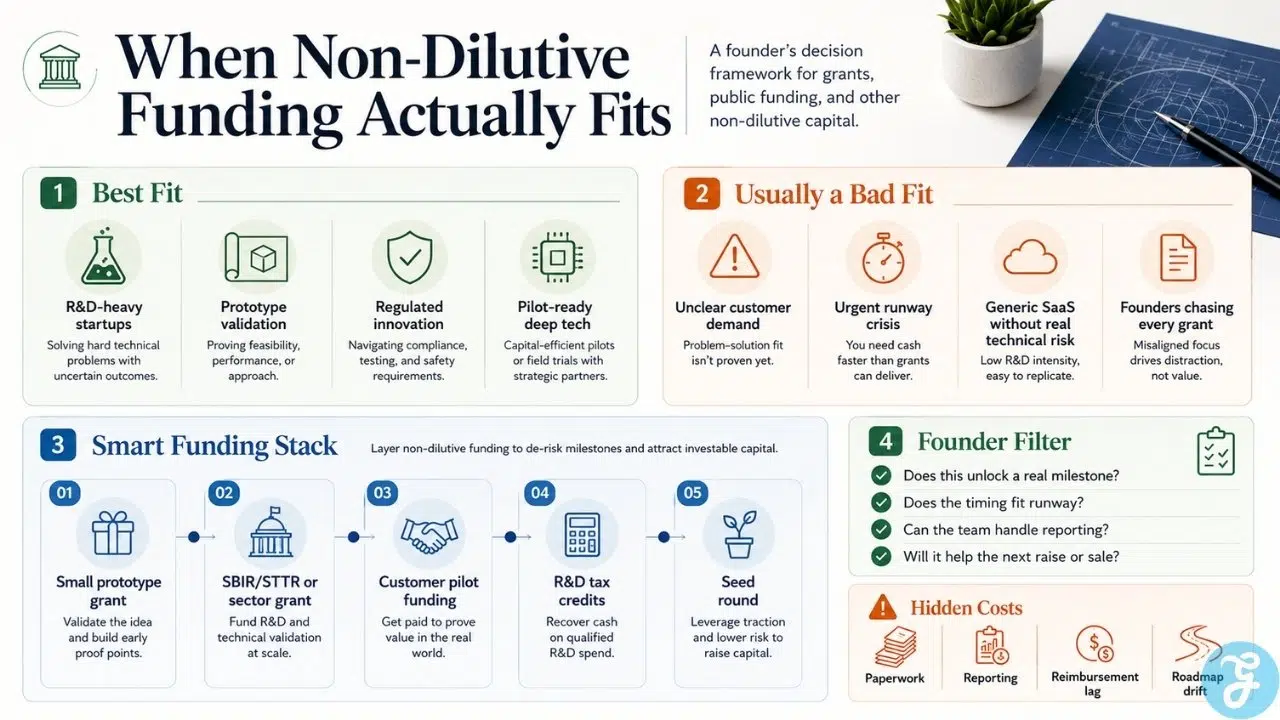
Before applying, put the opportunity through a hard filter.
First, check fit. Does the funder already support companies like yours, at your stage, in your sector, with your type of technical or commercial risk?
Second, check timing. If decisions take nine months and you need cash in three, this is not your runway plan.
Third, check effort. A serious SBIR proposal or government grant can take real founder time, technical writing, budgeting, partner coordination, and review. If the odds are low and the application distracts from revenue, think carefully.
Fourth, check restrictions. Know what the money can and cannot fund. Know whether it is paid upfront, milestone-based, or reimbursed after spending.
Fifth, check signal. Will winning this make customers, investors, regulators, or partners take you more seriously? Or will it just add a logo to the website?
A $50,000 grant that helps you finish a test investors care about may be more valuable than a $250,000 award that drags the company into irrelevant reporting work.
Build a Non-Dilutive Funding Stack, Not a Random Grant Hunt
The best founders do not chase grants randomly. They build a funding stack around milestones.
For a deep tech startup, that stack might look like university lab support, a small prototype grant, SBIR Phase I, customer pilot funding, R&D tax credits, and then a seed round. For a climate startup, it might combine state innovation funding, ARPA-E or DOE opportunities, paid pilots, corporate partnerships, and tax incentives. For a medical device startup, it might include NIH SBIR, clinical validation support, hospital pilots, and strategic partnerships.
The stack only works when each layer makes the next one easier.
A messy stack creates confusion. Too many grants with different reporting requirements, different technical aims, and different timelines can make the company feel busy but unfocused. Investors will ask a simple question: is this funding helping the core business, or is the company becoming a grant-writing machine?
Non-dilutive startup funding should strengthen the company’s main path. It should not become the path.
Common Mistakes Founders Make With Grants and Non-Dilutive Funding
Most mistakes start with a bad assumption: if the money is non-dilutive, it must be worth chasing.
A founder applies for startup grants without checking whether the program funds companies at that stage. Another founder spends weeks on a prize competition that has no serious buyer or investor audience. A technical founder applies for SBIR funding but cannot explain the commercial path. A SaaS founder calls ordinary product development “research” and wonders why the proposal feels weak. A hardware founder wins funding and then realizes the reimbursement schedule does not match the company’s cash position.
The ugly version is worse: the company keeps winning small awards but never learns how to sell.
That can become its own trap. The founder gets praised by accelerators, local programs, and innovation offices, but customers still are not paying. The company becomes grant-fluent and market-weak.
Do not let alternative funding sources become a substitute for commercial truth.
When Grants and Non-Dilutive Funding Are the Wrong Move
Grants and non-dilutive funding are the wrong move when speed matters more than fit.
If the company needs immediate customer revenue, write fewer applications and take more sales calls. If the team cannot handle reporting, compliance, and restricted budgets, wait until the operating base is stronger. If the opportunity forces the roadmap away from the product buyers actually want, pass.
Non-dilutive funding is also the wrong move when the founder uses it to avoid valuation, rejection, or sales pressure. Sometimes the hard thing is talking to investors. Sometimes the hard thing is asking customers to pay. A grant application can feel safer because the rejection is quiet and bureaucratic. That does not make it the right use of time.
The best non-dilutive money sharpens the company. The worst version numbs it.
The Practical Takeaway Before You Apply
Grants and non-dilutive funding deserve a place in the startup funding conversation, especially for companies with real technical risk, long development cycles, public-benefit alignment, or expensive validation work.
But founders need to be honest about the trade. You may keep your equity, but you pay with time, focus, compliance, restrictions, and uncertainty. That trade can be excellent. It can also be a slow way to avoid building something people will buy.
Use startup grants when they match the milestone. Use SBIR/STTR when the technical risk is real. Use tax credits when the work qualifies. Use prizes when the signal and effort make sense. Use customer funding when the market is willing to pay early. Use alternative funding sources as part of a deliberate capital strategy, not as a scavenger hunt.
Before you apply, write down the milestone this money will unlock. If you cannot name it in one sentence, you are probably chasing funding because it exists.
That is not strategy. That is procrastination with a grant deadline.