

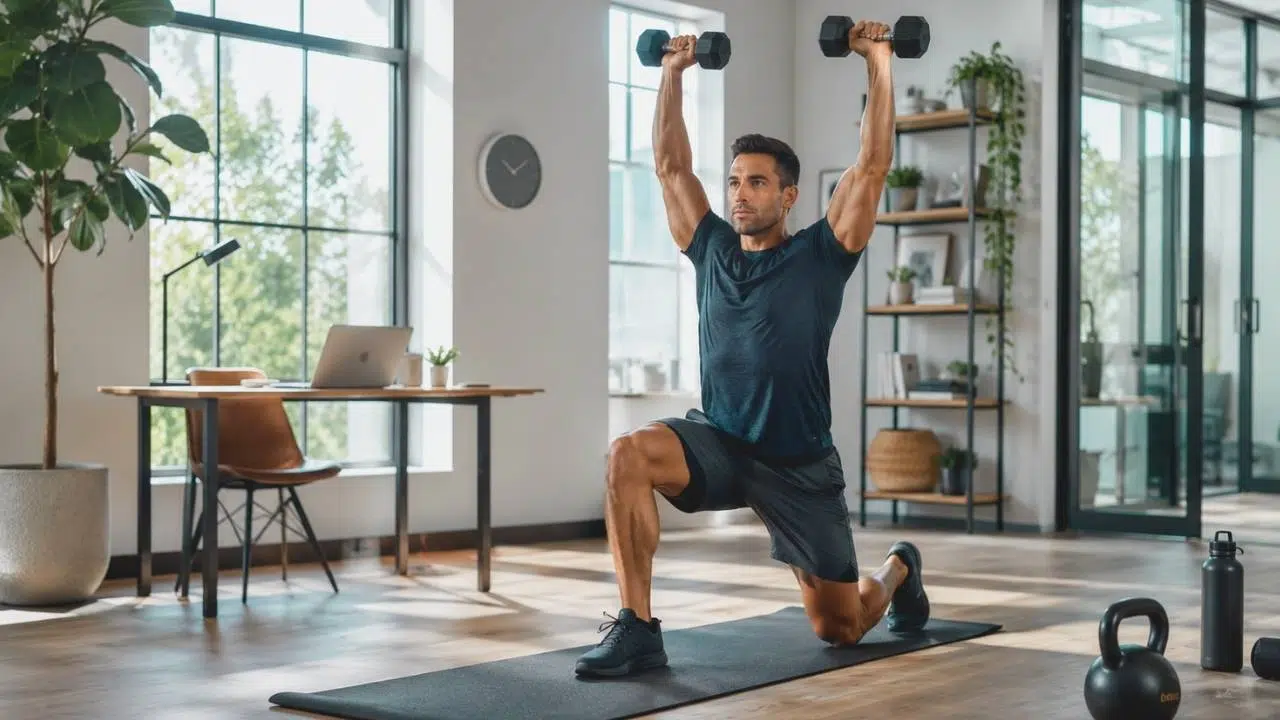
Full body workouts busy people can actually stick with are not built around perfect schedules. They are built around real mornings, packed calendars, desk fatigue, travel days, family needs, and low-motivation afternoons. Most people do not need a complicated training split at the beginning. They need a simple plan that trains the whole body, fits into 10 to 40 minutes, and leaves them able to show up again. That is where quick full body training works so well.
A useful workout should train the major movement patterns: squat, hinge, push, pull, core, carry, and sometimes conditioning. These patterns build practical strength for real life, not just the gym. For the Corporate Athlete, movement is part of performance. If your work depends on focus, posture, patience, decision-making, and long desk hours, your body needs regular strength and circulation.
These workouts also connect naturally with the best healthy habits because training improves when sleep, hydration, recovery, nutrition, and stress control are handled well.
Why Full-Body Workouts Work Better for Busy People?
Full-body workouts work better for busy people because they reduce the number of decisions needed to stay consistent. Instead of asking, “Is today chest day, leg day, back day, or shoulder day?” you train the whole body in one session. That makes the plan easier to follow when life gets crowded. A full-body workout usually includes lower-body training, upper-body pushing, upper-body pulling, core control, and sometimes a carry or conditioning move. This gives your body a balanced training effect without needing five or six separate gym days. For someone with a busy workweek, that matters.
Another reason this approach works is flexibility. If you miss one workout, the whole week does not fall apart. You can move the session to the next day and still train the major muscles. That is much harder with strict body-part splits. Full-body workouts also help desk workers because they include movement patterns that sitting tends to weaken or neglect. Rows support the upper back. Hinges train the hips and hamstrings. Squats rebuild lower-body strength. Core work improves control. Carries help posture and grip.
A quick full body session can also fit into different parts of the day. Some people train in the morning for energy. Some train at lunch to break up screen time. Others train after work as a stress reset. The structure is flexible enough to support different lifestyles. The biggest mistake is thinking a short workout is not worth doing. A focused 20-minute routine done three times per week can do more for a busy person than a perfect 90-minute workout that rarely happens.
Efficient training is not about doing less work. It is about removing wasted time and choosing exercises that give the best return.
| Why Full-Body Workouts Help Busy People | Practical Benefit | Real-Life Example |
| Fewer weekly sessions | Easier to stay consistent | Train two or three times weekly |
| Whole body trained each session | Better return on time | Legs, back, chest, core, and hips together |
| Flexible scheduling | Missing one day is less damaging | Move the session to the next open slot |
| Beginner-friendly structure | Easier to learn and repeat | Squat, push, pull, hinge, brace |
| Useful for desk workers | Supports posture and mobility | Add rows, hinges, and core work |
| Works with simple equipment | Good for home or travel | Dumbbells, bands, or bodyweight |
| Easier progression | Simple to track improvement | Add reps, load, sets, or control |
A busy person needs a training plan that bends without breaking. Full-body workouts do that better than most complicated routines.
What Makes a Full-Body Workout Efficient?
An efficient full-body workout has structure. It is not a random list of sweaty exercises. It should train the body in a balanced way while respecting time, energy, and recovery. The most useful structure includes a squat pattern, hinge pattern, push pattern, pull pattern, core pattern, and sometimes a carry or conditioning finisher. These are the movements that show up in both training and daily life. You squat to sit and stand. You hinge to pick things up. You push, pull, brace, walk, and carry.
A good workout also has a clear time limit. Busy people need to know what they are starting and when it ends. A 20-minute circuit, 25-minute dumbbell session, or 40-minute anchor workout feels manageable because the finish line is clear. Efficient training also uses compound movements. A compound exercise trains several muscles at once. A goblet squat trains legs, hips, core, and posture. A dumbbell row trains the back, arms, and grip. A farmer carry trains the core, shoulders, grip, and posture.
Rest matters too. Many people think time-saving workouts must be rushed. That is not always true. If you rush every set, your form suffers and the workout becomes messy. Good training uses enough rest to keep movement clean. Another part of efficiency is exercise selection. Busy people should avoid spending half the workout setting up equipment. Simple exercises usually work better. Dumbbells, resistance bands, bodyweight, kettlebells, and basic machines are enough for most people.
Progression is the final piece. A workout is not efficient if it never moves forward. Progress can mean more reps, better form, slower tempo, slightly heavier weight, more rounds, or less rest.
| Workout Element | Purpose | Exercise Examples |
| Squat pattern | Builds legs and hips | Bodyweight squat, goblet squat, split squat |
| Hinge pattern | Trains glutes, hamstrings, and back side | Glute bridge, Romanian deadlift, kettlebell deadlift |
| Push pattern | Trains chest, shoulders, and triceps | Push-up, dumbbell press, overhead press |
| Pull pattern | Trains back, arms, and posture muscles | Band row, dumbbell row, inverted row |
| Core pattern | Builds trunk control | Dead bug, plank, side plank |
| Carry pattern | Trains grip, posture, and core | Farmer carry, suitcase carry |
| Conditioning | Raises heart rate and work capacity | Step-ups, marching, low-impact intervals |
A quick full body workout should leave you feeling trained, not randomly exhausted.
11 Full-Body Workouts for Busy People
These 11 workouts are built for different types of busy days. Some require no equipment. Some use dumbbells, bands, or a kettlebell. Some are better for lunch breaks. Some fit hotel rooms. Some are gentle enough for low-energy days. You do not need to do all 11. Choose two or three that match your life right now. If you are new to training, start with the bodyweight workout, low-impact workout, or desk reset. If you already train, the dumbbell circuit, strength and core workout, or weekly anchor workout may fit better.
The goal is not to prove how hard you can suffer. The goal is to repeat useful training often enough that your body adapts. If you sit most of the day, prioritize workouts with rows, hinges, hip work, and core stability. If your schedule changes often, keep one 10-minute emergency workout ready. If you travel, learn the hotel-room routine before you need it.
A busy week should not mean no movement. It should mean smarter movement.
| Workout | Time Needed | Equipment | Best For |
| 1. 20-Minute Bodyweight Full-Body Workout | 20 minutes | None | Beginners and home workouts |
| 2. 25-Minute Dumbbell Strength Circuit | 25 minutes | Dumbbells | Busy professionals |
| 3. 15-Minute Quick Full Body Desk Reset | 15 minutes | None or chair | Desk workers |
| 4. 30-Minute Resistance Band Workout | 30 minutes | Resistance band | Home, travel, joint-friendly training |
| 5. 20-Minute Low-Impact Full-Body Workout | 20 minutes | Optional mat | Beginners and recovery weeks |
| 6. 30-Minute Kettlebell-Style Full-Body Session | 30 minutes | Kettlebell or dumbbell | Efficient strength and conditioning |
| 7. 10-Minute Emergency Workout | 10 minutes | None | Packed days |
| 8. 35-Minute Strength and Core Workout | 35 minutes | Dumbbells | Strength-focused training |
| 9. 25-Minute Lunch-Break Workout | 25 minutes | Bodyweight or dumbbells | Office or remote workers |
| 10. 20-Minute Hotel-Room Workout | 20 minutes | None or suitcase | Travelers |
| 11. 40-Minute Weekly Anchor Workout | 40 minutes | Dumbbells or gym | One strong weekly session |
1. 20-Minute Bodyweight Full-Body Workout
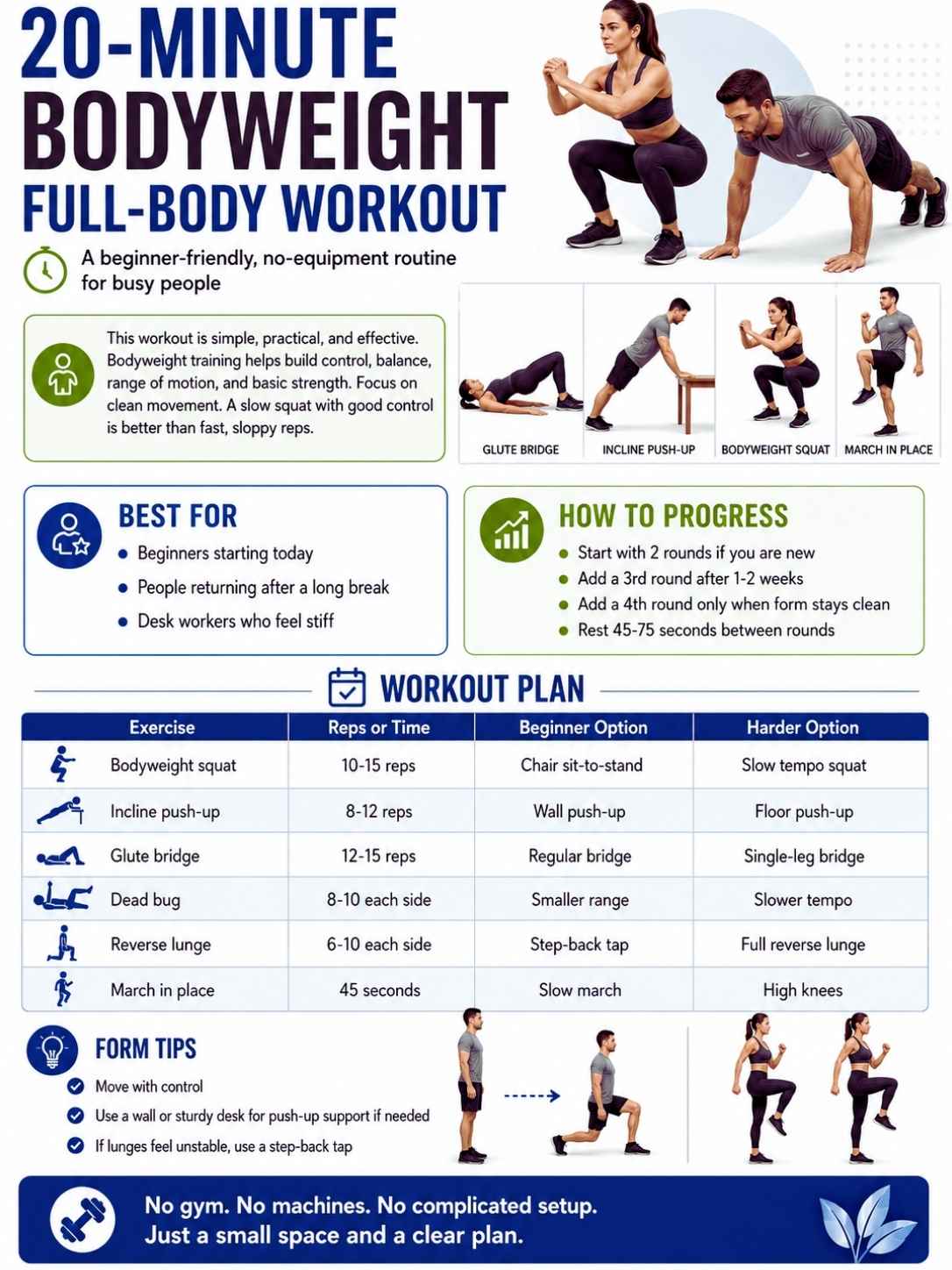
This is the workout I would give to someone who wants to start today with no equipment. It is simple, but it is not useless. Bodyweight training teaches control, balance, range of motion, and basic strength. The key is to move well. A slow squat with good control is better than fast, sloppy reps. A wall push-up or incline push-up is better than a floor push-up with poor form. Beginners often rush because they think speed makes the workout more serious. It usually makes it less effective.
This workout is ideal for people returning after a long break, desk workers who feel stiff, or anyone who wants to build the habit before buying equipment. It also works well as a morning movement session when you want energy without draining yourself. Start with two rounds if you are new. Add a third round after one or two weeks. Add a fourth round only when your form stays clean and recovery feels good.
If squats bother your knees, use a chair sit-to-stand exercise. If push-ups feel too hard, use a wall or sturdy desk. If lunges feel unstable, use a step-back tap instead.
| Exercise | Reps or Time | Beginner Option | Harder Option |
| Bodyweight squat | 10-15 reps | Chair sit-to-stand | Slow tempo squat |
| Incline push-up | 8-12 reps | Wall push-up | Floor push-up |
| Glute bridge | 12-15 reps | Regular bridge | Single-leg bridge |
| Dead bug | 8-10 each side | Smaller range | Slower tempo |
| Reverse lunge | 6-10 each side | Step-back tap | Full reverse lunge |
| March in place | 45 seconds | Slow march | High knees |
Rest 45 to 75 seconds between rounds. This quick full body session is a strong starting point because it removes excuses. No gym. No machines. No complicated setup. Just a small space and a clear plan.
2. 25-Minute Dumbbell Strength Circuit
A pair of dumbbells can make full-body training much more effective for busy people. Dumbbells are simple, versatile, and easy to use at home. They allow you to train strength without needing a full gym setup. This workout uses compound exercises. That means each move trains more than one muscle group. A goblet squat trains the legs, hips, core, and posture. A dumbbell row trains the back, arms, and grip. A floor press trains the chest, shoulders, and triceps.
The most important decision is choosing the right weight. The final few reps should feel challenging, but your form should not fall apart. If you have to twist, bounce, or hold your breath aggressively, the weight is too heavy for now. Do not race through this workout. Strength training needs control. Rest enough to make the next set strong. Efficient training is not about moving nonstop. It is about using every set well.
This workout can be repeated two or three times per week. To progress, add one or two reps, slow down the lowering phase, or increase the weight slightly when ready.
| Exercise | Sets | Reps | Coaching Tip |
| Goblet squat | 3 | 8-12 | Keep chest tall and feet stable |
| Dumbbell Romanian deadlift | 3 | 8-12 | Push hips back, not knees forward |
| Dumbbell floor press | 3 | 8-12 | Lower with control |
| One-arm dumbbell row | 3 | 8-12 each side | Pull elbow toward hip |
| Dumbbell reverse lunge | 2 | 6-10 each side | Step back softly |
| Plank | 2 | 30-45 seconds | Brace without sagging |
Rest 45 to 90 seconds between sets. This is one of the most practical time-saving workouts for people who want strength but cannot spend an hour training.
3. 15-Minute Quick Full Body Desk Reset
The desk reset is for the days when your body feels stuck in one shape. Long sitting can make the hips tight, upper back stiff, shoulders rounded, and legs sleepy. A short reset helps interrupt that pattern. This is not meant to replace every workout. It is a movement break with strength value. It works well between meetings, before lunch, after a long writing session, or when the afternoon slump hits.
One mistake desk workers make is waiting until the evening to move. By then, the body may already feel tight and tired. Short movement during the day keeps stiffness from building as much. You do not need to change clothes or sweat heavily. That makes this routine realistic during a workday. It is useful for remote workers, office workers, editors, writers, designers, and anyone who spends long hours at a screen.
The goal is to wake up the body, not exhaust it. Use smooth movement. Breathe normally. Keep the pace comfortable enough that you can return to work feeling clearer, not drained.
| Exercise | Time or Reps | Purpose |
| Shoulder rolls | 30 seconds | Releases upper-body tension |
| Chair sit-to-stand | 12-15 reps | Activates legs and hips |
| Desk incline push-up | 8-12 reps | Trains upper-body push |
| Standing hip hinge | 10-12 reps | Wakes hamstrings and glutes |
| Standing calf raise | 15-20 reps | Supports lower-leg circulation |
| Wall angels | 8-10 reps | Improves posture awareness |
| Standing march | 60 seconds | Raises heart rate lightly |
Repeat the circuit twice if time allows. This routine supports movement habits for sedentary lifestyles and habits for better focus because a short movement break can reset both posture and attention.
4. 30-Minute Resistance Band Workout
Resistance bands are useful because they are portable, affordable, and easy to store. They are especially helpful for people who travel, train at home, or do not want heavy equipment. Bands are also excellent for pulling movements. Many home workouts include squats and push-ups but miss rows and upper-back work. That is a problem for desk workers because the back side of the body often needs more training.
The key with bands is tension. If the band feels too easy, step farther away, shorten the band, or use a stronger one. If it feels too hard, reduce tension. You should control the movement both ways. Anchor safety matters. If you attach a band to a door, rail, or furniture, make sure it is secure. A loose band can snap back and cause injury.
This workout is joint-friendly for many people because bands create smoother resistance. Still, form matters. Do not let the band pull you out of position. Keep your ribs controlled, shoulders relaxed, and movements steady.
| Exercise | Sets | Reps | Coaching Tip |
| Band squat | 3 | 10-15 | Keep knees tracking over toes |
| Band Romanian deadlift | 3 | 10-12 | Hinge from hips |
| Band row | 3 | 12-15 | Squeeze shoulder blades gently |
| Band chest press | 3 | 10-12 | Anchor band safely |
| Band overhead press | 2 | 8-12 | Avoid arching lower back |
| Band pull-apart | 2 | 12-15 | Move slowly |
| Pallof press | 2 | 8-12 each side | Resist rotation |
Rest 45 to 75 seconds between sets. This is efficient training for people who need a lightweight, travel-friendly, full-body option.
5. 20-Minute Low-Impact Full-Body Workout
Low-impact training is not a weaker version of fitness. It is a smarter option for many people, especially beginners, heavier bodies, people returning after a break, and anyone managing joint sensitivity. This workout avoids jumping and hard landings. It focuses on controlled movement, steady breathing, and full-body activation. It should leave you feeling better, not punished.
Many people think exercise only counts if it is intense. That mindset creates problems. If every workout is exhausting, busy people stop recovering well and eventually skip sessions. Low-impact workouts help keep consistency alive. This routine is also useful during stressful weeks. When sleep is poor or work pressure is high, a lower-impact session can still support strength, circulation, and mood without adding too much strain.
Use this workout when you want to move but do not want to push hard. It also pairs well with recovery day routines.
| Exercise | Time or Reps | Coaching Tip |
| March in place | 60 seconds | Start gently |
| Chair squat | 10-15 reps | Sit back with control |
| Wall push-up | 10-15 reps | Keep body straight |
| Step-back lunge tap | 8-10 each side | Stay balanced |
| Standing band row or towel row | 12 reps | Pull smoothly |
| Glute bridge | 12-15 reps | Squeeze glutes at the top |
| Bird dog | 8 each side | Move slowly |
| Side step | 45 seconds | Keep knees soft |
This is a strong option for people who need full-body movement without high impact or heavy equipment.
6. 30-Minute Kettlebell-Style Full-Body Session
Kettlebell-style training can be very efficient because one tool can train strength, conditioning, grip, hips, and core. If you do not own a kettlebell, one dumbbell can work for many of the same patterns. This workout is best for people who already have some movement confidence. Kettlebell swings, carries, and single-arm moves require control. If you are new, learn the deadlift and hinge first before adding faster movements like swings.
The hip hinge is the heart of kettlebell-style training. The movement should come from the hips, not the lower back. If swings bother your back or feel confusing, replace them with kettlebell deadlifts or glute bridges. This session works well for busy people because it feels athletic without taking too long. It combines strength and conditioning in one workout.
Keep the weight moderate. You should feel challenged but not reckless. Every rep should look controlled.
| Exercise | Sets | Reps or Time | Coaching Tip |
| Kettlebell deadlift | 3 | 8-12 | Learn the hinge first |
| Goblet squat | 3 | 8-12 | Keep torso tall |
| One-arm row | 3 | 8-10 each side | Pull with control |
| Kettlebell swing | 4 | 10-15 | Use only with solid technique |
| Half-kneeling press | 2 | 8 each side | Keep ribs down |
| Suitcase carry | 3 | 30-45 seconds each side | Walk tall |
| Dead bug | 2 | 8 each side | Keep lower back controlled |
Rest as needed to keep form clean. This workout is great for efficient training, but technique matters more than speed.
7. 10-Minute Emergency Workout
Every busy person needs an emergency workout. It is not the workout you choose on your best day. It is the workout that saves the habit on your worst day. There will be days when everything runs late. You miss the gym. You lose your workout window. You feel tired, annoyed, or overwhelmed. The emergency workout gives you a way to still move.
The purpose is not to replace serious training forever. The purpose is to keep your identity alive. You are still someone who trains, even when the day is messy. This workout should be easy to remember. No setup. No equipment. No complex timing. Just a few basic movements repeated with good form.
Do not use the emergency workout as punishment. Do not try to make up for missing a longer session by destroying yourself in 10 minutes. Keep it steady and controlled.
| Exercise | Reps |
| Bodyweight squat | 10 |
| Incline push-up | 8 |
| Glute bridge | 12 |
| Plank shoulder tap | 10 each side |
| Reverse lunge or step-back tap | 6 each side |
| Standing march | 30 seconds |
Repeat as many quality rounds as possible in 10 minutes. This is one of the best time-saving workouts because it protects consistency when your schedule is not cooperating.
8. 35-Minute Strength and Core Workout
This workout is for people who want a little more strength focus while still keeping the session efficient. It trains the whole body and gives extra attention to core stability. Core training is often misunderstood. It is not just about crunches or visible abs. A strong core helps the body brace, resist unwanted movement, transfer force, and protect posture. That matters for desk workers, lifters, parents, travelers, and anyone who carries stress in the body.
This workout uses dumbbells, but it can be adapted with bands, machines, or bodyweight changes. It is a good option for two or three weekly strength sessions. Move with control. Do not rush the core exercises. A slow dead bug or side plank done correctly can be more useful than fast, sloppy reps.
If you are new to strength training, start with lighter weights and fewer sets. Add volume gradually.
| Exercise | Sets | Reps | Coaching Tip |
| Dumbbell squat | 3 | 8-10 | Use moderate weight |
| Dumbbell Romanian deadlift | 3 | 8-10 | Keep spine neutral |
| Push-up or dumbbell press | 3 | 8-12 | Choose the right level |
| Dumbbell row | 3 | 8-12 each side | Pull elbow back |
| Split squat | 2 | 6-10 each side | Control balance |
| Side plank | 2 | 20-40 seconds each side | Keep hips lifted |
| Farmer carry | 3 | 30-45 seconds | Walk tall |
This workout can become a reliable weekly strength session for busy professionals who want more than basic movement.
9. 25-Minute Lunch-Break Workout
A lunch-break workout can change the entire workday. Instead of waiting until evening, when energy and responsibilities may get in the way, you place training in the middle of the day. This is especially useful for remote workers and office workers. A midday workout breaks up sitting, clears mental fog, and gives the afternoon a cleaner start.
The key is to keep it practical. You may not want a workout that leaves you drenched before meetings. Choose a steady pace, controlled movements, and a short cooldown. If you train at home, dumbbells or bands work well. If you are at the office, use bodyweight, stairs, walking, or resistance bands. Even a simple routine can help.
Try not to spend half the break deciding what to do. Have the workout ready before lunch starts.
| Lunch-Break Workout Step | Time | What To Do |
| Warm-up | 3 minutes | March, arm circles, hip hinges |
| Strength circuit | 15 minutes | Squat, push-up, row, lunge, plank |
| Conditioning | 4 minutes | Step-ups, stairs, or brisk walk |
| Cooldown | 3 minutes | Breathing and light stretching |
Sample circuit:
| Exercise | Reps |
| Squat | 12 |
| Incline push-up | 10 |
| Band row or dumbbell row | 12 |
| Reverse lunge | 8 each side |
| Plank | 30 seconds |
Repeat for 3 rounds. This routine supports habits for better focus because movement can reset the brain before the second half of the workday.
10. 20-Minute Hotel-Room Workout
Travel breaks routines quickly. A hotel-room workout keeps your body moving when the gym is unavailable, the schedule is unpredictable, or the space is limited. The goal is not to recreate your perfect home or gym program. The goal is to maintain movement, reduce stiffness, and keep the habit alive.
This workout can be done in a small space. If you have a suitcase, backpack, or resistance band, you can add load. If not, bodyweight is enough. The biggest mistake while traveling is waiting for ideal conditions. The hotel gym may be closed. The room may be small. Your day may start early. You can still do 20 minutes.
Travel workouts are also useful because they reduce the stiff feeling that comes from sitting in cars, trains, airplanes, or long meetings.
| Exercise | Reps or Time | Travel Tip |
| Bodyweight squat | 15 | Use slow tempo |
| Suitcase deadlift | 10-12 | Use a loaded suitcase if safe |
| Bed or desk incline push-up | 8-12 | Choose a stable surface |
| Split squat | 8 each side | Hold wall for balance |
| Backpack row | 10-12 | Pull with control |
| Plank | 30-45 seconds | Brace the core |
| March or step-up | 60 seconds | Use safe surfaces only |
Complete 2 to 3 rounds. This workout supports the best healthy habits during travel because it keeps movement, energy, and routine from disappearing completely.
11. 40-Minute Weekly Anchor Workout
A weekly anchor workout is your strongest session of the week. It is useful when your schedule is too unpredictable for a perfect plan. If you can only protect one serious workout, make it full body. Train the major patterns, track what you do, and leave the session feeling like you built something.
This workout should not destroy you. Many busy people make their one weekly workout too hard, then spend several days sore and unmotivated. That is not smart training. The goal is a strong session you can recover from. The anchor workout can happen on a weekend, a lighter workday, or whenever your energy is highest. Around it, you can add short workouts, walks, mobility, or desk resets.
This approach works well for people with demanding jobs, parents with limited time, and professionals who travel often.
| Exercise | Sets | Reps | Coaching Tip |
| Squat variation | 3 | 6-10 | Goblet squat, leg press, or barbell squat |
| Hip hinge | 3 | 6-10 | Romanian deadlift or deadlift pattern |
| Push movement | 3 | 8-12 | Push-up, dumbbell press, or machine press |
| Pull movement | 3 | 8-12 | Row, pulldown, or band row |
| Lunge or step-up | 2 | 8 each side | Build single-leg strength |
| Core movement | 2 | 30-45 seconds | Plank or dead bug |
| Loaded carry | 3 | 30-60 seconds | Farmer or suitcase carry |
This workout gives the week a reliable strength foundation, even when everything else feels unpredictable.
How to Choose the Right Workout for Your Schedule?
Choosing the right workout is more important than choosing the hardest workout. A busy person needs a plan that fits time, energy, equipment, space, and recovery. If you have only 10 minutes, do the emergency workout. If you feel stiff at your desk, do the desk reset. If you have 20 minutes at home, use the bodyweight or low-impact session. If you have dumbbells, use the strength circuit. If you are traveling, use the hotel-room workout.
A useful system is to keep three versions ready: minimum, normal, and strong. The minimum workout keeps the habit alive. The normal workout builds steady progress. The strong workout gives you a deeper training effect when time and energy are available. This removes decision fatigue. You do not need to redesign your workout every day. You simply ask, “Which version fits today?”
Your energy should also guide the choice. On high-energy days, lift heavier or do the strength session. On low-energy days, use mobility, low-impact work, or a shorter routine. Training should support your life, not punish you for being busy. The right workout should feel realistic before it feels impressive. If you cannot repeat it, it is not the right plan yet.
| Schedule Situation | Best Workout Choice | Why It Works |
| Only 10 minutes | Emergency workout | Keeps consistency alive |
| 15 minutes between meetings | Desk reset | Reduces stiffness and improves focus |
| 20 minutes at home | Bodyweight or low-impact workout | Simple and repeatable |
| 25 minutes with equipment | Dumbbell circuit | Strong return on time |
| 30 minutes while traveling | Band or hotel-room workout | Portable and flexible |
| One open slot per week | Weekly anchor workout | Maintains strength foundation |
| Low-energy day | Low-impact session | Supports movement without overload |
| High-energy day | Strength and core workout | Allows deeper training |
The best workout is the one that fits the day without breaking the habit.
Beginner Mistakes That Make Full-Body Workouts Less Effective
The first beginner mistake is doing too much too soon. People get motivated, choose a hard workout, add too many exercises, rest too little, and train with poor form. Then they feel sore, tired, and discouraged.
The second mistake is treating every workout like a test. A workout should train the body, not punish it. You do not need to finish every session on the floor. Good training should challenge you and still allow you to recover.
Another common mistake is skipping pulling exercises. Many quick workouts include squats, lunges, push-ups, and planks, but they forget rows and upper-back work. Desk workers especially need pulling movements because screen posture often pulls the body forward. Some beginners also ignore warm-ups. You do not need a long warm-up, but going from chair to hard effort in seconds is not ideal. A few minutes of marching, shoulder rolls, hip hinges, and light squats can help.
Progression is another problem. If you do the same workout forever with the same reps and same effort, results may slow. Progress can be small. Add one rep. Slow the movement. Use a stronger band. Add a set. Increase weight gradually. Pain is another warning sign. Muscle effort is normal. Sharp joint pain is not something to push through. Modify the exercise or get professional help if needed.
The smartest workout plan lets you train again. Consistency beats occasional intensity.
| Mistake | Why It Hurts Progress | Better Habit |
| Doing too much too soon | Causes soreness and burnout | Start with 2 to 3 sessions weekly |
| Rushing every workout | Hurts form and control | Rest enough for quality reps |
| Skipping pulling exercises | Neglects back and posture | Add rows or band pulls |
| No warm-up | Body feels stiff | Use 3 to 5 minutes of movement |
| Chasing soreness | Confuses pain with progress | Track strength and consistency |
| No progression | Results stall | Add reps, control, or resistance |
| Training through pain | Raises injury risk | Modify or stop |
| No recovery | Fatigue builds up | Use recovery day routines |
Good full-body training should build confidence, not fear.
How to Build a Weekly Full-Body Training Plan?
A weekly plan should be simple enough to follow without constant decision-making. For most busy people, two or three full-body workouts per week is a realistic starting point. If you are new, start with two sessions. Add walking, mobility, or desk resets on other days. If you already train and recover well, three sessions can work. If your life is especially packed, use one weekly anchor workout and one or two shorter sessions.
The weekly plan should also respect recovery. Muscles adapt between workouts. Sleep, hydration, protein, light movement, and easier days all matter. More training is not always better when recovery is poor. Place workouts where they are most likely to happen. If Monday is always chaotic, do not schedule your hardest workout there. If Saturday morning is open, protect it as your anchor session.
A good plan should also include backups. If the normal workout does not happen, use the 10-minute emergency workout. If you miss a day, move the workout forward. Do not turn one missed session into a missed month. The plan should support your best healthy habits, not compete with them. Training works better when paired with morning habits for better energy, evening habits that improve sleep, hydration habits, and nutrition habits that work long term.
| Weekly Plan Type | Best For | Example Schedule |
| 2-day beginner plan | New or returning exercisers | Tuesday and Friday full-body |
| 3-day balanced plan | Busy but consistent people | Monday, Wednesday, Saturday |
| 1-anchor plan | Very packed schedules | Saturday anchor plus short weekday sessions |
| Desk-worker plan | Long sitting and stiffness | 2 strength days plus daily desk resets |
| Travel plan | Frequent travelers | Band workout, hotel-room workout, walking |
| Recovery-focused plan | Tired or sore beginners | 2 low-impact sessions plus mobility |
Example weekly plan:
| Day | Training Focus |
| Monday | 25-minute dumbbell full-body workout |
| Tuesday | Walk and mobility |
| Wednesday | 15-minute desk reset or low-impact workout |
| Thursday | Rest or light movement |
| Friday | 30-minute resistance band or bodyweight workout |
| Saturday | Longer walk or recovery movement |
| Sunday | Recovery and planning |
The best weekly plan is the one you can restart easily after a messy week.
Full-Body Workout Equipment That Actually Helps
You do not need a full gym to train well. A few smart tools can make full-body workouts easier to repeat. The best equipment for busy people is simple, compact, and versatile. Dumbbells, resistance bands, a yoga mat, a kettlebell, a pull-up bar, or a suspension trainer can all work depending on your space and experience.
Do not buy equipment before you know what routine you will follow. Buying gear feels productive, but unused gear does not build strength. Start with the workout. Add tools only when they make the routine easier or more effective. For desk workers, the most useful tools are often the ones that stay visible. A resistance band near the desk can encourage band pull-aparts and rows. A mat makes floor exercises easier. Adjustable dumbbells can reduce the need to visit a gym.
If you have limited space, start with bands and one pair of dumbbells. If you want more strength progression, adjustable dumbbells are useful. If you enjoy conditioning, a kettlebell can be a strong option once technique is solid. Good equipment reduces friction. It should not make the workout feel complicated.
| Equipment | Best For | Why It Helps |
| Resistance bands | Home, travel, pulling movements | Portable and affordable |
| Dumbbells | Strength training | Easy to progress |
| Kettlebell | Strength and conditioning | Compact and versatile |
| Exercise mat | Floor work and mobility | Makes workouts more comfortable |
| Pull-up bar | Back and grip strength | Useful for advanced users |
| Suspension trainer | Bodyweight rows and pushes | Great for small spaces |
| Step or sturdy box | Step-ups and lower-body work | Adds variety |
| Timer app | Circuits and intervals | Keeps sessions focused |
The right tool is the one that helps you train more consistently.
Safety, Progression, and Recovery Rules
Full-body workouts should challenge you, but they should not leave you feeling broken. Busy people often have limited recovery time, so training needs to be smart. Start with form. If an exercise causes sharp pain, stop. Muscle effort is normal. Joint pain, dizziness, chest pain, or unusual symptoms should not be ignored. If you have a medical condition, injury, or long training break, get proper guidance before pushing hard.
Progress slowly. Add one variable at a time. Do not increase weight, reps, sets, speed, and frequency all in the same week. That is how people overload themselves. Use a simple effort rule. Most sets should end with one to three good reps left. You do not need to train to failure every time. Leaving a little in reserve helps form, confidence, and recovery.
Warm up briefly before training. Three to five minutes can be enough for most short workouts. March, hinge, squat lightly, roll the shoulders, and move the hips. The goal is to tell your body that effort is coming. Recovery is not optional. Sleep, hydration, protein, light movement, and easier days all help training results. If recovery is poor, workouts feel harder and progress slows.
Track lightly. Write down exercises, sets, reps, and weight. You do not need a complicated app. A simple note is enough.
| Training Rule | Why It Matters | Practical Example |
| Warm up briefly | Prepares joints and muscles | 3-5 minutes of easy movement |
| Keep form clean | Reduces injury risk | Slow down reps |
| Progress gradually | Allows adaptation | Add 1-2 reps before adding weight |
| Rest enough | Maintains quality | 45-90 seconds between sets |
| Avoid sharp pain | Protects joints | Modify or stop exercise |
| Recover intentionally | Supports consistency | Sleep, protein, hydration |
| Track lightly | Shows progress | Record sets, reps, and weight |
| Use easier weeks | Prevents burnout | Reduce volume when tired |
The goal is not to win one workout. The goal is to build a body that can keep training.
How Full-Body Workouts Support the Best Healthy Habits?
Full-body workouts become more effective when they fit into a wider health routine. Training is important, but it does not work alone. Morning habits for better energy can make workouts easier because you start the day with light, hydration, and movement. Evening habits that improve sleep help your body recover from training. Nutrition habits that work long term support muscle repair and steady energy.
Hydration habits also matter. Even mild dehydration can make workouts feel harder for some people. Drinking water before training, after training, and throughout the workday helps make exercise feel more manageable. Recovery day routines are just as important as workout days. A recovery day might include walking, stretching, mobility, hydration, protein-rich meals, and better sleep. Recovery helps the body adapt instead of staying tired.
Movement habits for sedentary lifestyles fill the gaps between workouts. Even if you train three times per week, sitting all day can still leave your body stiff. Desk resets, short walks, and posture breaks help. Habits for better focus also connect with training. A short workout can clear mental fog, reduce restlessness, and create a stronger work rhythm. Habits that reduce stress long term help too, because stress affects recovery and consistency.
| Workout Habit | Related Healthy Habit Topic |
| Morning workout | Morning habits for better energy |
| Evening recovery | Evening habits that improve sleep |
| Strength training | Best healthy habits |
| Light training day | Recovery day routines |
| Desk reset workout | Movement habits for sedentary lifestyles |
| Protein after training | Nutrition habits that work long term |
| Water before and after training | Hydration habits |
| Breath control during exercise | Meditation aids and tools |
| Midday workout | Habits for better focus |
| Low-stress training plan | Habits that reduce stress long term |
A quick full body workout can improve more than strength. It can support energy, posture, focus, mood, and long-term consistency.
Final Thoughts
Full-body workouts are one of the most practical training options for busy people because they respect real life. You do not need six gym days. You do not need a perfect schedule. You do not need to destroy yourself every session. You need a plan that trains the whole body, fits your time, and gives you a way to restart when life interrupts.
Start with the workout that matches your current reality. If you have no equipment, use the bodyweight workout. If you have dumbbells, try the 25-minute strength circuit. If you are exhausted, use the low-impact routine. If you are traveling, use the hotel-room workout. If your week is packed, protect one anchor session.
The real win is not one heroic workout. The real win is becoming the kind of person who keeps returning to movement. That is how quick full-body training becomes sustainable. That is how time-saving workouts become part of your week.
And that is how efficient training supports the best healthy habits for strength, energy, focus, recovery, and long-term wellness.
Frequently Asked Questions (FAQs) About Full Body Workouts Busy
What are the best full-body workouts busy people can do?
The best full-body workouts for busy people are short, balanced, and repeatable. Good options include bodyweight circuits, dumbbell strength circuits, resistance band workouts, low-impact sessions, lunch-break workouts, hotel-room workouts, and one weekly anchor workout. The right choice depends on your schedule, equipment, fitness level, and recovery.
Are quick full body workouts effective?
Yes, quick full body workouts can be effective when they include major movement patterns and are repeated consistently. A focused 20 to 30-minute workout can train legs, hips, upper body, core, and conditioning. The key is quality movement, smart progression, and enough recovery.
How many days a week should busy people do full-body workouts?
Many busy people do well with two or three full-body workouts per week. Beginners can start with two. People with more experience and better recovery may use three. If your schedule is packed, use one weekly anchor workout and one or two shorter sessions.
Can I build muscle with short full-body workouts?
Yes, short full-body workouts can support muscle growth if the exercises are challenging enough, you progress over time, and you eat and recover well. As you get stronger, you may need added resistance from dumbbells, bands, machines, or other tools.
Is bodyweight training enough?
Bodyweight training can be enough for beginners and for maintaining fitness, especially when exercises are controlled and progressed. Over time, some people may need added resistance to keep building strength. Bands, dumbbells, kettlebells, and gym machines can help.
What should a full-body workout include?
A balanced full-body workout should include a squat or lunge, a hip hinge, an upper-body push, an upper-body pull, a core movement, and sometimes a carry or conditioning finisher. This structure trains the body more completely than random exercises.






















