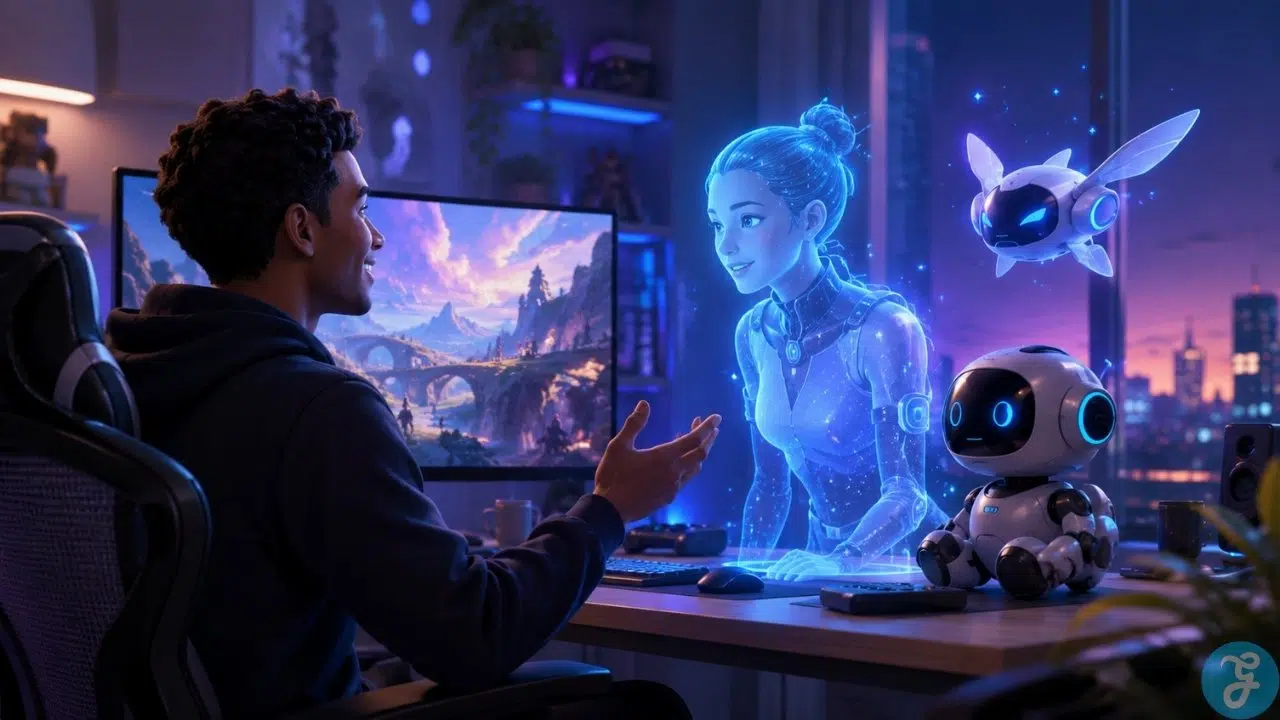
Games have spent decades giving players companions who repeat the same five lines, stand in doorways, and somehow make stealth missions harder. That old design is starting to crack. AI Game Companions are pushing the industry toward characters that can talk back, remember context, react to gameplay, guide players, role-play inside fictional worlds, and create the feeling that the game is not just responding to button presses but paying attention.
Our Selection Criteria
For this list, the country decision came before the company selection. I compared China, the United States, and Japan because they are the three strongest gaming markets by revenue, then narrowed the choice through a more specific lens: which country has the most visible, verifiable, SME/startup-style companies building AI companions, AI NPCs, real-time game characters, or companion-like AI gameplay systems.
Here is how the country selection was filtered before choosing the final market:
| Country Considered | Gaming Market Strength | Fit for Gaming SME AI Game Companion Startups | Final Assessment |
|---|---|---|---|
| China | Largest gaming market by revenue | Strong gaming scale, but fewer globally visible and independently verifiable SME/startup AI companion companies | Not selected |
| United States | Second-largest gaming market by revenue | Strongest concentration of verified startups working on AI NPCs, real-time companions, social AI games, narrative AI, and gaming AI agents | Selected |
| Japan | Deep game culture and major studio ecosystem | Strong creative market, but fewer independent AI game companion SMEs visible at this niche level | Not selected |
The companies were then selected using these filters:
- Headquartered, incorporated, or operationally rooted in the United States.
- SME/startup-style company, not a Big Tech division or traditional AAA publisher.
- Clear focus on AI companions, AI NPCs, AI-powered roleplay, real-time game characters, or playable AI character systems.
- Publicly verifiable website, company presence, product page, app listing, or credible third-party coverage.
- Relevance to gaming, interactive entertainment, game development, roleplay, streaming, or virtual characters.
- Excluded broad chatbot companies, generic AI art tools, non-gaming companion apps, and large companies where AI companions are only a minor side experiment.
10 AI Game Companions SMEs in the United States Redefining How Players Interact
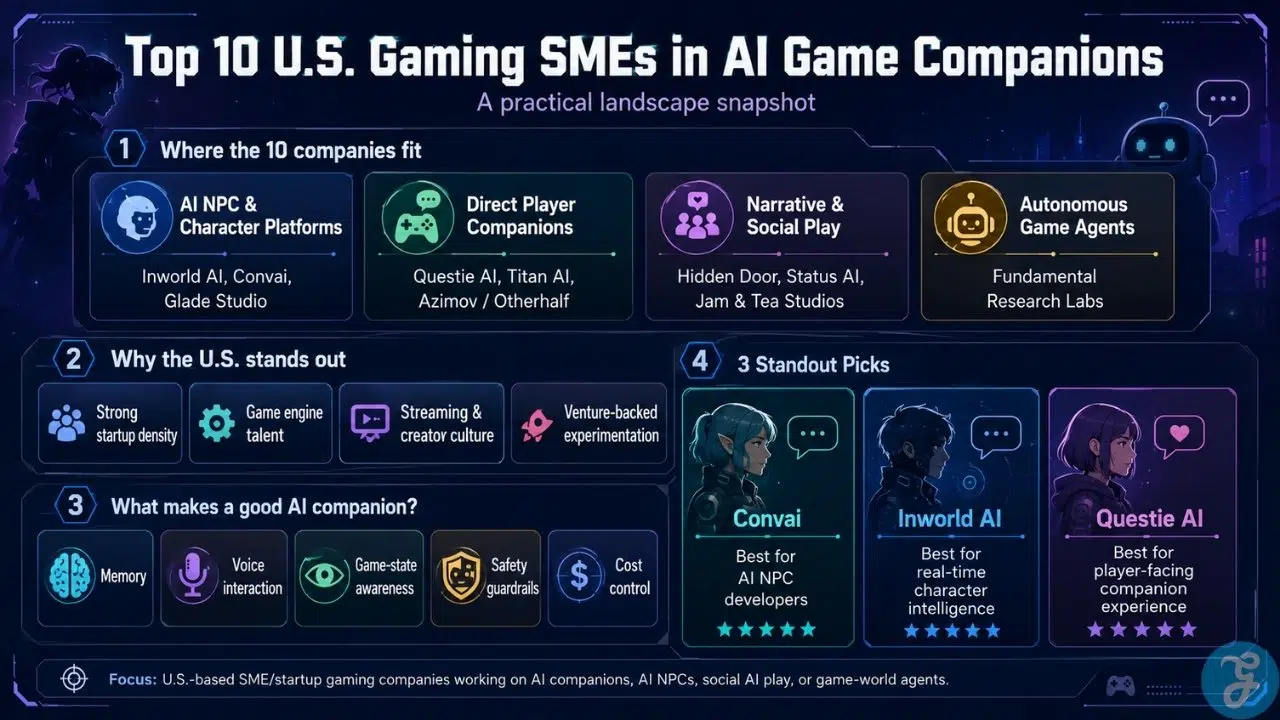
The U.S. list is not made up of one type of company. Some build infrastructure for studios, some create AI NPC engines, some build AI-powered games, and others create direct-to-player companions. That mix is exactly why the United States stood out.
1. Inworld AI
Headquarters: Mountain View, California, United States
Website: https://inworld.ai
Email: privacy@inworld.ai
Inworld AI is one of the strongest U.S. companies in the AI character and real-time voice intelligence space. It became widely known for its character engine, which helped developers create NPCs with personality, memory, contextual awareness, and more natural conversation. Its current positioning has expanded into real-time voice AI, but its gaming relevance remains important because believable companions need more than text generation. They need latency control, emotional tone, voice, context, and guardrails.
Best Feature/For:
- Best for studios and developers building intelligent NPCs or responsive character systems.
- Strong fit for teams that need voice, memory, context, and character behavior infrastructure.
Why We Chose It:
- One of the most visible U.S. startups in AI-driven game characters.
- Strong early association with AI NPCs, virtual worlds, and real-time characters.
- Useful for both gaming and interactive media teams.
- More infrastructure-focused than simple chatbot-style companion tools.
Things to consider:
- It may be too advanced or infrastructure-heavy for small indie teams.
- Studios should test latency, cost, moderation, and engine integration before production use.
2. Convai
Headquarters: San Jose, California, United States
Website: https://www.convai.com
Email: support@convai.com
Convai is a developer platform built around conversational AI characters for games, virtual worlds, XR, and interactive experiences. Its strongest use case is turning static NPCs into characters that can speak, perceive, respond, and participate more naturally inside a 3D environment. For game teams experimenting with companion characters, quest givers, AI allies, shopkeepers, or training simulations, Convai is one of the most direct fits on this list. It is not trying to be a general entertainment chatbot; it is clearly built for interactive character deployment.
Best Feature/For:
- Best for developers building AI NPCs inside games, XR worlds, and simulations.
- Strong for teams using real-time voice, character memory, and game-engine integration.
Why We Chose It:
- Clear gaming and XR focus.
- Strong use case for lifelike NPCs and interactive characters.
- Developer-friendly positioning for Unity, Unreal, and immersive environments.
- Better fit for AI companion implementation than broad consumer chatbot tools.
Things to consider:
- AI NPC costs can grow quickly if every conversation requires cloud processing.
- Developers need strong narrative boundaries so characters do not break game logic.
3. Glade Studio
Headquarters: New York, New York, United States
Website: https://gladestudio.ai
Email: glade@gladestudio.ai
Glade Studio is building AI tools for game creation, but its GladeCore product makes it especially relevant to AI companions and NPC systems. GladeCore is positioned as an on-device AI layer that can bring dynamic NPCs, companions, speech recognition, text-to-speech, emotional tuning, and retrieval-based memory into games. That local-first approach matters because latency and per-interaction cost are two of the biggest barriers to AI characters in games. If AI companions are going to scale beyond demos, companies like Glade may become very important.
Best Feature/For:
- Best for developers who want local, game-engine-friendly AI NPC and companion tools.
- Strong for indie and small-studio teams worried about cloud cost and latency.
Why We Chose It:
- Direct focus on AI NPCs and companions inside games.
- Offers a practical on-device approach rather than relying only on cloud calls.
- Backed by a builder-focused game development workflow.
- Strong relevance for Unity, Unreal, and game-engine experimentation.
Things to consider:
- On-device AI may have limits compared with larger cloud models.
- Teams should test whether local character quality is strong enough for their game genre.
4. Questie AI
Headquarters: Sheridan, Wyoming, United States
Website: https://www.questie.ai
Email: contact@questie.ai
Questie AI is one of the clearest consumer-facing examples of a real-time game companion. Instead of only living inside a specific game, Questie watches gameplay, reacts through voice chat, comments on what is happening, and acts like a companion that sits beside the player during play. That makes it especially interesting for streamers, solo gamers, and players who want banter, guidance, or roleplay layered over their existing gaming sessions. It is more of a gaming sidekick than a traditional NPC engine.
Best Feature/For:
- Best for players and streamers who want a real-time AI companion during gameplay.
- Strong for commentary, roleplay, banter, and screen-aware game reactions.
Why We Chose It:
- Very direct fit for the AI game companion category.
- Uses gameplay awareness instead of only text chat.
- Designed around gamers rather than general AI companion users.
- Good example of where companion AI may move outside the game engine itself.
Things to consider:
- Screen-watching AI raises privacy and permission questions.
- It may work better for some game genres than others depending on visual context.
5. Hidden Door
Headquarters: Brooklyn, New York, United States
Website: https://www.hiddendoor.co
Email: Not publicly listed
Hidden Door is a narrative AI game studio building social role-playing experiences where players can enter fictional worlds, create characters, and co-write stories with AI-guided systems. It is not a companion app in the narrow “AI buddy follows you around” sense. Its relevance comes from using AI as a storyteller, world guide, character system, and roleplay engine inside a game-like experience. For players who want narrative companions, fictional-world interaction, and AI-assisted social storytelling, Hidden Door is one of the most interesting U.S. startups in the space.
Best Feature/For:
- Best for AI-powered roleplay, narrative companions, and social storytelling games.
- Strong for players who want structured fiction worlds rather than open-ended chatbot chaos.
Why We Chose It:
- Clear gaming identity with narrative AI at the center.
- Focuses on roleplay, fanfiction-style worlds, and co-created stories.
- Builds limits and structure around AI interaction instead of pure freeform generation.
- Strong fit for the future of AI-guided narrative play.
Things to consider:
- Narrative AI can still feel slow, uneven, or overly controlled.
- Rights, licensing, and world consistency will remain important challenges.
6. Jam & Tea Studios
Headquarters: Los Angeles, California, United States
Website: https://www.jamandtea.studio
Email: info@jamandtea.studio
Jam & Tea Studios is a small U.S. game studio exploring how generative AI can change multiplayer gameplay and character interaction. Its project Retail Mage showed how AI can make NPCs and game systems react more flexibly to player choices instead of following rigid scripts. The company matters because it is not only selling AI tooling; it is testing what AI-native game design feels like inside actual playable experiences. That makes it valuable in a niche where too many startups stop at impressive demos.
Best Feature/For:
- Best for AI-native multiplayer experimentation and generative gameplay design.
- Strong for understanding how AI characters behave in actual player sessions.
Why We Chose It:
- U.S.-based gaming SME with AI deeply tied to gameplay.
- Focuses on generative AI as part of game architecture, not just a marketing layer.
- Useful proof point for AI interaction in multiplayer and roleplay contexts.
- Shows both the promise and difficulty of making AI-led gameplay fun.
Things to consider:
- AI gameplay experiments can be unpredictable and hard to polish.
- The commercial success of AI-native games is still very unproven.
7. Titan AI
Headquarters: Berkeley, California, United States
Website: https://titangen.app
Email: contact@astralabs.net
Titan AI is a small mobile gaming startup associated with AI-powered mobile RPG experiences and companion-style gameplay. Its public positioning emphasizes building mobile RPG games with AI companions, making it a direct fit for this list even though the company is still early-stage. Titan AI is interesting because mobile is where companion loops can become habitual: short sessions, recurring characters, daily progression, and emotional attachment. If AI companions become mainstream in games, mobile RPGs may be one of the first places where players accept them naturally.
Best Feature/For:
- Best for mobile RPG experimentation with AI companion-style characters.
- Strong for teams watching how companion mechanics could work in lightweight mobile games.
Why We Chose It:
- Directly connects mobile gaming with AI companions.
- Startup-scale company rather than a large incumbent.
- Interesting fit for RPGs, daily play loops, and character progression.
- Represents a mobile-first angle in a field often dominated by PC and XR demos.
Things to consider:
- Public product details are more limited than some larger AI NPC platforms.
- Mobile AI companion design must avoid becoming shallow engagement bait.
8. Fundamental Research Labs
Headquarters: Menlo Park, California, United States
Website: https://fundamentalresearchlabs.com
Email: Not publicly listed
Fundamental Research Labs, formerly known as Altera, is an applied AI research company that became known for game-world agent experiments, including large-scale AI agents inside Minecraft-like environments. Its original promise was close to the dream of game companions: agents that can play with people, collaborate, act socially, and behave less like scripted bots. The company has expanded beyond games, but its gaming-agent work remains relevant to the companion category. It belongs here because AI companions will not only be chatty sidekicks; some will be autonomous teammates, villagers, rivals, and long-running social agents inside game worlds.
Best Feature/For:
- Best for autonomous game-world agents and AI teammate research.
- Strong for studios thinking beyond dialogue and toward persistent agent behavior.
Why We Chose It:
- Strong U.S. AI startup with direct game-agent experimentation.
- Known for multi-agent simulations in playable environments.
- Relevant to future AI companions that act, cooperate, and socialize.
- Bridges gaming, virtual agents, and broader digital-human research.
Things to consider:
- It is no longer purely a gaming company.
- Research-grade agents may take time to become reliable commercial game features.
9. Status AI
Headquarters: New York, New York, United States
Website: https://www.statusai.com
Email: support@statusai.com
Status AI is a social simulation game where players create a persona, post inside a simulated social network, and interact with AI-powered characters, fandoms, followers, and rivals. It does not look like a traditional game companion product at first glance, but it is built around AI characters reacting to the player’s identity and actions. That makes it a strong example of companion-like AI inside a game loop: attention, roleplay, feedback, drama, progression, and social simulation. It also shows that AI companions may become popular through lightweight social games, not only through big 3D RPGs.
Best Feature/For:
- Best for AI-powered social simulation and fandom-style roleplay.
- Strong for players who want game-like interaction with AI characters and audiences.
Why We Chose It:
- Fast-growing U.S. social simulation game with AI characters at the center.
- Shows how companion mechanics can work outside traditional combat or quest systems.
- Strong appeal for roleplay, identity play, and fictional social feedback.
- Useful example of AI companionship blended with social gaming loops.
Things to consider:
- Social simulation with AI can blur emotional boundaries for younger users.
- Game designers need strong safety, moderation, and transparency policies.
10. Azimov / Otherhalf
Headquarters: Beaverton, Oregon, United States
Website: https://www.otherhalf.ai
Email: help@otherhalf.io
Azimov, through Otherhalf, is building immersive 3D AI companions with expressive characters, real-time voice, and game-engine-style presentation. Its work sits close to the border between gaming, virtual companions, anime-inspired characters, and embodied AI interaction. That border is exactly where the AI game companion category is moving: not just chat windows, but companions that look, speak, react, and feel present. Otherhalf shows how game technology and companion AI may merge into persistent character-driven experiences.
Best Feature/For:
- Best for embodied 3D AI companions with real-time voice and expressive characters.
- Strong for players and creators interested in anime-inspired or virtual companion experiences.
Why We Chose It:
- Uses game-engine-style presentation for AI companionship.
- Strong direct fit for embodied companion interaction.
- U.S.-based startup with visible app and product footprint.
- Shows where AI companions may become more visual, emotional, and persistent.
Things to consider:
- The line between healthy companionship and overattachment needs careful design.
- Companion AI companies must be transparent about data use, character limits, and simulated emotion.
An Overview of Our Selections
The U.S. market is not just producing one kind of AI companion. Some companies are building developer infrastructure, some are making narrative games, some are creating social simulations, and others are building direct companions for players. That diversity is why the United States is currently the strongest country choice for this list.
The comparison below helps separate the companies by their strongest use case rather than treating every AI character company as the same thing.
| Company | Main Category | Strongest Companion Angle | Best Buyer or User |
| Inworld AI | Real-time AI character infrastructure | Voice, memory, emotion, and character behavior | Studios, interactive media teams |
| Convai | AI NPC developer platform | Conversational NPCs for games and XR | Game developers, simulation teams |
| Glade Studio | On-device AI NPC tools | Local AI NPCs, companions, speech, and memory | Indie studios, engine-based developers |
| Questie AI | Consumer game companion | Screen-aware gameplay reactions and voice banter | Gamers, streamers, solo players |
| Hidden Door | Narrative AI roleplay game | AI storyteller and fictional-world interaction | Roleplayers, fanfiction communities |
| Jam & Tea Studios | AI-native game studio | Generative AI-driven gameplay and NPC behavior | Multiplayer and experimental game fans |
| Titan AI | Mobile RPG AI startup | Mobile AI companions and RPG loops | Mobile gamers, RPG audiences |
| Fundamental Research Labs | Autonomous AI agents | Game-world agents and persistent behavior | Research-led studios, agentic AI teams |
| Status AI | Social simulation game | AI followers, fandoms, rivals, and roleplay | Social sim players, fandom users |
| Azimov / Otherhalf | 3D virtual companions | Embodied real-time AI characters | Companion users, virtual character fans |
Our Top 3 Picks and Why?
The strongest picks depend on whether the reader is a game developer, player, investor, or studio operator. For this ranking, I prioritized direct relevance to AI game companions, technical seriousness, and clear gaming use cases.
| Rank | Pick | Why It Stands Out |
| 1 | Convai | Best specialist pick for developers building AI NPCs and game-world companions. |
| 2 | Inworld AI | Best infrastructure pick for real-time voice, character intelligence, and emotionally responsive AI. |
| 3 | Questie AI | Best consumer-facing pick because it acts like a real companion while the player is actively gaming. |
Why are AI Game Companions Booming in the United States
The United States has the right mix of ingredients for this niche: game developers, venture-backed AI startups, large language model access, game-engine talent, creator culture, streaming culture, and a massive player base comfortable with digital characters. That combination makes the market unusually friendly to AI companions, AI NPC tools, and playable character systems.
What’s their secret sauce?
The real secret is not that U.S. startups are magically better at “AI.” It is that they are combining AI engineering with entertainment design, venture capital, cloud infrastructure, Unreal and Unity workflows, fandom behavior, and creator-led distribution. An AI game companion is not just a model that talks; it needs timing, tone, memory, character rules, safety controls, game-state awareness, and a reason to exist inside the player’s experience.
The U.S. also has a strong culture of experimentation around digital identity and parasocial entertainment. Players already follow streamers, role-play in online communities, talk to fictional characters, and build emotional attachment to game worlds. AI companions simply make that interaction more responsive, personal, and continuous.
The Next Player Two Will Not Be Human
My honest view is that this market has real potential, but it is also full of traps. The future of AI Game Companions will not be won by whichever company makes the chattiest NPC. It will be won by companies that understand restraint, gameplay purpose, emotional boundaries, player safety, and cost control.
The uncomfortable truth is that many AI characters are still more impressive in demos than in actual games. They can ramble, hallucinate, forget the mission, break lore, slow down pacing, and create moderation headaches that traditional NPCs never caused. Game designers like control for a reason. A badly designed AI companion can turn a tight game into an expensive improv show where nobody knows when to stop talking.
Still, the category is not going away. The best companions will probably start small: a tactical teammate that gives useful callouts, a roleplay character that remembers your choices, a social sim cast that reacts believably, or a streamer-sidekick that makes solo play less lonely. The winning SMEs will not replace human multiplayer or handcrafted storytelling. They will add a new layer of presence where games currently feel empty, repetitive, or emotionally flat.
Frequently Asked Questions (FAQs) About AI Game Companions
What are AI game companions?
AI game companions are AI-powered characters, sidekicks, NPCs, or agents that interact with players during gameplay. They may talk, react, remember context, guide players, role-play, or participate inside game worlds.
Why was the United States selected for this list?
The United States was selected because it has the strongest visible concentration of verified SME/startup companies working on AI NPCs, AI companions, narrative AI games, gaming agents, and social AI simulations. China leads by total gaming revenue, but the U.S. has stronger publicly verifiable startup density in this exact niche.
Are AI game companions the same as AI NPCs?
Not always. AI NPCs usually exist inside a game world, while AI game companions may also sit outside the game as screen-aware sidekicks, voice assistants, stream companions, or social simulation characters. The categories overlap, but they are not identical.
Can AI companions make games better?
They can, but only when they serve a real gameplay purpose. If they improve roleplay, guidance, teamwork, storytelling, or emotional presence, they add value. If they only generate endless dialogue, they can quickly become annoying.
What should studios check before using AI companion tools?
Studios should test latency, cost per interaction, moderation controls, memory reliability, lore consistency, engine integration, and player safety. They should also ask whether the companion actually improves the game or only makes the demo look futuristic.