Product-led growth fundamentals sound simple on paper: let people try the product, help them experience value, and convert them when the product becomes useful enough to pay for. In reality, many SaaS teams get this wrong.
They launch a free plan and call it PLG. They add a trial and expect users to magically understand the product. They hide value behind too many setup steps. They ask for upgrades before users feel the benefit. Then they wonder why free users do not convert, why trials go cold, and why customer support gets overwhelmed.
Product-led growth is not just a pricing model. It is not just freemium. It is “no sales team.” It is a growth system where the product plays a direct role in acquisition, activation, conversion, retention, and expansion.
This product-led growth guide explains how PLG works, when it makes sense, what a practical PLG framework looks like, and how SaaS teams can avoid the mistakes that turn free users into dead accounts instead of paying customers.
What Is Product-Led Growth?
Product-led growth, often called PLG, is a SaaS growth strategy where the product itself becomes the main driver of user acquisition, conversion, retention, and expansion. Instead of asking every prospect to book a demo before they understand the product, a PLG strategy lets users experience value directly.
That may happen through:
- A free plan
- A free trial
- A reverse trial
- A self-serve signup flow
- Templates
- Interactive onboarding
- Usage-based upgrades
- Team invitations
- In-product education
The product becomes the first sales conversation. A user signs up, explores the product, reaches a useful outcome, invites others, and upgrades when the value becomes clear. Marketing still matters. Sales may still matter. Customer success still matters. But the product carries more of the growth journey.
This is why PLG works best when the product can show value quickly.
Why Product-Led Growth Matters for SaaS
SaaS buyers have changed. Many users do not want to sit through a sales call just to understand whether a tool is useful. They want to try it, test it, compare it, and decide based on real experience. That is where PLG becomes powerful.
A strong product-led model can help SaaS companies:
- Reduce friction in the buying journey
- Let users experience value before paying
- Improve activation and trial conversion
- Create organic sharing through Teams
- Support lower-touch customer acquisition
- Build expansion paths from real usage
- Collect product behavior data
- Improve onboarding based on user actions
Slack is a familiar example. A team can start using the product, create channels, send messages, and feel collaboration value before moving into paid plans. Notion also shows how flexible free usage can help individuals and teams build habits before upgrading as their needs grow.
The lesson is not to copy Slack or Notion. The lesson is to let the product prove value before asking for deeper commitment.
Product-Led Growth Is Not the Same as Freemium
This is one of the biggest misunderstandings. Freemium is a pricing model. Product-led growth is a business strategy. You can have a free plan without being product-led. You can also run a PLG motion with a free trial instead of a freemium plan.
Here is the difference:
| Concept | What It Means | Common Mistake |
| Freemium | Users get ongoing access to a limited free version | Assuming free users will automatically convert |
| Free trial | Users get temporary access to test the product | Making the trial too short for users to reach value |
| Reverse trial | Users start with premium features, then downgrade unless they upgrade | Confusing users when features disappear |
| PLG strategy | Product usage drives acquisition, conversion, retention, and expansion | Treating PLG as only a signup model |
A free plan is useful only if it leads users toward value. If users sign up and never understand what to do, freemium becomes a storage place for inactive accounts. Product-led growth needs intentional design.
When Product-Led Growth Makes Sense
PLG is not right for every SaaS company. It works best when the product is easy enough to try, useful enough to show value quickly, and simple enough for users to start without heavy human support.
Product-led growth usually fits when:
- Users can sign up without a sales call
- Setup is simple or guided
- The product has a clear first value moment
- The buyer or user can evaluate the product directly
- Usage can expand naturally
- The product benefits from collaboration or sharing
- Pricing can scale by seat, usage, feature, or team size
- Support cost for free or trial users is manageable
PLG may be harder when:
- The product requires complex implementation
- Data migration is heavy
- Security review is mandatory from day one
- The buyer is different from the end user
- The product needs deep customization
- Pricing is very high
- A human-led sales process is needed to explain value
In those cases, a hybrid model may work better. Users can try parts of the product, while sales support larger accounts or complex use cases.
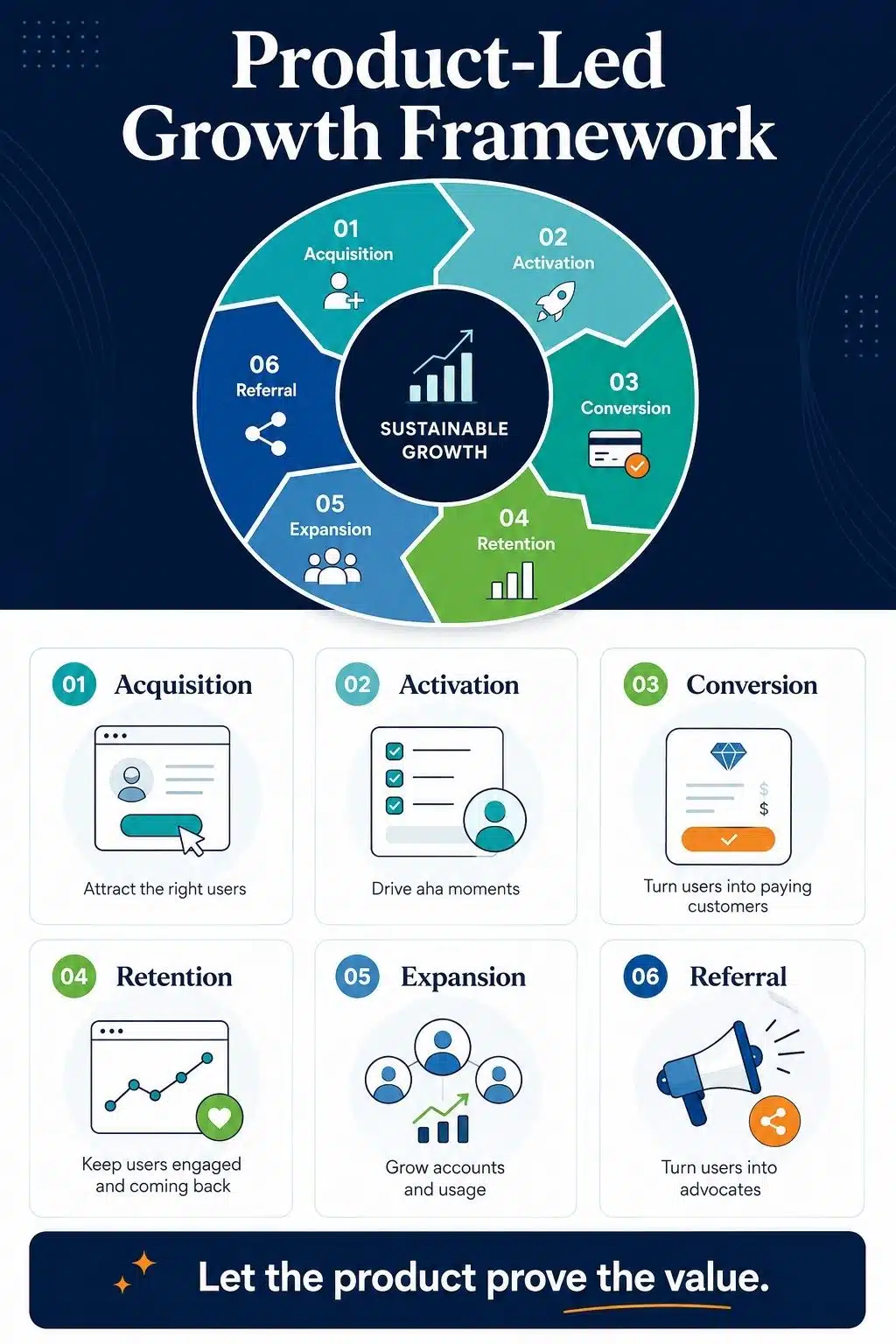
The Core PLG Framework
A useful PLG framework follows the full customer journey. It is not enough to get signups. You need users to reach value, keep using the product, and eventually expand.
| PLG Stage | Main Question | Example Focus |
| Acquisition | How do users discover the product? | SEO, templates, referrals, community, free tools |
| Activation | How do users reach the first value? | Onboarding, setup flow, guided actions |
| Conversion | Why would users pay now? | Usage limits, premium features, team needs |
| Retention | Why do users keep coming back? | Habit loops, workflows, reminders, value tracking |
| Expansion | Why do accounts grow? | Seats, usage, add-ons, advanced workflows |
| Referral | Why would users invite others? | Collaboration, sharing, rewards, and team workflows |
This framework keeps PLG practical. Every stage has a job.
- If acquisition works but activation fails, you get many signups and little revenue.
- If activation works but retention fails, users try the product and leave.
- If retention works but expansion fails, the business may grow slowly.
- If referral works, users help bring more users into the system.
Strong PLG connects all of these stages.
Step 1: Define the Right User and Use Case
Before improving onboarding or pricing, define who the product is for. PLG fails when the product attracts too many wrong-fit users. Free users may look exciting in analytics, but if they do not match your ideal customer profile, they will not convert or retain.
Start with these questions:
- Who feels the problem most urgently?
- Who can get value without a heavy setup?
- Who can start using the product alone?
- Who can invite others?
- Who is likely to pay when usage grows?
- Which use case creates the strongest first value moment?
For example, a reporting SaaS may attract students, freelancers, agencies, and enterprise teams. But the strongest PLG motion may come from agencies that need recurring client dashboards and invite teammates or clients into the workflow. A narrow focus makes PLG easier.
Step 2: Find the Aha Moment
The aha moment is when the user understands why the product matters. It is not always the same as signing up. It is not always the same as completing onboarding.
Examples:
- In a project management tool, the aha moment may be creating a project and assigning the first task.
- In an analytics tool, it may be connecting data and seeing the first useful dashboard.
- In an email platform, it may be sending the first campaign.
- In a design tool, it may be sharing the first design with a teammate.
- In a knowledge base tool, it may be publishing the first useful internal page.
A good PLG strategy is built around getting users to that moment faster. If users need 12 steps before they understand the value, many will leave before they reach it.
Step 3: Remove Friction From Onboarding
PLG onboarding should not explain every feature. It should help users complete the first meaningful action. Bad onboarding feels like a product tour. Good onboarding feels like progress. Instead of showing every menu, guide users toward one outcome.
Useful onboarding elements include:
- Short setup checklist
- Role-based onboarding
- Templates
- Sample data
- Progress indicators
- Empty-state guidance
- Tooltips only when needed
- Behavior-based emails
- In-app nudges
- Easy invite flow
Avoid asking for too much too early. Long forms, forced demos, unnecessary permissions, and confusing setup steps can hurt activation. The best onboarding asks only what it needs to help the user reach value.
Step 4: Build Conversion Around Usage
In PLG, conversion should feel like a natural next step. Users upgrade when they understand the value and hit a meaningful limit.
Good upgrade triggers may include:
- More seats
- More projects
- More storage
- Advanced reporting
- Team permissions
- Automation
- Integrations
- Branding controls
- Security features
- Usage volume
- Admin features
Bad upgrade prompts appear too early or too often. If a user has not reached a value yet, asking them to pay feels annoying. If they have reached value and need more capacity, paying feels logical. That is the difference. A strong PLG conversion path connects the paid plan to the user’s real progress.
Step 5: Use Product Data to Improve Growth
Product-led growth depends on behavior data. You need to know what users do after signing up, not just how many people signed up.
Track metrics such as:
- Sign up for the activation rate
- Time to first value
- Feature adoption
- Trial-to-paid conversion
- Free-to-paid conversion
- Invite rate
- Usage frequency
- Retention by cohort
- Expansion revenue
- Churn by user segment
- Upgrade trigger performance
Do not track everything equally. Focus on the actions that predict long-term customer value.
For example, if teams that invite three members are more likely to convert, the product should encourage team invitations after the user understands the value. If users who create five reports retain better, onboarding should guide new users toward creating useful reports faster. Product data turns PLG from guesswork into a system.
Step 6: Support Users Without Slowing Them Down
Product-led does not mean “no support.” It means support should help users move faster without forcing them into unnecessary human interaction.
Good PLG support includes:
- Clear help docs
- In-product guidance
- Short tutorial videos
- Live chat for high-intent moments
- Community support
- Template libraries
- Setup checklists
- Contextual help
- Lifecycle emails
- Customer success for larger accounts
For low-value free users, support may need to be mostly self-serve. For larger accounts, human support can help conversion and retention. The key is matching support effort to customer value and product complexity.
Step 7: Add Sales at the Right Moment
PLG does not remove sales. It changes when sales should enter.
Sales is most useful when:
- A team shows strong product usage
- Multiple users join from the same company
- The account hits a security or admin need
- The customer needs procurement support
- Usage suggests enterprise potential
- The product requires workflow consultation
- The buyer needs help building a business case
This is often called product-led sales. Instead of cold-selling to uninterested leads, salespeople talk to accounts that already show intent through product usage. That creates a better sales conversation because the user has already experienced the product.
Product-Led Growth Metrics That Matter
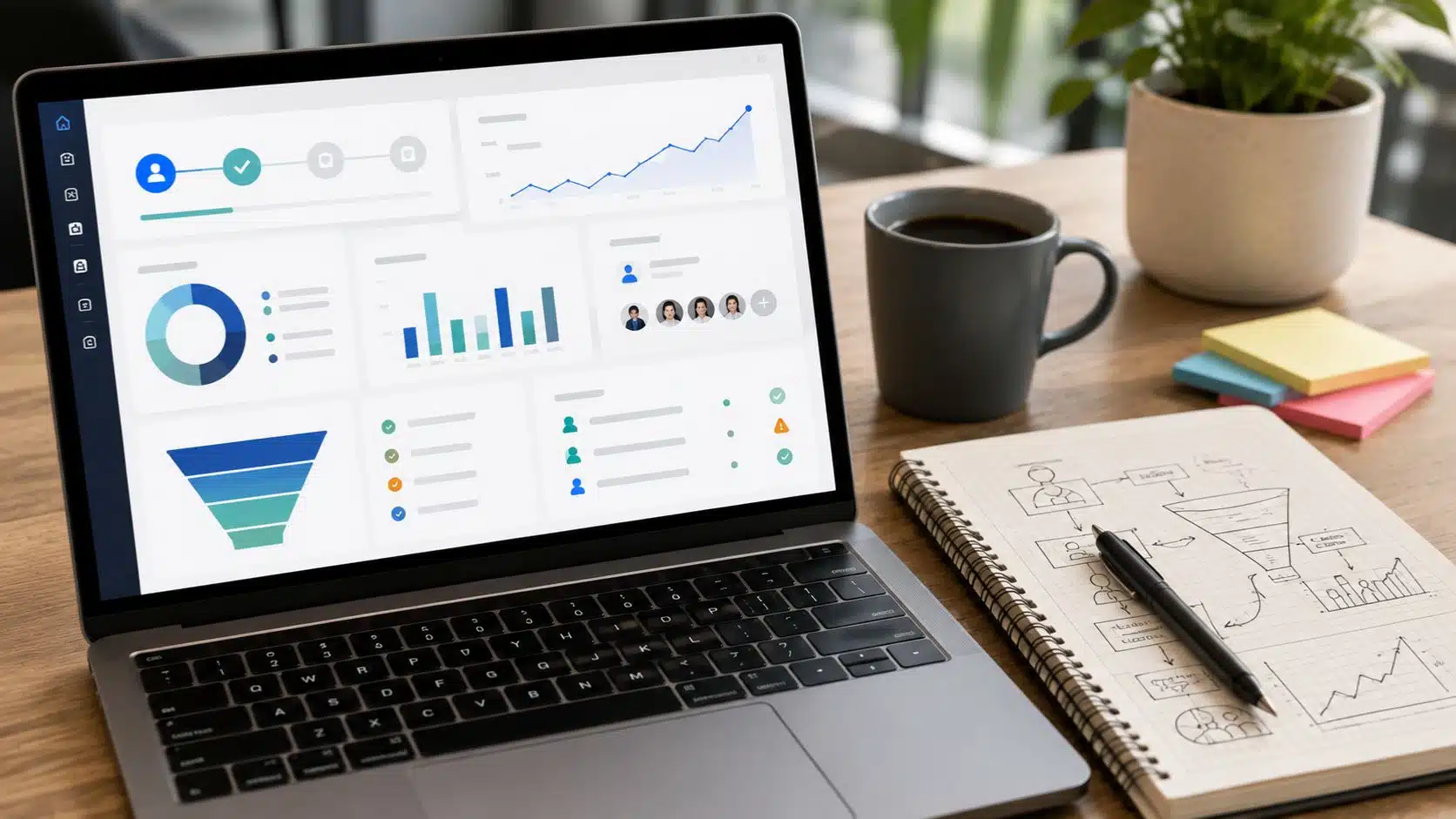
PLG teams should measure the full journey.
| Metric | What It Shows |
| Activation rate | How many users reach the first value |
| Time to value | How quickly users experience the benefit |
| Free-to-paid conversion | How well free users become customers |
| Trial-to-paid conversion | How well trial users convert |
| Product-qualified leads | Which users or accounts show buying intent |
| Feature adoption | Which features users actually use |
| Invite rate | How often users bring others in |
| Retention by cohort | Whether users keep using the product |
| Expansion revenue | How accounts grow over time |
| Churn rate | Where users or customers drop off |
For PLG, activation is especially important. If users do not reach value, conversion and retention will usually suffer. Do not celebrate signups too much. Signups are only the beginning.
Common Product-Led Growth Mistakes
Mistake 01: Calling Freemium a PLG Strategy
A free plan alone is not product-led growth.
PLG requires onboarding, activation, conversion paths, retention loops, and product usage data.
Mistake 02: Attracting Too Many Wrong-Fit Users
Free access can bring a lot of people who will never pay.
Measure user quality, not only signup volume.
Mistake 03: Making Onboarding Too Long
Long onboarding delays value.
Users should reach one meaningful outcome quickly before they are asked to explore every feature.
Mistake 04: Asking for Payment Too Early
Upgrade prompts should appear after the value is clear.
If users do not understand the product yet, payment prompts feel like friction.
Mistake 05: Ignoring Product Data
PLG needs behavioral insight.
Without product data, teams guess which users are likely to convert, retain, or expand.
Mistake 06: Removing Sales Completely
Some accounts still need help.
Sales can support high-intent teams, enterprise buyers, and complex use cases.
Mistake 07: Underestimating Support Cost
Free users can create support demand.
A PLG model needs scalable education, help docs, templates, and in-product guidance.
Product-Led Growth Best Practices
- Start with one clear use case.
- Design onboarding around the first value moment.
- Use templates to reduce setup friction.
- Use real product behavior to trigger emails and upgrades.
- Let users invite others easily.
- Offer self-serve help before users get stuck.
- Measure activation and retention by segment.
- Keep improving the product based on user behavior.
The best PLG systems feel easy for the user’s side. Behind the scenes, they are carefully designed.
How Product-Led Growth Connects to SaaS Growth Marketing
Product-led growth works best when it fits into the wider SaaS growth marketing system.
- Marketing brings the right audience.
- The product delivers first value.
- Email supports activation.
- Content educates users.
- Customer success improves retention.
- Sales help larger accounts.
- Referrals and team invites support expansion.
That is why PLG should not sit alone. A good PLG strategy connects to your full growth engine. If you want the larger roadmap, connect this cluster article to your main SaaS growth marketing pillar.
Is Product-Led Growth Right for Your SaaS?
Use this quick check. PLG may be a strong fit if:
- Users can try the product without a complex setup.
- The product delivers visible value quickly.
- Users can start without a sales call.
- Free or trial usage can lead to paid expansion.
- The product benefits from collaboration or sharing.
- Support costs can be controlled.
- You can track product behavior clearly.
PLG may not be the best primary model if:
- The product requires heavy implementation.
- The buyer must go through procurement first.
- The product needs a custom setup for each account.
- The value is hard to show without expert guidance.
- Security, compliance, or legal review blocks self-service use.
In those cases, a hybrid model may be better. Product-led does not have to mean product-only. The strongest SaaS companies often combine product, marketing, sales, and customer success in the right balance.
Final Thoughts
Product-led growth fundamentals come down to one simple idea: let users experience value before asking them for deeper commitment. But the execution is not simple. A strong PLG strategy needs the right audience, a clear use case, a fast aha moment, smooth onboarding, smart upgrade triggers, product data, scalable support, and retention loops.
Freemium alone will not do that. A free trial alone will not do that. A beautiful product tour will not do that. The product has to guide users toward a real outcome.
When PLG works, growth feels more natural. Users understand the product by using it. Teams expand because the workflow matters. Sales conversations become warmer because accounts already show intent. Marketing becomes stronger because the product experience supports the promise.
That is the real power of product-led growth.
Frequently Asked Questions About Product-Led Growth Fundamentals
1. What is product-led growth?
Product-led growth is a SaaS growth strategy where product usage drives acquisition, activation, conversion, retention, and expansion. Users experience the product directly before deciding whether to pay or expand.
2. Is product-led growth the same as freemium?
No. Freemium is a pricing model. Product-led growth is a full business strategy. A SaaS company can have freemium without a strong PLG strategy if onboarding, activation, and conversion paths are weak.
3. What is a PLG strategy?
A PLG strategy is a plan for using the product as a major growth driver. It usually includes self-serve signup, fast onboarding, a clear aha moment, product usage data, upgrade triggers, retention loops, and expansion paths.
4. What are the key metrics for product-led growth?
Important PLG metrics include activation rate, time to value, free-to-paid conversion, trial-to-paid conversion, product-qualified leads, invite rate, feature adoption, retention, expansion revenue, and churn.
5. When does product-led growth work best?
Product-led growth works best when users can start quickly, understand the product without heavy sales support, reach value fast, and expand usage over time. It is especially strong for intuitive, self-serve SaaS products.
6. Can enterprise SaaS use product-led growth?
Yes, but often through a hybrid model. Enterprise SaaS may use free tools, trials, sandbox environments, or product-qualified leads while sales support procurement, implementation, security, and larger account expansion.
7. What is the biggest PLG mistake?
The biggest PLG mistake is assuming that a free plan automatically creates growth. Without a clear activation path, free users may never understand the product, convert to paid plans, or become long-term customers.