
A domestic trip can look harmless on paper. No long-haul flight. No passport. No border crossing. Just a quick break, a family visit, a work meeting, or a few days away with a laptop.
The footprint can still grow fast.
A short domestic flight, a half-empty rental car, a hotel far from everything, daily ride-hailing, food delivery, overpacking, and throwaway purchases can turn a simple trip into a wasteful one. The problem is rarely one dramatic decision. It is usually a stack of ordinary choices made quickly.
How to Reduce Your Carbon Footprint While Traveling Domestically is mostly about fixing the decisions that happen before the trip is locked in. The main transport choice usually matters most. After that, location, local movement, food, luggage, and offsets all shape the final impact.
This is not about making travel joyless. It is about knowing which choices are worth your attention. A reusable bottle helps. Replacing an avoidable short flight with a train, coach, or shared ride where that is realistic usually matters more.
Domestic Does Not Automatically Mean Low-Carbon
Domestic travel often feels greener than international travel because the distance seems smaller. Sometimes that is true. A train trip to a nearby city or a shared road trip can be far lower-impact than flying overseas.
But “domestic” only describes geography. It does not describe the way you travel.
A 45-minute flight may involve airport transfers, security, taxiing, takeoff, climb, landing, baggage systems, and another ride after arrival. A weekend road trip can look modest until one person drives a large petrol vehicle hundreds of kilometres alone. A remote-work stay can sound slow and thoughtful while still involving repeated flights between cities.
A better first question is simple: what is the least wasteful way to make this trip work?
That means checking a few things before booking:
- Can this trip be combined with another purpose?
- Would a closer destination deliver the same break, meeting, family visit, or outdoor experience?
- Is there a realistic train, coach, bus, or shared-car option?
- Will the accommodation reduce local travel, or create more of it?
- Are you planning a trip that requires constant movement once you arrive?
Those questions are not glamorous. They are where many of the real savings begin.
How to Reduce Your Carbon Footprint While Traveling Domestically: Start With the Main Journey
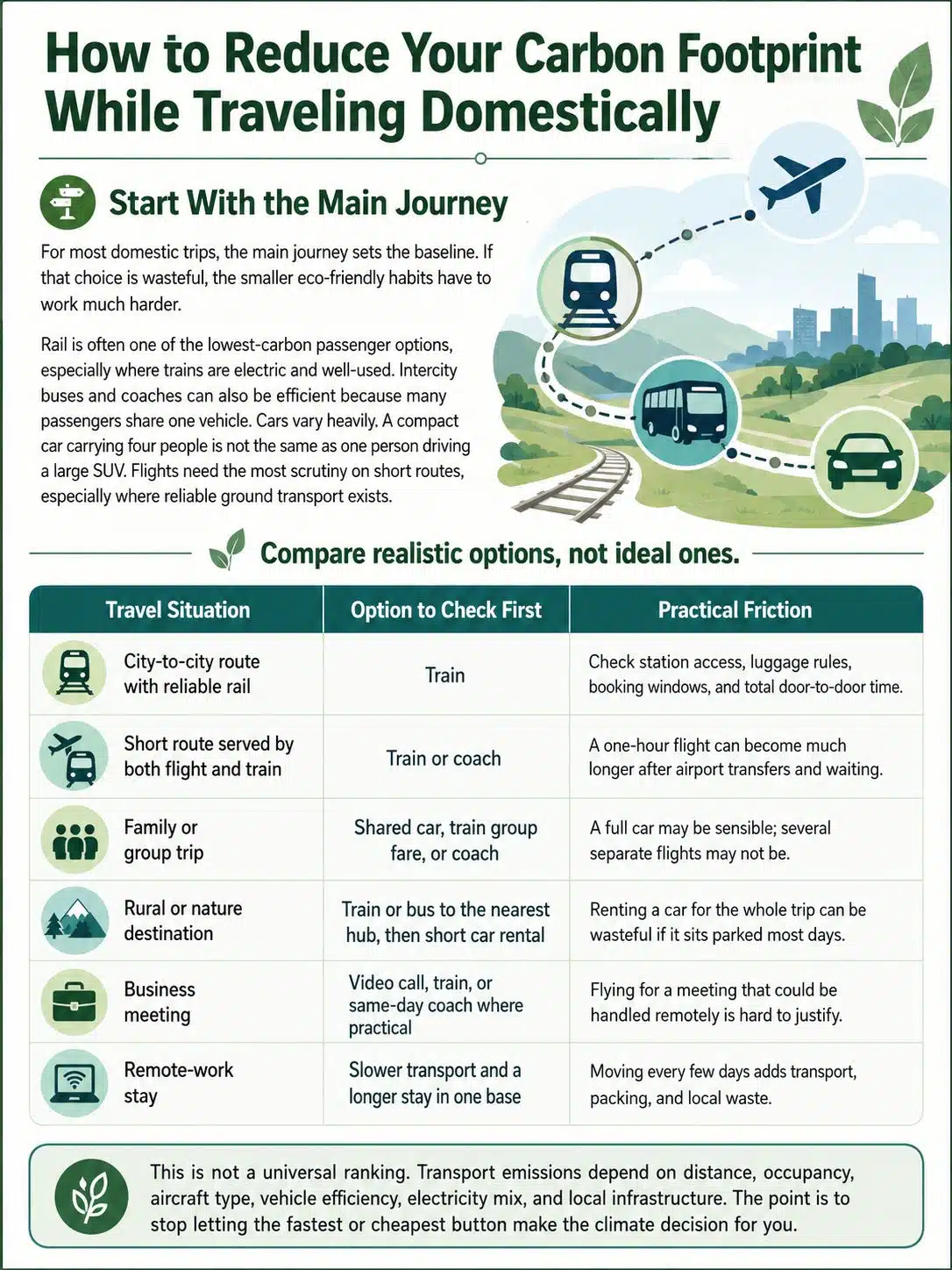
For most domestic trips, the main journey sets the baseline. If that choice is wasteful, the smaller eco-friendly habits have to work much harder.
Rail is often one of the lowest-carbon passenger options, especially where trains are electric and well-used. Intercity buses and coaches can also be efficient because many passengers share one vehicle. Cars vary heavily. A compact car carrying four people is not the same as one person driving a large SUV. Flights need the most scrutiny on short routes, especially where reliable ground transport exists.
A useful way to decide is to compare realistic options, not ideal ones.
| Travel Situation | Option to Check First | Practical Friction |
|---|---|---|
| City-to-city route with reliable rail | Train | Check station access, luggage rules, booking windows, and total door-to-door time. |
| Short route served by both flight and train | Train or coach | A “one-hour flight” can become much longer after airport transfers and waiting. |
| Family or group trip | Shared car, train group fare, or coach | A full car may be sensible; several separate flights may not be. |
| Rural or nature destination | Train or bus to the nearest hub, then short car rental | Renting a car for the whole trip can be wasteful if it sits parked most days. |
| Business meeting | Video call, train, or same-day coach where practical | Flying for a meeting that could be handled remotely is hard to justify. |
| Remote-work stay | Slower transport and a longer stay in one base | Moving every few days adds transport, packing, and local waste. |
This is not a universal ranking. Transport emissions depend on distance, occupancy, aircraft type, vehicle efficiency, electricity mix, and local infrastructure. The point is to stop letting the fastest or cheapest button make the climate decision for you.
Be More Demanding About Short Flights
Short domestic flights deserve extra scrutiny because the flight time can make them feel smaller than they are. Takeoff and climb use a meaningful amount of fuel, so short flights can be carbon-intensive per passenger-kilometre compared with many ground options.
That does not mean every short flight is irresponsible. Some countries have long distances, weak rail networks, islands, mountain barriers, safety concerns, or time constraints that make flying the only workable option. The mistake is treating flying as the default before checking whether the route has a good train, coach, or shared-car alternative.
If you do need to fly, improve the choice.
Choose nonstop where possible. A connection may look cheaper, but it can add another takeoff and landing, more taxiing, more airport time, and more delay risk.
Use flight-emissions estimates as a comparison tool. Some booking platforms show whether a flight is estimated to be lower, typical, higher, or unknown compared with similar route options. These numbers are not exact trip audits, but they can help when choosing between flights on the same route.
Fly economy unless you have a clear reason not to. Premium cabins use more space per passenger, which can increase each passenger’s allocated share of emissions.
Pack lighter, but keep the claim realistic. Lighter luggage is sensible and makes travel easier. It may reduce fuel use at the margin. It does not turn a high-emission route into a low-emission one.
A green product bought after security does not fix an unnecessary flight. The better decision happens before the ticket is paid for.
Make Car Trips Less Wasteful
Cars are often unavoidable in domestic travel. Many regions do not have good rail or coach links outside major corridors. Rural homes, national parks, beaches, mountain routes, and smaller towns may be difficult to reach without driving.
That makes the details more important.
Occupancy comes first. One car carrying four people is very different from one person driving alone. Vehicle choice comes next. A smaller efficient car, hybrid, or electric vehicle can reduce emissions compared with a larger petrol vehicle, though the exact result depends on the route, driving style, local electricity supply, and how the vehicle is used.
Rental sites often push upgrades as comfort or value. Sometimes a larger vehicle is genuinely needed for family size, mobility needs, luggage, or equipment. Many times, it is just more vehicle than the trip requires.
For a lower-waste road trip:
- Choose the smallest practical vehicle, not the biggest one you can afford.
- Avoid roof boxes unless the luggage truly requires one.
- Remove unnecessary weight before a long drive.
- Keep tires properly inflated where you control the vehicle.
- Drive smoothly instead of accelerating and braking aggressively.
- Avoid planning a trip where every meal and errand requires another drive.
Electric vehicle rentals can be a good option, but check charging before booking. EVs have no tailpipe emissions and are often cleaner over their use phase than comparable petrol cars, but they are not magic. Charging access, grid mix, charger reliability, plug type, payment apps, and hotel parking all matter.
A route that looks easy in a booking app can become annoying if the only fast charger is 40 minutes away, occupied, broken, or locked behind a local account you cannot set up. For unfamiliar destinations, check chargers before choosing the vehicle, not after collecting the keys.
A useful compromise is often overlooked: take a train or coach to the nearest city, then rent a car only for the hard-to-reach part. That can cut emissions, parking costs, and driving fatigue.
Stay Where You Need Fewer Rides
Accommodation is part of the transport decision. A cheaper room far from everything may cost more once taxis, ride-hailing, fuel, parking, and wasted time are included.
If every meal, meeting, museum, beach visit, coworking session, or family visit requires a ride, the location is not really cheap. It is shifting the cost into daily movement.
For city breaks, domestic work trips, and short holidays, look for lodging near at least one of these:
- A rail or bus station
- A reliable public transport line
- The main reason for your trip
- A walkable food and grocery area
- A coworking space if you need to work
- A safe walking route for evenings
For nature trips, the rule changes slightly. You may not need urban transit if the purpose is hiking, camping, or staying in one lodge. In that case, choose a base that reduces repeated driving. A cabin closer to trailheads may be better than a cheaper room that forces long drives every morning.
Sustainability labels can help, but they need scrutiny. A credible property should be able to show specific practices: energy management, water-saving systems, refill options, waste sorting, reduced single-use plastics, local hiring, nature protection, or third-party certification.
Vague language such as “eco-inspired,” “green living,” or “nature-friendly comfort” does not prove much. Look for who certified the property, what standard was used, and whether the claim is current. In sustainable tourism, the difference between a credible certification and a decorative green badge matters.
Pack Lighter Without Buying a New Eco Travel Kit
Packing lighter is useful. Buying new “sustainable travel” products before every trip is often just another form of consumption.
A practical low-waste kit is usually ordinary:
- A refillable water bottle where safe refill options are available
- A tote or foldable shopping bag
- A charger and power bank to avoid emergency purchases
- Weather-appropriate clothes so you do not buy extra layers at the destination
- Basic toiletries in refillable containers for trips where that makes sense
- A small container or reusable cutlery if takeaway meals are likely
Use what you already own first. A durable old backpack used for years is better than a new recycled-material bag bought mostly for appearances. The same goes for clothes. A few comfortable, repeatable outfits usually beat buying new travel clothes for each short break.
Domestic travel often makes lighter packing easier. You are usually closer to familiar shops, payment systems, languages, and services if something genuinely goes wrong. That should reduce “just in case” packing, not encourage it.
The hidden problem with overpacking is that it changes the rest of the trip. Too much luggage can push you toward taxis instead of trains, larger cars instead of smaller rentals, checked baggage instead of carry-on, and storage lockers instead of walking freely.
Eat Well, Waste Less
Food is part of travel. It should stay enjoyable.
The lower-carbon approach is not to turn every meal into a calculation. It is to avoid the most wasteful habits. Plant-forward meals often reduce the footprint of a trip, especially when they replace meat-heavy meals with higher production impacts. Local and seasonal food can help too, though “local” is not automatically low-carbon if production, storage, or transport is energy-intensive.
The most reliable food rule is less glamorous: waste less.
Hotel buffets are an easy place to get this wrong. Oversized plates, too many small tastes, and unfinished food create waste quickly. Take what you will eat. Go back if needed.
For remote workers and longer domestic stays, groceries can make a real difference. Breakfast supplies, fruit, snacks, tea, coffee, and simple lunches reduce delivery packaging and repeated short rides for food. They also help the budget.
Food delivery is convenient, and sometimes it is the practical choice after a long day. It becomes a problem when it turns into the default for every small need. Packaging, scooter trips, impulse orders, and unfinished portions add up quietly.
Slow the Itinerary Down
Many domestic itineraries suffer from map optimism.
A town two hours away looks close on a screen. A mountain road looks easy until traffic, parking, weather, and fatigue arrive. Add several of those drives to a short break and the trip becomes expensive, tiring, and emission-heavy.
A lower-carbon domestic trip usually has fewer transfers and fewer base changes. It also tends to feel better.
Stay longer in fewer places. Walk one neighborhood properly instead of driving across a region for rushed stops. Build one major activity into a day rather than stacking three locations that each require transport, parking, snacks, and another coffee stop.
Frequent domestic tourists can make the biggest improvement here: take fewer trips, make some of them longer, and reduce the number of movements inside each trip.
Remote workers have an advantage if they use it well. They can avoid peak travel days, take slower transport, and stay in one place long enough for the journey to make sense. A two-week stay reached by train is easier to defend than three short flight-based workcations in a month.
Use Carbon Calculators, but Do Not Pretend They Are Exact
Carbon calculators can help compare options, especially flights. They are useful before booking, not after the trip is already built.
A flight-emissions estimate can help you choose between a nonstop and a connecting route. A transport calculator can help compare train, coach, car, and flight options. Some rail operators, bus companies, government agencies, and travel platforms publish their own emissions comparisons.
Use these tools to answer practical questions:
- Is the nonstop flight lower-emission than the connecting one?
- Is rail meaningfully better on this route?
- Does sharing a car change the result?
- Would staying closer to the center reduce daily transport?
- Are two short flights worse than one slower surface journey?
The number will still be an estimate. It depends on methodology, aircraft type, route, passenger load, cargo allocation, vehicle efficiency, electricity mix, and assumptions about occupancy.
Do not use calculators for false precision. Use them to avoid obviously worse choices.
Treat Carbon Offsets as the Last Step
Carbon offsets are often sold as a quick fix. A checkbox appears at checkout, the price looks small, and the trip feels cleaner.
That is too convenient.
Some carbon credits support useful projects. Others are weak, poorly measured, double-counted, or based on reductions that may not be as additional or permanent as advertised. Quality matters.
A serious offset should be tied to emissions reductions or removals that are additional, carefully quantified, durable, not claimed by another entity, and not linked to serious social or environmental harm. Travelers do not need to become carbon-market specialists, but they should avoid vague “carbon neutral trip” claims with no clear project, registry, retirement, verification, or explanation.
Use this order:
- Avoid travel that does not need to happen.
- Choose a lower-carbon route where practical.
- Reduce waste during the trip.
- Support operators with specific sustainability practices.
- Consider high-quality offsets for emissions you could not reasonably avoid.
Offsets can be part of responsible travel. They should not become permission to fly more often or ignore easier reductions.
Common Mistakes That Undercut a Greener Trip
Some mistakes look harmless during planning.
Booking the faraway “eco resort” without checking access. If every meal, activity, and transfer requires a long drive, the green branding may not mean much.
Choosing the cheapest flight with a connection. A lower fare can mean a longer route, more airport time, more stress, and more emissions.
Renting an EV without checking chargers. The vehicle may be cleaner, but poor charging access can create detours and wasted time.
Staying outside town to save money. The room rate may be lower, but transport costs and emissions can rise.
Packing too much because the trip is domestic. Heavy luggage can push travelers toward taxis, larger cars, and unnecessary storage.
Trusting soft green language. Real sustainability claims are specific. Marketing language is often vague.
Focusing on tiny swaps while ignoring the main journey. Reusable cutlery helps. It does not cancel out an avoidable short flight.
A Practical Booking Order
A better domestic trip starts before the booking page.
First, decide whether the trip can be combined, shortened, delayed, or moved closer.
Second, compare rail, coach, bus, shared car, and flight options by door-to-door time. Include getting to the station or airport, waiting, baggage, transfers, parking, and likely delays.
Third, choose accommodation that reduces daily movement. A slightly higher room rate near transit may be cheaper overall than a remote bargain.
Fourth, plan at least one low-car or no-car day. Walkable areas, public transport, bike rentals, local markets, and nearby attractions can make the trip better, not just lower-carbon.
Fifth, pack to prevent waste. Bring the bottle, charger, bag, weather-appropriate clothes, and basics that stop you from buying emergency items.
Sixth, look at offsets only after the main choices are already improved.
This order works because it puts the largest decisions first. Many travelers start with hotel discounts, cheap flights, or rental car bundles. By then, most of the footprint is already built into the trip.
Final Thoughts
How to Reduce Your Carbon Footprint While Traveling Domestically is not about perfect travel. It is about making the obvious waste harder to ignore.
Start with the route. Check the train, coach, bus, or shared-car option before defaulting to a short flight. If driving, fill the car, choose a sensible vehicle, and avoid building the whole trip around constant movement. Stay closer to the places you actually need. Pack less. Waste less food. Treat green labels and offsets with healthy skepticism.
The best low-carbon travel habit is not a product. It is a pause before booking. That pause can save emissions, money, time, and frustration — and it usually makes the trip better planned too.