
Unanticipated meeting room tension often stems from low emotional awareness. Developing emotional intelligence leadership skills marks the definitive difference between a workforce that genuinely trusts a manager and one that merely complies, thereby preserving essential everyday corporate productivity and collaboration.
When unmanaged emotions dominate corporate environments, strategic decision making falters, conflict resolution stalls, and team dynamics rapidly suffer. According to Gallup’s 2026 U.S. workplace data, only 32% of employees are actively engaged, while 50% report experiencing significant stress the previous day. This widespread corporate reality clearly illustrates why emotional awareness matters so deeply for modern business leaders seeking organizational growth.
Overcoming these hurdles requires practical mastery of internal and interpersonal tools. Developing core self awareness, deliberate self regulation, active empathy, and strong social skills empowers executives to navigate tense workplace situations objectively. Ultimately, practicing these behavioral methods converts raw organizational friction into highly sustainable collaboration and long term team performance.
What Is Emotional Intelligence in Leadership?

Emotional intelligence in leadership means you can notice emotions, understand what they are doing to a situation, and respond in a way that helps the work instead of hurting it. It shapes followership because people decide very quickly whether your presence makes it safer to speak up, ask for help, and disagree respectfully.
This is not the same as being soft, agreeable, or endlessly upbeat. A leader with high emotional quotient, or EQ, can deliver tough feedback, hold a line, and still keep trust intact.
A simple test is this: when pressure rises, do people around you get clearer and steadier, or more defensive and quiet?
Harvard Business Publishing has reported that the top 7% of high-performing organizations are more likely to say empathy is emphasized in their organizational culture. That matters because emotional intelligence is not just personal development. It influences workplace performance, team management, and the quality of everyday decisions.
- Self-awareness helps you spot your triggers, tone, and blind spots.
- Self-regulation helps you manage strong reactions before they damage trust.
- Empathy helps you read what other people need, even when they do not say it clearly.
- Social skills help you turn insight into better communication, conflict management, and stronger team engagement.
Put together, these leadership skills shape the emotional tone of your team. Over time, that tone becomes part of your organizational behavior and your organizational culture.
The Core Components of Emotional Intelligence
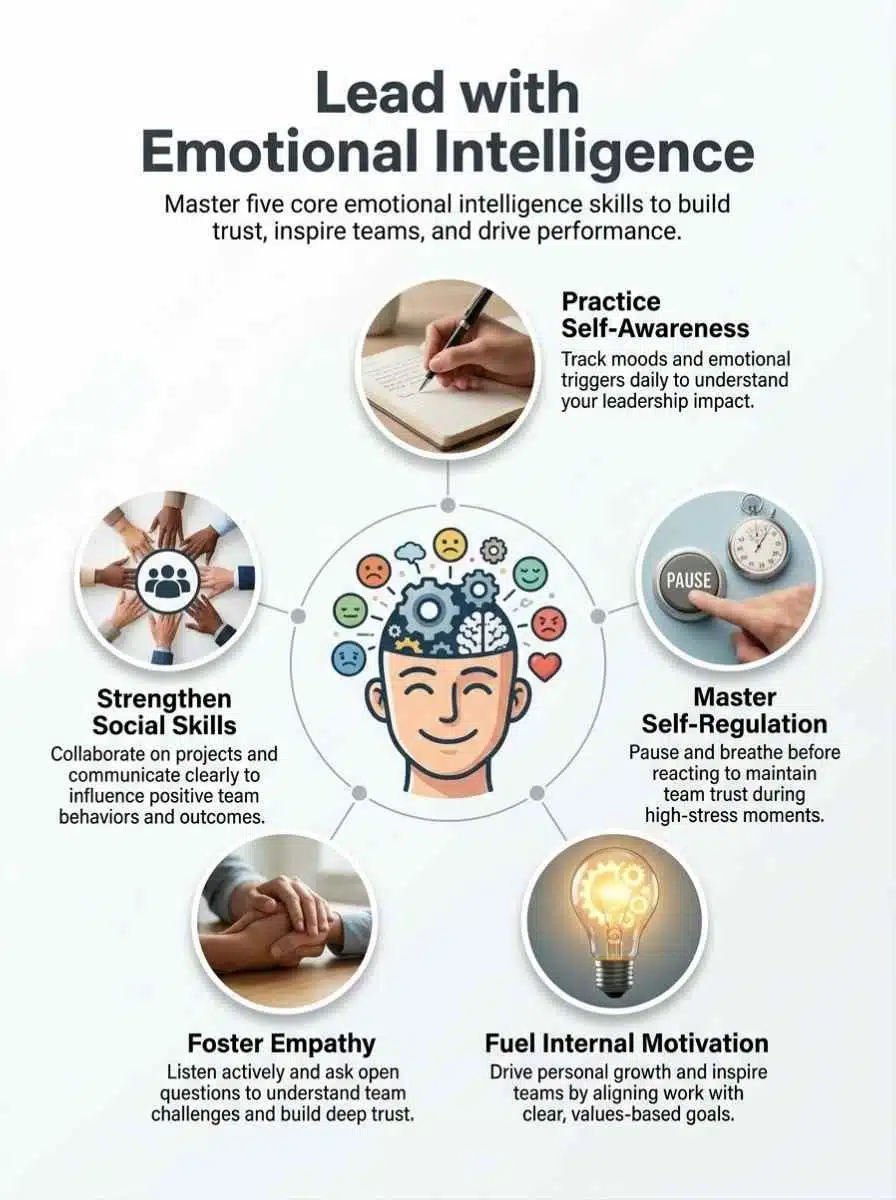
These core elements guide how leaders handle feelings, steer teams, and sharpen decisions. If you want a quick way to think about them, use the table below as your working map.
| Component | What it looks like at work | First habit to build it |
|---|---|---|
| Self-awareness | You notice your tone, stress signals, and blind spots | Review one tense moment at the end of each day |
| Self-regulation | You pause before replying and stay steady under pressure | Name the emotion before you act |
| Motivation | You connect effort to purpose instead of mood | Start the week with one meaningful priority |
| Empathy | You read concerns accurately and respond with care | Ask one open question before offering advice |
| Social skills | You handle feedback, conflict, and collaboration well | Summarize what you heard before solving |
Self-Awareness
Self-awareness sits at the center of emotional intelligence because you cannot manage a reaction you never noticed. A 2018 Harvard Business Review study by Tasha Eurich found that 95% of people think they are self-aware, but only about 10% to 15% really are.
That gap explains why smart leaders still create friction without meaning to. They think they are being direct, but the team hears impatience. They think they are calm, but their face and voice say something else.
Babson College professor Scott Taylor, the Arthur M. Blank Endowed Chair for Values-Based Leadership, has argued that external self-awareness matters just as much as self-knowledge. In plain English, that means you need to know how other people experience your leadership, not just what you intended.
- After a hard meeting, ask yourself: What was I feeling?
- Then ask: What did that feeling make me do?
- Finish with: How might the team have experienced me?
If you want better decision-making, start there. Self-awareness is the foundation that makes the rest of emotional management possible.
Self-Regulation
Self-regulation is the skill of staying in charge of your response when stress, anxiety, or frustration hit. It does not mean suppressing feelings. It means slowing them down long enough to choose a useful action.
HelpGuide’s Emotional Intelligence Toolkit explains this well: stress and anger make people more likely to act impulsively, say things they regret, or disconnect from what they feel. That is why the most practical self-regulation habit is not a big ritual. It is a short pause.
- Notice the first signal, such as a tight jaw, fast speech, or rushed typing.
- Name the feeling in one sentence, such as “I am irritated” or “I feel cornered.”
- Delay your reply for one breath, one minute, or one walk to the water bottle.
- Come back with a response that fits the goal, not the mood.
This sounds small, but it changes a lot. In conflict resolution, the leader who pauses usually becomes the leader who keeps options open.
Motivation
Motivation inside emotional intelligence is not hype. It is the ability to stay directed by purpose, standards, and progress instead of whatever mood showed up that morning.
Gallup’s August 2025 survey of 4,475 U.S. working adults found a sharp gap in turnover intent: 41% of employees with a strong sense of work purpose were watching for or actively seeking a new job, compared with 68% of those with low purpose. That tells you something important. Meaning is not fluff, it is a retention issue.
For leaders, this means you should connect tasks to outcomes more often. Do not just assign work. Explain why the work matters to the customer, the team, or the mission.
- Open the week with one priority that matters most.
- Tell the team why it matters now.
- Close the week by naming one piece of progress.
That simple rhythm builds a more positive outlook without pretending work is easy.
Empathy
Empathy helps leaders read feelings accurately and respond without rushing past them. It is a core part of social awareness, and it is one of the fastest ways to improve trust.
Center for Creative Leadership researchers analyzed 6,731 mid-level to upper-middle-level managers across 38 countries and found that managers rated as more empathetic by direct reports were also rated as better performers by their bosses. That is a strong reminder that empathy is tied to results, not just reputation.
Stanford psychologist Jamil Zaki often describes empathy as part of what makes collaboration possible. At work, that usually means doing three simple things well: asking, listening, and checking that you understood.
- Ask open questions, such as “What feels hardest about this right now?”
- Reflect the feeling before solving, which is a useful habit borrowed from therapeutic communication.
- Check your read by saying, “It sounds like the real issue is pressure, not the task itself. Is that right?”
Empathy does not mean lowering standards. It means understanding what is going on well enough to lead effectively.
Social Skills
Social skills are where emotional intelligence becomes visible. This is the part people notice in meetings, one-on-ones, feedback conversations, and conflict management.
Good social skills include active listening, clear feedback, steady body language, and the ability to repair tension before it turns into resentment. HelpGuide’s active listening guidance makes one point leaders often miss: summarize what you heard before you move into problem-solving. That one move cuts down misunderstandings fast.
- Listen to the end instead of finishing the other person’s sentence.
- Restate the issue in plain words.
- Ask one clarifying question.
- Agree on the next step before ending the conversation.
Leaders with strong social skills usually make conflict feel more workable. That makes team dynamics healthier and day-to-day collaboration much smoother.
Why Emotional Intelligence Is Important for Leaders
Emotional intelligence matters because work is emotional, even when people pretend it is not. Pressure, deadlines, recognition, fear, and uncertainty all shape performance.
Gallup’s 2026 U.S. data shows that 50% of employees felt stress a lot the previous day, and 22% felt sadness a lot the previous day. If you lead people, you are already leading through emotion whether you mean to or not.
Enhancing Team Performance
High EQ improves team performance because it helps leaders notice what is slowing the team down before metrics alone reveal it. You catch confusion sooner. You address friction earlier. You give better feedback because you are paying attention.
In Gallup research, 80% of employees who say they received meaningful feedback in the past week are fully engaged.
That number should change how you think about feedback. It is not a once-a-quarter event. It is a weekly leadership habit.
- Give feedback while the work is still fresh.
- Be specific about behavior, not personality.
- Ask the employee what they saw in the situation before giving your view.
- End with one clear adjustment, not five vague suggestions.
When leaders do this well, team engagement rises because people know where they stand and how to improve.
Building Trust and Relationships
Trust grows when people feel seen, heard, and treated fairly. Emotional intelligence supports all three.
This is where active listening matters more than polished speeches. If you interrupt, defend yourself too quickly, or turn every conversation into your own explanation, people stop bringing you the truth. They start bringing you the safe version.
Strong relationships also improve followership. People are more willing to accept a hard call from a leader who has built credibility through empathy, self-regulation, and consistent communication.
- Praise in public when it is earned.
- Correct in private with respect.
- Follow through on what you said you would do.
- Admit misses quickly, because repair builds trust faster than pretending.
That is how social skills become real leadership capital.
Change tests emotional intelligence fast. Teams watch the leader for cues on whether to panic, wait, or move.
The CDC noted in its May 2026 guidance on worker mental health that managers and supervisors can play a big role in reducing and preventing job-related stress, and that changing workplace policies and practices is the best way to address mental health at work. That means emotionally intelligent leadership during change is not just saying calm words. It is also fixing workload, priorities, and communication.
- Say what is changing, what is not, and what is still unknown.
- Repeat priorities more than you think you need to.
- Cut low-value work when new demands appear.
- Invite questions early so fear does not fill the silence.
Mindfulness helps here, but structure matters too. A calm tone without a clear plan rarely works.
Strategies for Developing Emotional Intelligence as a Leader
You do not build emotional intelligence by reading one good article and hoping it sticks. You build it by turning insight into repeatable habits.
Practicing Self-Reflection
Self-reflection works best when it is specific. General thoughts like “I need to be better” do not help much. A short review of one real moment does.
- Pick one meeting each day and replay only the tense parts.
- Write down the trigger, your reaction, and the effect on the room.
- Notice patterns in tone, speed, defensiveness, or avoidance.
- Choose one behavior to repeat or change tomorrow.
This is why journaling stays useful. It turns emotional awareness into visible data, and visible patterns are much easier to change.
Seeking Feedback from Others
Feedback closes the gap between how you think you lead and how people actually experience you. That is where real growth happens.
As of June 2026, Harvard Division of Continuing Education lists Margaret Andrews’s Emotional Intelligence in Leadership program with a 360-degree assessment built into the experience. The reason that detail matters is simple: outside perspective is not optional if you want accurate self-awareness.
| Feedback option | Time needed | Best use | Watch-out |
|---|---|---|---|
| Quick post-meeting check-in | 2 minutes | Catches tone and clarity issues fast | Can feel rushed if trust is low |
| Monthly pulse question | 5 minutes | Spots trends across the team | Tiny teams may doubt anonymity |
| Quarterly 360 review | 30 to 45 minutes to collect | Finds blind spots and patterns | Needs honest raters and follow-through |
A practical insider tip from manager forums is worth noting here: people in very small teams often do not trust “anonymous” surveys. If your team is small, pair surveys with optional one-on-ones so people can choose the safer channel.
Enhancing Empathy Through Active Listening
Most leaders think they listen well because they stay quiet for a few seconds. Real active listening is more disciplined than that.
HelpGuide recommends summarizing what you heard and avoiding the urge to shift the conversation back to your own story. That second point matters more than most leaders realize. The fastest way to make someone feel unheard is to turn their frustration into your example.
- Put the phone down and stop checking the clock.
- Ask one open question before giving advice.
- Reflect both the fact and the feeling.
- Summarize the issue before you solve it.
- Check whether the other person wants help, a decision, or simply to be heard first.
If you do this consistently, empathy stops being a vague trait and becomes a repeatable skill.
Improving Self-Regulation with Mindfulness
Mindfulness is useful because it helps you notice the emotional spike before it controls your reply. That is what makes it practical for leaders.
At MIT, the Search Inside Yourself program highlights self-awareness and emotion regulation as key outcomes of mindfulness-based practice. That is the right frame for work. You are not meditating to look serene. You are training your attention so you can respond with more intention under pressure.
- Take one slow breath before answering a provocative question.
- Name the emotion without judging it.
- Relax one part of the body, such as the jaw or shoulders.
- Answer the issue in front of you, not the story in your head.
Use mindfulness as a response tool, not as an excuse to tolerate a broken workload.
If stress is chronic, the next step is not just more meditation. It is also better boundaries, clearer priorities, and stronger stress management at the team level.
Strengthening Social Skills Through Collaboration
Social skills grow fastest when you practice them with other people, not when you just read about them. Collaboration gives you real-time feedback on tone, timing, and clarity.
SHRM’s 2025 workplace conflict checklist gives leaders a very practical structure: use “I” statements, restate for understanding, summarize the conflict, and agree on next steps. That sequence works because it lowers defensiveness and gives the conversation a shape.
- Run short after-action reviews after important projects.
- Ask teammates to restate decisions before the meeting ends.
- Use “I noticed” instead of “You always.”
- End conflict conversations with one owner and one deadline.
Those habits improve conflict resolution because they replace guesswork with clarity.
Daily Habits to Build Emotional Intelligence

Small habits beat big intentions here. Emotional intelligence grows faster when you practice it in short, repeatable moments.
| Daily habit | Time | Main payoff |
|---|---|---|
| End-of-day journal note | 3 minutes | Better self-awareness |
| Pause before a difficult reply | 30 to 60 seconds | Stronger self-regulation |
| One open question in each one-on-one | 1 minute | More empathy |
| Reflect back what you heard | 30 seconds | Clearer social skills |
| Name one team win | 1 minute | Higher motivation and engagement |
Journaling to Understand Emotions
Journaling is one of the easiest ways to build self-awareness because it slows down fuzzy reactions and turns them into language. Once you can name a pattern, you can work on it.
Keep it simple. Write down the trigger, the emotion, the behavior, and the outcome. Over a week or two, you will start seeing the same situations appear. That gives you a much stronger base for emotional management than vague reflection ever will.
Meditation for Emotional Control
Meditation helps most when it is short enough to stick. Five minutes before work or one minute before a tense conversation is often more useful than waiting for the perfect 20-minute session.
If you like structure, a meditation app can make the habit easier. If you prefer low-tech routines, try one minute of quiet breathing before opening email or joining a hard meeting. The goal is simple: create a little space between feeling and action.
Engaging in Constructive Conversations
Emotionally intelligent leaders do not avoid hard talks. They make those talks safer and clearer.
Start with what you observed. Use “I” statements. Ask the other person to respond. Then restate their point before proposing next steps. That rhythm keeps disagreement from turning into personal attack, and it supports healthier conflict management over time.
Common Misconceptions About Emotional Intelligence
A lot of leaders dismiss emotional intelligence because they misunderstand what it asks of them. Two myths show up again and again.
“EQ Is Only About Being Nice”
EQ is not about being endlessly agreeable. It is about reading the room accurately, handling your own reactions, and taking the action that best serves the team and the work.
That may mean compassion. It may also mean saying no, setting a boundary, or addressing poor performance clearly. Empathy without action can feel like lip service, which is why emotionally intelligent leaders pair care with follow-through.
Being nice avoids discomfort. Emotional intelligence helps you handle discomfort well.
“Emotional Intelligence Cannot Be Learned”
This one falls apart as soon as you look at how leaders improve. In a July 2025 Stanford study, even a short VR-based practice intervention changed how participants handled a difficult workplace conversation, including more language that showed understanding and emotion. That is a strong sign that empathy and communication can improve through practice.
The same pattern shows up in coaching, feedback, journaling, mindfulness, and structured learning. Emotional intelligence is a skill set. Like any skill set, it gets better when you train it on purpose.
Final Thoughts
Emotional intelligence is not a personality label. It is a set of habits you can build. Start with one small move this week: journal after one hard meeting, pause before one tense reply, or ask one better question in a one-on-one. Then ask for feedback.
That steady practice is what improves self-regulation, sharpens social skills, strengthens team engagement, and helps you become a leader people trust.
Frequently Asked Questions (FAQs) About Emotional Intelligence Leadership Skills
1. What is emotional intelligence for a leader?
Emotional intelligence is the skill to read feelings, and to act with self-awareness and social skills. It helps a leader build trust, guide teams, and boost motivation.
2. How can a leader develop emotional intelligence?
Start with self-awareness, keep a journal, and ask for honest feedback, then listen with care. Practice active listening, empathy, and self-regulation daily, roll up your sleeves and do the work. Training, coaching, and real talks, will move you forward.
3. How do you use emotional intelligence in conflict?
Pause, listen, name the feelings, and seek a shared win. Use calm words, control your tone, and focus on solutions, not blame.
4. How can a leader measure progress in emotional intelligence?
Track feedback from your team, watch for better relationships and clearer communication. Note steady changes in behavior, reduced conflicts, and higher team motivation.