Starting fitness at home sounds simple until you are standing in your living room thinking, “Okay… what do I actually do now?” That is where many beginners get stuck. They either copy a workout that is too advanced, do random jumping exercises, or push so hard on day one that they spend the next three days sore, tired, and annoyed. I have seen this happen again and again. Most beginners do not fail because they are lazy.
They fail because the routine is too aggressive, too confusing, or clearly designed for someone who already has a fitness base. The best beginner home workouts should feel doable. They should teach basic movement, build strength slowly, improve mobility, raise your heart rate safely, and help you feel confident enough to repeat the routine next week. You do not need a gym. You do not need expensive machines. You need a clear starting point.
That matters because physical inactivity is still a major global health issue. WHO reported that adults should aim for at least 150 minutes of moderate-intensity activity per week, or 75 minutes of vigorous activity, plus muscle-strengthening activities on 2 or more days weekly. The CDC gives similar guidance for adults, recommending 150 minutes of moderate-intensity physical activity and 2 days of muscle-strengthening work each week.
But here is the beginner-friendly truth: you do not need to hit the perfect weekly target immediately. Your first job is to start moving, stay safe, and build a routine you can actually repeat. In this guide, I have mentioned 9 realistic, easy home workouts for beginners. Each one is simple, practical, and built for real people with real schedules, small spaces, low energy days, and zero interest in doing burpees on day one.
How I Selected These 9 Beginner Home Workouts
Not every workout labeled “beginner” is actually beginner-friendly. Some routines start with jump squats, fast mountain climbers, burpees, and long planks. That may be fine for someone who already trains, but it is not the best place for most beginners to start.
So, these starter routines were selected using practical filters.
| Selection Factor | Why It Matters for Beginners |
| Low barrier to entry | You should be able to start with little or no equipment |
| Joint-friendly movement | Beginners need safe options for knees, wrists, hips, and back |
| Clear structure | Confusion makes consistency harder |
| Full-body value | A useful beginner routine should train more than one area |
| Easy progression | You should be able to make it harder slowly |
| Real home practicality | It should work in a bedroom, living room, or small apartment |
| Repeatability | A beginner workout should be something you can do again next week |
The goal is not to create the hardest possible workout. The goal is to create a workout that helps you come back.
Before You Start: A Simple Beginner Safety Check
A beginner workout should challenge you, but it should not scare your body into rebellion. Use the talk test. During moderate-intensity activity, you should be able to talk but not sing. During vigorous activity, you may only be able to say a few words before needing to pause for breath.
For the first few weeks, stay mostly in the easy-to-moderate zone. If your form breaks, your joints hurt, or you feel dizzy, stop and rest. A simple rule I use is this: finish the workout feeling like you could do a little more. That feeling helps you stay consistent.
What You Need for Beginner Home Workouts
You can start with only your bodyweight. Still, a few basic tools can make easy home workouts more comfortable.
| Item | Why It Helps | Required? |
| Exercise mat | Makes floor exercises more comfortable | Helpful |
| Stable chair | Useful for squats, support, and incline work | Very useful |
| Resistance band | Adds light strength training options | Optional but useful |
| Towel | Helps with sweat, grip, and stretching | Helpful |
| Water bottle | Keeps hydration nearby | Basic |
| Timer | Keeps workouts structured | Helpful |
You do not need to buy a full home gym. In fact, beginners usually do better with fewer tools and a clearer plan.
If you want a simple, intentional home workout setup, start with durable basics instead of random gadgets. A mat, resistance band, towel, and reusable water bottle are enough for most beginners. You can also explore practical wellness and lifestyle products through the Eco Shop if you prefer building a cleaner, more sustainable home fitness corner.
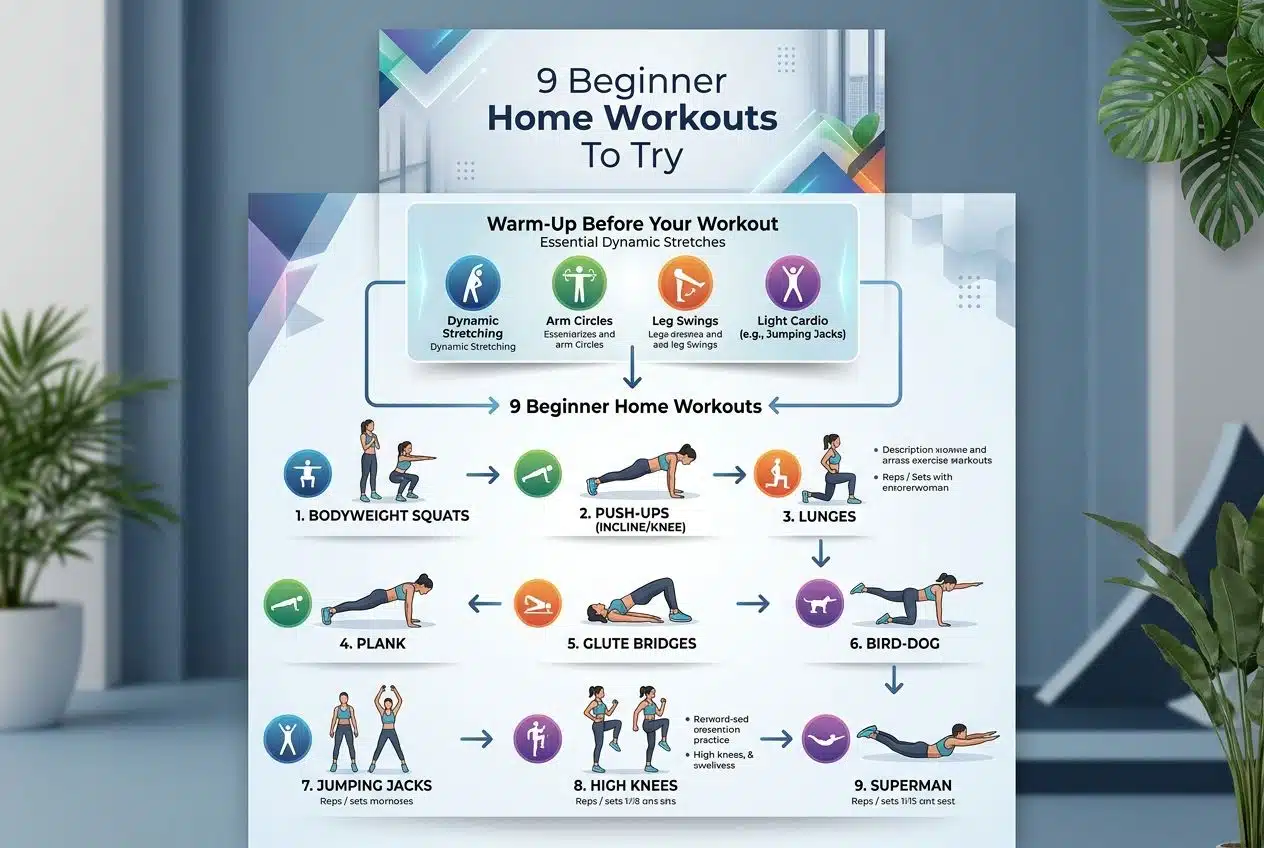
9 Beginner Home Workouts You Can Try This Week
These routines move from very easy to slightly more challenging. Start with one or two workouts first. You do not need to complete all nine in one week. The goal is simple: move better, build confidence, and create a routine you can repeat without feeling overwhelmed.
1. The 10-Minute Wake-Up Mobility Routine
This is the easiest workout on the list, and that is exactly why it works. Some beginners do not need a hard workout first. They need a simple routine that helps the body feel less stiff and more awake.
Use this in the morning, during a work break, or on a low-energy day. It is gentle enough to do almost daily and works well for people who sit for long hours.
Routine:
| Exercise | Time |
| Neck circles | 45 seconds |
| Shoulder rolls | 45 seconds |
| Arm circles | 45 seconds |
| Hip circles | 45 seconds |
| Bodyweight good mornings | 60 seconds |
| Slow squats | 60 seconds |
| Calf raises | 60 seconds |
| Marching in place | 90 seconds |
| Deep breathing | 60 seconds |
Move slowly and avoid forcing any stretch. This routine is not meant to be intense. It is meant to build the habit of starting.
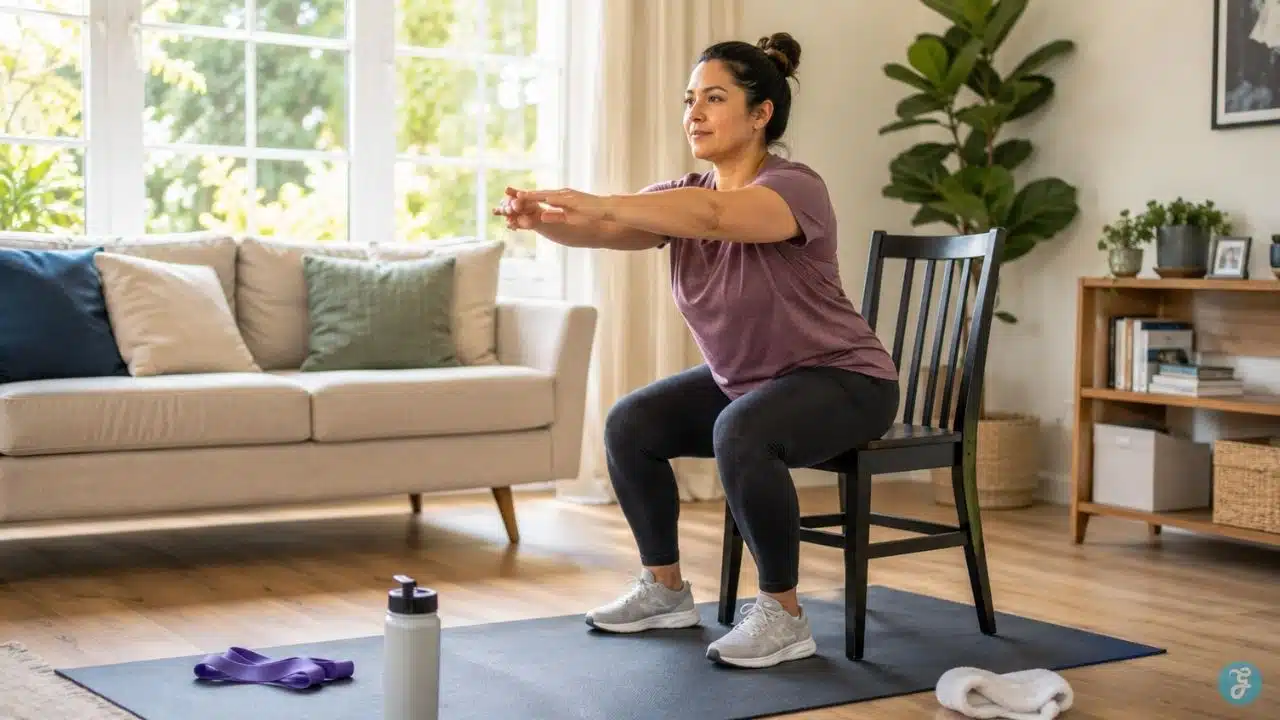
2. The Chair Squat Starter Routine
Chair squats are one of the most practical beginner exercises because they train something you already do every day: sitting down and standing up.
For beginners, the chair gives support and confidence. It helps you learn the squat pattern without worrying about balance. This is especially helpful if regular squats feel awkward at first.
Routine:
| Exercise | Reps or Time |
| Chair squats | 10 reps |
| Standing calf raises | 12 reps |
| Seated knee lifts | 10 reps per side |
| Wall push-ups | 10 reps |
| Marching in place | 45 seconds |
| Rest | 60 seconds |
| Repeat | 2–3 rounds |
Use a stable chair that does not slide. Sit down with control instead of dropping into the seat. As you improve, try touching the chair lightly instead of fully sitting.
3. The Beginner Full-Body No-Equipment Workout
This is a simple full-body workout for beginners who want a complete session without equipment. It trains your legs, chest, hips, core, and light cardio in one routine. The goal is not speed. The goal is to learn basic movement patterns: squat, push, bridge, brace, and step. These are the foundations for many home workout routines.
Routine:
| Exercise | Time |
| Bodyweight squats | 40 seconds |
| Incline push-ups | 40 seconds |
| Glute bridges | 40 seconds |
| Dead bugs | 40 seconds |
| Step touches | 40 seconds |
| Rest | 60 seconds |
| Repeat | 3 rounds |
Use a wall, table, or sofa edge for incline push-ups. Stop the set when your form starts to break. A clean short set is better than a messy long one.
4. The Low-Impact Cardio Beginner Workout
Cardio does not have to mean jumping. Many beginners do better with low-impact movement first because it is easier on the knees, ankles, hips, and lower back. This routine raises your heart rate without making the workout noisy or aggressive. It is a good choice for apartment workouts and people who want beginner-friendly stamina training.
Routine:
| Exercise | Time |
| Marching in place | 45 seconds |
| Step touches | 45 seconds |
| Standing punches | 45 seconds |
| Low-impact jumping jacks | 45 seconds |
| Side steps with arm reach | 45 seconds |
| Rest | 60 seconds |
| Repeat | 3–4 rounds |
Keep your steps soft and controlled. If your shoulders get tired, reduce the arm movement and focus on steady footwork.
5. The Wall Push-Up and Upper-Body Starter
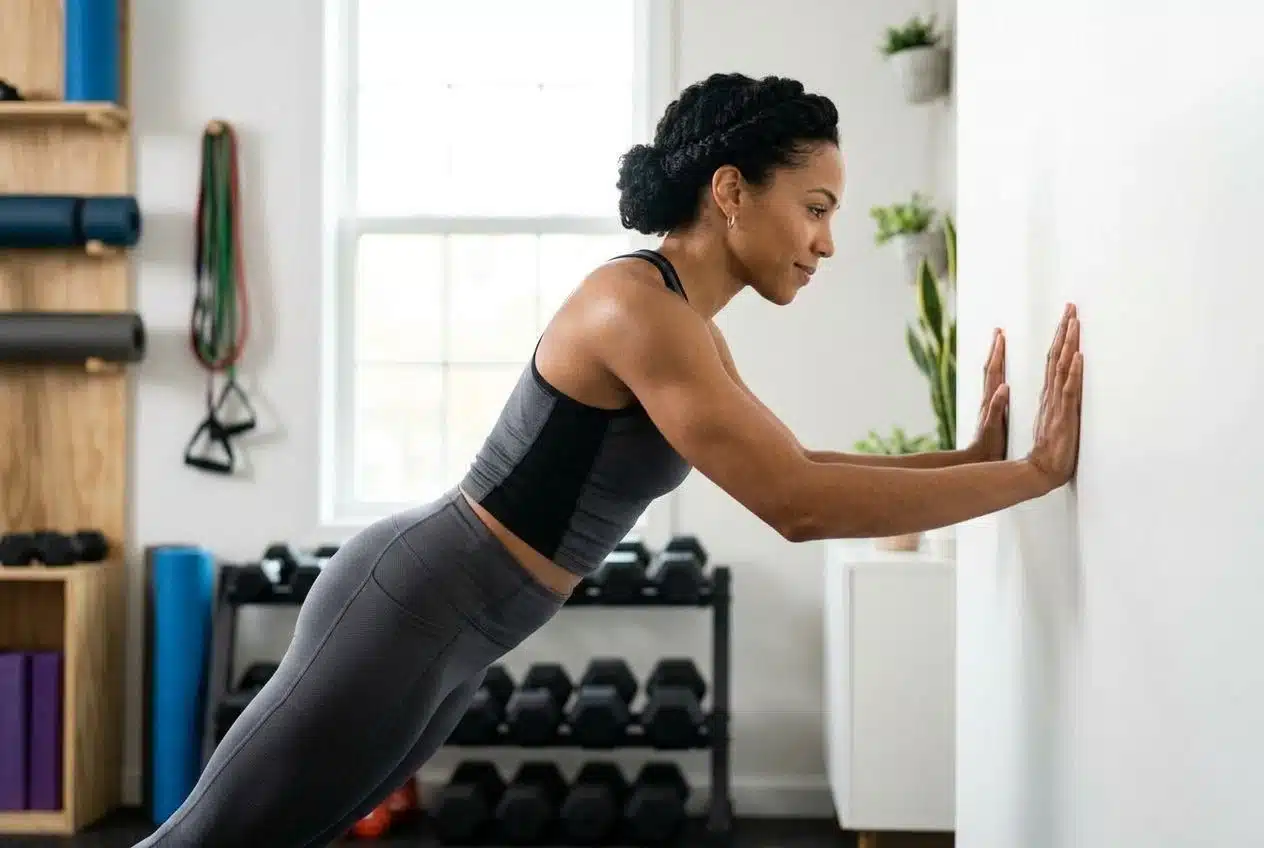
Many beginners struggle with push-ups because they start on the floor too soon. Wall push-ups are a better first step because they reduce the load while still training the chest, shoulders, arms, and core.
This routine also helps desk workers because it includes simple shoulder and upper-back movement.
Routine:
| Exercise | Reps or Time |
| Wall push-ups | 10–12 reps |
| Wall angels | 8–10 reps |
| Shoulder blade squeezes | 12 reps |
| Standing arm circles | 30 seconds each direction |
| Incline plank on the wall | 20–30 seconds |
| Rest | 45–60 seconds |
| Repeat | 3 rounds |
Keep your body straight during wall push-ups. Do not let your hips sag, or your shoulders shrug toward your ears. When wall push-ups become easy, move to a table or sofa edge for incline push-ups.
6. The Beginner Core Workout Without Crunches
Crunches are not required for beginner core training. Many beginners feel crunches in the neck or hip flexors more than the abs.
This routine focuses on core stability. That means your midsection learns how to brace and control movement. This helps with posture, balance, squats, push-ups, and daily movement.
Routine:
| Exercise | Reps or Time |
| Dead bugs | 8 reps per side |
| Glute bridges | 12 reps |
| Bird dogs | 8 reps per side |
| Knee plank | 20–30 seconds |
| Side plank from knees | 15–20 seconds per side |
| Rest | 60 seconds |
| Repeat | 2–3 rounds |
Move slowly during dead bugs and bird dogs. If your lower back arches during dead bugs, reduce the range of motion. Control matters more than speed.
7. The Walk-and-Strength Combo
This is one of the most realistic beginner home workouts because it combines walking with simple strength work. Walking builds aerobic fitness, while strength moves train muscles that walking alone does not target enough. This routine is great when you want something simple, low-pressure, and easy to repeat.
Routine:
Start with a 5-minute easy walk. Then walk briskly for 10–15 minutes. After that, complete 2 rounds of the following:
- 10 chair squats
- 10 wall push-ups
- 12 glute bridges
- 20-second knee plank
Walk at a pace where you can talk but not sing. Do not rush the strength section after walking. Keep every rep controlled.
8. The Beginner Resistance Band Routine
Resistance bands are a smart next step for beginner home training. They are affordable, easy to store, and useful for pulling movements that bodyweight workouts often miss. This routine adds light resistance without needing dumbbells or gym machines.
Routine:
| Exercise | Reps |
| Band rows | 10–12 reps |
| Band chest press | 10 reps |
| Band squats | 10–12 reps |
| Band pull-aparts | 12 reps |
| Band good mornings | 10 reps |
| Rest | 60 seconds |
| Repeat | 2–3 rounds |
Use a light band first. Check that the band is not damaged before starting. Control the return phase instead of letting the band snap back.
9. The 20-Minute Beginner Weekly Reset Workout
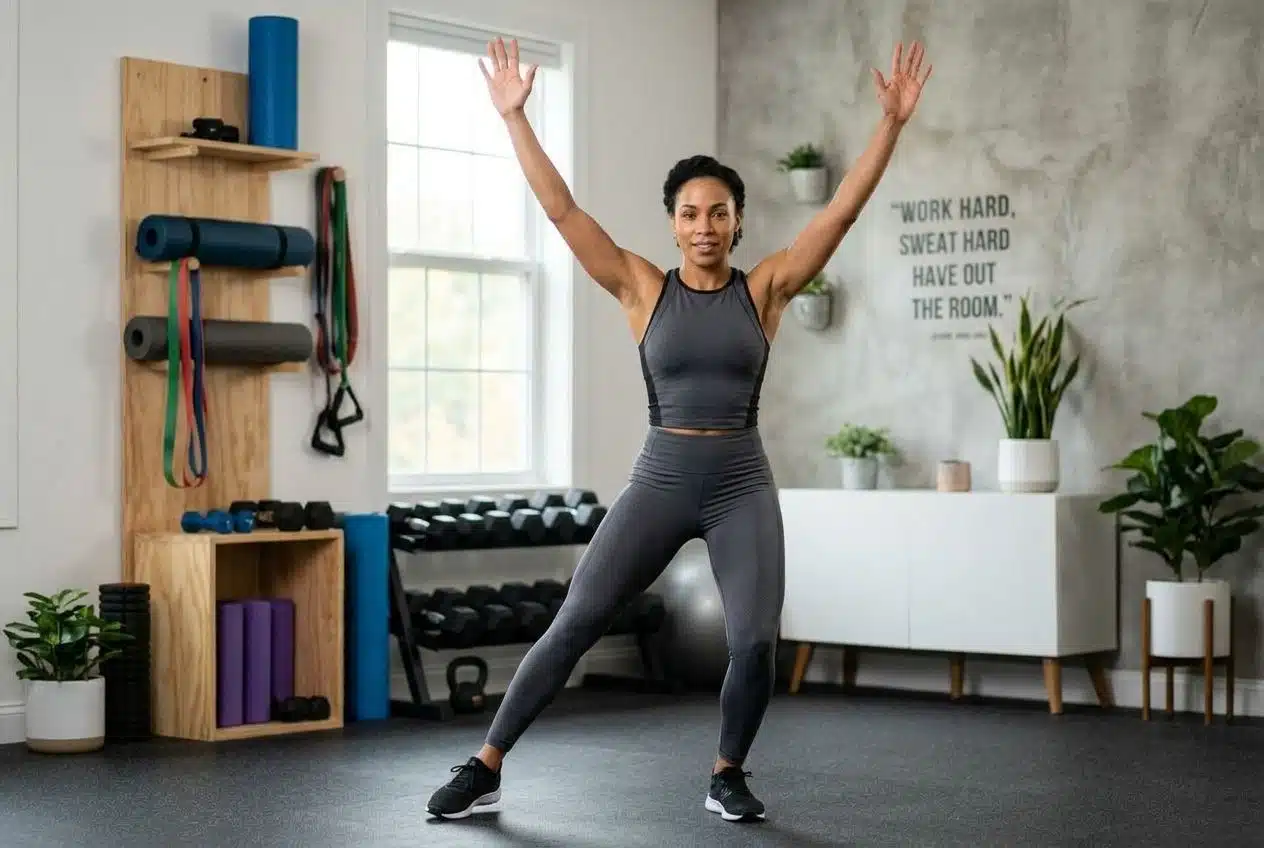
This is a complete beginner session you can use once or twice per week. It combines mobility, strength, cardio, and core work in one simple routine. Think of it as your reset workout. If you miss a few days or feel unsure what to do, come back to this one.
Routine:
Start with 3 minutes of marching and arm circles to warm up.
Then complete 2 rounds of:
- 10 chair squats
- 10 incline push-ups
- 12 glute bridges
- 8 dead bugs per side
- 60 seconds of step touches
Finish with 3 minutes of hip flexor stretching and slow breathing. Keep the first round easy. Use the second round to increase your effort slightly. Do not turn it into a race. This routine works best when you move with control.
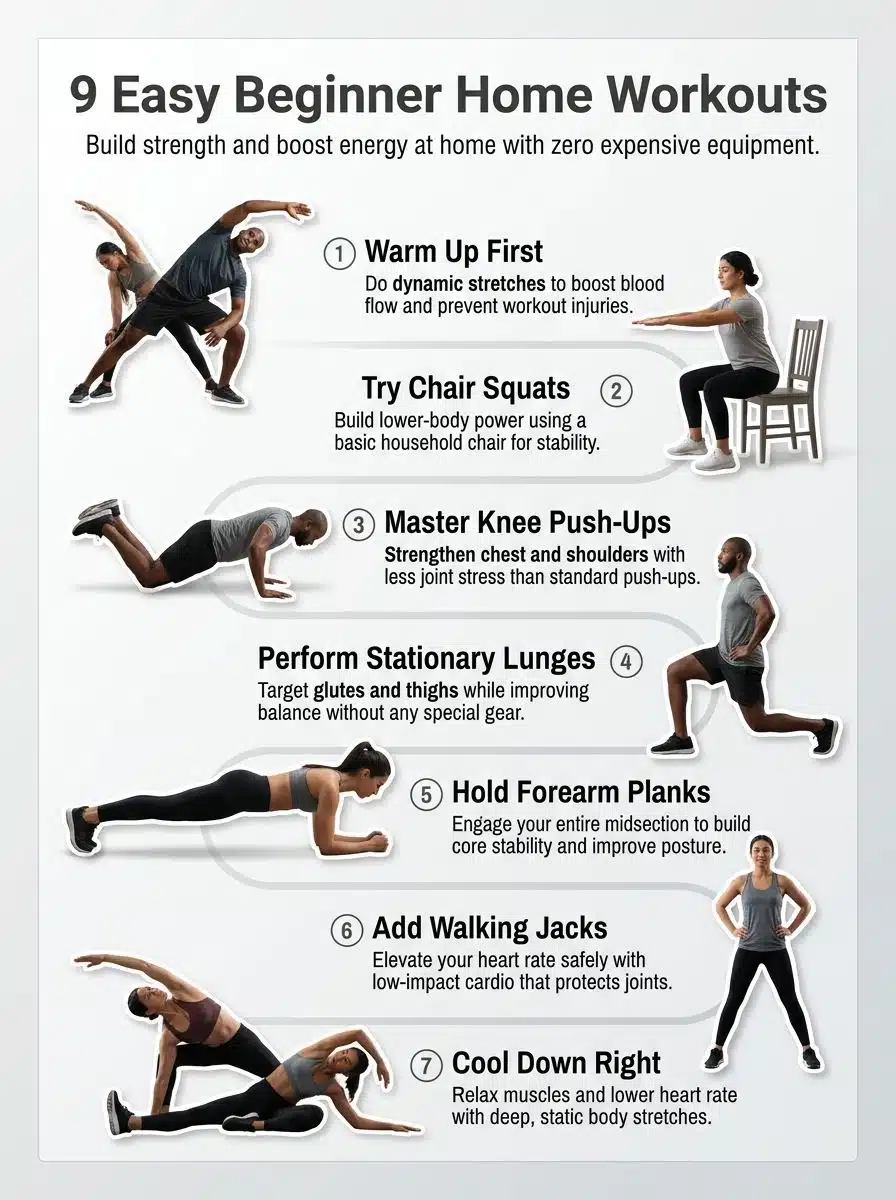
Quick Comparison of the 9 Beginner Home Workouts
These beginner home workouts solve different beginner problems. Some help you move when you feel stiff. Some build strength. Some improve cardio. Some train their core without crunches.
Use this quick comparison to choose the best routine for your current energy level and goal.
| Workout | Time | Equipment | Best For | Intensity |
| Wake-Up Mobility Routine | 10 min | None | Stiff mornings | Easy |
| Chair Squat Starter | 12–15 min | Chair | Lower-body strength | Easy–Moderate |
| Full-Body No-Equipment Workout | 18–20 min | None | Complete beginner training | Moderate |
| Low-Impact Cardio Workout | 15–20 min | None | Cardio without jumping | Moderate |
| Wall Push-Up Starter | 12–15 min | Wall | Upper-body strength | Easy–Moderate |
| No-Crunch Core Workout | 12–15 min | Mat optional | Core stability | Easy–Moderate |
| Walk-and-Strength Combo | 25–30 min | None | Cardio plus strength | Easy–Moderate |
| Beginner Resistance Band Routine | 18–22 min | Band | Strength progression | Moderate |
| Weekly Reset Workout | 20 min | Mat optional | Balanced full-body routine | Moderate |
My Top 3 Picks and Why
| Pick | Why It Stands Out |
| Full-Body No-Equipment Workout | Best overall starter routine because it trains strength, core, and cardio |
| Walk-and-Strength Combo | Best for people who want a gentle, realistic weekly habit |
| Beginner Resistance Band Routine | Best next step when bodyweight work starts feeling too easy |
If you are completely new, start with the Wake-Up Mobility Routine and Chair Squat Starter. If you’ve already moved a little, start with the Full-Body No-Equipment Workout.
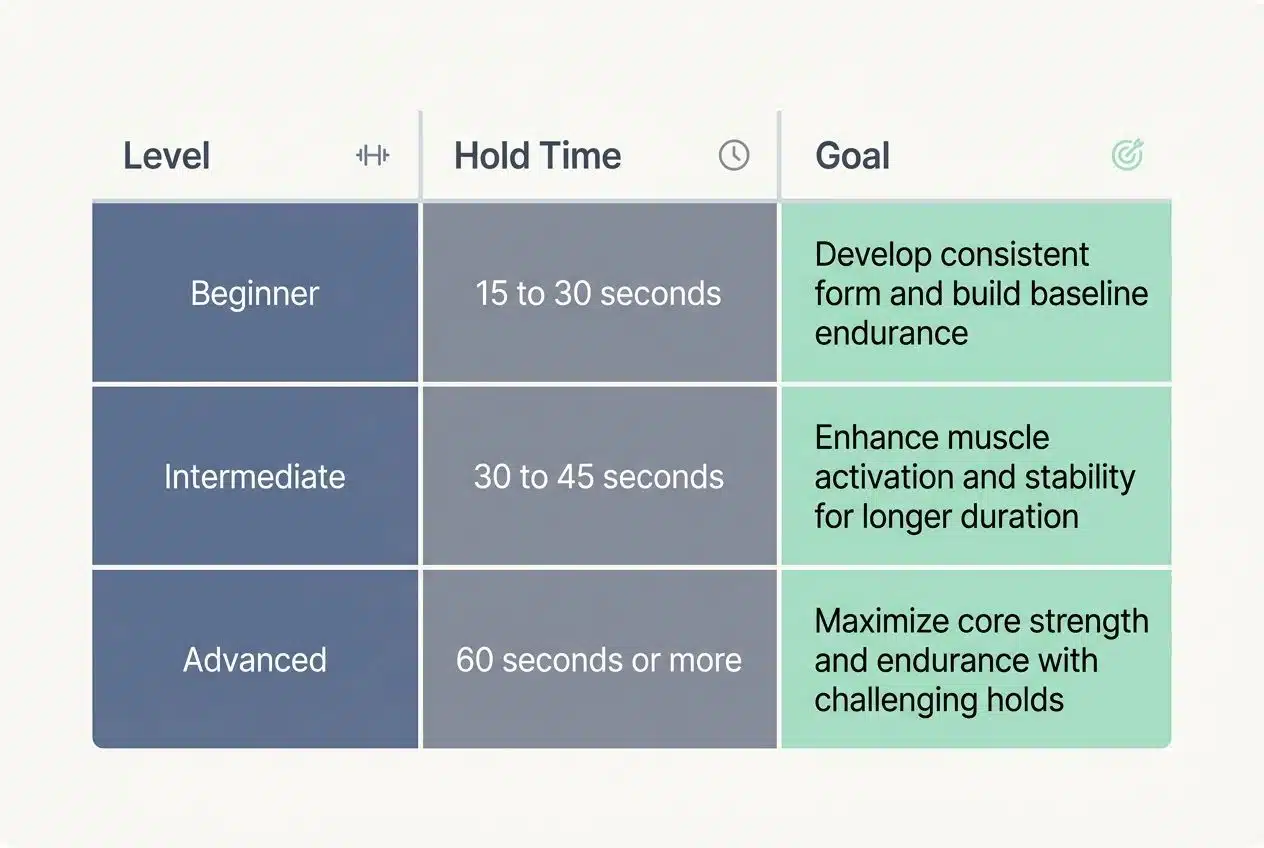
How to Choose the Right Beginner Home Workouts by Yourself
Choosing the right workout is not about finding the hardest option. It is about matching the routine to your body, schedule, and confidence level.
| Question | Best Choice |
| Do you feel stiff or tired? | Wake-Up Mobility Routine |
| Do you want stronger legs? | Chair Squat Starter |
| Do you want a full-body session? | Full-Body No-Equipment Workout |
| Do you want cardio without jumping? | Low-Impact Cardio Workout |
| Do you want upper-body strength? | Wall Push-Up Starter |
| Do you want core training without crunches? | No-Crunch Core Workout |
| Do you like walking? | Walk-and-Strength Combo |
| Do you have a resistance band? | Beginner Resistance Band Routine |
| Do you want one balanced weekly workout? | Weekly Reset Workout |
A good beginner plan usually includes 2–3 workout types. For example, you can do one strength routine, one cardio routine, and one mobility routine each week.
A Simple 7-Day Beginner Home Workout Plan
This plan uses the routines above and keeps the week realistic.
| Day | Workout |
| Monday | Chair Squat Starter Routine |
| Tuesday | Wake-Up Mobility Routine |
| Wednesday | Full-Body No-Equipment Workout |
| Thursday | Rest or easy walk |
| Friday | No-Crunch Core Workout |
| Saturday | Walk-and-Strength Combo |
| Sunday | Rest or gentle mobility |
This structure gives you strength, cardio, mobility, core work, and recovery. It is not extreme, and that is the point. Beginners need a repeatable structure more than heroic intensity.
Once these routines start feeling easy, move into the complete guide to the best home workouts for strength, mobility, bands, yoga, core, and HIIT.
Common Beginner Home Workout Mistakes to Avoid
Beginners often make mistakes because motivation is high in the first week. The problem is that motivation can push you faster than your body is ready to go.
| Mistake | Why It Hurts Progress | Better Approach |
| Starting too hard | Causes soreness and burnout | Begin with an easy to moderate effort |
| Doing random workouts daily | Makes progress hard to track | Repeat the same routines for 3–4 weeks |
| Skipping warm-ups | Makes movement feel stiff | Start with 3–5 minutes of mobility |
| Ignoring strength work | Limits long-term progress | Add strength at least twice weekly |
| Chasing sweat only | Sweat does not equal quality | Focus on form and consistency |
| Comparing yourself to advanced people | Creates frustration | Track your own progress |
| No rest days | Reduces recovery | Keep 1–2 easy or rest days weekly |
The smartest beginner is not the one who does the most on day one. It is the one who is still training three months later.
The Beginner’s Advantage: Starting Small Is Not Starting Weak
The best thing about being a beginner is that small changes can feel meaningful quickly. A 10-minute routine can improve your mood. A chair squat can build confidence. A short walk can make you feel more capable. A wall push-up can become an incline push-up later.
That is why beginner home workouts should be simple, not silly. Simple does not mean useless. Simple means repeatable. Start with the routine that feels least intimidating. Do it twice this week. Then do it again next week. After that, add one more round, one more rep, or one more workout day.
That is how fitness becomes part of your life instead of another failed promise.
Frequently Asked Questions About Beginner Home Workouts
1. What Are the Best Beginner Home Workouts to Start With?
The best beginner home workouts include chair squats, wall push-ups, glute bridges, dead bugs, bird dogs, marching, step touches, and simple mobility routines. These exercises are easy to learn and do not require gym equipment.
2. How Many Days a Week Should a Beginner Work Out at Home?
Most beginners can start with 3 days per week. Add light walking or mobility on other days if your body feels good. Adults should work toward 150 minutes of moderate-intensity activity and 2 days of muscle-strengthening work weekly, but beginners can build toward that gradually.
3. Can I Get Fit With Easy Home Workouts?
Yes. Easy home workouts can help you build the foundation for better fitness. Over time, you need progression, but your first goal is consistency, movement quality, and confidence.
4. Do Beginner Workouts Need Equipment?
No. You can start with bodyweight exercises only. A chair, mat, and resistance band can make home training more comfortable and flexible, but they are not required.
5. Should Beginners Do HIIT?
Beginners can do light HIIT-style routines, but they should avoid extreme jump-heavy workouts at first. Low-impact cardio and basic strength circuits are usually better starting points.
6. When Should I Make My Workouts Harder?
Make workouts harder when you can complete all rounds with good form and recover well by the next day. Add reps, time, rounds, or light resistance gradually.