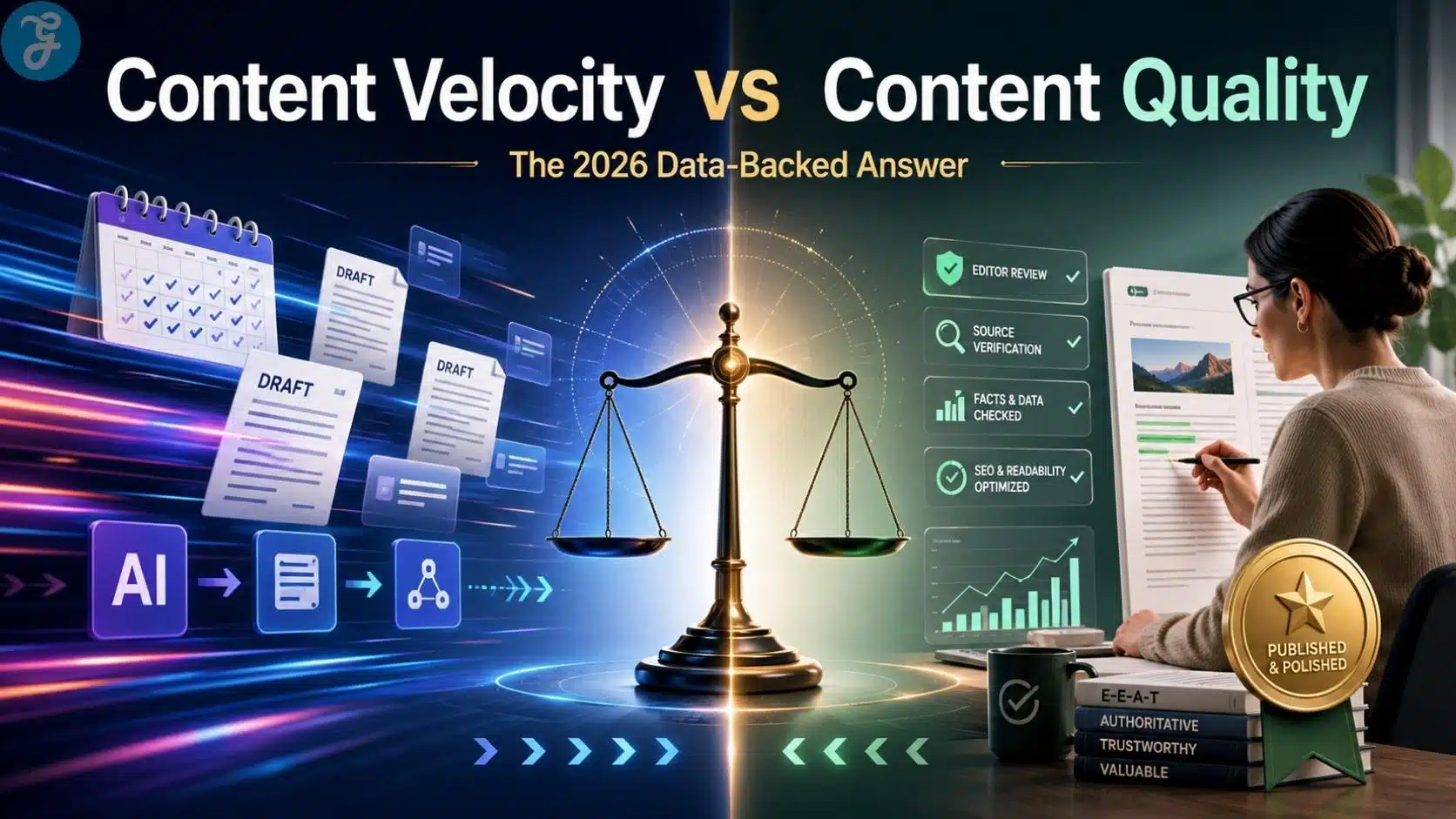
Search teams love a false binary. Publish more, or publish better. Scale fast, or protect quality. Flood the site, or polish every sentence until the calendar quietly dies of boredom. The debate around Content Velocity vs Content Quality has become louder in 2026 because AI can now produce content at a speed that makes old editorial calendars look like handwritten letters sent by horse.
But the data-backed answer is not “publish more” or “publish less.” The answer is sharper: publish faster only when your quality control, originality, usefulness, and distribution system can keep up. Velocity without quality creates content debt. Quality without consistency creates invisible brilliance. The winning model in 2026 is quality-controlled velocity.
Why This Debate Matters More In 2026
The content environment has changed because AI has made production cheaper, faster, and more crowded. HubSpot’s 2026 State of Marketing data says 80% of marketers use AI for content creation and 75% use it for media production. That means speed is no longer a rare advantage. It is becoming the default setting.
At the same time, Google’s own guidance still says its ranking systems are designed to reward helpful, reliable, people-first content, not content created primarily to manipulate search rankings. Google also warns that using generative AI to create many pages without adding value may violate its scaled content abuse policy.
So the 2026 problem is simple: everyone can publish faster. Not everyone can publish something worth trusting.
The Short Answer: Quality-Controlled Velocity Wins
The strongest content strategy in 2026 is not slow perfection. It is also not reckless scale. It is a system where teams publish consistently, update aggressively, and maintain a clear editorial standard.
Here is the practical answer.
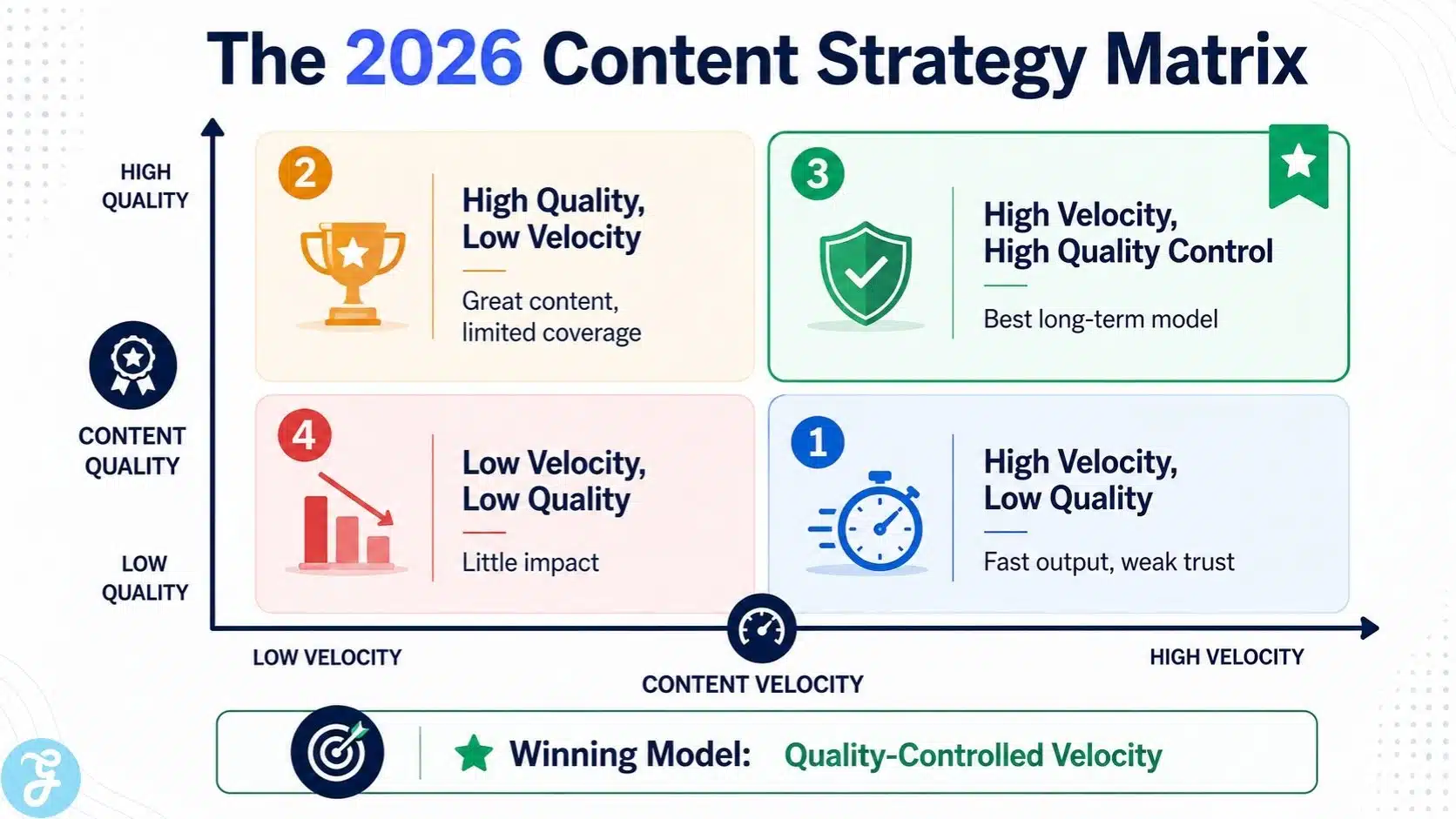
| Strategy Type | What It Looks Like | Likely 2026 Outcome |
|---|---|---|
| High Velocity, Low Quality | Many generic AI-assisted posts with little originality | Indexing risk, weak trust, poor conversions |
| High Quality, Low Velocity | Excellent content, but too little publishing or updating | Strong pieces, weak topical coverage |
| High Velocity, High Quality Control | Frequent publishing with expert input, editing, data, updates, and internal linking | Best chance of ranking, converting, and earning AI/search visibility |
| Low Velocity, Low Quality | Infrequent, generic, outdated content | Basically digital decoration |
The winning strategy is not about choosing one side. It is about building a machine that can move fast without producing junk.
What The Data Says About Content Velocity
Velocity still matters because search is becoming fresher, faster, and more competitive. Ahrefs reported in late 2025 that AI-cited content was 25.7% fresher than organic Google results after analyzing 17 million citations. That suggests freshness and update cadence may matter even more in AI-influenced search visibility.
AI Overviews are also changing how visibility works. A 2026 empirical study of Google Search, Gemini, and AI Overviews found that AI Overviews appeared for 51.5% of representative real-user queries and were displayed above organic results. That means publishers and brands are no longer competing only for blue-link rankings. They are competing for machine-selected visibility.
Another 2026 study of Google AI Overviews found overall AI Overview activation at 13.7%, rising to 64.7% for question-form queries. The study also found that 11% of atomic claims in AI Overview responses were unsupported by cited pages. That creates a strange but important opportunity: brands with accurate, well-structured, source-backed content can become more useful in a search environment where reliability is under pressure.
So yes, velocity matters. But it must include updates, freshness, structure, evidence, and source clarity. Publishing fast just to publish fast is not strategy. It is noise with a CMS login.
What The Data Says About Content Quality
Quality is not a vague compliment anymore. It has measurable traits: originality, usefulness, expertise, structure, proof, readability, search intent fit, conversion alignment, and freshness.
The Content Marketing Institute’s 2026 B2B research reported that 12% of marketers said AI decreased content quality. It also found that around one-fifth did not see AI improving creativity or content quality, which suggests AI helps production but does not automatically improve strategic value.
Orbit Media’s 2025 blogging research, summarized by MarketingProfs, found that only 9% of respondents published posts longer than 2,000 words, but 39% of those publishing 2,000-plus-word posts reported strong results, compared with a 21% benchmark. That does not mean every article must be long. It means depth still matters when the topic demands it.
Google’s helpful content guidance also pushes creators to ask whether content provides original information, substantial value, clear sourcing, expertise, and a satisfying experience for readers. That is the quality standard velocity must protect.
The Real Problem Is Content Debt
Content debt happens when a team publishes faster than it can maintain quality. It looks productive in the monthly report, but the site slowly fills with outdated, thin, overlapping, or barely differentiated content.
Content debt usually shows up as:
- multiple articles competing for the same keyword;
- old statistics that nobody updated;
- AI-written sections with no real insight;
- weak internal linking;
- shallow articles that answer nothing deeply;
- pages that rank briefly, then fade;
- traffic that does not convert;
- content that sounds correct but feels painfully generic.
The danger is that content velocity can create the illusion of progress. More URLs. More published posts. More indexable assets. More meetings where someone says “pipeline.” Lovely. But if the content does not build trust, topical authority, or conversions, it is just inventory.
Where Content Velocity Wins
Velocity wins when timing, freshness, and topical coverage matter.
This includes:
- breaking industry trends;
- fast-changing software topics;
- AI, fintech, health tech, policy, and market updates;
- product-led SEO pages;
- comparison pages;
- glossary and definition clusters;
- recurring data updates;
- news explainers;
- seasonal buying guides;
- content refreshes.
In these cases, waiting three months for perfection can be a mistake. Search demand may move before your editorial process finishes admiring itself.
But velocity must be structured. A fast content team needs briefs, source rules, expert review, internal linking, update schedules, and clear quality gates. Otherwise, AI-assisted speed becomes a content landfill.
Where Content Quality Wins
Quality wins when trust, expertise, or buying decisions matter.
This includes:
- YMYL topics;
- B2B SaaS buying guides;
- legal, finance, health, and policy content;
- thought leadership;
- original research;
- case studies;
- enterprise comparison pages;
- high-intent commercial pages;
- expert explainers;
- pillar content.
For these topics, readers do not want 600 words of recycled internet soup. They want evidence, clarity, experience, examples, and decision support. AI can help draft, structure, summarize, and repurpose, but the strategic insight still needs human judgment.
The 2026 Content Strategy Matrix
The smartest teams decide velocity based on content type, risk, and business value.
| Content Type | Recommended Velocity | Quality Requirement |
|---|---|---|
| News Reactions | High | Accurate, sourced, fast updates |
| Product-Led SEO Pages | Medium To High | Strong intent match and conversion path |
| Thought Leadership | Lower | Original opinion and expert depth |
| Comparison Pages | Medium | Evidence, fairness, buyer clarity |
| Data-Backed Reports | Lower | Research quality and methodology |
| Glossary Content | High | Clear definitions and internal linking |
| YMYL Content | Lower To Medium | Expert review and factual precision |
| Content Refreshes | High | Updated data, improved structure, better usefulness |
The principle is simple: speed up where freshness matters, slow down where trust matters, and never publish without a reason.
How AI Changes The Equation
AI has made content velocity easier, but it has also made quality more visible by contrast. When everyone can generate a passable article, passable becomes worthless.
Axios reported in May 2026 that an analysis by Graphite suggested AI-generated online content had stabilized at around 50% of news articles, blog posts, and listicles for more than a year. That means the web is not just becoming AI-assisted. It is becoming AI-saturated.
This creates a brutal new rule: generic content is easier to produce and easier to ignore.
AI should be used for:
- research organization;
- outline development;
- content briefs;
- gap analysis;
- summarization;
- repurposing;
- first drafts;
- internal linking suggestions;
- schema planning;
- refresh audits.
AI should not be trusted blindly for:
- original opinion;
- subject-matter authority;
- facts without verification;
- quotes;
- current statistics;
- legal or financial interpretation;
- final editorial judgment.
The human layer is no longer optional. It is the differentiator.
The Data-Backed Answer For SEO Teams
The best answer to Content Velocity vs Content Quality is a three-layer model.
1. Build A Minimum Quality Bar
Every article should meet a basic standard before publishing:
- clear search intent;
- verified facts;
- original angle;
- useful structure;
- clean internal links;
- no filler sections;
- updated source references;
- defined conversion goal.
This prevents velocity from becoming chaos.
2. Segment Content By Risk And Reward
Not every page deserves the same editorial process. A quick glossary update does not need the same review cycle as a financial analysis article. But high-stakes pages need stronger review, better sourcing, and more cautious claims.
3. Measure Outcomes Beyond Traffic
Traffic is not enough. Measure:
- rankings by topic cluster;
- engagement quality;
- assisted conversions;
- demo or lead attribution;
- newsletter signups;
- content-assisted revenue;
- AI search visibility;
- branded search lift;
- refresh performance;
- internal link contribution.
A high-velocity strategy that brings unqualified traffic is not winning. It is just making analytics louder.
Where The CTA Fits Naturally
If your team is stuck between publishing more and publishing better, the fix is usually not “hire more writers and pray.” The fix is a proper SEO content operating system: topic research, brief quality, expert input, editorial controls, refresh cycles, internal linking, and conversion tracking.
That is where Digital Services SEO fits naturally: as the support layer for brands that need content velocity without sacrificing authority, accuracy, or business impact.
The Practical 2026 Publishing Framework
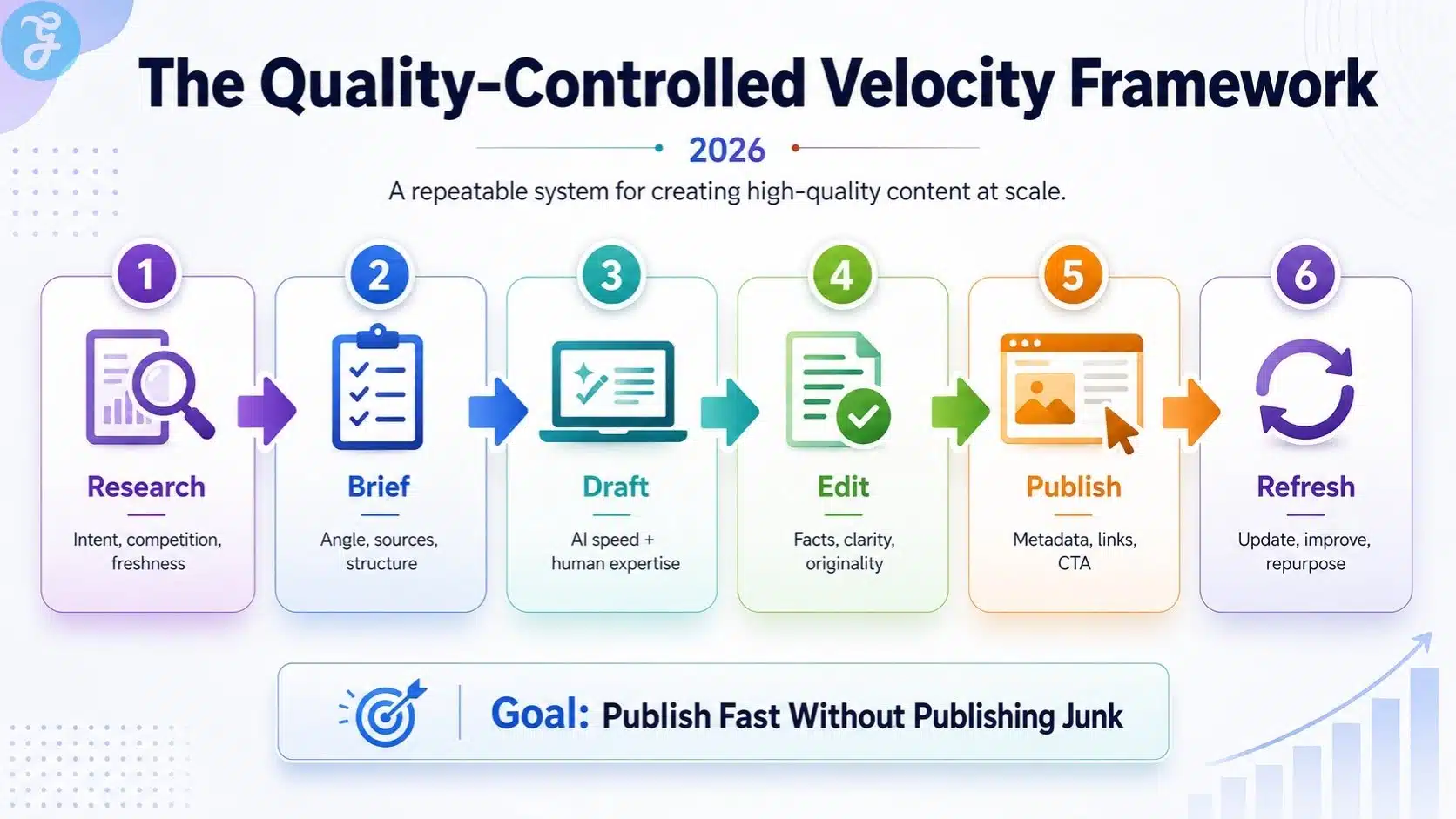
Here is the cleanest publishing model for 2026.
| Stage | What To Do | Why It Matters |
|---|---|---|
| Research | Validate search intent, competitors, freshness needs, and business value | Stops teams from publishing useless content |
| Brief | Define angle, sources, structure, CTA, internal links, and quality bar | Makes velocity repeatable |
| Draft | Use AI for structure and speed, but add human expertise | Prevents generic content |
| Edit | Check facts, originality, readability, and usefulness | Protects quality |
| Publish | Add metadata, schema, internal links, and conversion paths | Improves discoverability |
| Refresh | Update data, improve sections, merge weak pages, and remove decay | Maintains relevance |
| Measure | Track rankings, conversions, engagement, and AI visibility | Connects content to business outcomes |
This is how brands stop arguing about speed versus quality and start building a system that handles both.
The Uncomfortable Truth
Most brands do not have a content velocity problem. They have a decision-making problem.
They publish too slowly because every article gets trapped in approval purgatory. Or they publish too quickly because nobody wants to admit the content is thin. Both sides lose.
The 2026 answer is not to worship velocity. It is not to romanticize quality either. Quality that never ships is just private excellence. Velocity that produces weak pages is just public clutter.
The winner is the team that can publish useful, differentiated, verifiable content consistently. That team will survive AI search, content saturation, and Google volatility better than the team still asking whether five average posts are better than one excellent post.
The real answer to Content Velocity vs Content Quality is this: publish as fast as your standards can honestly support. Then improve the system so your standards and speed rise together.
Frequently Asked Questions (FAQs) About Content Velocity vs Content Quality
What Is Content Velocity In SEO?
Content velocity means how often and how consistently a website publishes or updates content. It measures publishing speed, but quality and usefulness still matter.
Is Content Velocity More Important Than Content Quality?
No. Speed helps only when the content is useful, original, and accurate. Poor content published quickly creates more problems than growth.
How Does Content Velocity Affect SEO Rankings?
It can help build topical coverage and freshness. But rankings still depend on search intent, authority, internal links, technical SEO, and content quality.
How Do You Balance Content Velocity And Content Quality?
Use faster publishing for low-risk topics and deeper review for high-stakes content. The goal is to publish as fast as your standards can support.
What Is A Good Content Velocity For A Website?
There is no fixed number. A good pace is one your team can maintain without lowering quality, accuracy, or usefulness.
Can AI Improve Content Velocity Without Hurting Quality?
Yes, if AI supports research, outlines, drafts, and refreshes. Human review is still needed for facts, expertise, originality, and final judgment.
Does Publishing More Content Always Improve SEO?
No. More content helps only when it fills real topic gaps and serves user intent. Weak content can cause cannibalization and content debt.
What Is Content Debt?
Content debt is the buildup of outdated, thin, duplicate, or poorly maintained content. It makes a site harder to rank and manage.