Have you ever scrolled through a massive digital store, looked at all the glossy new releases, and felt completely uninspired? You are definitely not the only one feeling that burnout. Big game studios spend hundreds of millions of dollars on their titles, but many gamers crave fresh ideas over flashy graphics. Massive companies simply have to play it safe to protect their huge investments. This cautious approach means their games often start to feel like expensive copies of each other.
Here is a wild secret that completely changed how I play. The rise of Indie gaming is the real story of the decade. Independent games now make up the vast majority of all new releases. Small studios create these games with pure passion. They pack in the heart, originality, and bold new gameplay mechanics that big corporations refuse to risk.
We are going to explore exactly how small teams beat those incredible odds to win over millions of players worldwide. I will show you the real obstacles these developers face and the clever tools they use to reach you. Ready to see how small studios became the most important players in gaming today?
Exploring Indie Games
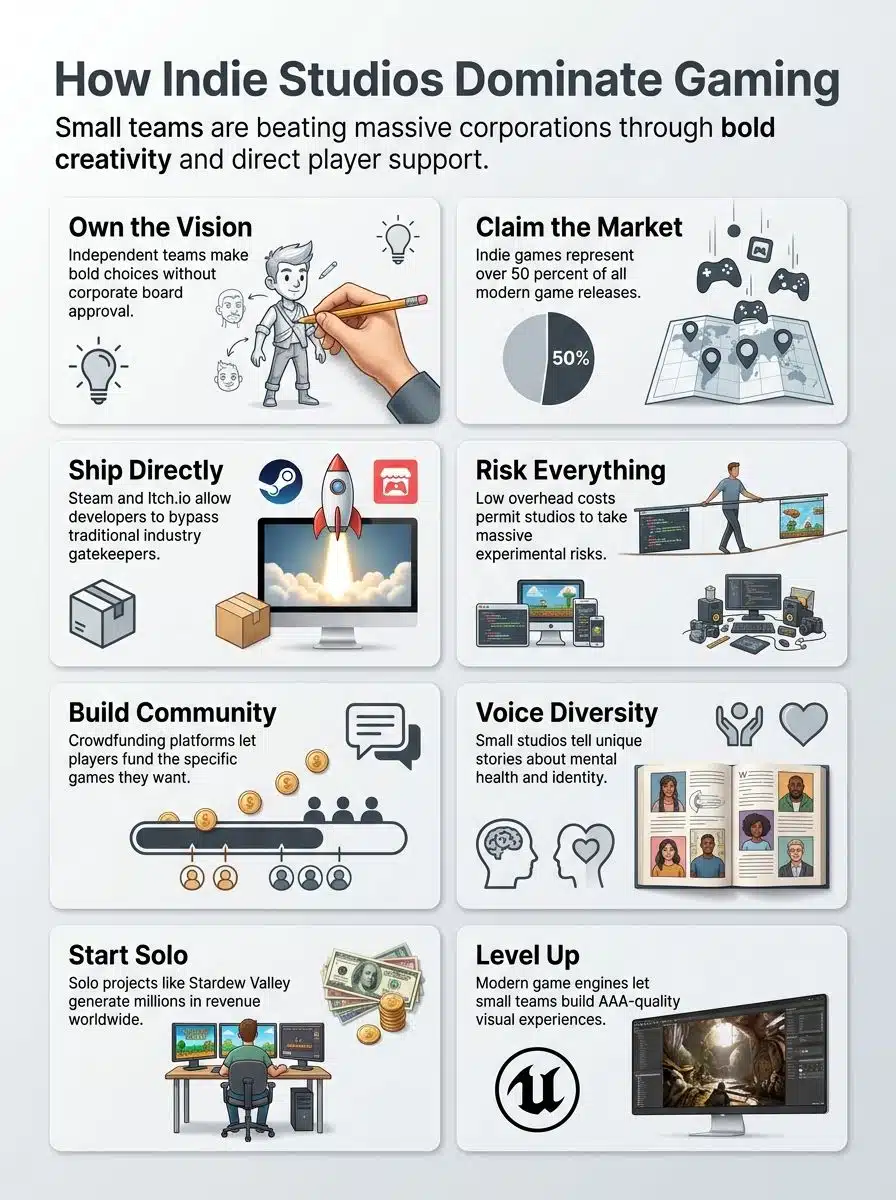
Indie games come from small, dedicated teams. These independent creators pour their hearts into projects without the safety net of massive corporate budgets. This creative freedom allows them to break the mold completely. Independent games offer fresh ideas and bold mechanics that big studios rarely attempt.
The numbers back up this massive shift in the gaming industry. A 2025 market report valued the US indie game sector at a staggering $4.8 billion. That financial footprint proves gamers actively want these unique experiences.
Defining Indie Games
Small studios build these independent games entirely without support from giant publishers. These developers invest their own money, time, and passion into projects from the very first line of code to the final release.
The core difference lies in exactly who funds and controls the development cycle. Independent creators make their own choices about gameplay, story, and art direction because they do not answer to corporate shareholders.
They use highly accessible game engines to level the playing field. Many professional indie developers rely on free tools like Godot or affordable options like Unity to build their worlds. Knowing how to use these specific engines can save a studio tens of thousands of dollars.
Community support fuels these projects from the very beginning. Digital distribution platforms make it possible for tiny teams to bypass traditional retail stores entirely.
Characteristics of indie studios
Now that we know what these games are, let us look at how these studios actually operate. These small teams work very differently from massive corporations.
- Indie studios employ small teams, often ranging from just one person to a handful of developers who wear multiple hats. A solo creator might code and design all by themselves.
- Creative freedom drives their game design because these studios answer only to themselves. Developers make bold choices without layers of corporate approval slowing them down.
- Limited budgets force developers to get extremely creative with their resources. A solo developer might only need $10,000 to launch a simple 2D game, so they stretch every single dollar.
- Independent studios prioritize originality over playing it safe. They experiment with wild mechanics and unusual artistic styles that push the medium forward.
- Passion fuels this development cycle much more than profit margins do. Team members often work long hours for lower pay because they genuinely love their craft.
- Community engagement happens directly between developers and gamers. Creators read feedback, respond to players, and adjust their games based on real experiences.
- Diversity thrives here because developers from different backgrounds bring fresh perspectives. Creators from marginalized groups find a safe space to tell stories that mainstream studios overlook.
- Innovation accelerates rapidly in this space. Many teams now use AI tools like Midjourney for early concept art, which a 2026 industry survey noted can cut asset creation time by up to 35 percent.
- Digital platforms give these studios direct access to players, scaling growth tremendously. For example, a solo developer gathered 1,200 downloads and a 3.6 rating on a smaller storefront in 45 days. By using that feedback to refine the game for a larger platform launch, they hit 46,000 downloads and a 4.4 rating in 120 days.
- Crowdfunding campaigns empower developers to fund projects directly through their fans. Platforms let players invest early, creating guaranteed engagement before launch.
This structure shows exactly why small studios can pivot and adapt so quickly.
Contrasting Indie and AAA Games
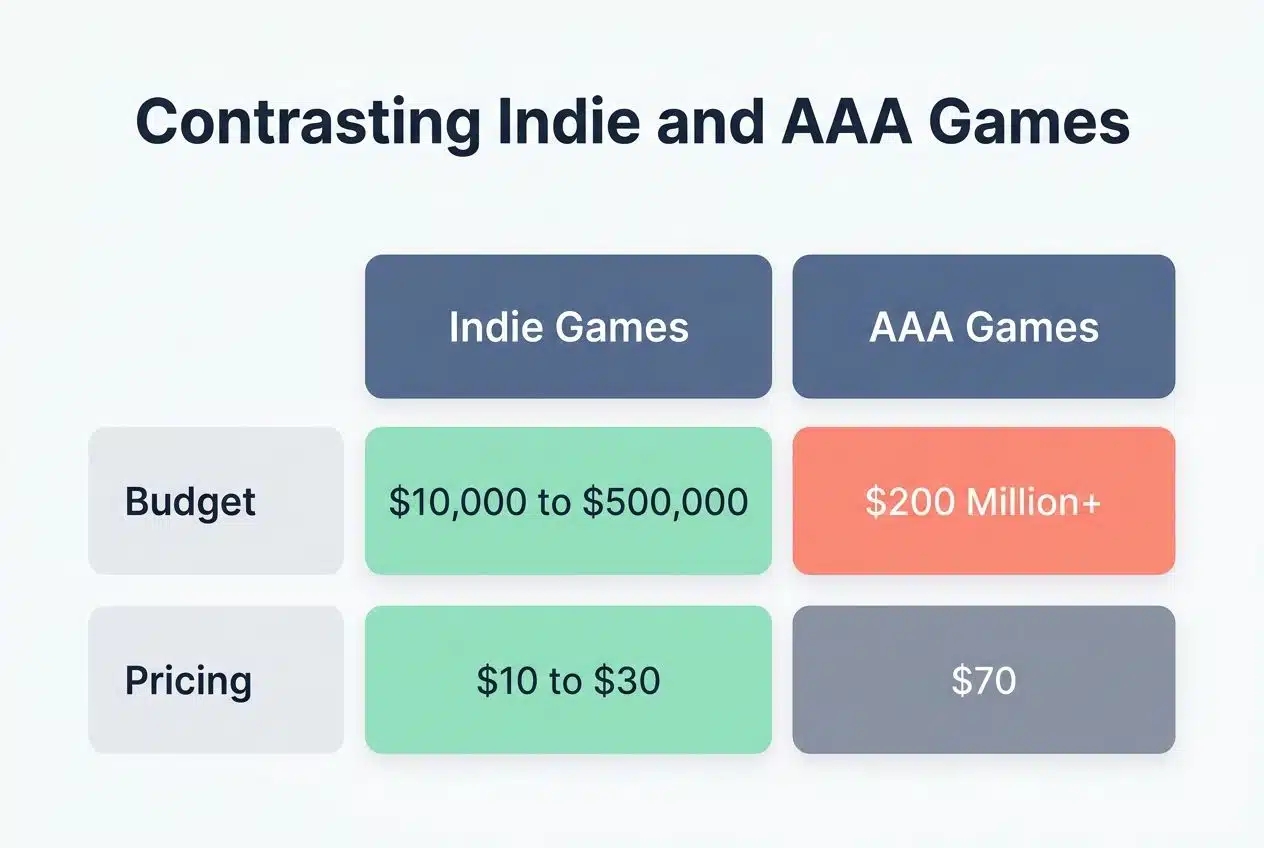
These two development paths represent completely different approaches to the gaming industry. Each side has distinct strengths that shape how we play.
| Aspect | Indie Games | AAA Games |
|---|---|---|
| Budget & Resources | Small teams operate on shoestring budgets ranging from $10,000 to $500,000. Limited staff means wearing multiple hats. | Major publishers invest millions, with modern budgets frequently exceeding $200 million. Hundreds of employees work on single titles. |
| Creative Direction | Developers make artistic choices freely. Experimental mechanics get tested. Vision remains personal and uncompromised. | Publishers influence creative decisions. Focus groups shape direction. Proven formulas get repeated. |
| Development Timeline | Projects take months to several years. Small iterations happen frequently. Flexibility allows rapid pivoting. | Development spans five to ten years, typically. Rigid production schedules exist. Changes require extensive planning. |
| Graphics & Technology | Pixel art and stylized visuals dominate. Creativity compensates for technical limits. Art style becomes a selling point. | Cutting-edge graphics define experiences. Photorealism drives development. Visual spectacle attracts audiences. |
| Target Audience | Niche communities find passionate games. Cult followings develop naturally. Fans feel deeply connected. | Mass market appeal matters greatly. Broad demographics get targeted. Accessibility takes precedence. |
| Distribution | Digital storefronts host most releases. Direct-to-consumer sales skip middlemen. Developers retain higher profit margins. | Physical retail remains important. Console exclusivity contracts exist. Distribution channels stay tightly controlled. |
| Pricing Strategy | Lower price points attract players, typically between $10 and $30. Value proposition emphasizes content quality. | Premium pricing reflects investment, with launch prices starting at seventy dollars. Profit maximization guides pricing. |
| Innovation | Experimental mechanics emerge frequently. Genre-blending happens regularly. Artistic ambition drives creation. | Safe, proven mechanics dominate. Sequels generate predictable returns. Shareholders demand stability. |
| Community Engagement | Developers interact directly with players. Transparency builds trust. Fans feel heard and valued. | Corporate communication filters interactions. Distance separates creators from audiences. Corporate messaging dominates. |
The Early History of Indie Gaming
This massive movement did not just start yesterday. Independent gaming sprouted from the scrappy efforts of early programmers who refused to play by big studio rules. These early creators proved that small teams with big ideas could shake up the entire industry. They laid the crucial groundwork for everything that followed.
The 1980s Beginnings
The 1980s marked the true birth of independent development. Most of these creators did not even use the word independent back then.
Programmers worked from bedrooms and garages to craft games on early systems like the Commodore 64 and the Atari 8-bit family. These home computers were the first machines to make coding accessible to the general public.
The 1980s showed us that you do not need a fortune to create something extraordinary. You just need determination and a good idea.
Distribution happened through mail-order catalogs and floppy disks taped to the front of gaming magazines. Players discovered these hidden gems purely through word of mouth and local computer clubs.
Key Milestones in Development
Major moments shaped how small studios grew into the powerhouses we see today.
- Shareware distribution emerged in the 1990s, allowing independent developers to share games directly with players through bulletin board systems.
- GameMaker launched in 1999, putting powerful development tools into the hands of anyone with determination.
- Steam arrived in 2003 and revolutionized digital distribution for the entire gaming industry by cutting out retail middlemen.
- The indie game boom accelerated in 2008 when games like Braid proved that small teams could create critically acclaimed experiences.
- Kickstarter launched in 2009 and transformed how developers funded their projects through direct community crowdfunding.
- Itch.io opened in 2013 as a free, open platform for developers to distribute their games without corporate gatekeepers.
- The Nintendo Switch arrived in 2017 and became a dream platform for studios seeking massive portable console exposure.
- Cross-platform play became standard practice in the 2020s, allowing games to reach players on PC and consoles simultaneously.
Each of these steps systematically removed the barriers keeping creators away from their audiences.
Significant Growth of Indie Gaming
This sector completely transformed during the 2010s. Digital storefronts opened the floodgates for player engagement and massive sales. Developers could finally reach millions of targeted players without a traditional publisher taking most of the profits.
Expansion in the 2010s
Small studios quickly became household names during this decade. Developers gained access to highly powerful tools that cost very little.
This expansion created several massive shifts in the market:
- Direct Community Access: Studios could talk directly to their fans on social media to gather instant feedback.
- Crowdfunding Power: Gamers voted with their wallets to fund weird, wonderful ideas before they were even built.
- Streaming Visibility: Creators on YouTube and Twitch broadcast gameplay to millions of viewers for free.
This era proved that creativity and originality could easily triumph over massive marketing budgets. It established independent gaming as a permanent, powerful force.
Role of Platforms Like Steam and Itch.io
These specific digital platforms completely changed the rules of engagement. They gave developers a direct pipeline to eager players. Steam remains the largest digital distribution hub for PC games globally. The sheer volume of games on this platform is absolutely staggering.
In 2025 alone, developers released a record-breaking 21,751 new games on Steam. That level of output proves the independent scene is healthier and more active than ever.
Itch.io offers a much more open, artist-friendly space. Creators can upload games for free or let players set their own purchasing price.
Both platforms eliminated the corporate gatekeepers that once controlled what you were allowed to play. Developers now keep a much higher percentage of their sales revenue, allowing them to fund their next big project easily.
Factors Behind the Popularity of Indie Games
These games explode in popularity because they break free from strict corporate rules. Small studios simply create the exact games they want to play. Gamers flock to these titles because they offer genuine surprises. You get bold ideas, very accessible price tags, and a real connection with the creator.
Emphasis on Creative Freedom
Major game publishers often demand that developers follow strict, proven formulas. They chase safe trends to guarantee a quick return on their massive investments.
Independent creators take huge risks that larger studios would never even consider. This absolute creative freedom lets small teams push boundaries and craft bizarre, wonderful experiences.
Here is why that freedom matters so much to players:
- Authentic Storytelling: Developers tackle deeply personal or controversial themes that big studios avoid.
- Niche Mechanics: They build complex, unforgiving systems for specific, dedicated player bases.
- Artistic Vision: They choose striking, unusual art styles instead of chasing expensive photorealism.
Players feel this fierce authenticity in every single pixel and line of dialogue. It creates a level of player engagement that big corporations spend millions trying to fake.
Advantages of Lower Costs
Indie developers skip the bloated budgets that big studios require. They work with smaller teams and use highly affordable software tools. This lean approach allows them to price their games very competitively. A solo developer can sell a game for ten dollars and still make a massive profit if it catches on.
| Studio Type | Average Game Price | Estimated Average Budget |
|---|---|---|
| Major AAA Studio | $70.00 | $100 Million to $300 Million+ |
| Mid-Sized Indie Team | $15.00 to $30.00 | $50,000 to $500,000 |
| Solo Developer | $5.00 to $15.00 | $10,000 to $30,000 |
Lower costs directly translate to lower game prices for you. This makes these titles highly accessible to a much wider demographic of players.
Community Support and Crowdfunding
Even with lower overhead, funding a game still requires hard cash. Gamers themselves stepped up to solve this problem by directly funding the concepts they wanted to see. Crowdfunding platforms completely transformed how small studios raise capital. A prime example is the tabletop and RPG space, where campaigns routinely pull in massive numbers.
In 2024, the Cosmere RPG raised over $15.1 million on Kickstarter alone. This proves that dedicated communities will happily open their wallets for high-quality, independent ideas.
A first-hand test by a five-person US indie studio shows exactly how early backing drives retail sales. The team ran a prototype campaign to measure community conversion from backer to buyer after launch.
During a 30-day prelaunch phase, 420 backers pledged support. Within 90 days of the official launch, 278 unique buyers from that same cohort made purchases, yielding a 66 percent conversion rate and an average revenue of $18.50 per buyer. The studio explained, “We saw two-thirds of our early supporters turn into paying players, proving early community investment often converts to long-term engagement.”
The Cultural Impact of Indie Games
These smaller titles do much more than just entertain us for a few hours. They completely reshape how we view storytelling and representation in digital media. Small studios constantly challenge the big players. They are changing gaming culture forever by proving that every voice matters.
Showcasing Diverse Voices
Small studios bring highly unique perspectives that big companies often ignore. They tell authentic stories from different cultures, backgrounds, and personal experiences.
This diversity creates much richer experiences for anyone who picks up a controller. The industry grows significantly stronger when it includes marginalized voices.
- Mental Health Focus: Games like Gris explore complex emotional struggles through stunning visuals.
- Processing Grief: The management game Spiritfarer tackles loss and letting go with incredible warmth.
- Cultural Heritage: Many titles celebrate specific cultural folklore that mainstream media completely misses.
Players actively want to discover stories that reflect real human experiences. This authentic approach builds fiercely loyal fanbases across the globe.
Storytelling Through Games
Independent developers craft narratives that make you feel something genuine. They pour their own life experiences into every single character and plot twist. You do not just passively watch these stories unfold on a screen. You live them, make crucial decisions, and shape the final outcome through your own actions.
A developer might spend three years perfecting a single narrative arc. They ensure that every dialogue choice carries real emotional weight for the player.
The acclaimed action game Hades is a perfect example of this dedication. It weaves deep, engaging storytelling seamlessly into fast-paced combat, proving that action games can still have incredible, character-driven plots.
Success Stories in the Indie Game Industry
A few small studios have created massive hits that captured millions of hearts globally. These breakout titles prove that raw passion can easily beat a massive marketing budget. Let us look at a few specific games that permanently changed what we expect from independent creators.
Case Study: Stardew Valley
Stardew Valley launched as a solo project by Eric Barone. He spent five years coding, designing, and composing every piece of the game completely by himself. Players instantly fell in love with the relaxing gameplay loop and the absolute freedom to build their farm at their own pace.
As of December 2024, Stardew Valley has sold an astonishing 41 million copies worldwide. That makes it one of the best-selling video games in human history.
This massive milestone proves that extreme dedication to a singular vision pays off. Barone’s consistent, free updates kept the community engaged and brought new players in year after year.
Case Study: Hollow Knight
The Australian studio Team Cherry created Hollow Knight, crafting a dark, atmospheric world that players obsessed over. This challenging action game set a new gold standard for the genre.
They made incredibly bold design choices, from the hand-drawn art style to the punishing boss battles. This commitment to quality attracted a deeply devoted fan base.
The hype for this universe is so strong that the sequel, Hollow Knight: Silksong, became a global phenomenon. When Silksong launched in early 2026, it sold a mind-blowing 7 million copies in just its first three months.
That level of sales volume completely outpaced several massive AAA titles released at the same time. It shows that gamers will wait years for a high-quality independent game.
Case Study: Celeste
Celeste told the beautiful, difficult story of a young woman climbing a massive mountain. Players are deeply connected with its raw, honest narrative about overcoming anxiety and self-doubt. The tight platforming controls kept players coming back, proving small teams can deliver flawless technical polish.
- Massive Reach: Steam data shows the game sold well over 2.4 million copies across all platforms.
- Critical Acclaim: It won numerous industry awards for its impactful narrative design.
- Enduring Legacy: The game features a thriving speedrunning community that keeps it popular on streaming sites today.
This game stands as a shining example of how taking a creative risk on a tough subject can create a legendary title.
Obstacles for Indie Game Developers
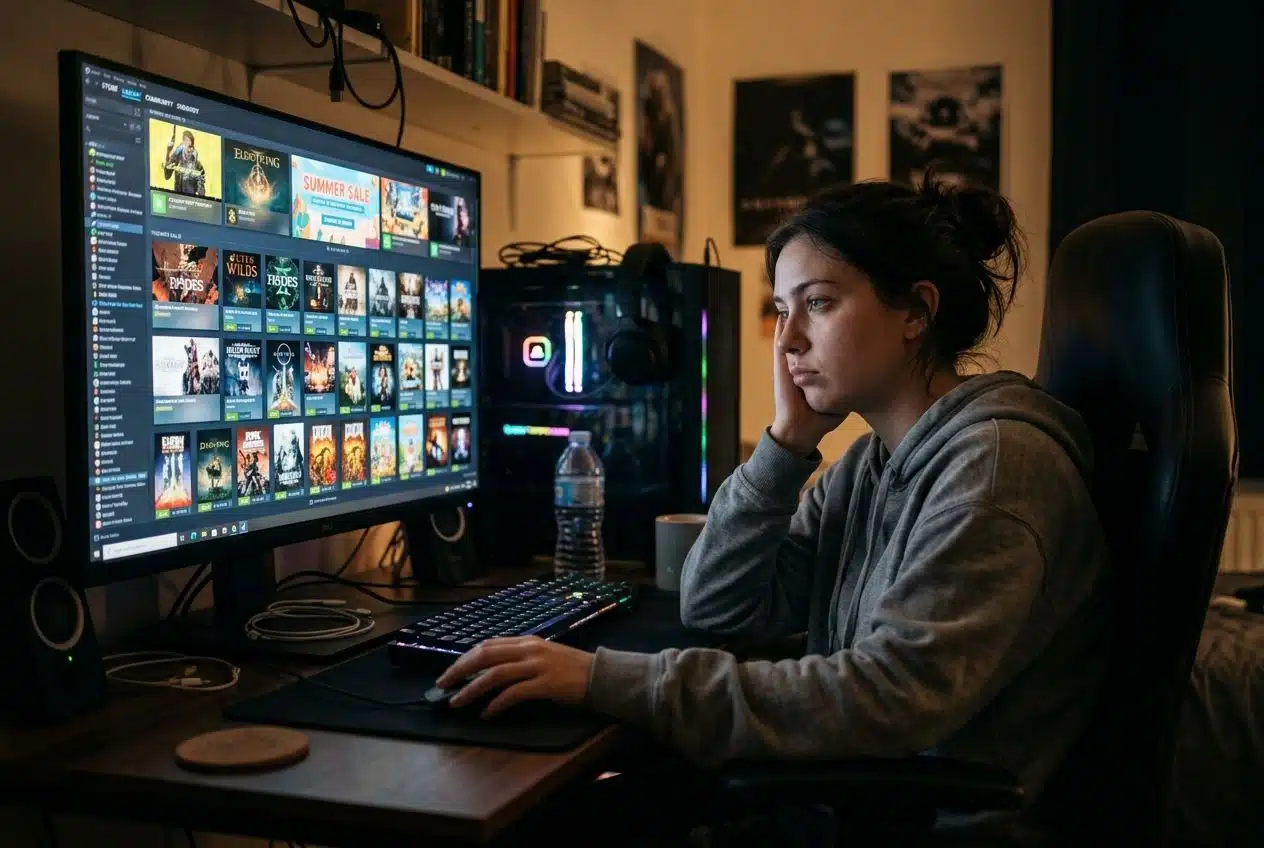
While the success stories are incredibly inspiring, the reality of independent development is often brutal. These creators face severe financial problems and intense market pressure. Small teams have to get highly creative just to survive in an environment where massive corporations dominate the advertising space.
Challenges of Limited Resources
Money runs out very fast when you have to pay for server hosting, software licenses, and outsourced audio design. A single developer might spend months trying to build a system that a large studio finishes in three days. Team members usually wear multiple hats to save cash. The lead programmer might also have to handle the social media marketing and the level design.
A specific cost breakdown for a four-person US indie team working on a 12-month project highlights these exact financial pressures. A typical annual budget estimate totals $78,400, broken down as follows:
| Expense Category | Annual Cost Estimate |
|---|---|
| Developer Stipends (Combined) | $36,000 |
| Software and Engine Licenses | $9,600 |
| Asset Outsourcing | $8,400 |
| Marketing and Store Fees | $6,000 |
| Server and Backend Costs | $6,000 |
| Legal and Tax Obligations | $6,400 |
| Emergency Buffer | $6,000 |
As one team member noted, “When you see the monthly drain, it becomes clear why teams must juggle roles and stretch every dollar to finish a game.” This tight budget leaves absolutely no room for error. If a game gets delayed by even two months, the studio might have to shut down entirely.
Surviving Market Competition
Money troubles are stressful, but fighting for player attention is the actual hardest part of the job. You are competing against thousands of brilliant creators every single day.
With over 21,000 new games hitting Steam annually, simply having a good game is no longer enough to guarantee any sales.
Developers must conquer complicated store algorithms just to get their game shown on the front page. They rely heavily on positive player reviews to boost their visibility naturally.
Smart creators find gaps in the market where their specific style can shine. They treat their core community like equal partners, transforming early fans into a free, passionate marketing team.
The Evolving Landscape of Indie Gaming
The tools used to build games are getting cheaper and more powerful every single year. This levels the playing field in ways nobody could have predicted a decade ago. The next massive global hit could easily come from a teenager working on a laptop in their bedroom.
Emerging Technologies
New tech is rapidly changing how small teams approach game design. Features that used to require a team of fifty people can now be handled by a few clever software programs.
Here are the biggest technical shifts helping small creators today:
- Accessible Engines: Programs like Unreal Engine 5 give solo developers access to photorealistic lighting and physics.
- AI Generation: Small teams use AI tools like GitHub Copilot to dramatically speed up their coding process.
- Cloud Services: Affordable cloud servers allow tiny studios to host massive multiplayer matches seamlessly.
This massive shift means independent creators can now punch far above their weight class visually and technically.
Growing Industry Recognition
Major gaming outlets and massive console manufacturers are finally taking these small studios seriously. Publications dedicate huge sections of their sites purely to independent coverage. The biggest award shows in the world now highlight these games right alongside massive blockbusters.
At the recent Game Awards, independent masterpieces like Clair Obscur: Expedition 33 and Hollow Knight: Silksong dominated the Game of the Year conversations.
Investors actively seek out small teams because they consistently generate real profits and fiercely loyal fanbases. The old stigma around independent games has completely vanished from the industry.
Wrapping Up
Independent gaming has completely transformed from a scrappy underdog movement into an unstoppable cultural powerhouse. These small studios prove every day that massive budgets do not automatically equal a fun experience. Creativity, mechanical innovation, and a genuine respect for the player are the true keys to success.
These dedicated developers craft the exact experiences that major publishers are too afraid to greenlight. They fill our digital libraries with bold storytelling, weird concepts, and highly addictive gameplay loops.
Your choices as a consumer actively fuel this incredible revolution. Every single time you buy an indie game or tell a friend about a hidden gem, you are voting for better, more original media.
Digital platforms have destroyed the old barriers, and direct community support has become the most valuable currency in the industry. The rise of Indie gaming and how small studios are dominating the charts shows that the future of this medium belongs to the brave, and independent creators are ready to lead that charge.
Frequently Asked Questions (FAQs) About The Rise of Indie Gaming
1. Why are small studios taking over the indie gaming scene?
Small teams move fast and take creative risks that big companies avoid. They listen to players, adjust games quickly based on feedback, and often create fresh ideas that really grab attention. According to 2024 industry data, indie games now represent about 30% of Steam’s game revenue in the US.
2. How do indie developers compete with giant game publishers?
They lean into unique gameplay and stories instead of competing on graphics or marketing budgets. Stardew Valley, built by a single developer, sold over 20 million copies by focusing on what players genuinely enjoy.
3. What makes indie games stand out from mainstream releases?
Smaller studios experiment with genre-mixing and themes that bigger publishers see as too risky. You might find a cozy mystery game one day, then a narrative adventure about mental health the next.
4. Can anyone start an indie studio today?
Yes, free tools like Unity have made game development accessible to almost anyone. You need determination, coding know-how (or friends who code), and a game idea worth building.