Remote work is no longer just a pandemic-era experiment, a laptop-on-the-couch fantasy, or a perk companies mention in job posts to sound less emotionally attached to office chairs. It has become a real geographic force. Some US cities now have unusually high shares of workers doing their jobs from home, and those places are quietly reshaping housing demand, commuting patterns, local business traffic, and the meaning of “work-life balance.” That is why understanding the Cities With The Most Remote Workers matters in 2026.
For this list, the ranking is based mainly on SmartAsset’s 2026 study of 357 large US cities, which ranked cities by the percentage of workers aged 16 and older who worked from home using 2024 data. That means this list focuses on remote work prevalence, not simply raw population size. A giant city may have more total remote workers, but a smaller city can have a much higher concentration of remote workers. SmartAsset also notes that remote work in large US cities declined from 15.7% in 2023 to 13.45% in 2024, while the US Census Bureau reported that 13.3% of US workers worked from home in 2024.
Our Selection Criteria
The goal was not to create another “best places to live” list based on vibes, coffee shops, and someone’s personal relationship with mountain views. This ranking is built around measurable remote work concentration.
Here is the selection logic used for this guide.
| Selection Factor | Why It Matters |
|---|---|
| Remote Work Prevalence | Shows what share of the city’s workforce works from home |
| Number Of Remote Workers | Helps show the size of the remote-worker base |
| Workforce Size | Gives context to the remote-work percentage |
| Commute Time For In-Person Workers | Shows what remote workers may be avoiding |
| Year-Over-Year Direction | Helps identify whether remote work is rising or falling locally |
| Lifestyle Fit | Adds context around why remote workers may cluster there |
| Economic Profile | Professional, tech, education, and corporate jobs often support remote work |
| Location Advantage | Proximity to major metros can support hybrid and remote arrangements |
This list uses the best available 2026-published ranking data, but the underlying worker data comes from 2024. That is normal for city-level labor statistics because official datasets take time to collect, process, and publish.
Whom This Is For
This guide is useful for remote workers, job seekers, relocation planners, HR teams, city planners, real estate professionals, founders, and businesses watching where flexible work is clustering.
It is especially relevant for:
- professionals considering a remote-friendly city;
- companies hiring distributed employees;
- real estate writers and market analysts;
- coworking space operators;
- local business owners;
- city leaders studying post-office work patterns;
- readers tracking the future of work in the US.
Now let’s look at the cities where remote work is most concentrated.
Top 10 Cities With The Most Remote Workers In The US 2026
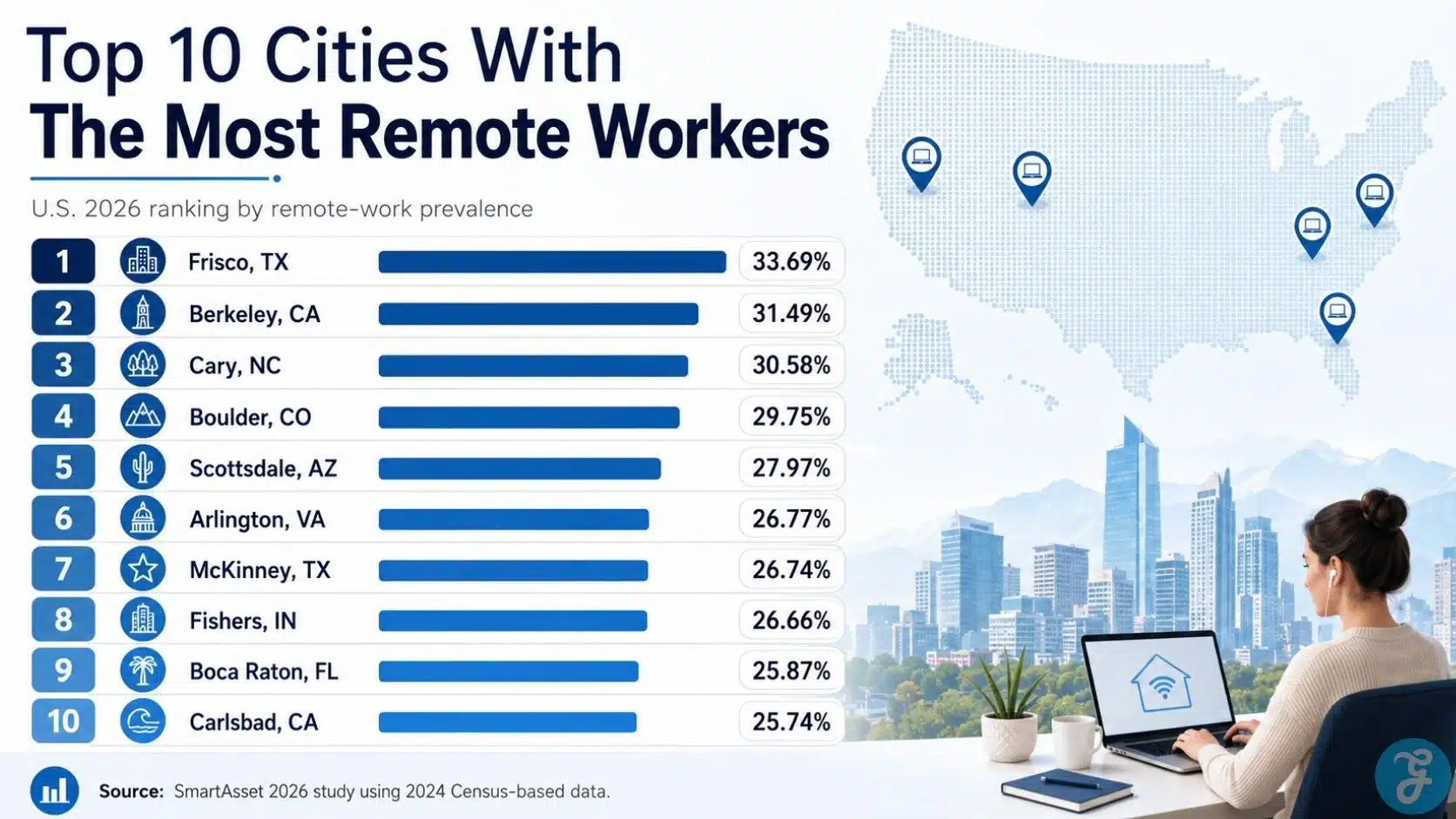
These cities ranked highest for remote work prevalence in SmartAsset’s 2026 study. The figures below reflect 2024 remote-work data published in 2026.
1. Frisco, Texas
Frisco ranks first among the largest US cities for remote work prevalence, with 33.69% of workers aged 16 and older working remotely in 2024. SmartAsset reported 42,133 remote workers out of 125,051 total workers in the city. Frisco’s remote-work share was slightly down from 34.16% in 2023, but it still remained the national leader.
Frisco benefits from its position in the Dallas-Fort Worth metro area, where corporate, tech, finance, and professional-service jobs are common. It offers suburban space while still keeping residents connected to a major economic region. For remote workers, that combination can be powerful: big-market job access without necessarily living in the center of Dallas.
Best for:
- Remote professionals who want suburban living near a major job market
- Workers in tech, corporate, finance, and professional services
Why We Chose It:
- Highest remote work prevalence in the 2026 ranking
- More than one-third of workers worked from home
- Strong connection to the Dallas-Fort Worth economy
- Large remote-worker base for a suburban city
Things to consider:
- Remote work share slightly declined from 2023
- Suburban growth can bring housing cost and traffic pressure
2. Berkeley, California
Berkeley ranked second, with 31.49% of workers working from home in 2024. SmartAsset reported 17,595 remote workers out of 55,882 total workers, with remote work slightly up from 31.29% in 2023.
Berkeley’s remote-work strength is not surprising. It has a highly educated workforce, proximity to the San Francisco Bay Area economy, and deep connections to research, technology, education, and knowledge work. It also has one of the strongest walking rates among the top remote-work cities, with SmartAsset reporting 12.88% of workers walking to work.
Best for:
- Knowledge workers, researchers, tech professionals, and academics
- Remote workers who value walkability and intellectual culture
Why We Chose It:
- More than 31% remote work prevalence
- Strong Bay Area economic access
- Highly educated workforce supports remote-capable jobs
- Stronger walkability than many remote-heavy suburbs
Things to consider:
- High housing costs can limit affordability
- California cost-of-living pressure remains a serious factor
3. Cary, North Carolina
Cary ranked third, with 30.58% of workers working from home in 2024. SmartAsset reported 29,140 remote workers out of 95,290 total workers, with remote work rising from 29.40% in 2023.
Cary sits in North Carolina’s Research Triangle region, which gives it access to technology, healthcare, education, research, and corporate jobs. It has become one of the strongest examples of a suburban city where remote work fits naturally into a high-skill labor market.
Best for:
- Remote workers connected to tech, research, healthcare, and corporate roles
- Families looking for a remote-friendly suburban environment
Why We Chose It:
- Remote work share crossed 30%
- Year-over-year remote work prevalence increased
- Strong connection to the Research Triangle economy
- Good fit for professional and technical workers
Things to consider:
- Growth can increase housing demand
- Car dependency may still matter for daily errands and local life
4. Boulder, Colorado
Boulder ranked fourth, with 29.75% of workers working from home in 2024. SmartAsset reported 16,800 remote workers out of 56,473 total workers, with remote work up from 28.28% in 2023.
Boulder has long appealed to remote-capable professionals because it combines a high-skill economy with outdoor access and a lifestyle-focused identity. It also had one of the shortest mean commute times among the top 10 for in-person workers, at 18.2 minutes, while 12.19% of workers walked to work.
Best for:
- Remote workers who want outdoor access and a knowledge-economy environment
- Professionals in tech, startups, research, and creative fields
Why We Chose It:
- Nearly 30% remote work prevalence
- Remote work increased year over year
- Strong outdoor and lifestyle appeal
- Walkability is stronger than in many other top-ranked cities
Things to consider:
- Boulder is expensive compared with many US cities
- Lifestyle demand can make housing competitive
5. Scottsdale, Arizona
Scottsdale ranked fifth, with 27.97% of workers working remotely in 2024. SmartAsset reported 35,739 remote workers out of 127,769 total workers, with remote work slightly up from 27.71% in 2023.
Scottsdale’s appeal is clear: warm weather, a strong service economy, proximity to Phoenix, and a lifestyle that attracts professionals who can work from anywhere. Its remote-worker base is large, and the city continues to stand out as one of the most remote-friendly places in the Southwest.
Best for:
- Remote professionals seeking warm weather and suburban comfort
- Workers connected to Phoenix-area business networks
Why We Chose It:
- Nearly 28% remote work prevalence
- Large remote-worker population
- Slight increase from 2023
- Strong lifestyle appeal for flexible workers
Things to consider:
- Summer heat can be intense
- Popularity may keep housing and lifestyle costs elevated
6. Arlington, Virginia
Arlington ranked sixth, with 26.77% of workers working remotely in 2024. SmartAsset reported 39,191 remote workers out of 146,397 total workers, although its remote-work share declined from 28.60% in 2023.
Arlington’s ranking reflects its concentration of professional, government-adjacent, consulting, technology, defense, and policy-related jobs. Its location near Washington, DC makes it especially suitable for hybrid workers who may need occasional access to offices, agencies, contractors, or client meetings.
Best for:
- Hybrid and remote professionals tied to Washington, DC
- Workers in consulting, policy, technology, government contracting, and professional services
Why We Chose It:
- High remote work concentration
- Large base of remote workers
- Strong professional-services economy
- Excellent access to the DC metro area
Things to consider:
- Remote-work share declined from 2023
- Cost of living is high compared with many other cities
7. McKinney, Texas
McKinney ranked seventh, with 26.74% of workers working from home in 2024. SmartAsset reported 32,798 remote workers out of 122,639 total workers, with remote work rising from 24.23% in 2023.
Like Frisco, McKinney benefits from the broader Dallas-Fort Worth economy. It offers suburban space, access to a large labor market, and a growing population of professionals who may work for companies across the region or beyond. Its year-over-year increase is also notable.
Best for:
- Remote workers who want North Texas suburban living
- Professionals connected to Dallas-Fort Worth employers
Why We Chose It:
- Remote work increased meaningfully from 2023
- More than one in four workers worked remotely
- Strong regional economic access
- Large remote-worker base
Things to consider:
- Car dependency may be high
- Rapid growth can affect affordability and infrastructure
8. Fishers, Indiana
Fishers ranked eighth, with 26.66% of workers working remotely in 2024. SmartAsset reported 14,784 remote workers out of 55,453 total workers, with remote work rising from 25.15% in 2023.
Fishers is part of the Indianapolis metro area and has built a reputation as a strong suburban business and residential community. Its high remote-work share shows that remote work is not limited to coastal tech hubs or expensive lifestyle cities. Midwestern suburbs can compete strongly when they combine professional job access, livability, and home-office-friendly housing.
Best for:
- Remote workers looking for a Midwestern suburban base
- Families and professionals seeking lower-cost alternatives to coastal cities
Why We Chose It:
- Remote work prevalence is above 26%
- Remote share increased from 2023
- Good example of remote work beyond coastal markets
- Strong fit for professionals seeking space and affordability
Things to consider:
- Fewer big-city amenities than larger metros
- Commute and car use still matter for hybrid workers
9. Boca Raton, Florida
Boca Raton ranked ninth, with 25.87% of workers working from home in 2024. SmartAsset reported 13,607 remote workers out of 52,589 total workers.
Boca Raton combines warm weather, coastal lifestyle, business services, finance, healthcare, and access to South Florida’s broader economy. It is also attractive to remote workers who want lifestyle benefits without leaving professional networks behind.
Best for:
- Remote workers who want South Florida lifestyle access
- Professionals in finance, business services, healthcare, and consulting
Why We Chose It:
- More than one-quarter of workers worked remotely
- Strong lifestyle and coastal appeal
- Good fit for remote-capable professional workers
- Shorter in-person commute time than many ranked cities
Things to consider:
- Housing and insurance costs can be significant in South Florida
- The city may not suit workers seeking a lower-cost relocation option
10. Carlsbad, California
Carlsbad ranked tenth, with 25.74% of workers working remotely in 2024. SmartAsset reported 14,043 remote workers out of 54,554 total workers, though remote work declined from 29.06% in 2023.
Carlsbad offers coastal living, access to San Diego County’s economy, and a strong quality-of-life pull for remote professionals. It is not the cheapest remote-work city, but it shows how lifestyle markets remain attractive to workers who can separate job location from home location.
Best for:
- Remote professionals seeking coastal Southern California living
- Workers connected to San Diego, tech, life sciences, design, or professional services
Why We Chose It:
- More than one-quarter of workers worked from home
- Strong lifestyle appeal
- Access to the San Diego regional economy
- Attractive for remote workers prioritizing location quality
Things to consider:
- Remote work prevalence declined from 2023
- High cost of living may limit accessibility
An Overview Of Top 10 Cities With The Most Remote Workers In The US
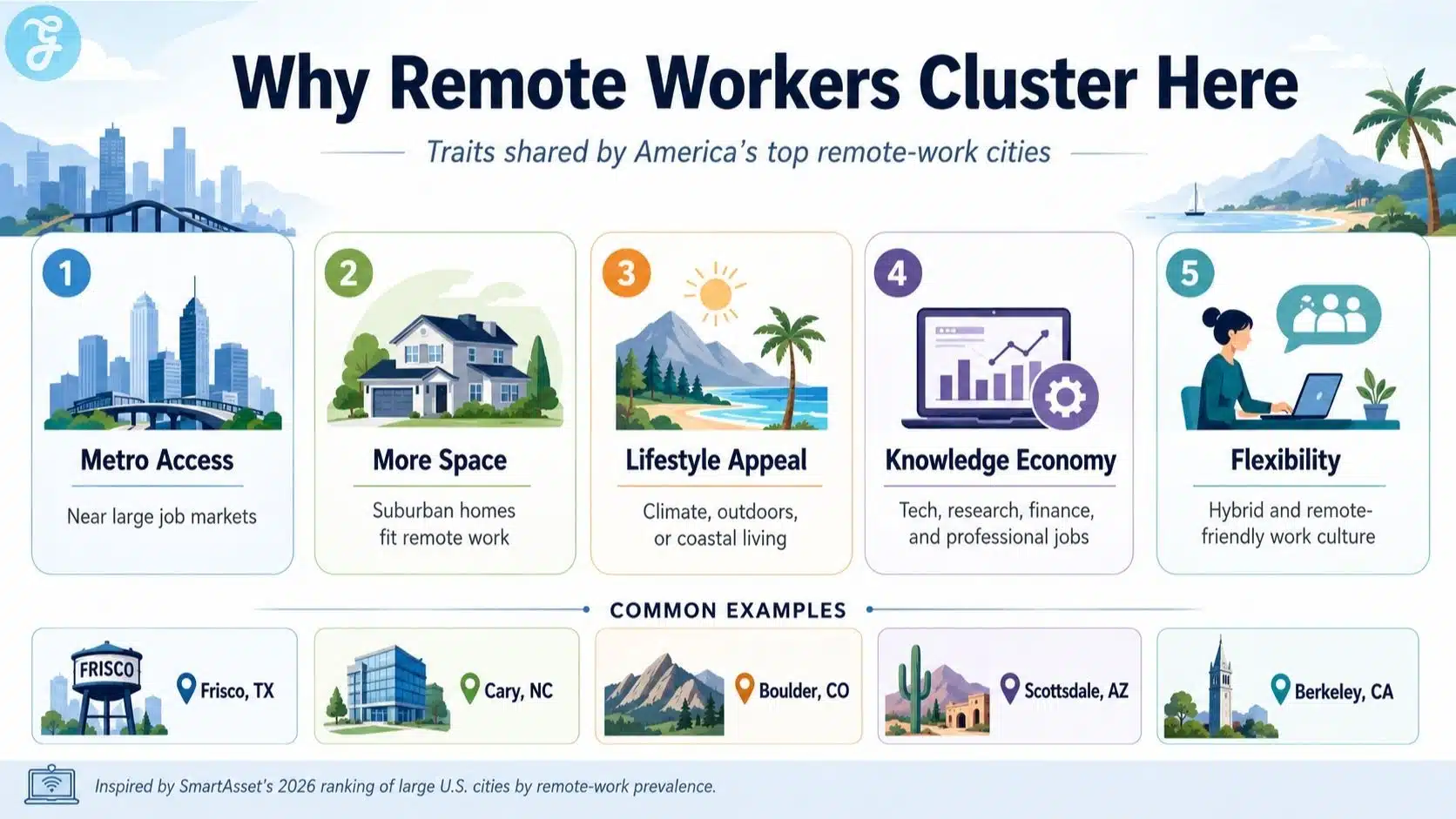
The top cities show a clear pattern: remote work clusters in places with professional jobs, high education levels, suburban space, strong metro access, or lifestyle appeal. Texas appears strongly through Frisco and McKinney, while California remains present through Berkeley and Carlsbad. North Carolina, Colorado, Arizona, Virginia, Indiana, and Florida also make the top 10.
Overview Comparison
Here is a quick snapshot of the top 10 based on SmartAsset’s 2026 ranking.
| Rank | City | Remote Work Prevalence | Remote Workers | 2023 Remote Work Prevalence |
|---|---|---|---|---|
| 1 | Frisco, Texas | 33.69% | 42,133 | 34.16% |
| 2 | Berkeley, California | 31.49% | 17,595 | 31.29% |
| 3 | Cary, North Carolina | 30.58% | 29,140 | 29.40% |
| 4 | Boulder, Colorado | 29.75% | 16,800 | 28.28% |
| 5 | Scottsdale, Arizona | 27.97% | 35,739 | 27.71% |
| 6 | Arlington, Virginia | 26.77% | 39,191 | 28.60% |
| 7 | McKinney, Texas | 26.74% | 32,798 | 24.23% |
| 8 | Fishers, Indiana | 26.66% | 14,784 | 25.15% |
| 9 | Boca Raton, Florida | 25.87% | 13,607 | Not available |
| 10 | Carlsbad, California | 25.74% | 14,043 | 29.06% |
The ranking shows concentration, not absolute workforce size. For example, larger cities such as Austin, Denver, Seattle, Atlanta, and Charlotte have bigger total populations and large remote-worker counts, but they ranked outside the top 10 by remote-work share in this dataset.
Our Top 3 Picks And Why?
These three cities stand out for different reasons.
| Pick | Why It Stands Out |
|---|---|
| Frisco, Texas | The highest remote-work prevalence in the ranking |
| Cary, North Carolina | Strong balance of remote-work concentration and Research Triangle access |
| Boulder, Colorado | Strong remote-work share plus lifestyle and walkability appeal |
These are not automatically the “best” cities for every remote worker. They are simply the strongest examples of different remote-work models: suburban corporate access, research-region convenience, and lifestyle-driven knowledge work.
How To Choose The Right City With The Most Remote Workers By Yourself
A city with a high remote-work share is not automatically the right city for you. Remote workers still need housing they can afford, reliable internet, suitable time zones, healthcare, schools, community, and sometimes airport access.
The Selection Framework:
- Check Total Cost, Not Just Rent: Taxes, insurance, utilities, transport, and home-office space all matter.
- Match The City To Your Work Style: Fully remote workers may prioritize lifestyle, while hybrid workers need regional office access.
- Study The Local Economy: A city with many professional workers may offer stronger networking and fallback job options.
- Look Beyond The Ranking: Remote-work prevalence is useful, but quality of life depends on your needs.
The Final Checklist
Before relocating for remote work, use this five-point checklist.
- Can you afford housing with a comfortable workspace?
- Is internet reliability strong enough for video-heavy work?
- Does the city match your climate and lifestyle preferences?
- Are there coworking spaces, professional networks, or social communities?
- If your job becomes hybrid, can you still reach your employer or industry hub?
The Bigger Lesson Behind America’s Remote-Work Cities
The rise of remote-heavy cities shows that work is no longer tied as tightly to downtown office towers as it once was. But the story is not as simple as “everyone works from home now.” Nationally, the Census Bureau reported that 13.3% of US workers worked from home in 2024, down slightly from 13.8% in 2023. Meanwhile, Robert Half’s 2026 research found that hybrid work remains the top preference among job seekers, with 55% ranking hybrid as their preferred setup, while only 16% preferred fully in-office work.
That means the future is probably not fully remote or fully office-based. It is uneven, city-specific, job-specific, and industry-specific. Some cities will become remote-worker magnets because they offer space, lifestyle, and professional networks. Others will remain office-heavy because their industries require physical presence.
The uncomfortable truth is that remote work does not automatically make every city more affordable or every worker freer. It can raise housing demand in desirable suburbs, shift spending away from downtowns, and create new divides between remote-capable professionals and workers who must show up in person. Still, the Cities With The Most Remote Workers show one important thing: flexibility has become a real part of America’s economic geography, not just a workplace perk.
Frequently Asked Questions (FAQs) About Cities With The Most Remote Workers
Which US City Has The Most Remote Workers In 2026?
By remote-work prevalence among large cities, Frisco, Texas ranks first in SmartAsset’s 2026 study, with 33.69% of workers working from home in 2024. It had 42,133 remote workers out of 125,051 total workers.
Are These Rankings Based On Total Remote Workers Or Percentage?
This list is based on the percentage of workers who work remotely, not the raw number of remote workers. That is why some smaller cities rank above larger cities with bigger total populations.
Is Remote Work Still Growing In The US?
It depends on the measure. The Census Bureau reported that the national worked-from-home share was 13.3% in 2024, slightly lower than 13.8% in 2023. However, hybrid work remains very popular among job seekers in 2026.
Why Do Suburbs Rank So Highly For Remote Work?
Many remote-capable professionals want more space, home offices, schools, safety, or lifestyle benefits while staying near major metro economies. This helps explain why places like Frisco, Cary, McKinney, Fishers, and Scottsdale rank highly.
What Should Remote Workers Consider Before Moving?
They should consider housing costs, internet reliability, taxes, healthcare, climate, time zone, airport access, coworking options, and whether their employer might later require hybrid attendance.