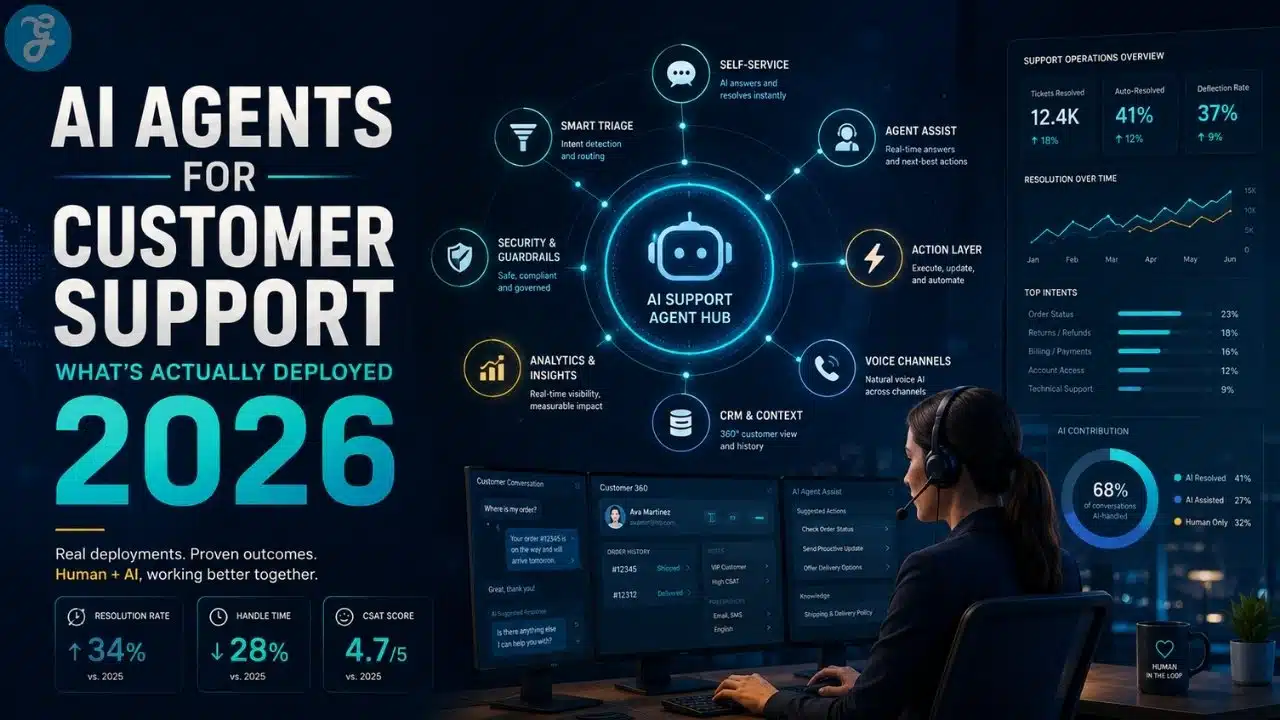
AI agents for customer support are no longer just demo-stage chat widgets that answer “Where is my order?” and then panic when the customer replies with a real problem. In 2026, the market has moved into a more practical phase: companies are deploying AI agents inside help desks, CRM systems, knowledge bases, messaging tools, contact centers, and internal service workflows.
But “deployed” does not mean “fully autonomous.” That distinction matters.
The current reality is mixed. Some AI agents are genuinely resolving customer issues without human involvement. Some are assisting human agents in the background. Some are routing cases, updating records, summarizing conversations, and pulling customer context. Others are still glorified chatbots with better branding and more expensive pricing pages.
The useful question in 2026 is not whether AI agents exist in customer service. They do. The better question is: what are companies actually trusting them to do?
What Counts as AI Agents for Customer Support in 2026?
Before analyzing deployment, the definition needs to be practical. Otherwise, everything from a chatbot to a search bar suddenly becomes an “agent,” and then language has officially resigned from its job.
AI agents for customer support are systems that can understand customer requests, use business knowledge, take action within approved guardrails, and either resolve the issue or escalate it with context. Salesforce describes customer service AI agents as technology that can understand and respond to inquiries within provided guardrails, including handling simple or complex issues such as FAQs or product returns.
Here is the practical breakdown:
| Support capability | What it means in real deployment | Common 2026 status |
|---|---|---|
| FAQ answering | Responds using help center or knowledge base content | Widely deployed |
| Ticket triage | Tags, routes, prioritizes, or categorizes support cases | Widely deployed |
| Conversation summarization | Creates case summaries for human agents | Widely deployed |
| Agent assist | Suggests replies, next steps, or knowledge articles | Widely deployed |
| Transactional actions | Checks order status, processes returns, updates CRM fields | Growing deployment |
| Voice AI support | Handles phone-based requests or assists voice agents | Expanding |
| End-to-end resolution | Solves issues without human handoff | Real, but uneven |
| Multi-system orchestration | Coordinates across CRM, help desk, billing, logistics, and policy systems | Still maturing |
The keyword here is guardrails. In customer support, autonomy without limits is not innovation. It is a refund policy, an accident waiting to happen.
What Is Actually Deployed Right Now?
The clearest pattern in 2026 is that customer support AI agents are being deployed first where the work is repetitive, data-rich, policy-driven, and easy to verify.
That means support teams are not handing over every emotional, legal, billing, technical, or escalation-heavy issue to AI. They are starting with workflows where the agent can operate safely and where mistakes are easier to detect.
1. Self-Service Resolution
The most visible deployment is AI-powered self-service. These agents answer customer questions using help centers, product documentation, policy pages, and conversation history.
Intercom says its Fin AI Agent is used by more than 7,000 teams and reports an average resolution rate of 67% across customers as of March 2026. Intercom also defines Fin’s resolution rate as the percentage of conversations resolved without human involvement.
That is a meaningful shift. It shows that AI agents are not just deflecting tickets; they are being measured by whether the customer actually gets an answer without needing a human teammate.
However, resolution rate should be interpreted carefully. A 60% or 70% resolution rate does not mean the agent can handle every support case. It usually means the tool is effective within the use cases, channels, knowledge quality, and escalation rules configured by the business.
2. Ticket Triage and Routing
Ticket triage is one of the most realistic deployments because it does not require the agent to solve everything. It only needs to understand enough to classify the issue and send it to the right place.
AI agents can now:
- identify customer intent,
- detect urgency,
- assign ticket categories,
- route cases to the right team,
- summarize the problem,
- suggest priority level,
- flag sentiment or escalation risk.
This is less glamorous than a fully autonomous support agent, but it is often more useful. Bad routing wastes time. Good routing shortens response cycles and helps human agents start with better context.
Zendesk says its AI agents work across social, web, mobile, voice, and email channels and combine generative AI with proprietary intent models. That combination reflects where the market is going: not just language generation, but support-specific classification and workflow logic.
3. Agent Assist for Human Support Teams
One of the most mature deployments is not AI replacing support agents, but AI sitting beside them.
Agent assist tools can:
- suggest replies,
- summarize long threads,
- recommend knowledge articles,
- draft follow-up messages,
- surface customer history,
- identify next-best actions,
- reduce after-call work.
This matters because customer support is not only about answering questions. It is about reducing the cognitive load on human agents who often handle multiple systems, emotional customers, strict policies, and time pressure.
Salesforce’s Service Cloud positioning shows this direction clearly: it brings AI agents, human expertise, and trusted data together to automate routine tasks and equip teams with real-time insights across support touchpoints.
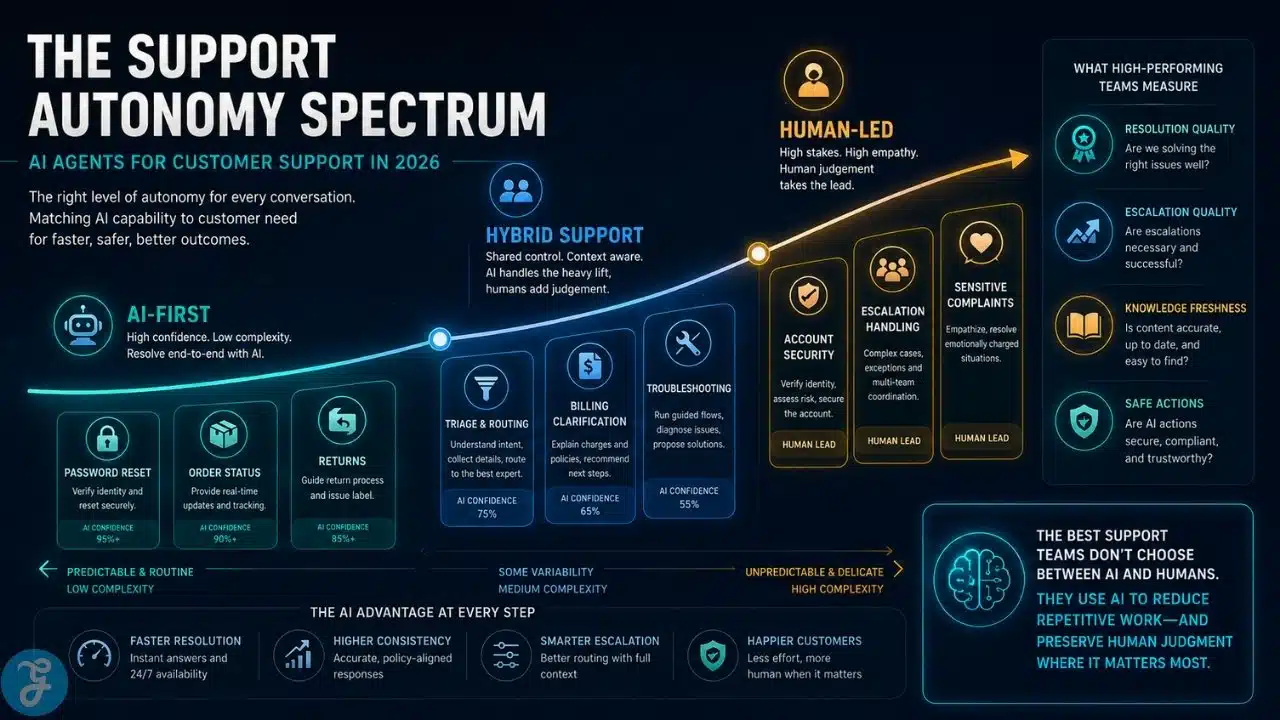
In practical terms, many support operations are not jumping straight from human-only support to fully autonomous AI support. They are moving through a hybrid model where AI handles repetitive work and humans handle exceptions, judgment, and sensitive interactions.
4. CRM and Case Updates
Another real deployment area is CRM action. This is where AI agents become more than answer engines.
Salesforce describes Agentforce as an autonomous AI application that can answer questions, take actions, and use business knowledge according to a specific role. Salesforce also introduced Agentforce Contact Center in March 2026, positioning it around voice, digital channels, CRM data, AI agents, self-service, AI-to-human handoffs, and real-time visibility across interactions.
That matters because customer support lives inside systems of record. If the AI agent cannot read customer history, understand case status, update records, or pass clean context to a human, it remains a front-end conversation layer.
The more advanced deployments are moving toward action-based workflows:
| Action area | Real customer support use |
|---|---|
| CRM lookup | Pull account history, open cases, entitlement, plan, or subscription status |
| Order support | Check delivery, return eligibility, refund status, or replacement options |
| Case management | Update ticket fields, add notes, attach summaries, route cases |
| Follow-up | Draft messages, schedule reminders, trigger next-step workflows |
| Escalation | Hand off to human teams with customer context and issue history |
This is where AI support agents become operationally useful. The value is not just a better answer. It is less manual system-hopping.
5. Internal Support and IT Service Desk Workflows
Customer support is not limited to external customers. Internal employees also create support demand through IT, HR, finance, and operations requests.
ServiceNow says AI agents can streamline incident management and request fulfillment and can support work such as incident resolution, CRM updates, employee onboarding, and vulnerability remediation. In April 2026, ServiceNow also said AI agents were automating 37% of its own customer support case workflows.
That is one of the more concrete signals of real deployment. It also shows why internal support may be one of the strongest areas for AI agents: workflows are often more structured, systems are standardized, and permissions can be managed through enterprise platforms.
What Is Still Not Fully Solved?
The 2026 market is real, but it is not magic. Several gaps still separate deployed support agents from truly reliable autonomous support operations.
1. Complex Judgment Still Needs Humans
AI agents can answer policy-based questions. They can process routine requests. They can summarize. They can retrieve. They can route.
But difficult support often involves judgment:
- angry customers,
- unclear product defects,
- legal or regulatory implications,
- high-value accounts,
- ambiguous refund situations,
- safety or medical concerns,
- account security issues,
- emotionally sensitive conversations.
In those cases, the best deployment model is usually AI plus human escalation, not AI pretending to be a senior support manager after reading three help articles.
2. Knowledge Quality Controls Everything
AI agents are only as useful as the knowledge they can access. If the knowledge base is outdated, vague, contradictory, or incomplete, the agent will produce confident confusion at scale.
Support teams need to maintain:
- accurate help center content,
- clear policy documents,
- current product information,
- structured internal notes,
- escalation rules,
- consistent tagging,
- feedback loops from unresolved cases.
This is why companies that treat AI support as a plug-and-play shortcut often get mediocre results. The agent is not just a model; it is the visible layer on top of knowledge operations.
3. Governance and Cost Are Becoming Serious Issues
The hype around agentic AI has also triggered caution. Gartner, according to Reuters, predicted that more than 40% of agentic AI projects could be canceled by the end of 2027 due to rising costs, unclear business value, and hype-driven deployment. Reuters also reported Gartner’s warning about “agent washing,” where conventional AI tools are mislabelled as agentic.
That warning applies directly to customer support. A vendor calling something an AI agent does not prove it can resolve real cases, integrate with core systems, or reduce workload without creating new risks.
A practical buyer should ask:
- What percentage of conversations are fully resolved without humans?
- How is resolution measured?
- Can the system show why it gave an answer?
- What systems can it access?
- What actions can it take?
- What happens when it is wrong?
- How are escalations handled?
- Can the business inspect logs and decisions?
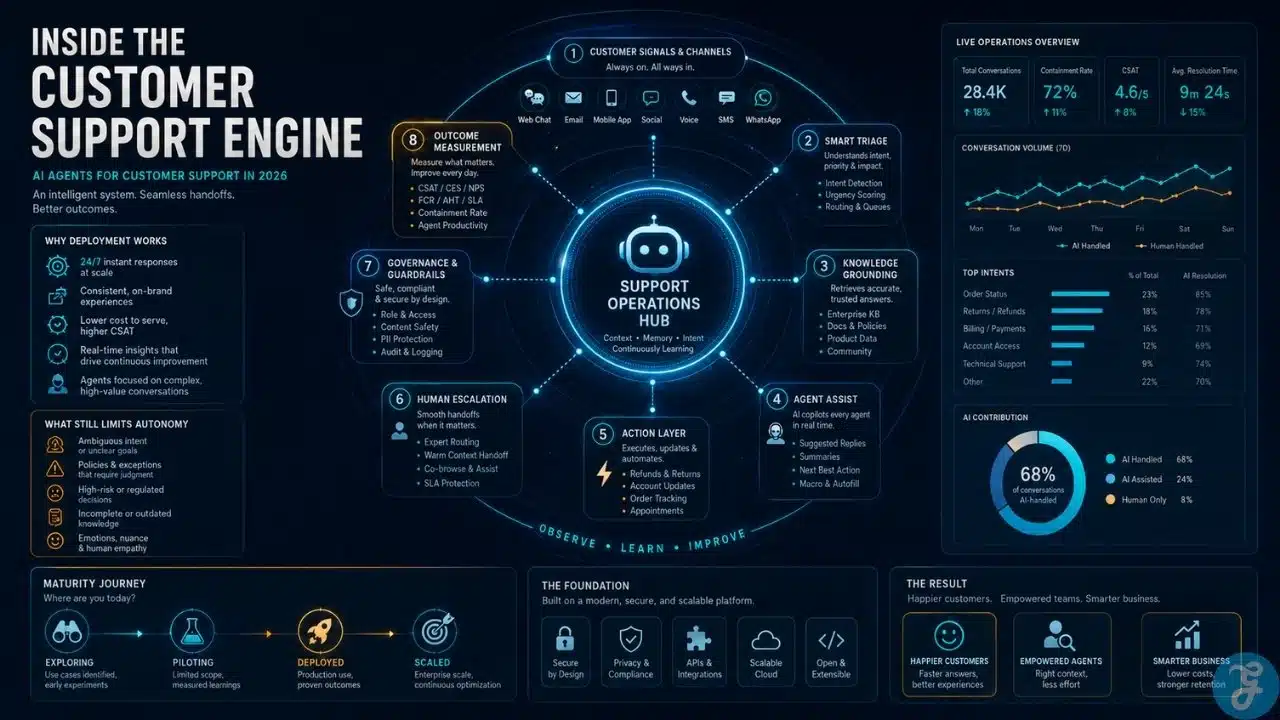
The best support leaders are no longer buying the word “agent.” They are buying measured outcomes.
How Deployment Differs by Business Type
Not every company deploys AI support agents in the same way. The maturity of deployment depends on volume, data quality, risk level, and system complexity.
| Business type | Most realistic deployment in 2026 | What to watch carefully |
|---|---|---|
| SaaS companies | Product FAQs, account questions, onboarding support, technical triage | Accuracy around product updates and billing |
| E-commerce brands | Order status, returns, refunds, shipping updates, product questions | Policy exceptions and customer frustration |
| Financial services | Account support, document guidance, secure routing, agent assist | Compliance, identity, fraud, audit trails |
| Healthcare | Appointment support, intake guidance, non-clinical FAQs | Privacy, safety, regulated advice boundaries |
| Telecom and utilities | Billing, outages, plan changes, service requests | Escalations and customer anger |
| Enterprise IT | Passwords, access requests, incident triage, employee service desk | Permissions and internal system access |
The safest early deployments are usually high-volume, low-risk, easy-to-verify workflows. The riskiest ones involve regulated advice, financial decisions, security credentials, or emotionally charged disputes.
What Buyers Should Look for in 2026
The buying criteria for AI agents for customer support should be more specific than “Does it use generative AI?” That question is now too basic to be useful.
A serious evaluation should focus on capability, control, and measurable outcomes.
| Evaluation area | What to check |
|---|---|
| Resolution quality | Does it actually solve issues, or just close conversations? |
| Escalation design | Does it hand off to humans with full context? |
| Knowledge grounding | Does it cite or rely on approved support content? |
| System actions | Can it safely update CRM, tickets, orders, or records? |
| Guardrails | Can it block unsafe answers and restricted actions? |
| Analytics | Can leaders see resolution rate, automation rate, failures, and trends? |
| Human control | Can teams review, tune, and override behavior? |
| Compliance | Does it meet the data, privacy, and audit needs of the business? |
Zendesk’s pricing and positioning around automated resolutions shows how the market is shifting from selling seats alone toward selling support outcomes. Zendesk says AI agents are priced by automated resolution, and its pricing page describes advanced AI agents as built to reason, adapt, and take action. Intercom also uses automation and resolution metrics to track the share of conversations handled without human teammate involvement.
That shift is important. Buyers should care less about how impressive the demo looks and more about whether the agent reduces real support load without hurting customer trust.
What “Actually Deployed” Means in Plain English
By 2026, AI agents in customer support are genuinely deployed in several areas:
- answering common questions,
- resolving routine support conversations,
- classifying and routing tickets,
- assisting human agents,
- summarizing customer interactions,
- retrieving CRM and account context,
- supporting returns, order updates, and service requests,
- helping with voice and digital contact center workflows,
- automating internal service desk processes.
But they are not fully replacing customer support teams across the board.
The practical model is hybrid. AI handles volume, speed, and repetitive work. Humans handle ambiguity, emotion, judgment, exceptions, and accountability.
That is not a failure of AI. That is how responsible customer support should work.
Final Thoughts
AI agents for customer support are real in 2026, but the most successful deployments are not built on fantasy. They are built around specific workflows, clean knowledge, measurable resolution, safe actions, and clear escalation paths.
The strongest use cases are practical: self-service resolution, ticket triage, agent assist, CRM updates, contact center support, and internal service workflows. The weaker deployments are the ones that promise full autonomy without enough governance, context, or accountability.
So the real story is not “AI agents are replacing support.” The more accurate story is this: support is becoming a coordinated system where AI handles more of the repeatable work and humans focus on the cases that require judgment.
That may sound less dramatic than the usual AI headline.
It is also much closer to what is actually deployed.