The corporate landscape completely flipped when the pandemic sent everyone home. Tech workers spent years enjoying unprecedented flexibility. They proved they could ship multi-billion-dollar software updates from their living rooms without missing a beat. But the pendulum swung back hard. Corporate executives suddenly decided the era of remote-first work needed to end. What started as polite requests to come back for a few days a week escalated into hardline ultimatums.
Companies want butts in seats, and employees want to keep the flexibility they earned. The result is a messy, highly publicized standoff reshaping how companies operate, hire, and retain talent. If you look closely at tech companies RTO mandates, the cracks start to show immediately. It is not just about real estate or productivity. It is a battle for control. Here are 17 facts about how tech companies are actually handling these mandates amid massive pushback from their workers.
The Reality of tech companies RTO mandates in 2026
Tech leaders thought getting people back into office buildings would be a simple process. They were entirely wrong about that. As the dust settles on the initial wave of return-to-work orders, the reality looks completely different from the original corporate vision. We are seeing massive logistical failures across major campuses, and widespread pushback is forcing executives to rethink their timelines. Hard data continues to prove that mandatory office days do not automatically boost revenue or innovation. Let us break down what is actually happening on the ground.
1. Amazon’s 5-Day Mandate Met a Hilarious Hurdle: No Desk Space
Amazon shocked the corporate world when leadership announced a strict five-day return policy for corporate employees. It was the most aggressive move by a major tech giant to date, pushing past the hybrid models most competitors adopted. However, a major logistical oversight quickly surfaced that embarrassed leadership. By the time the mandate approached its enforcement date, Amazon realized it simply lacked the desk space to accommodate its own massive workforce. Facilities teams were completely overwhelmed, and office managers scrambled to figure out seating charts.
Employees reported wandering floors looking for a place to sit, sharing desks, or taking Zoom calls in noisy hallways. The internal message boards lit up with complaints from frustrated workers who commuted an hour just to sit on the floor. It highlighted exactly how detached some executive decisions are from physical, everyday realities. When you mandate a return without auditing your real estate portfolio first, you get chaos instead of collaboration.
| Logistics Check | Expected Outcome | Actual Reality |
| Office Seating | 1-to-1 desk ratio | Not enough desks, hot-desking chaos |
| Meeting Rooms | Easy access for teams | Fully booked weeks in advance |
| Commute Time | Readjustment period | Deep frustration over wasted hours |
| Productivity | Immediate boost | Lower output due to workspace hunting |
2. The 3-Day Hybrid Schedule is the True Standard
While headlines focus on the strict five-day mandates from companies like Amazon or Tesla, comprehensive workforce data shows a much different baseline. The vast majority of tech firms that successfully implemented an office policy settled on a three-day hybrid schedule. Companies like Apple and Google require three days of in-person attendance, establishing a clear industry norm. The typical required days are Tuesday through Thursday, leaving Monday and Friday as universal work-from-home days.
This schedule emerged as the only viable compromise between angry workers and stubborn management. It prevents massive staff walkouts while giving executives the in-person oversight they demand. Even companies that initially pushed for four days often quietly walked it back to three after facing internal rebellions. Employees clearly draw the line at giving up more than half their week to a commute.
| Schedule Model | Corporate Adoption Rate | Employee Acceptance Level |
| Fully Remote | Low (Decreasing) | Extremely High |
| 2 Days In-Office | Moderate | High |
| 3 Days In-Office | Very High (The Standard) | Moderate |
| 5 Days In-Office | Low (Headline grabbers only) | Extremely Low |
3. Flexible Firms Outpace Office-Centric Rivals in Revenue
Executives frequently argue that the office is the exact place where true innovation, spontaneous ideas, and growth happen. Financial data completely refutes this outdated claim. Research focusing on corporate financial health shows companies offering fully remote or highly flexible work arrangements actually grow faster. These flexible organizations saw their revenue grow nearly twice as fast as their office-centric competitors over recent fiscal years.
Giving people the freedom to manage their own time leads to better focus and much lower operational overhead. Without the massive burden of real estate leases, remote companies reinvest that cash directly into product development and higher salaries for top talent. It removes office distractions and drives higher output per employee. The companies forcing people back are actually hurting the very growth metrics they claim to protect.
| Financial Metric | Highly Flexible Companies | Office-Mandated Companies |
| Revenue Growth Speed | 1.7x faster | Baseline |
| Real Estate Overhead | Minimal to Zero | Extremely High |
| Profit Margins | Generally higher | Strained by facility costs |
| R&D Investment | High (reinvested savings) | Lower (budget tied in leases) |
4. The Glaring RTO and AI Contradiction
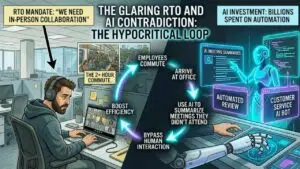
Tech companies are caught in a massive hypocritical loop right now that employees clearly see through. Leadership teams argue loudly that physical proximity is required to foster human interaction, build culture, and create serendipitous collaboration. At the exact same time, these exact same companies are pouring billions of dollars into artificial intelligence tools designed to eliminate the need for human interaction.
Workflows are actively being automated to bypass human touchpoints and streamline communication via AI agents. Employees are being asked to commute two hours to sit in an office and use AI tools to summarize meetings they didn’t need to attend. You cannot claim human connection is your absolute top priority while deploying software built to bypass it entirely. This contradiction is a massive source of resentment among software engineers.
| Corporate Stance | Action Taken | The Contradiction |
| “We need collaboration” | Forcing RTO mandates | Teams sit on Zoom with remote peers |
| “Human touch is key” | Automating customer service | Replacing human jobs with AI |
| “Culture happens in-person” | Cutting team-building budgets | Office time is spent working silently |
| “Efficiency is our goal” | Forcing unpaid commutes | Wasting 10+ hours a week in traffic |
How Employee Pushback is Reshaping Tech?
Employees are not just writing angry posts on internal company message boards anymore. They are taking tangible action to protect their work-life balance and their sanity. The pushback against tech companies RTO mandates is causing deep structural shifts in tech demographics. Data shows that these policies often ignore basic human behavior, leading to predictable and damaging spikes in turnover. Highly skilled workers simply refuse to accept archaic management styles when they know they have other options.
5. Senior Talent is Heading for the Exits
Forcing people back into cubicles has a severe, entirely predictable unintended consequence. The most experienced people leave the company first. Economic studies analyzing employment data from giants like Microsoft and Apple reveal that strict RTO mandates directly cause an exodus of senior employees. These high-level engineers, principal architects, and directors know their exact market value.
They do not need in-person mentorship, and they do not want to deal with office politics. When faced with an inflexible mandate, they take their institutional knowledge and walk out the door. They simply move to a competitor or a mid-sized startup that gladly offers a flexible schedule. The big tech companies are effectively bleeding out their most valuable, hardest-to-replace assets just to satisfy a seating quota.
| Employee Level | Flight Risk Post-Mandate | Primary Reason for Leaving |
| Junior / Entry | Low | Needs job security, accepts RTO |
| Mid-Level | Moderate | Frustration with lost flexibility |
| Senior / Principal | Very High | Knows market value, refuses commute |
| Director / VP | High | Burns out from enforcing the mandate |
6. Disproportionate Impact on Women and Skilled Workers
Return-to-office policies do not impact all demographics equally, and the collateral damage is reversing years of diversity efforts. Employment history data from millions of workers shows abnormally high turnover rates among female employees following strict RTO announcements. Society still places the vast majority of childcare and household logistics on women. During the remote work era, mothers relied heavily on that flexibility to balance their careers and their home lives.
When that flexibility is ripped away with a three-day or five-day mandate, the math stops working. Many are forced to downshift their careers or leave their technical roles entirely. Furthermore, highly specialized skilled workers who live far from tech hubs are being forced out because they refuse to relocate their entire lives for a job they were already doing perfectly from home.
| Demographic Group | Impact of Strict RTO | Resulting Corporate Trend |
| Working Mothers | Extremely Negative | High attrition, loss of female leaders |
| Neurodivergent Staff | Negative | Sensory overload in open offices |
| Rural/Non-Hub Staff | Extremely Negative | Forced resignations due to location |
| Local/Single Workers | Neutral to Moderate | Mild annoyance, but generally comply |
7. Gen Z and Millennials Are Leading the Defiance
Younger generations have absolutely zero tolerance for old-school workplace rules that do not make logical sense to them. Recent surveys show massive blocks of Gen Z and Millennial workers actively looking for new roles due to expanded RTO requirements. These generations entered the workforce during or just before the remote work boom. For them, working from a laptop anywhere in the world is the baseline normal.
Commuting two hours a day to sit on video calls in a noisy office is not a rite of passage; they view it as an absurd waste of their time and energy. They prioritize mental health, work-life boundaries, and side hustles over climbing a traditional corporate ladder. If a company demands five days in the office, Gen Z talent simply looks the other way, starving these companies of entry-level pipelines.
| Generation | View on Remote Work | Reaction to RTO Mandates |
| Baby Boomers | Prefer traditional office | Generally supportive of management |
| Gen X | Mixed, likes hybrid | Frustrated but likely to comply |
| Millennials | Demand flexibility | Actively update resumes, vocal pushback |
| Gen Z | View remote as baseline | Outright refusal to apply for office jobs |
8. Internal Morale is Freefalling Fast
You cannot force people to commute against their will, take away their flexibility, and expect them to smile about it. Job satisfaction metrics are crashing across the board at companies heavily enforcing office mandates. After rolling out harsh policies, internal surveys at companies like Dell and Amazon revealed a massive drop in employee net promoter scores (eNPS). Toxic positivity from executive leadership clashes directly with the angry, anonymous feedback on company polls.
A disengaged workforce is a slow-moving disaster for software development. People stop going the extra mile. They do the bare minimum required to not get fired, pack up their laptops at exactly 5:00 PM, and log off. This phenomenon, known as quiet quitting, is entirely self-inflicted by management teams pushing unpopular mandates.
| Morale Indicator | Pre-Mandate (Remote Era) | Post-Mandate Reality |
| Employee NPS Scores | High (60+) | Tanking (often dipping negative) |
| Discretionary Effort | High (working odd hours) | Low (strict adherence to 9-to-5) |
| Internal Message Boards | Collaborative | Filled with complaints and memes |
| Trust in Leadership | Moderate to High | Completely fractured |
9. Stealth Defiance and the Rise of Coffee Badging
Rather than quitting outright and losing their healthcare, a massive segment of the tech workforce resorts to malicious compliance. The phenomenon known as “coffee badging” took over Silicon Valley and other major tech hubs. Employees commute to the office, swipe their security badge at the front desk to register their attendance, and grab a coffee in the breakroom. They might chat with a coworker for twenty minutes so they are visually seen by management.
Then, they quietly walk out to their cars and immediately drive back home to do their actual deep, focused work. HR departments are pulling their hair out trying to figure out how to stop it. This behavior completely proves that physical attendance does not equal in-office productivity. People are treating the office like a tollbooth they have to pass through rather than a place to actually get work done.
| The Coffee Badging Routine | Employee Action | HR Perspective |
| 9:30 AM | Swipe badge at lobby | “Employee has arrived.” |
| 9:45 AM | Grab coffee, say hi to boss | “Culture is happening.” |
| 10:15 AM | Walk out back door to car | Completely unaware. |
| 11:00 AM | Finish complex code at home | “Wow, great productivity today.” |
The Employer Response: Enforcement, Threats, and Exceptions
Faced with plummeting morale and widespread defiance, tech executives decided to double down on their demands rather than admit defeat. The carrots vanished entirely, and the sticks came out in full force. HR departments transformed into compliance enforcement agencies over the last two years. Despite the ongoing backlash, tech companies RTO mandates continue to roll out with harsher financial and career penalties attached to them. Companies are actively trading employee trust for basic surveillance.
10. Tying Attendance to Performance Reviews
When employees easily ignored the initial polite requests to return, companies weaponized the annual review cycle. Tech giants officially linked in-office attendance metrics to employee evaluations, base pay raises, and promotions. Managers received strict instructions from HR to view non-compliance as a severe performance issue, regardless of the employee’s actual output.
If a top-tier engineer writes perfect code but fails to swipe their badge three times a week, they lose their annual bonus or get placed on a restrictive performance improvement plan (PIP). This creates a highly toxic environment where average employees who show up every day get promoted over brilliant engineers who prefer to work from their home offices. It shifts the company’s focus from measuring actual results to measuring simple attendance.
| Review Component | Old Method (Results-Based) | New Method (Attendance-Based) |
| Code Quality | Primary focus | Secondary to seat-time |
| Promotions | Based on project success | Blocked if badge swipes are low |
| Bonuses | Tied to company revenue | Slashed for missing office days |
| Manager Check-ins | Discussing blockers | Discussing commute schedules |
11. Hyper-Surveillance Through Badge Tracking

Trust completely eroded between workers and management, replaced by an intense tracking system. To enforce these mandates, companies actively monitor badge swipes, internal network logins, and Wi-Fi connections to generate massive compliance dashboards. Some companies even track how long a laptop is actively connected to the specific in-office IP address to prevent coffee badging.
Managers receive automated, color-coded reports detailing exactly who was in the building, what days they attended, and for how long. This level of micromanagement destroys any remaining psychological safety. It clearly signals to employees that leadership views them as liabilities that must be watched, rather than trusted adult professionals hired to do a job.
| Surveillance Method | What it Tracks | Employee Countermeasure |
| Badge Swipes | Entry to the building | Swiping and leaving immediately |
| Wi-Fi Triangulation | How long you stay in-office | Leaving laptops open on desks |
| VPN Logs | Where the work happens | Using mobile hotspots |
| Desk Sensors | Butt-in-seat time | Covering sensors (in extreme cases) |
12. The Contagion Effect Across Other Industries
What happens in Big Tech rarely stays in Big Tech. The aggressive mandates from heavyweights like Amazon, Google, and Meta created a powerful permission structure for older, traditional industries to follow suit. Major financial institutions on Wall Street and traditional media companies used the tech sector’s pushback as cover to enforce their own strict office requirements.
CEOs in banking and manufacturing pointed to Silicon Valley and said, “If they are doing it, we have to do it too.” The remote-first era faced systematic dismantling across the entire corporate spectrum strictly because tech companies set the precedent. This contagion effect frustrated workers nationwide, as the dream of a permanent flexible economy was crushed by a few influential tech billionaires.
| Industry | Pre-Tech Mandate Stance | Post-Tech Mandate Stance |
| Wall Street Finance | Wanted people back, but hesitant | Hardline 5-day mandates |
| Traditional Media | Experimenting with hybrid | Forced 3 to 4 days in-office |
| Healthcare Admin | Embracing remote roles | Pulling staff back to clinics |
| Law Firms | Highly flexible | Tying partner tracks to face-time |
13. A Self-Inflicted Recruiting Nightmare
Companies enforcing strict location rules are finding out the hard way that top-tier talent simply ignores their job postings. Corporate recruiters report massive spikes in candidate ghosting midway through the interview process. The exact moment a recruiter mentions a mandatory hybrid or five-day office policy, highly qualified candidates politely withdraw their applications and look elsewhere.
Companies dealing with tech companies RTO mandates face prolonged job vacancies because their talent pool shrinks to only people living within a 30-mile radius of the office. Ultimately, these hiring managers are forced to settle for less qualified candidates who are desperate enough to accept the commute, lowering the overall talent density of the organization.
| Recruiting Metric | Remote/Flexible Job Postings | Mandated Office Postings |
| Application Volume | Massive (Global talent pool) | Very Low (Local talent only) |
| Candidate Quality | High (Pick of the litter) | Average (Limited options) |
| Time to Fill Role | Fast (Weeks) | Slow (Months) |
| Ghosting Rate | Low | Extremely High |
14. Trust-Based Management Outweighs Location Mandates
A glaring takeaway from the corporate experiments of the past five years is that physical location means nothing compared to company culture. Academic research repeatedly shows companies with high-trust management models see incredible productivity gains from remote work. They operate on asynchronous communication, clear documentation, and outcome-based goals.
Low-trust environments, however, struggle regardless of whether their employees are at home or sitting in a cubicle. The companies fighting the hardest for RTO often run fundamentally broken, outdated management structures. They rely on physical visibility because their managers do not actually know how to measure workflow or productivity without visually seeing an employee typing at a desk.
| Management Style | Proximity-Based (Low Trust) | Outcome-Based (High Trust) |
| Measuring Success | Hours spent at the desk | Projects completed on time |
| Communication | Unplanned tap on the shoulder | Documented, asynchronous updates |
| Employee Autonomy | Micromanaged tasks | Full ownership of workflow |
| Result of RTO | Resentment and slow output | High retention, fast delivery |
15. The “Water Cooler” Collaboration Myth is Busting
The entire foundation of the RTO argument rests heavily on serendipity. Executives claim random interactions by the office water cooler or in the cafeteria lead to million-dollar product ideas. Employees and academic researchers constantly call out this massive bluff. Workplace data shows workers accomplish significantly less in the office precisely because of forced socialization and constant, annoying interruptions.
True technical work—like writing complex code, designing systems, or drafting strategy—requires long stretches of uninterrupted deep focus. Open-plan offices destroy that focus. Today, employees commute to an office just to put on noise-canceling headphones and ignore the people sitting next to them while they take Zoom calls with team members in different time zones.
| Office Environment | Corporate Expectation | Actual Daily Reality |
| Open Floor Plans | Buzzing collaboration | Noise-canceling headphones everywhere |
| Water Cooler Chats | Million-dollar ideas | Complaining about the commute |
| Conference Rooms | High-energy brainstorming | Sitting silently on laptops |
| Desk Time | Focused execution | Constant tap-on-the-shoulder interruptions |
16. The Anti-RTO Tech Leaders Breaking the Mold
Not every single tech company is marching backward into the 2010s. A distinct group of tech leaders actively poaches top talent from the RTO enforcers by offering permanent, guaranteed flexibility. Leaders at companies like Atlassian, Spotify, and Airbnb have been incredibly vocal about treating their employees like responsible adults. They compare forcing people back to physical offices to forcing consumers back to physical shopping malls instead of buying online.
By embracing a “Work From Anywhere” policy, they bypass local hiring restrictions and reap massive benefits in global talent acquisition. They grab the senior engineers that Amazon and Google alienate, turning remote work into a massive competitive superpower.
| Company | Current Work Policy | Stated Leadership Philosophy |
| Atlassian | Team Anywhere | “Talent exists everywhere, not just in hubs.” |
| Spotify | Work From Anywhere | “Work is not a place you go, it’s what you do.” |
| Airbnb | Live and Work Anywhere | “Flexibility creates the best creative output.” |
| Dropbox | Virtual First | “Offices are for planned gatherings, not daily work.” |
17. Permanent Damage to Employer Branding
The heavy-handed, aggressive way these mandates rolled out leaves a lasting, ugly scar on employer reputations. Tech workers have incredibly long memories, and they talk to each other constantly. Companies that suddenly demanded five days in the office, threatened mass termination, and treated their staff with blatant suspicion permanently damaged their corporate attractiveness.
Glassdoor reviews for these companies have tanked, with current employees warning prospective hires to stay away. Even if the labor market tightens and people temporarily accept these jobs out of financial necessity, employer loyalty is completely dead. The exact moment the economic market shifts back to favoring labor, these rigid companies will experience a devastating, unavoidable exodus of talent.
| Branding Metric | Pre-RTO Reputation | Post-RTO Reality |
| Glassdoor Scores | 4.5+ Stars | Dropping below 3.5 Stars |
| Social Media Sentiment | Aspirational workplace | Mocked as “dinosaur management” |
| Alumni Networks | “Proud to have worked there” | “Glad I got out when I did” |
| Talent Pipeline | Overflowing with eager grads | Struggling to attract top decile talent |
Final Thoughts
The clash over where work gets done is far from settled. Executives currently hold the leverage to force compliance through blunt threats to compensation and employment. However, the long-term data paints a highly grim picture for strict mandates. The loss of senior talent, the alienation of diverse workers, and the stark drop in overall job satisfaction are massive, heavy prices to pay just to keep commercial real estate occupied.
As artificial intelligence automates routine tasks, the physical office increasingly looks like a relic of an outdated, industrial management style. Companies that adapt by offering trust-based, flexible work arrangements will undoubtedly capture the best minds of the next generation. Those that insist on tracking badge swipes and policing seat time will eventually find themselves out-innovated by leaner, happier, and fully distributed competitors. Ultimately, the future of tech companies RTO mandates looks incredibly shaky, and history will likely view this era as management’s last desperate grasp for physical control.
Frequently Asked Questions (FAQs) About Tech Companies RTO Mandates
1. Do tech employees have legal grounds to refuse RTO mandates?
Generally, no. In the US, employment is mostly at-will. Unless an employee has a specific remote-work clause in a signed, binding employment contract or requires an accommodation under the Americans with Disabilities Act, employers can legally change work location requirements. Refusal to comply is usually treated as voluntary resignation or job abandonment.
2. Does getting fired for refusing RTO qualify for severance pay?
It depends heavily on the company policy and how the termination is classified. If a company frames the mandate refusal as resigning voluntarily, employees rarely get severance. However, some tech companies offer transition packages or formal severance to employees who explicitly opt out of the new location requirements to avoid messy legal disputes.
3. How are RTO mandates impacting local city economies?
City mayors frequently lobby tech CEOs to mandate office returns to save downtown businesses. While RTO brings some foot traffic back to urban lunch spots and transit systems, the impact is fractured. Many employees practice “coffee badging” and leave before spending money on lunch or after-work drinks, meaning the anticipated economic boom for downtowns has largely fallen flat.
4. Are tech companies using RTO as a quiet layoff strategy?
Yes. Industry analysts widely consider strict RTO mandates as a form of stealth layoffs. By instituting rigid office requirements, companies know a certain percentage of the workforce will quit. This allows companies to reduce their total headcount and save money without paying severance packages, reporting official layoff numbers, or taking a massive public relations hit.
5. What happens to employees hired specifically as “fully remote” during the pandemic?
Many of these employees are facing difficult ultimatums. Companies are actively rewriting original offer letters. Remote workers are typically given a harsh choice: relocate to an approved office hub at their own expense by a specific date, or face termination. The “permanent remote” promises made heavily in 2020 and 2021 have largely been voided by new leadership directives.