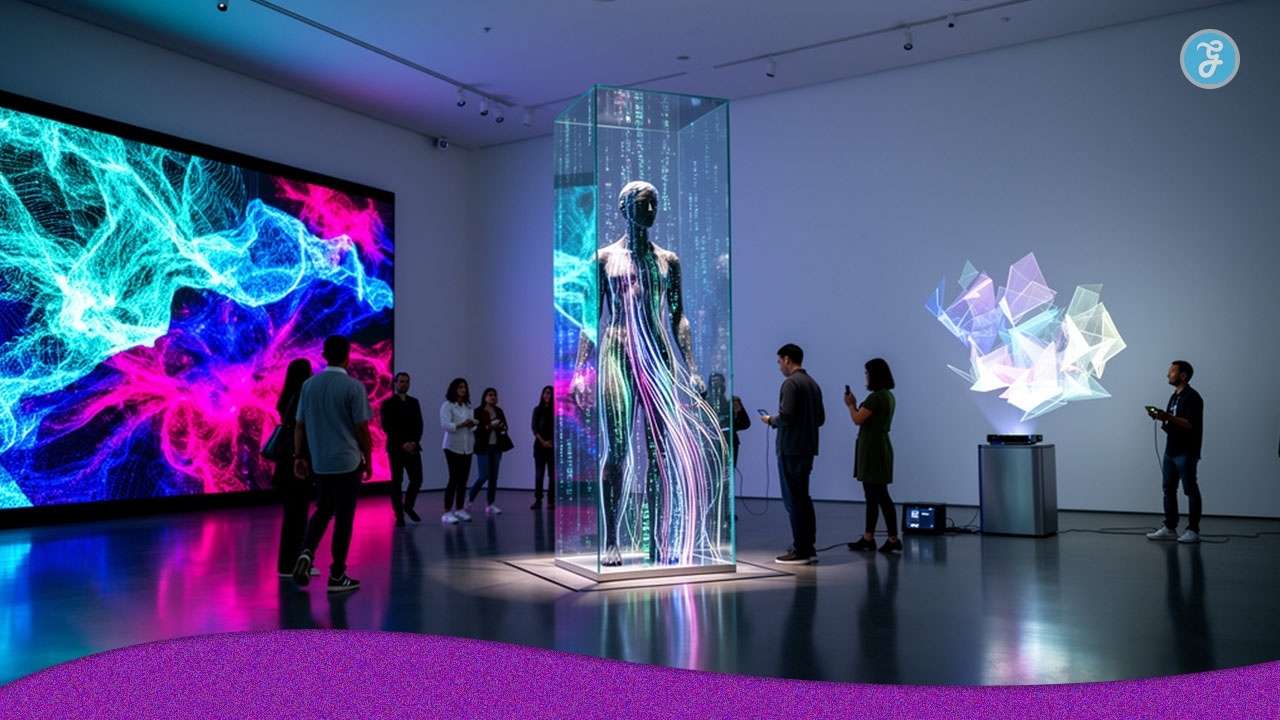
Have you ever looked at a stunning digital painting and wondered how the artist pulled it off without spilling a single drop of paint? Art used to live only in museums and galleries, locked behind velvet ropes and expensive admission fees. Today, artists create work on computers, phones, and tablets, then share it instantly with millions of people around the world. The Intersection of Technology and Contemporary Art has changed everything about how creators work and how we experience their pieces.
Here is a wild secret about the art market today. A digital artwork by the artist Beeple sold for 69 million dollars at a major US auction house, proving that pixels hold just as much value as physical canvas.
So, grab a cup of coffee, and let us go through it together. I am going to walk you through exactly how these tools work, and I think you will be surprised by how accessible they all are.
Historical Perspectives on Art and Technology
Artists have always grabbed new tools to push their creative boundaries. Technology did not suddenly appear in art studios. It shaped how creators worked for centuries.
Early technological influences on art
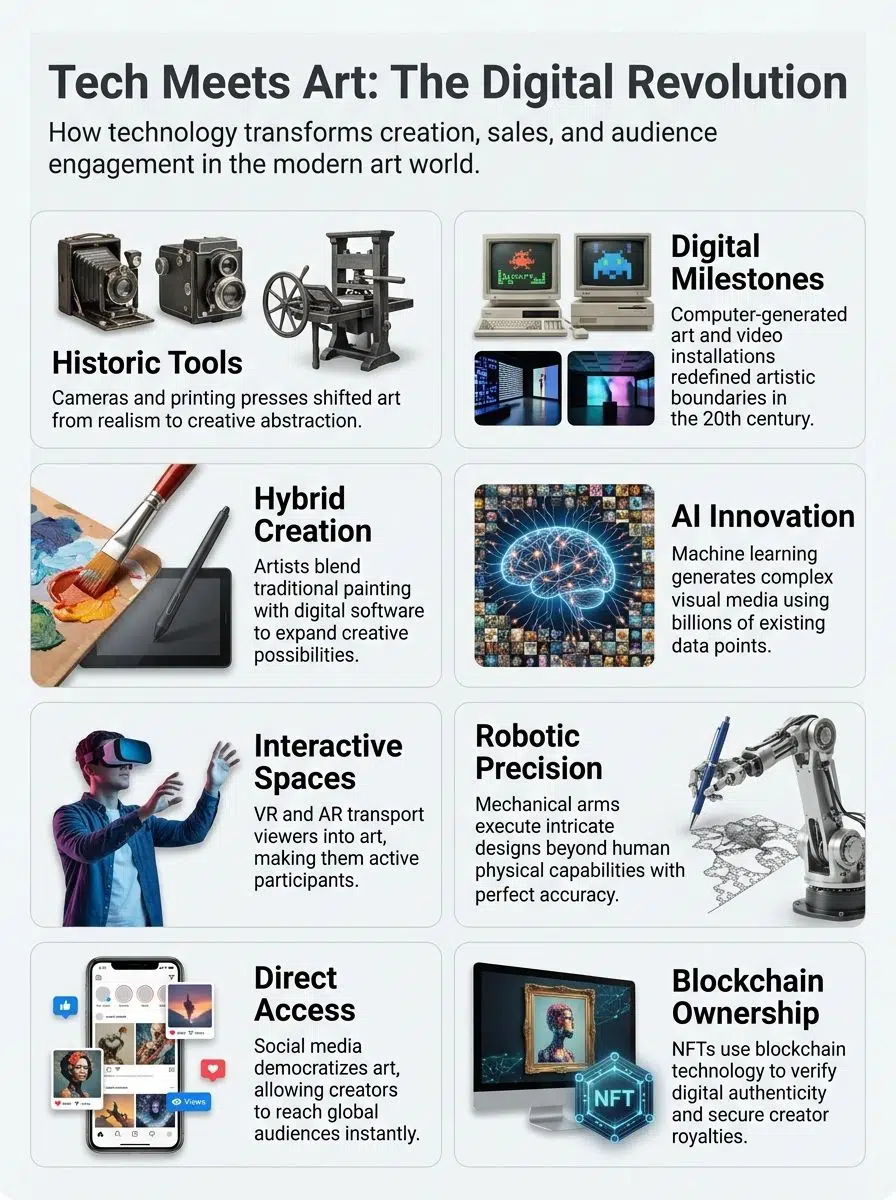
Technology shaped how artists created work for centuries. Paint, brushes, cameras, and printing tools all changed what art could become. For example, the invention of the neon light transformed American streets into glowing canvases. By the 1920s, neon signs lit up Times Square in New York, and soon artists adopted fluorescent light as a serious artistic medium.
Here are a few other major historical shifts:
- Photography: Cameras emerged in the 1800s and captured reality faster than any brush. This forced painters to explore abstraction and emotion, birthing movements like Impressionism.
- The Printing Press: Woodcuts and engravings let people reproduce images at scale. Visual culture spread beyond wealthy collectors and reached ordinary people in their homes.
- Film and Cinema: Moving images arrived in the late 1800s. They inspired artists to think about time, sequence, and narrative in fresh ways.
- The Photocopier: Invented in 1959, this machine democratized reproduction. Photocopied images became raw material for collages and mixed media pieces.
Milestones in digital and media art
Digital art emerged from experimental computer labs in the 1960s. It completely transformed how artists create and share their work. Media art followed closely behind, opening doors to entirely new forms of creative expression that challenge traditional boundaries. We have seen massive shifts in recent years that prove digital art is here to stay.
- Refik Anadol at MoMA: In 2022 and 2023, Refik Anadol’s AI-driven exhibition Unsupervised at the Museum of Modern Art in New York drew nearly 3 million visitors. His algorithmic compositions proved that machines could produce aesthetically compelling visual works that captivate massive audiences.
- The Birth of DATALAND: Following his museum success, Anadol co-founded DATALAND in Los Angeles in 2025. This marks the world’s first physical museum dedicated entirely to AI arts and data sculpture.
- Procreate’s Stand for Human Artists: In August 2024, the popular digital illustration app Procreate officially announced it would never include generative AI in its software, ensuring its tools remain focused on human creativity.
- The Rise of Video Art: Nam June Paik pioneered video art in the 1960s by manipulating television signals. His groundbreaking work established video as a serious artistic tool rather than just a broadcasting device.
The challenges surrounding intellectual property and AI in art creation now demand serious attention from both artists and audiences alike.
Impact of Technology on Contemporary Art
Technology reshapes how artists create, think, and share their work with the world. Artists now wield digital tools that transform their creative vision into something audiences never imagined possible.
Evolution of artistic tools and media
Artists have swapped paintbrushes for styluses and canvas for screens. Tablets and graphics pads let artists draw directly on digital surfaces, making art creation faster and more flexible.
Many digital artists flock to Procreate as their software of choice. In December 2025, the company released Procreate Dreams 2, giving independent creators powerful new 2D animation tools for a single, low price.
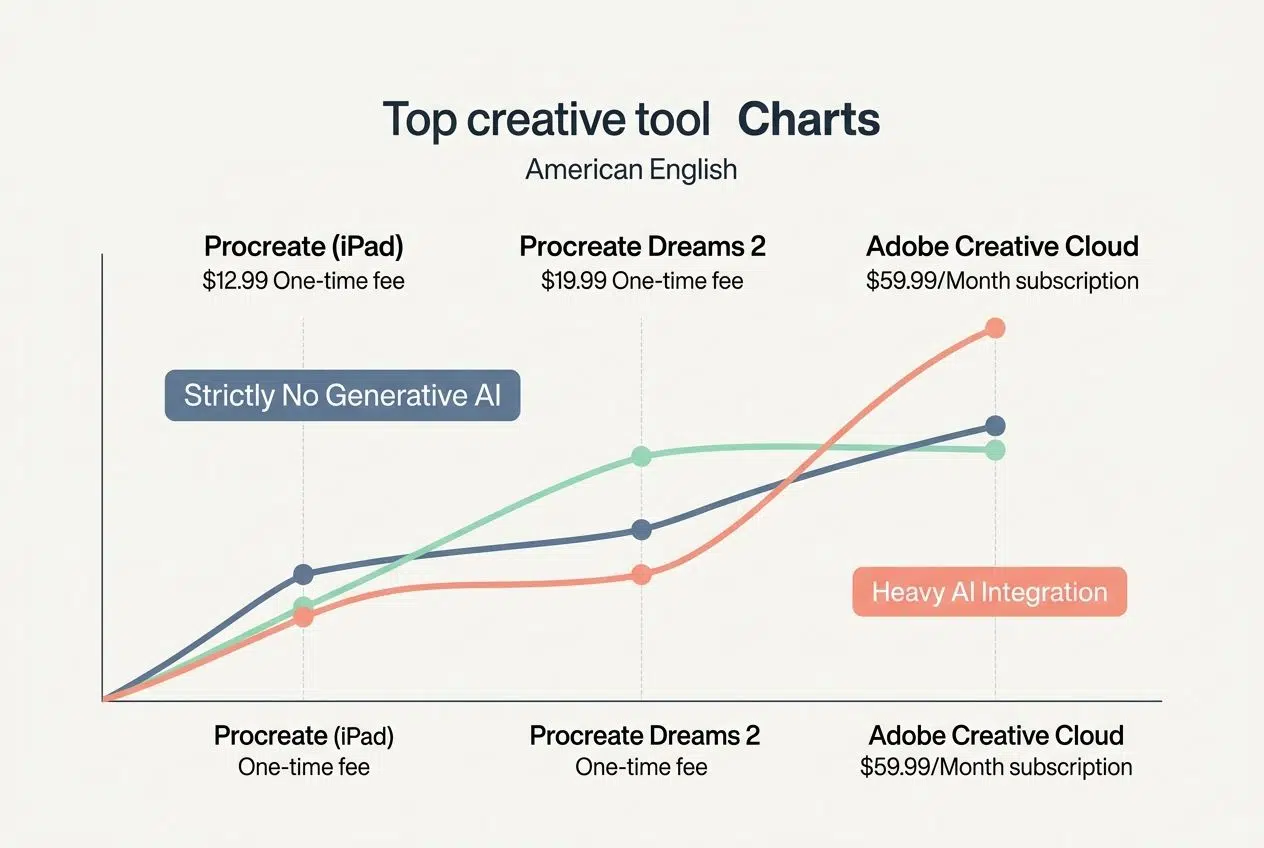
Here is how the top creative tools compare for artists today:
| Tool | Price Model (As of 2026) | Core Focus | AI Integration Status |
|---|---|---|---|
| Procreate (iPad) | $12.99 One-time fee | Digital painting & sketching | Strictly No Generative AI |
| Procreate Dreams 2 | $19.99 One-time fee | 2D Animation | Strictly No Generative AI |
| Adobe Creative Cloud | $59.99/Month subscription | Industry-standard suite | Heavy AI Integration (Firefly) |
Traditional media still matter. Many artists now blend classical techniques with creative coding and digital manipulation. This fusion opens new doors for artistic expression.
Shifting aesthetics and visual perceptions
Technology has completely changed how we see and experience art. Digital tools let artists play with color, form, and space in ways that traditional brushes never could. Virtual elements now blend seamlessly into galleries and museums, making viewers question what art actually is. Interactive installations pull people off the bench and into the creative process itself.
These new tools directly shift our visual culture:
- Augmented Reality Filters: Artists build custom AR filters on Snapchat and Instagram, turning the viewer’s face or living room into an interactive canvas.
- Spatial Computing: US museums are increasingly adopting headsets like the Apple Vision Pro in 2026, allowing visitors to step inside a 3D recreation of a classic painting.
- Dynamic Projection Mapping: Creators use heavy-duty projectors to wrap digital video around physical buildings, changing city skylines overnight.
Multimedia presentations now dominate galleries. This proves that artistic expression thrives when creators blend traditional techniques with cutting-edge innovation.
Innovations in Artistic Expression
Artists now wield artificial intelligence, robotics, and interactive technology to create works that respond to viewers in real time. These fresh approaches shatter old boundaries.
AI-generated art
Machines now create art that makes people stop and stare. AI-generated art uses algorithms and machine learning to produce paintings, sculptures, and digital works.
Software learns from thousands of existing artworks, then generates something new based on what it learned. Tools like Midjourney v6 and DALL-E 3 let anyone type words and watch the computer paint a picture.
If you want the best results from these AI tools, users on the r/midjourney subreddit note that you must use specific photography terms in your prompts. Adding phrases like “35mm photography” or “cinematic lighting” dramatically improves the realism of the output.
The computer does not feel emotions or see beauty the way humans do, yet it produces visual media that sparks conversation. An artist can now blend their own vision with AI’s power, creating multimedia pieces that combine human imagination with computational speed.
The question is not whether AI will stay in the art world. The real question is how artists will use this tool to push visual culture forward.
Interactive and immersive installations
Interactive and immersive installations transform art galleries into living, breathing spaces. Visitors step inside the creative work itself.
Look at Meow Wolf, an American arts and entertainment company. Their Omega Mart installation at Area15 in Las Vegas is a massive 52,000-square-foot multisensory grocery store that blends narrative storytelling with interactive art.
They are wildly successful and are expanding with a highly anticipated Los Angeles location opening in 2026. These interactive installations merge technology integration with traditional storytelling.
Here is what makes these modern immersive spaces so compelling:
- Physical Exploration: You do not just look at art; you walk through hidden doors and climb through tunnels.
- Responsive Environments: Sensors detect your movement and change the lighting or sound in the room automatically.
- Narrative Discovery: Guests piece together a mystery by interacting with physical objects and digital screens.
Virtual reality and augmented reality tools give artists powerful ways to build these immersive environments. This approach breaks down barriers and makes contemporary culture feel more accessible to everyone.
Robotics in art creation
Robots now paint, sculpt, and create visual media in ways that push artistic expression into new territory. Artists use robotic arms to make precise movements that humans cannot replicate.
These machines follow code written by artists, turning creative coding into physical art forms. Sougwen Chen, a Chinese-Canadian artist who exhibits widely across the US, creates collaborative drawings with robotic arms.
Chen’s robotic arm responds to her hand movements in real-time on the canvas. This creates a fascinating dance between human intuition and mechanical precision.
Other artists employ robotic arms to execute repetitive tasks with flawless accuracy. These cyber art collaborations show that robotics does not replace human creativity. Instead, it amplifies artistic vision.
The Role of Digital Media and Social Platforms
Social media platforms transformed how people discover, share, and discuss art in real time. Artists now reach millions of followers without needing gallery gatekeepers to validate their work.
Social media’s influence on art consumption
Instagram and TikTok have completely changed how people find and enjoy art. Artists now post their work directly to millions of followers, skipping galleries and museums altogether.
This shift means that visual culture spreads faster than ever before. A painter in rural Montana can reach collectors in Tokyo within hours.
Social media algorithms specifically reward certain types of content today:
- Process Timelapses: A 2025 shift in TikTok’s algorithm heavily rewards process videos. Artists who show a time-lapse of digital painting get far more views than those who just post the finished piece.
- Educational Hooks: Creators who explain their technique in the first three seconds of a video retain viewers much longer.
- Niche Hashtags: Tags connect artists with highly specific communities, creating instant fan bases around niche creative works.
Online platforms have made art accessible to everyone with a smartphone. Emerging creators build careers without expensive studio spaces or connections to established institutions.
Democratization of art through online platforms
Online platforms have shattered the old gatekeepers of the art world. Artists no longer need gallery owners or museum curators to share their work with millions of people.
Social media sites, art marketplaces, and digital portfolios let creators post their creative works directly to audiences worldwide. A teenager can now build a massive following for their digital art straight from their bedroom.
Websites like Patreon and Etsy changed the financial game for independent creators. A sculptor in rural Montana can ship physical pieces or sell digital 3D-printing files directly to buyers in New York, completely avoiding the standard 50% gallery commission.
This shift in accessibility means that talent matters far more than connections or money. The democratization of art creation through technology integration has opened doors for millions of people.
Combining Tradition with Modern Innovation
Artists today blend classical techniques with cutting-edge digital tools, creating works that honor the past while embracing the future. This fusion produces something powerful.
Blending classical techniques with modern technology
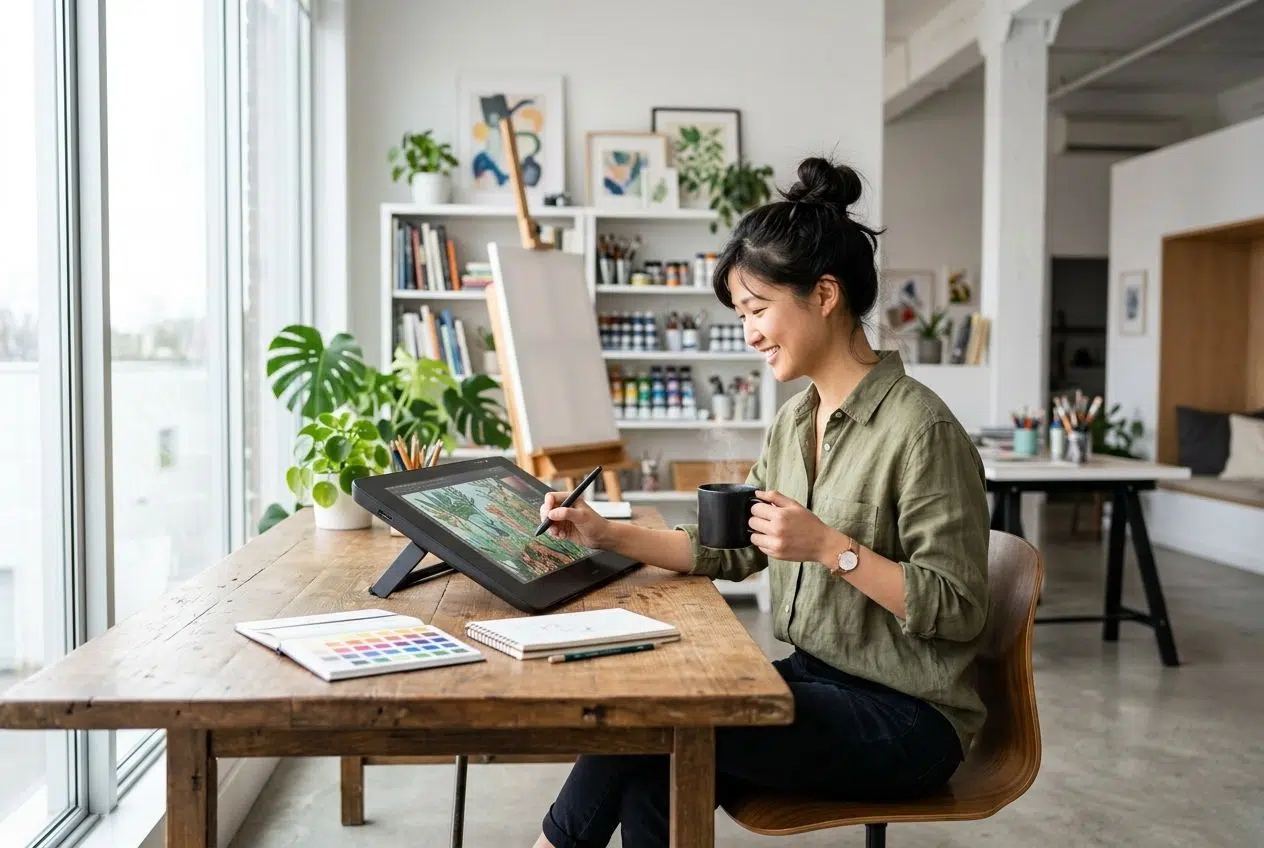
Painters, sculptors, and printmakers combine old methods with new tools every single day. A traditional oil painter might use digital art software to sketch designs before touching a physical canvas.
Photographers blend classical composition rules with augmented reality filters. Musicians layer acoustic instruments with electronic beats. This fusion creates something fresh, yet it honors what came before.
Here is how artists are mixing these two worlds:
| Traditional Technique | Modern Technology Counterpart | The Blended Result |
|---|---|---|
| Charcoal Sketching | iPad Pro & Apple Pencil | Digital sketches are projected onto large-scale public walls. |
| Clay Sculpting | 3D Modeling Software | Hand-sculpted details scanned and 3D printed in durable resin. |
| Oil Painting | AI Pattern Generation | AI-generated base patterns were traced and painted over with thick oil impasto. |
This technology integration does not erase classical training; it amplifies it. Digital art tools give artists more control, more speed, and more possibilities than ever before.
Case studies of artists integrating both approaches
Artists across the United States merge classical techniques with cutting-edge technology to create groundbreaking work. These creative minds show us how tradition and innovation work together beautifully.
- Kim Keever: Based in New York, Keever constructs elaborate underwater landscapes inside glass tanks. He then photographs them with professional lighting and digital enhancement. His process combines handcrafted physical sets with sophisticated camera work.
- Eric Standley: As a professor of studio art at Virginia Tech, Standley employs vector-based software to design complex geometric patterns. He then uses laser-cutting technology to transform flat paper into intricate three-dimensional sculptures.
- Cai Guo-Qiang: Operating out of his New York studio, Guo-Qiang harnesses explosive materials as his primary artistic medium. His explosive art pieces often incorporate digital documentation and augmented reality elements for a broader audience reach.
- Refik Anadol: Operating his studio in Los Angeles, Anadol generates massive visual installations using artificial intelligence. His creative works combine architectural design with data visualization, culminating in the 2025 launch of DATALAND, his dedicated AI art museum.
Artists Who Blend Technology and Art
Some artists push boundaries by merging code, cameras, and canvas into stunning visual experiences. These creators show us that art does not have to choose between tradition and innovation.
Kim Keever’s Artistic Chemistry
Kim Keever transforms tanks of water, paint, and light into visual masterpieces that stop viewers in their tracks. Before becoming a renowned artist in New York, Keever worked as a thermal engineer.
This scientific background heavily influences his creative process. He pours acrylic paint into 200-gallon aquariums, then captures the swirling colors with high-speed photography and digital art techniques.
- Fluid Dynamics: His engineering knowledge helps him predict how different paint densities will interact in the water.
- Digital Layering: Keever layers multiple photographs together on his computer to build complex compositions.
- Lighting Control: He uses precision studio lighting to catch the exact moment the pigments collide.
His technique demonstrates how creative innovation emerges when artists abandon conventional tools and embrace physical materials alongside digital enhancements.
Eric Standley’s Laser-Cut Masterpieces
While Kim Keever creates art through water and light, Eric Standley takes a completely different approach to artistic expression. Standley uses laser technology to cut intricate patterns into materials.
As a professor of studio art at Virginia Tech, he relies heavily on technology integration. He designs his patterns using advanced vector software before any physical cutting begins.
“The laser technology allows Standley to produce intricate details that would take hours, or even days, to create by hand. His work proves that multimedia art forms can combine mathematical accuracy with deep emotional impact.”
Each piece requires careful planning and technical skill to execute properly. His interactive installations invite viewers to experience art from multiple angles, engaging their senses in new ways.
Cai Guo-Qiang’s Explosive Art
Cai Guo-Qiang transforms gunpowder into a medium that challenges what art can be. Though born in Quanzhou, China, he has lived and worked in New York for decades.
He is famous worldwide for his massive visual events, including the daytime fireworks displays he orchestrated for the 2008 Beijing Olympics. His pieces light up the sky, leaving traces of color and ash that tell stories about the human experience.
His approach to multimedia and creative innovation pushes audiences to experience art with all their senses. Here is why his explosive art is so impactful:
- Unpredictability: No matter how carefully he plans the gunpowder fuses, the final burn pattern always contains an element of surprise.
- Sensory Overload: Viewers stand close enough to feel the heat and hear the roar of the ignition.
- Digital Permanence: While the explosions last only seconds, his team captures them using high-speed digital cameras and drones to preserve the performance forever.
The artist proves that technology and creative works do not always mean computers or screens. Sometimes they mean reimagining what physical tools artists can use in contemporary culture.
Challenges and Ethical Considerations
As artists push technology to its limits, real problems pop up. From stolen ideas to machines making art without human hands, creators face massive hurdles today.
Intellectual property and copyright dilemmas
Artists and tech creators face serious copyright problems in today’s digital art world. AI-generated art raises tough questions about who owns the final piece, the artist or the machine’s creator.
In March 2026, the US Supreme Court denied an appeal in Thaler v. Perlmutter. This major decision cemented the US Copyright Office’s ruling that works created purely by a machine cannot receive copyright protection.
Here is how US copyright law handles digital art right now:
| Creation Method | US Copyright Status (As of 2026) |
|---|---|
| Pure AI Generation (Text Prompt Only) | Not Protected (Falls to Public Domain) |
| AI Generation + Significant Human Editing | Only the Human Edits are Protected |
| Traditional Digital Art (Photoshop/Procreate) | Fully Protected from the start |
The gap between artistic freedom and legal protection keeps widening. Many creators feel frustrated and undercompensated for their talent when tech companies profit from user-generated content.
Ethical implications of AI in art
Copyright battles pale in comparison to the moral questions that AI art raises. Artificial intelligence systems train on millions of existing artworks without asking permission from the original creators.
This practice sparks serious concerns about whether machines should learn from human creativity without compensation. Artists across the United States filed multiple class-action lawsuits in 2025 and 2026 against major AI platforms for scraping their portfolios.
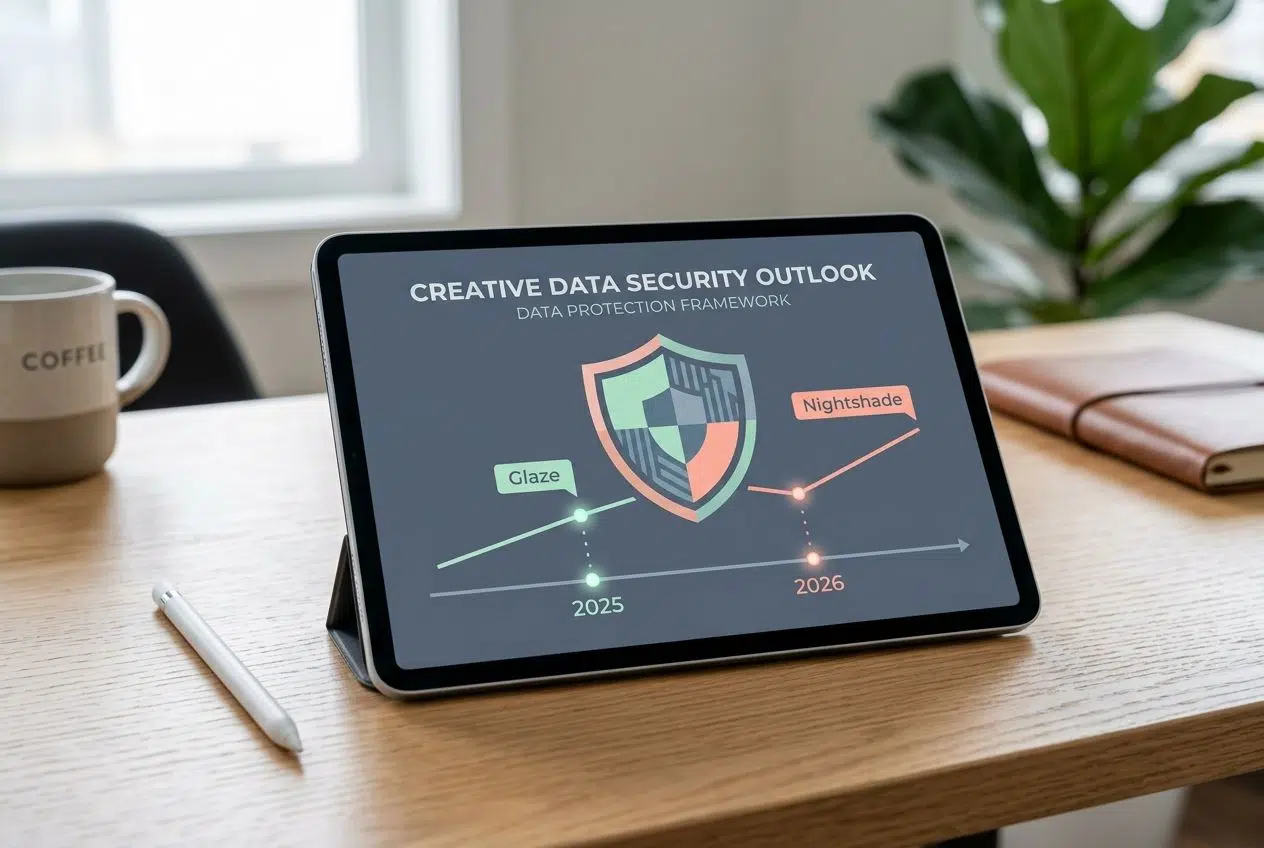
“We are fighting back. Tools like Glaze and Nightshade, developed by researchers at the University of Chicago, allow artists to invisibly ‘poison’ their images before posting them online. This disrupts the AI training models if they scrape the art without permission.”
The ethical implications of AI in art go far deeper than money matters. AI-generated art challenges our core beliefs about what creativity actually means.
Artists worry that AI tools will flood markets with cheap alternatives. Society needs clear rules about how tech companies can use existing creative works, or human creators risk losing control over their own legacy.
Future Trends in the Intersection of Art and Technology
Artists and collectors will shape tomorrow’s visual culture through blockchain technology and immersive digital experiences. Keep reading to discover which innovations will transform your relationship with creative expression.
The emergence of blockchain and NFTs
Blockchain technology and NFTs transformed how artists sell their creative works. These digital tools create permanent records of ownership, so collectors know exactly who made each piece.
While the massive media hype of 2021 cooled down, the US digital art market stabilized by 2026. Blockchain technology remains a reliable way for creators to prove provenance.
Artists use these networks to benefit their careers in several specific ways:
- Direct Sales: Creators bypass traditional galleries and keep a much larger percentage of their profits.
- Smart Contracts: Artists can program their digital art sales to automatically pay them a royalty fee every time the piece is resold in the future.
- Global Reach: A digital artist in the US can instantly transfer a verified piece of cyber art to a collector in Japan without shipping costs.
Virtual art, multimedia projects, and interactive installations all benefit from this system. Digital art now stands alongside traditional art in galleries, changing how we view visual culture forever.
Predictions for the evolution of visual culture
Visual culture will shift dramatically as technology keeps pushing boundaries. Artificial intelligence tools will create art faster than ever before, making creative works more accessible to everyday people.
Virtual reality and augmented reality will transform how we experience art. Galleries will turn into immersive spaces where viewers step inside paintings rather than just looking at them.
Here are a few predictions for the near future:
- Spatial Computing Mainstream: Headsets like the Apple Vision Pro will become standard tools for viewing digital art exhibitions from your living room.
- Responsive Art: Interactive installations will become the norm. Audiences will expect art to respond to their movements, their voices, and their physical presence.
- Hybrid Art Forms: Cyber art and creative coding will merge with classical painting, producing hybrid works that museums struggle to categorize.
Cultural dialogue will expand as technology breaks down barriers between creators and viewers. Artistic expression will feel less like something distant and more like something anyone can touch, manipulate, and share with others.
Final Words
Technology and contemporary art have merged into something powerful. This shift transforms how creators make work and how audiences experience it.
Artists now blend traditional techniques with digital tools, AI systems, and interactive installations to push creative boundaries further than ever before. Social media platforms democratize art consumption, letting anyone share their work globally without gatekeepers standing in the way.
You can start exploring these spaces today by visiting online galleries, following digital artists, or experimenting with creative coding tools yourself. The Intersection of Technology and Contemporary Art is open to everyone.
The future belongs to those who dare to mix paint with pixels, classical methods with cutting-edge innovation, and imagination with technology to reshape what art can become.
Frequently Asked Questions (FAQs) on Technology And Contemporary Art
1. How does technology change contemporary art?
Technology opens new doors for artists to experiment with digital media like 3D modeling, AI-generated imagery, and virtual reality installations. According to a 2024 Art Basel report, the digital art market grew to $2.9 billion, showing how many creators now use tools like Procreate and Blender to reach global audiences. This shift lets artists try things that were once impossible with traditional materials alone.
2. Can you give an example of a tech meeting in modern art?
Think about immersive experiences like teamLab Borderless in Tokyo, where entire rooms of digital projections react to visitors’ movements. Artists like Refik Anadol use machine learning algorithms to turn data into mesmerizing visual displays on giant screens.
3. Why do some people say technology makes art more fun?
Tech brings surprises into the mix by letting viewers interact directly with the work. Imagine walking into a room where the walls react to your voice or seeing sculptures that move when you wave your hand.
4. What challenges come up when mixing tech and today’s art?
Sometimes gadgets glitch or software gets outdated fast, which can frustrate both artists and viewers alike. A 2025 study from the National Endowment for the Arts found that professional VR headsets can cost upwards of $3,500, creating a gap between those who can afford to experiment and those left out.