Lab-Grown Regenerative Fabrics are no longer a localized experiment in high-end design labs; they have become the structural foundation for a fashion industry desperate to decouple growth from environmental degradation. For decades, the narrative of sustainable fashion was limited to recycling existing plastics or marginally reducing water usage in traditional cotton farming.
However, as we move through 2026, the paradigm has shifted toward “growing” materials rather than “extracting” them. This transition is powered by the convergence of molecular biology and textile engineering, allowing American startups to program cells to produce fibers with specific performance characteristics.
How Lab-Grown Regenerative Fabrics Restore the Global Ecosystem
The movement toward bio-fabrication addresses the three most significant pain points in global apparel: land scarcity, water toxicity, and the microplastic crisis. Traditional synthetic fibers, like polyester and nylon, are essentially fossil fuels woven into garments, shedding persistent pollutants with every wash.
Conversely, lab-grown textiles utilize natural organisms, such as mycelium, yeast, and plant cells, to create fibers that are molecularly superior and inherently biodegradable. By utilizing closed-loop fermentation and cellular agriculture, the US startups highlighted in this report are proving that we can produce high-performance everyday wear that actually restores the ecosystems it inhabits.
10 US Startups Engineering Lab-Grown Regenerative Fabrics
The United States has emerged as the primary global incubator for material science innovation, particularly in the field of cellular agriculture and bio-fabrication. The startups leading this charge are not simply looking to create “less bad” versions of existing materials; they are engineering an entirely new category of Lab-Grown Regenerative Fabrics.
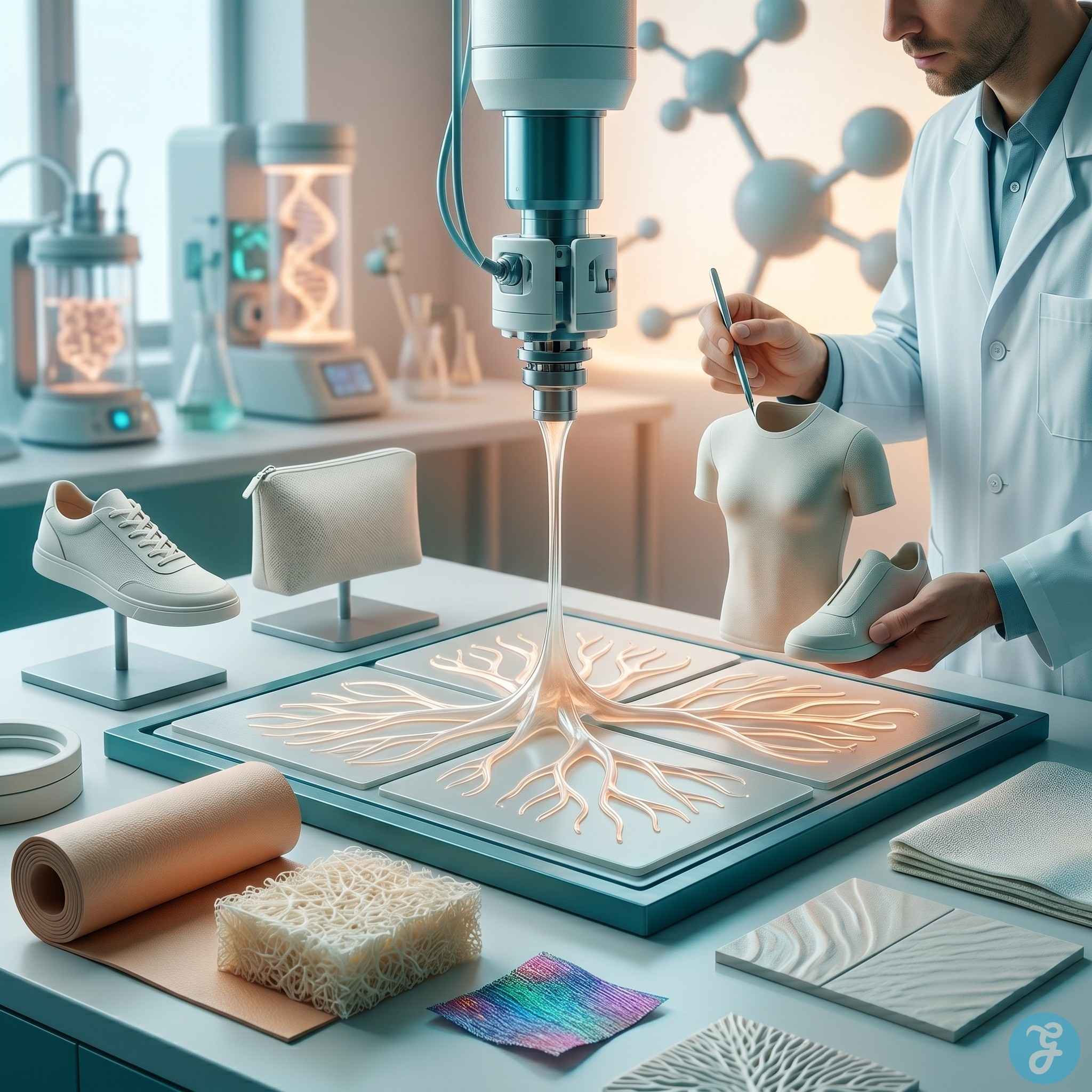
These are designed to be better for the planet than the natural fibers they replace. By utilizing advanced bioreactors and precision fermentation, these companies have effectively moved the manufacturing floor from the factory to the laboratory.
This list explores the ten most significant American companies that have transitioned from early-stage research to viable commercial production. Each of these innovators addresses a specific failure in the traditional textile supply chain, be it the ethical concerns of animal leather, the high water footprint of cotton, or the plastic pollution caused by synthetic polyesters.
By prioritizing biological performance and circularity, these startups are proving that the future of our wardrobes is being grown, cell by cell.
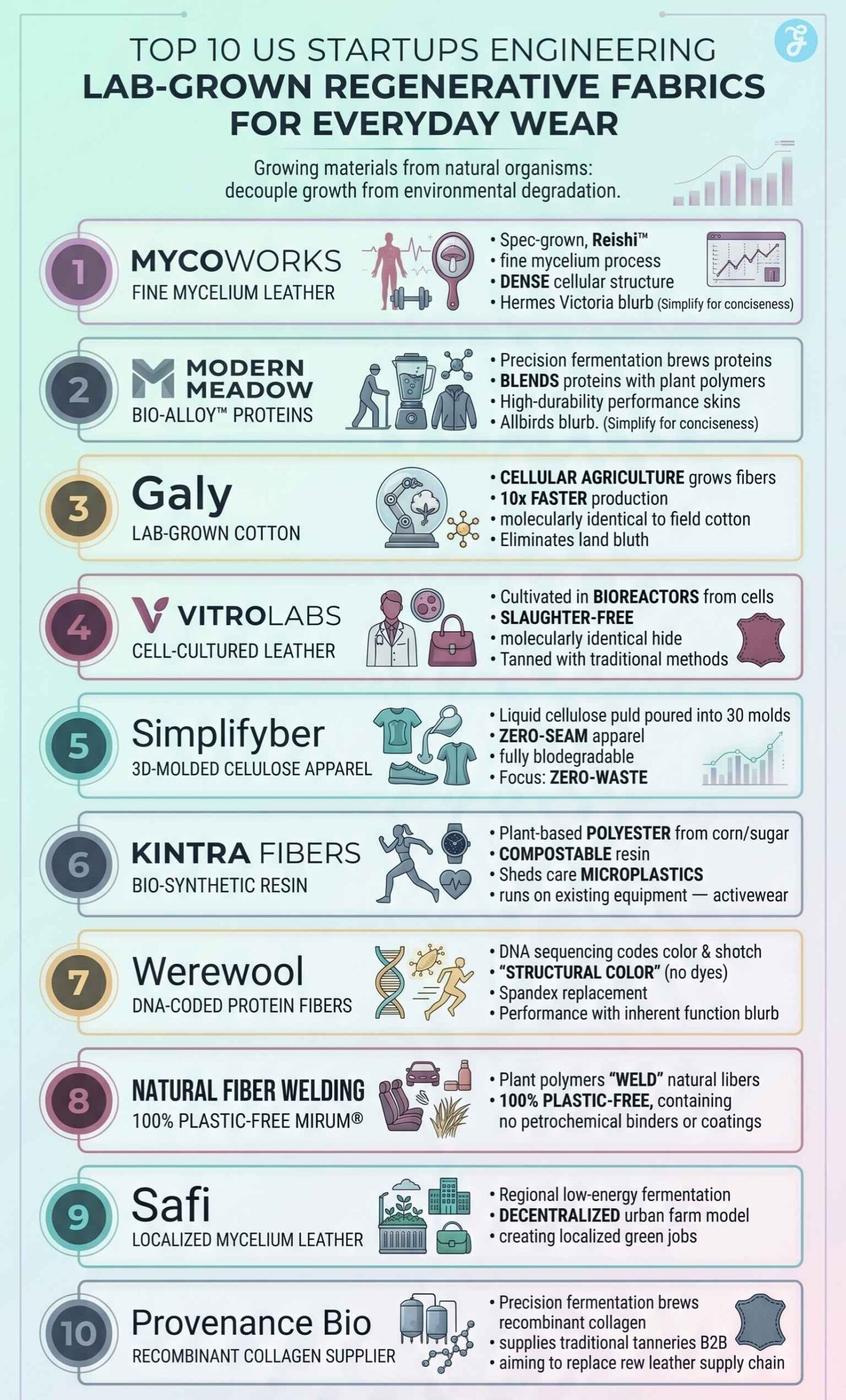
1. MycoWorks
MycoWorks has moved beyond the “mushroom leather” phase and into the era of Fine Mycelium. By controlling the growth of mycelium cells into a dense, interwoven structure, they produce a material that mimics the cellular density and durability of animal hide.
Their flagship material, Reishi, is grown in sheets that can be programmed for specific thickness and flexibility, virtually eliminating the waste associated with natural hide imperfections.
- Utilizes a patented Fine Mycelium process to create dense, leather-like cellular structures.
- Enables “grown-to-spec” manufacturing, reducing material waste by up to 30% compared to animal hides.
- Maintains high-profile luxury partnerships, most notably with Hermès for the Victoria bag.
Luxury Fabrication Goal: premium, slaughter-free hides for heritage fashion houses.
Biological Innovation: proprietary Fine Mycelium technology that directs cellular growth for uniform density.
Market Adoption Maturity: currently operating at commercial scale with a major production facility in South Carolina.
Transitioning from mycelium to molecular blends, we look at how protein engineering is creating a new class of performance materials.
2. Modern Meadow
Modern Meadow has successfully shifted the paradigm from growing whole hides to “Bio-Alloy” protein technologies. This approach allows them to blend bio-fabricated proteins, produced through precision fermentation, with bio-based polymers to create high-performance materials for everyday athletic and outdoor wear.
Their technology is designed to be a “drop-in” solution, meaning it can be processed by existing tanneries and garment factories.
- Leverages precision fermentation to “brew” collagen-like proteins without animal inputs.
- Integrates Bio-Alloy technology to create high-durability performance fabrics for footwear and apparel.
- Focuses on “drop-in” compatibility with existing global manufacturing equipment.
Performance Integration Goal: replacing petroleum-based skins with bio-alloyed protein fabrics.
Fermentation Breakthrough: engineering yeast to produce high-yield, functional proteins for textile applications.
Supply Chain Compatibility: specifically designed to utilize existing tanning and finishing infrastructure.
While Modern Meadow tackles performance skins, our next entry is reimagining the most common natural fiber on the planet.
3. Galy
Galy is fundamentally changing the global cotton economy by growing the fiber directly from plant cells in a lab. By bypassing the need for roots, stems, and leaves, Galy focuses the plant’s biological energy entirely on fiber production.
This method eliminates the need for vast acreages, pesticides, and the thousands of gallons of water required for traditional field-grown crops.
- Grows cotton fibers 10x faster than traditional agriculture using cellular agriculture.
- Reduces land usage by 80% and water consumption by 90% compared to field-grown cotton.
- Produces fibers that are molecularly identical to traditional cotton, requiring no changes to spinning or weaving.
Agricultural Displacement Goal: high-volume lab-grown cotton for mass-market essentials.
Cellular Agriculture Feat: successful cultivation of specialized plant cells in controlled bioreactors.
Scalability Projection: currently moving from pilot phase to large-scale industrial bioreactor deployment.
Shifting back to the luxury sector, we find a startup using actual animal cells to grow genuine leather without the animal.
4. VitroLabs
VitroLabs focuses on the high-fidelity luxury market by utilizing actual animal cells to grow genuine leather. This “slaughter-free” genuine leather maintains the exact protein structure of a hide without the environmental footprint of livestock.
It is the only material in this list that is molecularly identical to the real thing, allowing it to be tanned and finished using traditional artisanal methods.
- Cultivates bovine and exotic leather hides in bioreactors using isolated animal cells.
- Maintains the identical protein matrix of traditional hides for superior aging and patina.
- Positions itself as a biodiversity-positive solution for the ultra-luxury fashion industry.
Slaughter-Free Heritage Goal: genuine leather production that honors traditional craftsmanship without animal harm.
Molecular Authenticity: creates a product that is chemically and physically indistinguishable from traditional hide.
Production Complexity: highly technical cell-culturing environment requiring precise nutrient and environmental controls.
Moving from material growth to garment construction, our next startup is eliminating the waste found in traditional cutting and sewing.
5. Simplifyber
Simplifyber is addressing the waste inherent in the “cut-and-sew” model of fashion. Their liquid cellulose technology allows them to pour clothing into 3D molds, effectively creating fully finished garments with zero textile scrap waste.
By removing the spinning, weaving, and sewing stages, Simplifyber drastically reduces the carbon footprint and labor complexity of apparel production.
- Uses a proprietary 3D-molding process to create whole garments from liquid cellulose pulp.
- Eliminates up to 15% of material waste usually lost in the “cut-and-sew” process.
- Produces biodegradable apparel that can be ground down and recycled into new garments.
Zero-Waste Construction Goal: seamless, 3D-molded apparel that removes manufacturing scrap entirely.
3D Molding Evolution: transitioning from traditional flat-fabric thinking to architectural, volumetric construction.
Design Adoption Shift: requires designers to work with liquid pulp and molds rather than patterns and fabric rolls.
While Simplifyber rethinks shape, Kintra Fibers is re-engineering the chemistry of our most common synthetic fabrics.
6. Kintra Fibers
Kintra Fibers is solving the microplastic crisis by re-engineering polyester. Their bio-synthetic resin is derived from plants and is fully compostable, meaning it offers the high-stretch performance of synthetics without the permanent environmental damage. It is a “farm-to-fiber” solution that runs on existing spinning equipment, making it highly scalable.
- Engineers a 100% bio-based polyester replacement that is fully industrially compostable.
- Prevents microplastic pollution by ensuring fibers break down at the end of their life cycle.
- Integrates with existing polyester manufacturing lines for immediate global scalability.
Oceanic Preservation Goal: preventing microplastic shedding in performance activewear.
Compostable Polymerization: creating bio-resins that maintain high tensile strength while remaining biodegradable.
End-of-Life Requirements: specifically optimized for industrial composting to ensure a closed-loop cycle.
From re-engineered plastics, we move to a startup that is coding color and function directly into the DNA of the fiber.
7. Werewool
Werewool utilizes DNA sequencing to identify proteins found in nature, such as the fluorescent color of coral or the stretch of spider silk, and engineers these into bio-fabricated fibers. This allows for “structural color,” where the fiber itself is colored by its protein structure rather than toxic chemical dyes, and inherent stretch without the need for petroleum-based spandex.
- Codes DNA sequences into proteins to produce inherent color and elasticity.
- Eliminates the need for toxic textile dyes and plastic elastomers like Lycra.
- Focuses on performance fabrics with built-in biological functionality.
Structural Aesthetic Goal: non-toxic color and performance stretch built into the fiber’s DNA.
DNA-Encoded Functionality: using genetic blueprints from nature to replicate complex textile properties.
R&D Strategic Roadmap: currently in the high-innovation laboratory phase with pilot production targets for 2027.
While Werewool codes proteins, Natural Fiber Welding uses plant polymers to weld natural materials together into high-performance surfaces.
8. Natural Fiber Welding (NFW)
NFW has achieved widespread commercial success with Mirum, a material that uses plant-based polymers to “weld” natural fibers into a durable, plastic-free leather alternative. It is the only material in the category that is 100% plastic-free, containing no petrochemical binders or polyurethane coatings.
- Produces Mirum, a 100% plastic-free leather alternative made from cork, hemp, and natural rubber.
- Operates a closed-loop manufacturing process that is safe enough to be used as fertilizer at end-of-life.
- Currently used in high-volume applications across the automotive, footwear, and luxury sectors.
Petrochemical Elimination Goal: creating a high-performance material with zero reliance on plastics or fossil fuels.
Mechanical Welding Process: using proprietary nutrient-based chemistry to bond fibers without synthetic glues.
Density Profile Optimization: creates a heavier, more durable material suitable for high-wear environments like seating and footwear.
Targeting accessibility, our next startup is focused on bringing the mycelium revolution to the local urban farm model.
9. Safi
Safi is positioning itself as the “urban farmer” of the mycelium leather world. They focus on regional, low-energy fermentation to create accessible, affordable leather alternatives for everyday consumer goods. Their model emphasizes local production cycles, reducing the carbon footprint associated with international material shipping.
- Specializes in regional mycelium fermentation for localized leather production.
- Focuses on low-energy, affordable bio-fabrication for mass-market accessibility.
- Reduces global shipping emissions through an “urban farm” manufacturing model.
Hyper-Local Accessibility Goal: reducing the logistics and cost barriers of bio-fabricated leather.
Urban Fermentation Model: utilizing decentralized, small-scale facilities near major fashion hubs.
Product Specialization focus: primarily targeting accessories and mid-market consumer leather goods.
Finally, we look at the B2B foundry providing the essential biological precursors for the entire industry.
10. Provenance Bio
Provenance Bio serves as a B2B biological foundry, using precision fermentation to “brew” collagen proteins that can be used by traditional tanneries to create lab-grown leather. Their recombinant protein platform is designed for massive scalability, aiming to replace the raw supply chain of the leather industry by providing a drop-in biological precursor.
- Brews collagen proteins via precision fermentation for B2B material manufacturing.
- Acts as a biological foundry for global brands seeking sustainable raw material sources.
- Enables traditional manufacturers to transition to bio-fabricated materials without changing their machinery.
Supply Chain Foundry Goal: providing the high-volume biological ingredients for a global leather transition.
Recombinant Protein Efficiency: using engineered yeast to produce high-purity collagen at industrial scales.
B2B Integration Level: focuses on raw material supply rather than finished consumer-facing products.
The Economic and Environmental ROI of Lab-Grown Textiles
The transition to Lab-Grown Regenerative Fabrics is increasingly driven by economic reality rather than just altruism. Traditional textile supply chains are notoriously volatile, subject to climate-related crop failures, fluctuating water costs, and shifting geopolitical trade risks. In contrast, bio-fabrication offers a controlled, predictable manufacturing environment.
For a brand, the ability to “grow” exactly the amount of material needed, with zero pre-consumer waste, drastically improves the bottom line. By eliminating the costs associated with land management, pesticides, and the disposal of toxic dye runoff, these startups are providing a superior return on investment for the next generation of apparel conglomerates.
Furthermore, the environmental ROI is measurable at the molecular level. A single t-shirt made from lab-grown cotton or bio-synthetic polyester represents a massive reduction in the carbon and water footprint of a consumer’s wardrobe.
As global regulations around “Extended Producer Responsibility” (EPR) tighten, brands that have integrated regenerative fabrics into their core lines will avoid the heavy fines and disposal taxes that will soon be levied against plastic-based fast fashion.
Mapping the Material Revolution: A Comparative Study of US Bio-Innovators
To understand the breadth of this innovation, it is helpful to view the diverse biological approaches currently reaching commercial scale. The following table provides a clear comparison of the primary innovators in the United States, categorized by their biological medium and the specific market sector they are disrupting.
| Startup Name | Biological Medium | Primary Innovation | Market Reach |
| MycoWorks | Fine Mycelium | Spec-grown Reishi leather | Luxury & Accessories |
| Modern Meadow | Bio-Alloy™ Proteins | Protein-based performance skins | Athletic & Outdoor |
| Galy | Plant Cell Culture | Thousand-acre cotton in a lab | Mass-market Basics |
| VitroLabs | Animal Cell Culture | Slaughter-free bovine leather | Ultra-Luxury Goods |
| Simplifyber | Cellulose Pulp | 3D-molded, zero-seam apparel | Sustainable Footwear |
| Kintra Fibers | Bio-Synthetic Resin | Compostable high-stretch yarns | Athleisure |
| Werewool | DNA-Coded Protein | Structural color without dyes | Performance Wear |
| Natural Fiber Welding | Plant Polymers | 100% Plastic-free Mirum | Automotive & Tech |
| Safi | Mycelium Fermentation | Localized “urban farm” leather | Mid-market Goods |
| Provenance Bio | Recombinant Collagen | B2B leather precursor foundry | Supply Chain B2B |
As we look toward 2027, the challenge for these startups has shifted from “Can we grow this?” to “Can we grow this for a billion people?” The industrialization of biology requires a massive investment in bioreactor infrastructure and the standardization of bio-fabricated material certifications.
Consumers are also demanding a new level of “bio-transparency,” wanting to know not just that a material is lab-grown, but exactly what organisms were used and how the waste streams were managed.
The startups highlighted here are not just creating better fabrics; they are building a more resilient, circular economy where our clothing is no longer a pollutant, but a nutrient.
The “grown to spec” model represents the ultimate synergy between human ingenuity and natural systems, proving that the future of everyday wear is regenerative by design.
Frequently Asked Questions (FAQs) on Lab-Grown Regenerative Fabrics
1. Are lab-grown regenerative fabrics actually biodegradable?
Most lab-grown fabrics, especially those derived from mycelium, plant cells, or recombinant proteins, are designed to be fully biodegradable or compostable. However, it is important to check if the material has been blended with synthetic polymers for durability, as hybrid materials may require specialized industrial composting facilities.
2. Is lab-grown leather as durable as traditional animal leather?
Yes. In many cases, lab-grown leathers like Reishi or cell-cultured hides are engineered to have superior tensile strength and consistency compared to animal hides, which often have natural weak points or scars. These materials undergo rigorous “flex” and “wear” testing to ensure they meet the standards of high-end footwear and accessories.
3. Why are lab-grown fabrics more expensive than traditional options?
Currently, the cost is driven by the initial investment in bioreactor technology and the fact that production is still scaling. However, as infrastructure improves and production volumes increase, the price of bio-fabricated textiles is expected to reach parity with, and eventually become cheaper than, resource-heavy traditional fabrics.
4. Does bio-fabrication use harmful chemicals?
One of the primary benefits of bio-fabrication is the reduction of toxic chemicals. For instance, structural color (Werewool) eliminates the need for heavy-metal dyes, and mycelium growth requires far fewer chemicals than the traditional chrome-tanning process used in the leather industry.
5. Where can I buy clothing made from these materials?
Many of these startups have already launched products with major partners like Hermès, Stella McCartney, BMW, and Allbirds. As we move through 2026, you will see an increasing number of “bio-fabricated” lines appearing in mainstream retail stores as production capacity scales up across the United States.