

Every single day on our calendar holds a treasure trove of stories waiting to be uncovered by curious minds. When we peel back the layers of time specifically for April 18, we find a rich tapestry of human triumph, cultural shifts, and groundbreaking scientific discoveries. This date has served as a canvas for revolutionary acts and the birth of individuals who would go on to shape modern entertainment and physics. Understanding the weight of these moments helps us appreciate the complex journey of global civilization.
Transitioning from the broad scope of history, we can now narrow our focus to the specific occurrences that shook the world on this very date.
Defining Global Events of April 18
The events that took place on this day span multiple continents and eras, proving that history is always in motion regardless of geography.
Before we dive deep into the specific details of each major historical event, the following table provides a clear timeline of the moments that redefined our world.
Quick Look at April 18 Historical Events
| Year | Event Name | Location | Significance |
| 1906 | San Francisco Earthquake | United States | A massive natural disaster that reshaped American urban development. |
| 1942 | The Doolittle Raid | Japan | The first American air raid on the Japanese home islands during World War II. |
| 1955 | Bandung Conference | Indonesia | A pivotal meeting of Asian and African states promoting economic and cultural cooperation. |
| 1980 | Zimbabwe Gains Independence | Zimbabwe | The official transition from white minority rule to an independent republic. |
| 1983 | US Embassy Bombing | Lebanon | A tragic terrorist attack that altered international security protocols. |
Moving beyond the brief timeline, let us explore the profound impact of these historical milestones in greater detail.
The 1906 San Francisco Earthquake
The 1906 San Francisco Earthquake remains one of the most devastating natural disasters in the history of the United States. Striking the coast of Northern California at 5:12 in the morning, the massive tremor ruptured the San Andreas Fault for nearly 300 miles. The initial shaking lasted for about a minute, but the immediate destruction was only the beginning of the nightmare for the city’s residents. The earthquake severed gas mains and water lines across the densely populated urban center. This combination proved catastrophic as deadly fires broke out and quickly spread through the wooden structures of the city.
Firefighters found themselves completely powerless without water pressure to battle the infernos. The fires raged for three consecutive days, ultimately consuming over 500 city blocks and leaving more than half of the population homeless. The aftermath of the disaster fundamentally changed how cities approach structural engineering and disaster response. Modern building codes and seismic retrofitting standards trace their origins directly back to the lessons learned from the rubble of San Francisco. Furthermore, the tragedy prompted a massive leap forward in urban planning and fire safety regulations. It also sparked the modern scientific study of earthquakes and seismic activity. In the face of unimaginable loss, the recovery effort showcased incredible community resilience as citizens rallied to rebuild their iconic city from the ashes.
The Doolittle Raid of 1942
In the dark early days of World War II, the United States executed a daring and unprecedented military operation known as the Doolittle Raid. On April 18, 1942, sixteen B-25 Mitchell medium bombers launched from the deck of the aircraft carrier USS Hornet deep in the Pacific Ocean. Led by Lieutenant Colonel James Doolittle, the mission was designed to strike the Japanese home islands, including Tokyo.
This audacious raid provided a crucial morale boost for the American public, who were still reeling from the devastating attack on Pearl Harbor just months prior. While the physical damage inflicted on Japanese industrial targets was relatively minor, the psychological impact was immense. The raid proved to the Japanese military and civilian leadership that their mainland was truly vulnerable to aerial assault. The mission also demonstrated the incredible bravery of the bomber crews who flew knowing they likely did not have enough fuel to safely return. Ultimately, the raid forced the Japanese high command to recall vital combat forces from the front lines to defend their home territories, altering the strategic balance of the Pacific theater.
The Bandung Conference Begins in 1955
The Bandung Conference, officially known as the Asian-African Conference, opened on April 18, 1955, in Indonesia. This monumental gathering brought together representatives from twenty nine newly independent nations, representing over half of the world’s population at the time. The primary goal was to promote Afro-Asian economic and cultural cooperation and to oppose colonialism or neocolonialism by any nation.
The conference was a watershed moment for the Global South. It provided a platform for countries that had recently thrown off the yoke of European imperialism to assert their collective voice on the global stage. By promoting mutual respect for sovereignty and strict non-aggression among member states, the conference challenged the bipolar world order dominated by the United States and the Soviet Union. Key figures like India’s Jawaharlal Nehru, Egypt’s Gamal Abdel Nasser, and China’s Zhou Enlai played pivotal roles in shaping the discussions. They sought to navigate a third path in a deeply polarized world, laying the essential groundwork for what would soon become the Non-Aligned Movement.
Zimbabwe Gains Independence in 1980
On April 18, 1980, the nation of Zimbabwe officially gained its independence, marking the end of a long and deeply painful era of white minority rule. Previously known as Rhodesia, the country had been locked in a bitter bush war for over a decade. The transition to independence was the culmination of the Lancaster House Agreement, which paved the way for democratic elections and the establishment of a new, globally recognized republic.
The independence celebrations in the capital city of Salisbury, later renamed Harare, were joyous and historic. The official transition brought international sanctions to a close and finally opened the country to global trade. Representatives from over one hundred nations attended the ceremonies to welcome the new state into the international community. The event was further immortalized by the performance of reggae icon Bob Marley, who wrote a song specifically for the occasion and funded the trip for his entire band. The birth of Zimbabwe ended decades of unrecognized government control and symbolized hope and self determination for millions of people across the African continent.
The United States Embassy Bombing in Beirut in 1983
The geopolitical landscape of the Middle East shifted violently on April 18, 1983, when a suicide bomber detonated a massive explosive device outside the United States Embassy in Beirut, Lebanon. The blast tore through the front of the building, collapsing multiple floors and claiming the lives of sixty three people, including seventeen Americans.
This catastrophic event occurred during the complex Lebanese Civil War and fundamentally altered how diplomatic missions operate and secure their facilities worldwide. The attack was a stark introduction to the rising threat of asymmetric warfare and state sponsored terrorism in the modern era. It triggered a massive shift in foreign policy approaches to regional conflicts and forced a complete reevaluation of international security protocols. This tragedy directly led to the implementation of the strict physical security standards, heavily fortified embassy designs, and comprehensive perimeter defenses seen around the globe today.
Having explored the actions that shaped nations, we must also acknowledge the individuals who were born on this date and left their mark on global culture.
Celebrated Births on April 18
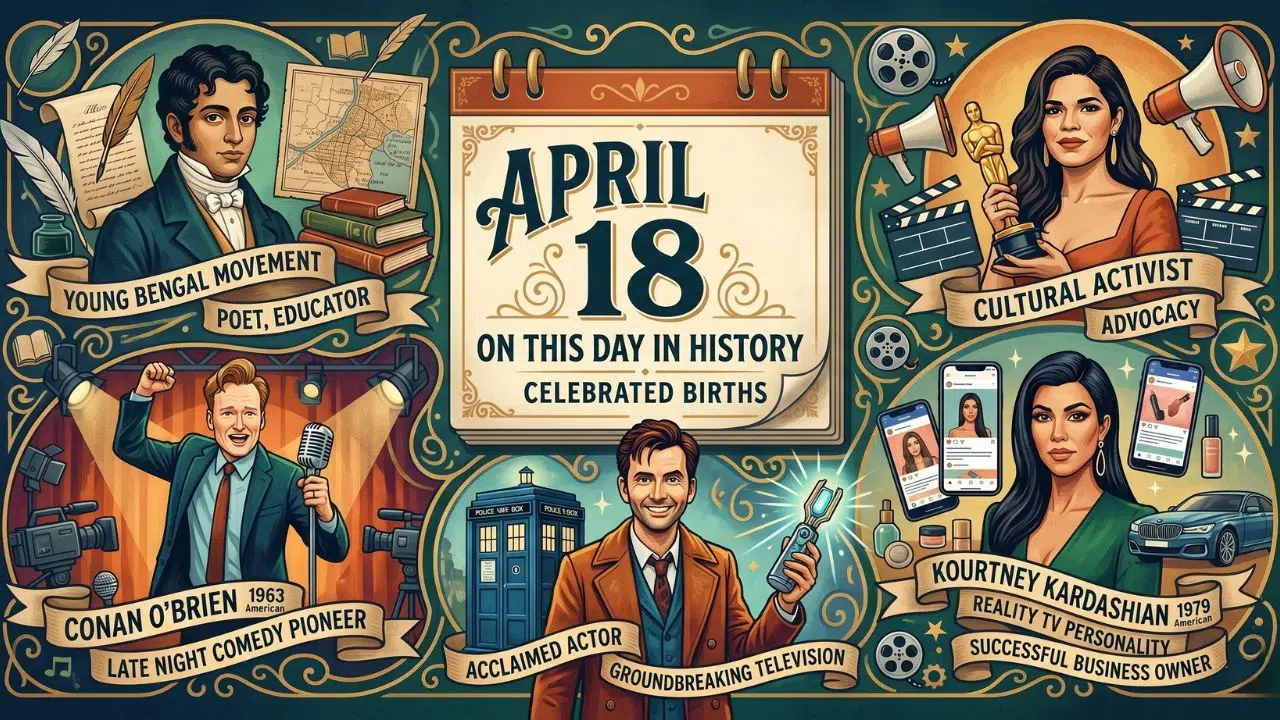
The individuals born on this day have gifted the world with groundbreaking television, compelling dramatic performances, and vital educational reforms.
To give you a quick overview of these remarkable people, the table below highlights their origins and primary claims to fame.
Famous Birthdays on April 18
| Birth Year | Name | Nationality | Known For |
| 1809 | Henry Louis Vivian Derozio | Indian | Poet, educator, and founder of the Young Bengal movement. |
| 1963 | Conan O’Brien | American | Television host, writer, and late night comedy pioneer. |
| 1971 | David Tennant | Scottish | Acclaimed actor best known for playing the Doctor in Doctor Who. |
| 1979 | Kourtney Kardashian | American | Reality television personality and successful business owner. |
| 1984 | America Ferrera | American | Award-winning actress and prominent cultural activist. |
With these names in mind, let us look closer at the specific contributions and legacies of these notable figures.
Henry Louis Vivian Derozio
Henry Louis Vivian Derozio, born in 1809, was a visionary thinker who ignited a spirit of rationalism and intellectual curiosity among the youth of Bengal. As an educator and assistant headmaster at Hindu College in Kolkata, his influence extended far beyond the traditional classroom. He lived during a critical period of cultural transition in the Indian subcontinent and used his position to boldly challenge entrenched societal norms.
Derozio is perhaps best remembered as the founder of the Young Bengal movement. This radical group of free thinking students embraced modern education, debated philosophical concepts, and openly questioned religious orthodoxies. He championed free speech and critical thinking in early nineteenth century education, creating a lasting impact on academic freedom. Furthermore, Derozio was a highly talented poet. He composed powerful nationalist poetry that resonated deeply with his students and laid the early intellectual groundwork for the broader Indian independence movement that would gain momentum in the following decades.
Conan O’Brien
Born in 1963, Conan O’Brien revolutionized late night comedy with a highly intelligent, self deprecating, and brilliantly absurd writing style. Before stepping in front of the camera, he honed his comedic voice behind the scenes as a writer for Saturday Night Live and The Simpsons. His work on The Simpsons is particularly legendary. He contributed iconic and culturally defining episodes that are still celebrated by animation fans around the world.
When O’Brien took over Late Night in 1993, he introduced a completely new energy to the format. His show was characterized by surreal sketches, rapid fire intellect, and a profound willingness to embrace the ridiculous. Over the decades, he established himself as a dominant force in American television. He currently holds the record as the longest working late night talk show host in the United States. After stepping away from his nightly television duties, he successfully transitioned into a global podcasting powerhouse with massive reach, proving his adaptability in a rapidly changing media landscape.
David Tennant
Scottish actor David Tennant, born in 1971, possesses a dynamic range that has allowed him to define iconic pop culture roles while maintaining a highly respected stage career. For many fans around the globe, he is the definitive modern face of Doctor Who. His portrayal of the Tenth Doctor brought a massive new global audience to the classic British science fiction series, blending profound emotional depth with manic energy and charm.
Beyond his television fame, Tennant is a deeply committed theatrical actor. He has delivered critically acclaimed performances in demanding Shakespearean productions, including celebrated runs as Hamlet and Richard II with the Royal Shakespeare Company. His ability to seamlessly transition from broad science fiction heroics to intense, psychological stage dramas demonstrates a rare and remarkable level of versatility. He further proved this range by creating a truly terrifying and complex villain with his highly praised portrayal of Kilgrave in the series Jessica Jones.
Kourtney Kardashian
Kourtney Kardashian, born in 1979, represents the dawn of the modern influencer era and the massive commercial power of reality television families. As an original cast member of Keeping Up with the Kardashians, she helped build a billion dollar multimedia and retail empire alongside her siblings and mother. Her journey on television essentially created the blueprint for how modern celebrities leverage personal branding into corporate success.
In recent years, Kardashian has successfully carved out her own distinct space in the business world. She launched her own lifestyle and wellness brand, focusing on natural products and health conscious living. Her ability to maintain sustained public relevance for over a decade in a highly volatile and constantly shifting media landscape is a testament to her keen understanding of audience engagement. She has mastered the art of digital marketing and continues to influence consumer trends on a global scale.
America Ferrera
America Ferrera, born in 1984, has consistently used her platform to break stereotypes and advocate for marginalized voices in the entertainment industry. She first captured the public’s heart with her groundbreaking leading role in the television series Ugly Betty. Her deeply relatable and nuanced performance earned her an Emmy Award, a Golden Globe, and a Screen Actors Guild Award. She quickly became a trailblazer for Latina representation on mainstream television, proving that diverse stories resonate with broad audiences.
Ferrera’s career is marked by a deliberate choice to engage with culturally resonant projects. Her highly praised performance in the blockbuster film Barbie further cemented her status as an actress capable of delivering powerful social commentary alongside immense entertainment value. Off screen, she works tirelessly as an activist. She has launched numerous voter registration initiatives and continues to fight passionately for women’s rights and equitable representation across all forms of media.
While we celebrate those who entered the world on this day, we must also pay our respects to the brilliant minds we lost.
Remembering Notable Deaths on April 18
The departure of great thinkers and adventurers leaves a void, yet their accumulated knowledge continues to light the way for future generations.
The following table summarizes the legendary figures who passed away on this date, noting the fields they forever transformed.
Notable Passings on April 18
| Death Year | Name | Nationality | Legacy |
| 1945 | Ernie Pyle | American | Pulitzer Prize-winning war correspondent known for his humanizing combat reports. |
| 1955 | Albert Einstein | German-born | Theoretical physicist who fundamentally changed our understanding of the universe. |
| 2002 | Thor Heyerdahl | Norwegian | Adventurer and ethnographer famous for his daring Kon-Tiki expedition. |
Let us take a moment to reflect on the lasting impact of these extraordinary individuals following their departure.
Ernie Pyle
Ernie Pyle, who died on April 18, 1945, changed the nature of war reporting by focusing on the gritty, everyday experiences of the ordinary infantry soldier rather than grand strategic maneuvers. During World War II, Pyle embedded himself with the troops, living alongside them in the mud and danger of the front lines. He earned the deep, unwavering respect of the military personnel he covered because he shared their hardships without complaint.
His syndicated columns provided families back home with an honest, unvarnished look at the realities of global conflict. His deeply moving and beautifully written dispatches earned him a Pulitzer Prize and made him a household name. Pyle did not glorify war. Instead, he humanized the young men tasked with fighting it. Tragically, his dedication to frontline reporting ultimately cost him his life. He was killed by enemy fire during the Battle of Okinawa, leaving behind a legacy of journalistic integrity that remains the gold standard for war correspondents today.
Albert Einstein
The passing of Albert Einstein in 1955 marked the end of an era for global science. His name is completely synonymous with genius, and his theoretical frameworks remain the absolute bedrock of modern astrophysics. Born in Germany, Einstein developed the special and general theories of relativity, fundamentally altering humanity’s understanding of space, time, and gravity. His equation E=mc² is arguably the most famous mathematical formula in history, changing physics forever.
Beyond his groundbreaking scientific achievements, which included a Nobel Prize in Physics for his brilliant discovery of the photoelectric effect, Einstein was a deeply philosophical figure. After fleeing Nazi Germany and settling in the United States, he became a passionate global advocate for civil rights, education, and peaceful conflict resolution. His intellectual legacy continues to drive modern technological innovations and our ongoing exploration of the universe, proving that his mind was as expansive as the cosmos he studied.
Thor Heyerdahl
Norwegian adventurer and ethnographer Thor Heyerdahl passed away in 2002, leaving behind a legacy of daring exploration and controversial historical theories. He boldly put his own life on the line to prove his concepts, capturing the global public imagination with his incredible ocean voyages. Heyerdahl was convinced that ancient peoples had the capability to cross vast oceans long before the modern era of European exploration, and he was determined to prove it.
To test his hypothesis, he organized and executed the legendary Kon-Tiki expedition in 1947. He and a small crew sailed a hand built balsa wood raft from South America across the Pacific Ocean to Polynesia. He later authored international bestselling books detailing his daring maritime expeditions, which sparked massive public interest in experimental archaeology and historical anthropology. While many of his specific migration theories are still heavily debated by modern academic historians, his spirit of discovery and willingness to test the limits of human endurance remain universally admired.
Reflecting on these significant events and remarkable lives brings us to a broader understanding of why this specific date matters.
The Legacy of April 18 in Human History
When we review the timeline of April 18, we are reminded that history is rarely a quiet affair. It is built through the literal shaking of the earth, the roar of bomber engines, the quiet determination of global diplomats, and the brilliant calculations of unmatched physicists. By examining this single day, we see how individual moments of courage and creativity weave together to form the world we inhabit right now. Whether it is a poet inspiring a generation of students in Bengal or a scientist unlocking the secrets of the cosmos, the events of April 18 continue to inform, entertain, and educate us long after the calendar page has turned.
























