


Many international students dream of building a permanent life down under after finishing their education. The journey often feels like a massive hurdle, filled with competitive points tests, complex visa subclasses, and long waiting periods. If you want to cut through the noise and improve your chances, you have to look beyond the crowded streets of Sydney and Melbourne. Choosing to base yourself outside the major metropolitan zones is no longer just a lifestyle choice, but rather a highly calculated migration strategy.
Exploring the benefits of studying in regional Australia for PR reveals a structured, government-backed pathway designed to reward those willing to step outside the big capitals. When you look at the sheer volume of applicants competing for a limited number of spots in the major cities, the regional route becomes the most logical option. You bypass the fiercest competition, align yourself with government economic goals, and set yourself up for a much smoother transition into the workforce. The immigration department actively encourages this geographic distribution to support local economies that are crying out for skilled labour and fresh talent.
| Introduction Overview | Key Details |
| Core Subject | Regional study pathways in Australia |
| Primary Goal | Securing Australian Permanent Residency |
| Main Audience | Prospective and current international students |
| Key Benefit | Extra points, longer visas, priority processing |
What Exactly Counts as Regional Australia?
Before jumping into the migration perks, we need to clear up a massive misconception about Australian geography and how the government classifies different zones. When people hear the word regional, they often picture isolated farming towns, dusty roads, or the deep outback with absolutely no phone reception. The Department of Home Affairs sees things very differently and their definitions are crucial for your visa strategy. For migration purposes, the government defines regional Australia as literally any location outside of Sydney, Melbourne, and Brisbane.
This means you can live in incredibly vibrant, modern, and bustling cities while still claiming all the regional benefits. You could be studying right next to a famous beach or living in a state capital with over a million people, and the government still considers you a regional student. The government splits these locations into two distinct categories to manage migration incentives, ensuring that the areas with the highest need for population growth offer the most attractive visa perks.
| Regional Classification | Definition | Examples |
| Major Cities (Not Regional) | Excluded from regional benefits | Sydney, Melbourne, Brisbane |
| Category 2 | Cities and Major Regional Centres | Perth, Adelaide, Gold Coast, Hobart |
| Category 3 | Regional Centres and Other Areas | Darwin, Townsville, Alice Springs |
Cities and Major Regional Centres
If you want the big city experience without losing your migration advantages, this category is your absolute sweet spot for balancing lifestyle and visa strategy. It includes massive state capitals like Perth and Adelaide, alongside famous coastal hubs like the Gold Coast, Sunshine Coast, and Wollongong. Canberra, the nation’s capital, also falls into this list, along with Hobart, Geelong, Newcastle, and Lake Macquarie. Studying in these centres gives you access to world-class universities, major international airports, brilliant public transport, and endless entertainment options. You get the metropolitan lifestyle alongside a very clear pathway to permanent residency without feeling isolated. You can easily find part-time work in thriving hospitality or retail sectors while you complete your degree, making your everyday life comfortable and financially sustainable.
Regional Centres and Other Regional Areas
This category covers the rest of the country and is designed for students who want the absolute maximum visa benefits available in the Australian immigration system. Locations like Darwin, Alice Springs, Townsville, Cairns, and Ballarat fall into this group. While these cities and towns have smaller populations compared to Category 2, the Australian government offers the highest migration incentives to international students who settle here. You will find tighter community networks, unique local industries, and the maximum possible extensions on your post-study work visas. For students fully committed to maximising their permanent residency chances quickly, Category 3 locations are incredibly powerful. The cost of living is substantially lower, and local employers are often far more willing to train and sponsor international graduates because they face severe skills shortages.
12 Must-Know Facts About the Regional Study PR Pathway
1: You Get 5 Extra Points for the General Skilled Migration Test
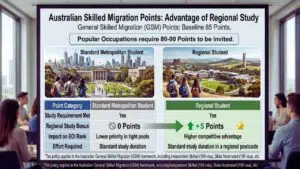
The Australian immigration system operates on a notoriously competitive points matrix where every single point counts towards your final outcome. To even lodge an Expression of Interest for independent visas, you need a baseline of 65 points, but the reality is that popular occupations often require scores closer to 80 or 90 to secure an actual invitation. By completing a diploma, degree, or trade qualification at a campus located in a designated regional area, you are rewarded with five bonus points.
Your course must meet the Australian study requirement, which generally means two academic years of full-time study. In a system where five points can easily separate a successful applicant from someone waiting in the pool for years, this is a massive free advantage. You are essentially getting rewarded just for choosing a different geographic location for your education. When you add up points for age, English proficiency, and work experience, that regional bonus often becomes the deciding factor that pushes your application over the threshold.
| Point Category | Standard Metropolitan Student | Regional Student |
| Study Requirement Met | Yes | Yes |
| Regional Study Bonus | 0 Points | 5 Points |
| Impact on EOI Rank | Lower priority in tight pools | Higher competitive advantage |
| Effort Required | Standard study duration | Standard study duration in a regional postcode |
2: You Gain Access to Longer Post-Study Work Visas
After tossing your graduation cap, you will likely apply for the Temporary Graduate visa subclass 485 to start building your career. This visa lets you stay, work full-time, and gain the crucial local experience needed to pass your skills assessment. A standard graduate usually gets a fixed duration depending on their degree level and the current immigration rules. But if you graduate from a regional institution and continue living regionally, the government grants you a massive extension.
Category 2 graduates can secure one extra year, and Category 3 graduates can get up to two extra years. Having three or four years to secure a skilled job takes the immense pressure off your shoulders and gives you breathing room to plan your next migration step. You can use this extra time to complete professional year programmes, improve your English scores, or simply save up enough money to pay for your final permanent residency application fees.
| Visa Subclass | Location of Study | Potential Post-Study Work Visa Extension |
| Subclass 485 | Sydney, Melbourne, Brisbane | No extension available |
| Subclass 485 | Category 2 Regional Centres | 1 additional year |
| Subclass 485 | Category 3 Regional Areas | 2 additional years |
| Work Rights | All Locations | Full unrestricted working rights |
3: Your Visa Applications Get Priority Processing
Nobody likes waiting, especially when your future depends on an email from the immigration department that could take months to arrive. Standard skilled visas processed in major cities can sit in a queue for a very long time, leaving applicants stuck on bridging visas with an uncertain future. The government uses Ministerial Directions to tell case officers which files to look at first and which to push to the back. Regional visas, especially employer-sponsored ones, are consistently placed at the absolute front of the processing queue.
The Australian economy relies heavily on getting skilled labour into regional towns quickly to prevent local business closures. As a regional applicant, your paperwork is handled with incredible urgency, meaning you transition from a temporary resident to a permanent one much faster than your metropolitan peers. This speed allows you to buy property, secure bank loans, and plan your life with total confidence much sooner.
| Application Queue | Visa Type | Processing Priority Level |
| General Skilled | Metropolitan Independent (189) | Standard to Low |
| State Sponsored | Metropolitan Nominated (190) | Medium |
| Regional Provisional | Skilled Work Regional (491) | High |
| Employer Sponsored | Regional Employer Sponsored (494) | Highest Priority |
4: Dedicated State and Territory Nominations Give You an Edge
Each Australian state gets a specific quota of permanent and provisional visas they can hand out to skilled migrants every single financial year. State governments are highly protective of these quotas and heavily favour applicants who already live, work, and study within their borders. South Australia, Tasmania, and Western Australia have built exceptional reputations for rewarding their local international graduates with streamlined nomination pathways.
They often lower the work experience requirements, reduce English score minimums, or publish exclusive occupation lists solely for alumni of their local universities. By studying in a regional state, you instantly become a preferred candidate for their specific state nomination programmes. You are essentially bypassing the massive federal applicant pool and competing in a much smaller, highly favourable local pool where the state government genuinely wants you to succeed.
| State Policy | Metropolitan Graduate View | Regional Graduate View |
| Loyalty Preference | Seen as transient | Seen as committed to the local state |
| Occupation Lists | Restricted to standard lists | Access to broader, exclusive graduate lists |
| Experience Needed | Often requires 1-3 years post-grad | Often reduced or waived for local alumni |
| Nomination Chances | Highly competitive | Favourable and highly accessible |
5: It Opens the Door to the Subclass 491 Visa
The Skilled Work Regional Provisional visa subclass 491 is currently the most accessible stepping stone to permanent residency in the entire Australian immigration catalogue. It allows you and your family to live, work, and study in a regional area for a full five years. The massive drawcard here is that securing a state nomination for the 491 visa gives you an incredible 15 bonus points on your migration test. This completely changes the game if you are struggling with your English test scores or lack years of overseas work experience.
Because you are already fully integrated into a regional centre through your studies, state governments view you as a low-risk, highly desirable applicant for this specific visa pathway. Transitioning onto the 491 visa feels like a natural progression rather than a stressful leap, as you simply continue living in the town you have already called home for your university years.
| Subclass 491 Feature | Detail and Benefit |
| Points Boost | Awards 15 extra points towards your total score |
| Visa Duration | Granted for 5 years with full work rights |
| Medicare Access | Grants immediate access to Australia’s public healthcare |
| Pathway to PR | Directly leads to the Subclass 191 Permanent Visa |
6: Employer-Sponsored Regional Visas Become More Accessible
Finding an employer willing to sponsor your visa is exceptionally tough in big cities because the local talent pool is overflowing with domestic graduates and established professionals. In regional towns, it is a completely different story, with local businesses constantly fighting to attract and retain good staff. Businesses in healthcare, engineering, agriculture, and hospitality constantly struggle to find qualified staff to keep their doors open.
If you secure a job locally, your employer might sponsor you through the Skilled Employer Sponsored Regional Provisional visa subclass 494. This visa is built specifically to solve regional labour shortages and offers a direct route to permanence. Because you are locally trained, familiar with the community, and ready to work immediately, regional employers are far more willing to navigate the sponsorship paperwork to keep you on their team long-term.
| Sponsorship Factor | City Employer Dynamics | Regional Employer Dynamics |
| Talent Pool Size | Massive domestic competition | Extremely limited local talent |
| Willingness to Sponsor | Low, too much paperwork | High, desperate for skilled labour |
| Staff Retention | High turnover | Strong desire to keep reliable staff |
| Applicable Visa | Subclass 482 (Often temporary) | Subclass 494 (Direct regional PR path) |
7: Cheaper Cost of Living Makes Financial Proof Easier
Migrating is an expensive process from start to finish, and poor financial planning ruins many permanent residency dreams. You have to pay for skills assessments, English tests, medical exams, and hefty visa application charges that increase every year. If you live in Sydney, the sheer cost of a tiny apartment can eat up your entire budget, leaving you financially stressed and unable to save for your visa fees.
Regional cities offer significantly cheaper rent, groceries, transport, and entertainment options. You can often rent a spacious room in Adelaide or Perth for half the price of a similar room in Melbourne, giving you a massive financial buffer. This lower cost of living makes it much easier to show proof of funds for your initial student visa, and allows you to save substantial money to fund your future migration applications without going into severe debt.
| Expense Category | Metropolitan Cost Example | Regional Cost Example |
| Weekly Rent (Room) | Exorbitantly high | Significantly more affordable |
| Daily Transport | High commuting costs | Lower costs, often walking distance |
| University Fees | Premium metropolitan pricing | Often lower base tuition fees |
| Savings Potential | Minimal, living paycheck to paycheck | High, easier to save for visa costs |
8: DAMA Agreements Open Up More Occupation Categories
Sometimes, your specific job title does not appear on the standard federal skilled occupation lists, which usually spells disaster for a migration strategy. This usually ruins a migration plan, but regional areas have a brilliant workaround called a Designated Area Migration Agreement. DAMAs are special labour agreements negotiated between local councils, regional authorities, and the federal government.
They feature highly customised occupation lists tailored to exactly what that specific town needs, including semi-skilled roles that do not qualify anywhere else. More importantly, DAMAs often include concessions for age limits, English language proficiency, and minimum salary thresholds. If your profession is niche or you cannot achieve a perfect English score, studying and working in a region covered by a DAMA could be the only viable route to secure your permanent stay in Australia.
| DAMA Advantage | Standard Visa Requirement | DAMA Concession |
| Occupation List | Strictly limited to federal lists | Custom local lists including niche roles |
| English Level | High IELTS/PTE scores required | Often accepts lower English test scores |
| Age Limit | Usually cuts off at 45 years old | Can offer age concessions up to 50+ |
| Salary Threshold | Must meet high minimum salary | Offers lower minimum income thresholds |
9: You Face Less Competition for Graduate Jobs

Passing your degree is only half the battle; the other half is landing a professional job in your field to claim vital work experience points. The graduate job market in metropolitan capitals is fiercely saturated, making it incredibly depressing for newly minted international alumni. You are competing against thousands of domestic students, permanent residents, and international peers for a handful of entry-level corporate roles.
In regional Australia, the dynamic completely flips in your favour. There is a high demand for graduate nurses, civil engineers, teachers, and IT support staff, but very few people applying for these rural and regional postings. This severe lack of competition means you can secure a professional role much faster, allowing you to start logging your post-qualification work experience the moment your graduation results are officially published.
| Job Market Factor | Metropolitan Reality | Regional Reality |
| Number of Applicants | Hundreds per graduate role | Very few qualified applicants |
| Speed of Hiring | Slow, multi-stage interviews | Fast, eager to fill vacant positions |
| Entry Level Roles | Highly competitive, demand experience | Willing to train fresh graduates |
| Work Experience Points | Hard to start accumulating | Can start earning points immediately |
10: You Can Unlock Regional Scholarships and Incentives
Studying in Australia requires a massive financial investment upfront, but picking a regional campus can significantly soften the blow to your bank account. The federal government actively funds the Destination Australia programme, which awards scholarships of up to AUD 15,000 per year to eligible students undertaking study at regional campuses.
On top of this federal money, many regional universities offer automatic international student bursaries, slashing tuition fees by 15 to 25 percent just for enrolling in their programmes. Graduating with less financial burden means you enter the workforce in a much stronger position. You will be fully prepared to tackle the expenses associated with launching your professional career, buying a car for regional travel, and funding your expensive permanent residency medicals and police checks.
| Financial Incentive | Source | Description |
| Destination Australia | Federal Government | Up to AUD 15,000 per year for regional students |
| International Bursaries | Regional Universities | Automatic 15% to 25% tuition fee reductions |
| Relocation Grants | State Governments | Occasional grants for moving to regional zones |
| Alumni Discounts | University specific | Reduced fees for studying a second degree locally |
11: A Stronger Sense of Community Helps with Networking
It is incredibly easy to feel like just another invisible number in a massive Sydney lecture hall holding five hundred people. Regional universities operate very differently, focusing on pastoral care and student integration. They have smaller class sizes, giving you direct access to your lecturers and tutors who actually remember your name and career goals. This intimate environment extends directly into the local town where people are naturally more inclined to chat and help out newcomers.
Regional communities are famously welcoming and highly connected, making it easy to build a powerful local network by joining local sports clubs or volunteering. In Australia, the hidden job market is massive, and a casual conversation at a community barbecue or a good word from your professor to a local business owner often leads directly to a secure job offer.
| Networking Aspect | City Campus Environment | Regional Campus Environment |
| Class Sizes | Massive, anonymous lectures | Small, interactive tutorial groups |
| Professor Access | Hard to get one-on-one time | Easy to build mentoring relationships |
| Local Integration | Students stick to their own bubbles | High integration with town locals |
| Job Referrals | Rely purely on online applications | Heavy reliance on word-of-mouth referrals |
12: A Clear Transition to the Permanent Residence Visa Subclass 191
The ultimate destination of the entire regional migration strategy is the Permanent Residence Skilled Regional visa subclass 191. This is the golden ticket that grants full permanent residency, allowing you to live anywhere in Australia indefinitely. To get it, you must hold a regional provisional visa like the 491 or 494 and live and work in a designated regional area for at least three years while meeting minimum income thresholds.
Because you started your journey studying regionally, you do not have to uproot your life, break a rental lease, or find a new job in a strange town to meet these strict conditions. You are already established, making the transition from a temporary graduate to the permanent 191 visa a smooth, predictable administrative step rather than a massive life disruption.
| Subclass 191 Pathway | Requirement | How Regional Study Helps |
| Prerequisite Visa | Must hold a 491 or 494 visa | You already qualify easily via regional study |
| Residency Condition | Live in a region for 3 years | You are already settled in a regional home |
| Employment Condition | Work regionally for 3 years | You already have local professional networks |
| Final Outcome | Unrestricted Permanent Residency | Seamless transition without moving cities |
Why Choosing Regional Australia Matters for Your Future?
Deciding where to spend the next three to four years of your life is not a choice to take lightly, as it heavily dictates your career trajectory. The temptation of famous metropolitan landmarks is strong, but you have to look at the long-term reality of Australian immigration policies. The government heavily restricts metropolitan migration quotas because the big city infrastructure is currently struggling to cope with rapid population growth. Planning your future around studying in regional Australia for PR means you have access to a system that actively wants you to succeed and will facilitate your paperwork.
| Strategic Advantage | Why It Matters Long-Term |
| Policy Alignment | You fit the government’s economic growth strategy perfectly |
| Job Security | Regional industries offer long-term stability and growth |
| Lifestyle Benefits | Less traffic, cleaner air, stronger community bonds |
| PR Certainty | Multiple clear pathways to the 191 permanent visa |
You are positioning yourself exactly where the economic demand is highest, turning yourself into a highly valued asset. The government rewards this strategic choice with points, processing speed, and exclusive visa categories that city students cannot touch. Beyond the sheer mechanics of migration, the regional lifestyle offers a genuinely fantastic work-life balance. You get to build a lucrative career without the crushing commute times of a major city, enjoy stunning natural landscapes, and integrate into a community that values your presence. It is a strategic decision that provides immense peace of mind, solid financial stability, and the clearest possible road map to calling Australia your permanent home.
Final Thoughts
Securing an Australian permanent visa is a long marathon, not a quick sprint to the finish line. It requires careful financial planning, immense dedication, and a strong willingness to adapt to the shifting priorities of the federal immigration department. The days of easily securing an independent visa while living in the absolute heart of Sydney or Melbourne are largely behind us. The future of Australian migration is firmly planted in the regions, and those who adapt to this reality will succeed.
Many students find that studying in regional Australia for PR is the most reliable and stress-free strategy available today. You gather crucial points effortlessly, extend your working rights by years, face far less competition for lucrative graduate jobs, and enjoy priority processing from the government. You also get to experience an authentic, high-quality Australian lifestyle with a significantly lower cost of living. Ultimately, making the choice to head out to a regional centre removes much of the crushing anxiety from the visa process. It places you on a clear, well-supported path, ensuring your hard work and heavy educational investment translate directly into the permanent residency outcome you deserve.
Frequently Asked Questions (FAQs) About Studying In Regional Australia For PR
Navigating the immigration framework naturally brings up a lot of highly specific questions and understandable anxieties. While the general rules are relatively clear, personal circumstances and changing university campuses often create confusion for international students. We have gathered some of the most uncommon but absolutely crucial questions international students ask when planning their regional migration strategy. Understanding these nuances will prevent you from making a costly mistake halfway through your degree.
1. What happens if I study at a regional campus but live in a metropolitan city?
You cannot claim the five extra points for regional study if you commute from a big city to a regional campus. The Department of Home Affairs requires you to physically live and study in a designated regional area for the entire duration of your course. Your residential address on your bank statements, utility bills, and rental agreements must consistently match the regional postcode requirement to satisfy the case officer.
2. Do short English language courses count towards the two-year regional study requirement?
No, unfortunately they do not count at all. To claim the regional study points, your core course must be registered on CRICOS and meet the strict Australian study requirement guidelines. This generally means completing a full degree, diploma, or advanced trade qualification that takes at least two academic years of full-time study. Short standalone language courses or bridging programmes do not qualify for the bonus points.
3. Can I move between different regional areas during my studies and still claim the bonus points?
Yes, you absolutely can move around. You are not locked into one specific town for your entire educational journey. If you complete one year of study in Adelaide and then transfer to a university in Hobart to finish your second year, you can still claim the points. The only strict rule is that both locations must be officially classified as designated regional areas by the government during your time there.
4. What happens if the government changes the regional postcode classifications while I am studying?
Immigration policies and postcode lists change constantly based on population data. However, if a postcode is removed from the regional list while you are halfway through your degree, the government usually applies transitional arrangements or grandfathering rules to protect current students. This means that if the area was classified as regional when you first started your course, you can typically still claim the benefits upon graduation, though you should always verify the latest legislation with a registered migration agent.





















