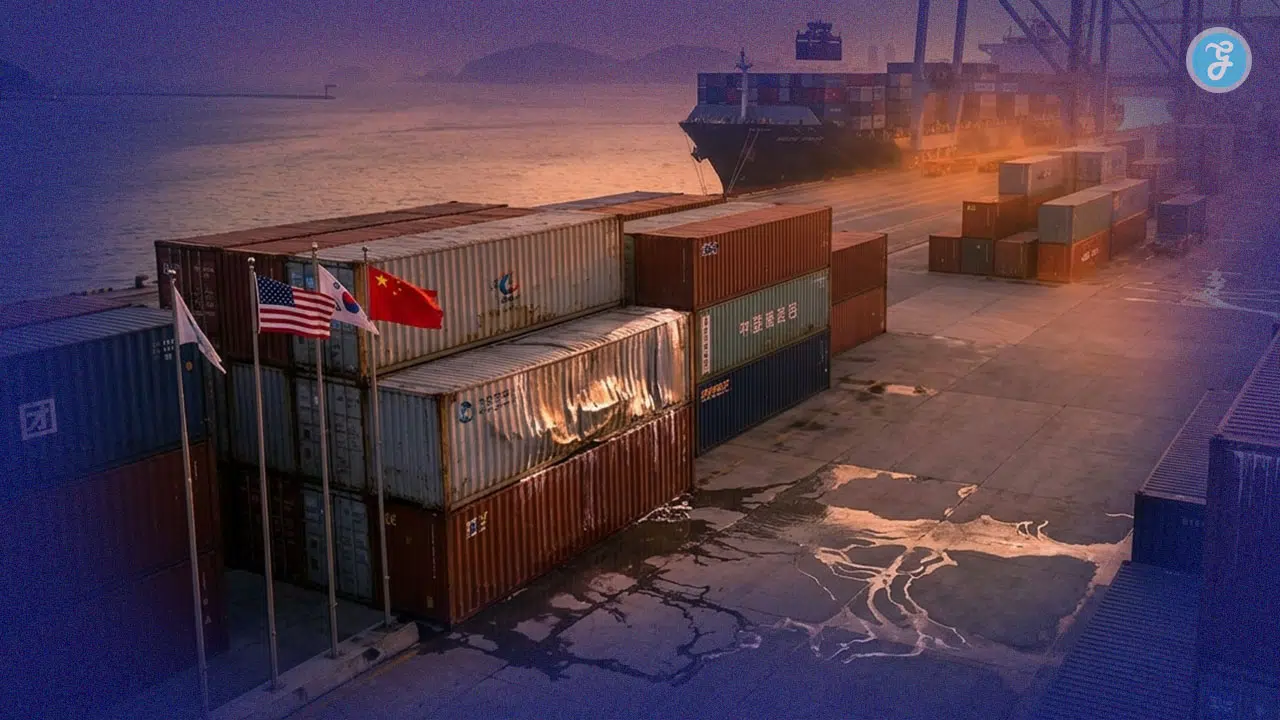
The runways at Beijing Capital International Airport remained quiet this week. There were no motorcades. No red carpets rolled across the tarmac. The anticipated “Grand Reset” of the US-China Trade War 2026 has been pushed back to May 14. In Washington, the lights are burning late, but the focus is not on tariffs or silicon. It is on the Persian Gulf.
The October 2025 Busan Summit was supposed to be the moment the world breathed again. Leaders shook hands. Markets rallied. We were told the “Cold Peace” had arrived. In reality, Busan was a geopolitical sedative. It numbed the pain without treating the infection. Now, as the administration pivots toward an escalating conflict in Iran, that sedative is wearing off.
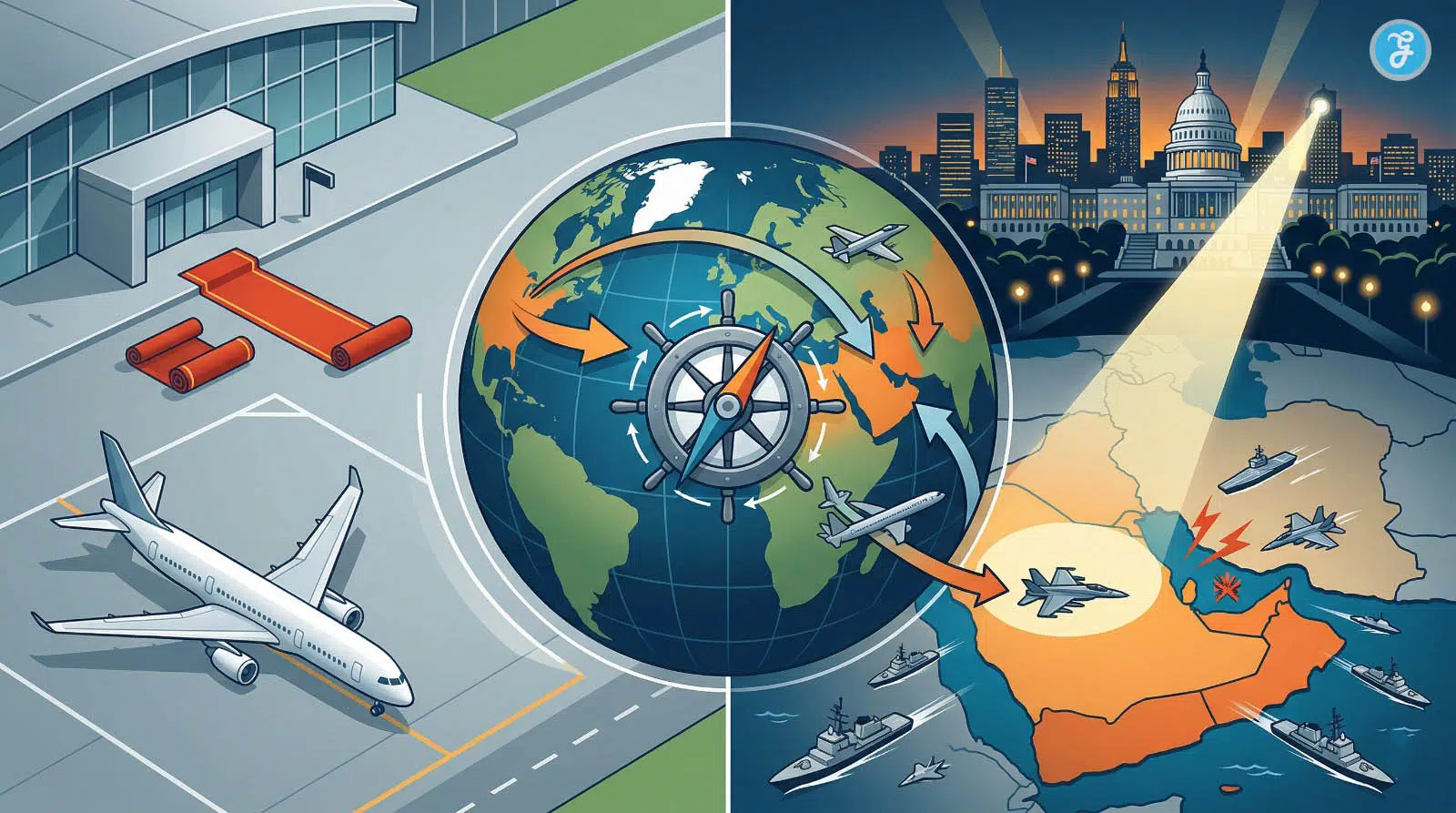
The postponement of the Beijing follow-up proves an uncomfortable truth. Diplomacy requires executive bandwidth, and Washington is currently overdrawn. The “Cold Peace” is melting. It is not failing because of a sudden trade dispute. It is failing because the American government cannot manage two existential crises at once.
The one-year clock from Busan is ticking toward October 2026. According to data from the U.S. Census Bureau, in January and February 2026, two-way trade between the United States and China plummeted by 39.9 percent compared to the same period last year, marking a total decoupling of volume from diplomatic rhetoric. While the diplomats talk of stability, the numbers tell a story of a messy, permanent divorce. We are witnessing a strategic standoff where competition is merely managed until the next fire breaks out.
The May 14 date is a gamble. It assumes that the Middle East will quiet down long enough for a two-day meeting to fix a decade of distrust. It assumes that “managed competition” is a sustainable strategy. It isn’t. The Busan Break is a reminder that in 2026, peace is often just a pause between different kinds of war.
US-China Trade War 2026: A Year of Living Dangerously
The handshake in South Korea last October felt like a breakthrough. It was a momentary lapse in hostility that global markets desperately needed. Yet, beneath the smiles, the Busan agreement was a fragile patchwork of temporary concessions. It bought time but ignored the rot at the center of the relationship.
Deconstructing the Truce
The deal was a simple trade. Beijing agreed to suspend its restrictive export controls on rare earth elements. These minerals are the lifeblood of the American defense and electric vehicle industries.

In exchange, Washington put a hold on its aggressive “50 percent ownership” rule. That policy would have effectively banned any Chinese affiliate from operating in the American tech sector. It was a trade of necessities. Neither side gave up their long-term goals. They just agreed to stop punching for a few months.
The False Sense of Security
Multinational corporations made a dangerous mistake. They treated this tactical pause as a permanent strategic shift. Investment started flowing back into trans-Pacific projects. Supply chain managers slowed down their efforts to move factories to Vietnam or Mexico. They mistook a temporary cease-fire for a lasting peace treaty. They ignored the fact that the underlying tariffs remained in place. The fundamental disagreement over who controls the future of high-tech was never settled. Businesses bet on a stability that did not exist.
The Ticking Clock
The Busan agreement came with an expiration date. It was a one-year truce set to end in October 2026. We are now halfway through that window. There has been no movement on the issues that actually matter. Intellectual property theft remains a constant friction point. Industrial subsidies in Beijing continue to flood the global market with cheap goods. Without a follow-up deal in May, the protections of Busan will vanish. The world is staring at a return to open economic warfare. The clock is not just ticking. It is accelerating.
The Refining Trap
The October truce relied on a fundamental misunderstanding of the supply chain. While Beijing agreed to “approve civilian applications” for rare earth exports through November 2026, it remains a controlled leverage point, not a policy rollback. China still holds 98 percent of the world’s heavy rare earth refining capacity. Approval authority is not openness. It is calibrated control. By allowing the flow of minerals today, Beijing is simply ensuring that Western manufacturers do not panic-fund the expensive mines and processing plants needed to replace them. It is a strategic delay, designed to keep the West dependent until the next escalation.
The Iran Distraction: Bandwidth Bankruptcy
The Biden administration once spoke of “extreme competition” with China. The current administration speaks of deals. Yet, the most important deal of 2026 is currently gathering dust. While trade officials in Washington and Beijing try to find common ground, the rest of the American government is looking toward the Persian Gulf. The “Cold Peace” is not just cooling. It is being ignored.
The Pivot from Dragon to Gulf
Washington has a bandwidth problem. For the last six weeks, the escalating conflict with Iran has consumed every ounce of diplomatic energy. The joint US-Israeli strikes on Tehran and the subsequent closure of the Strait of Hormuz have sent oil prices to $114 per barrel.
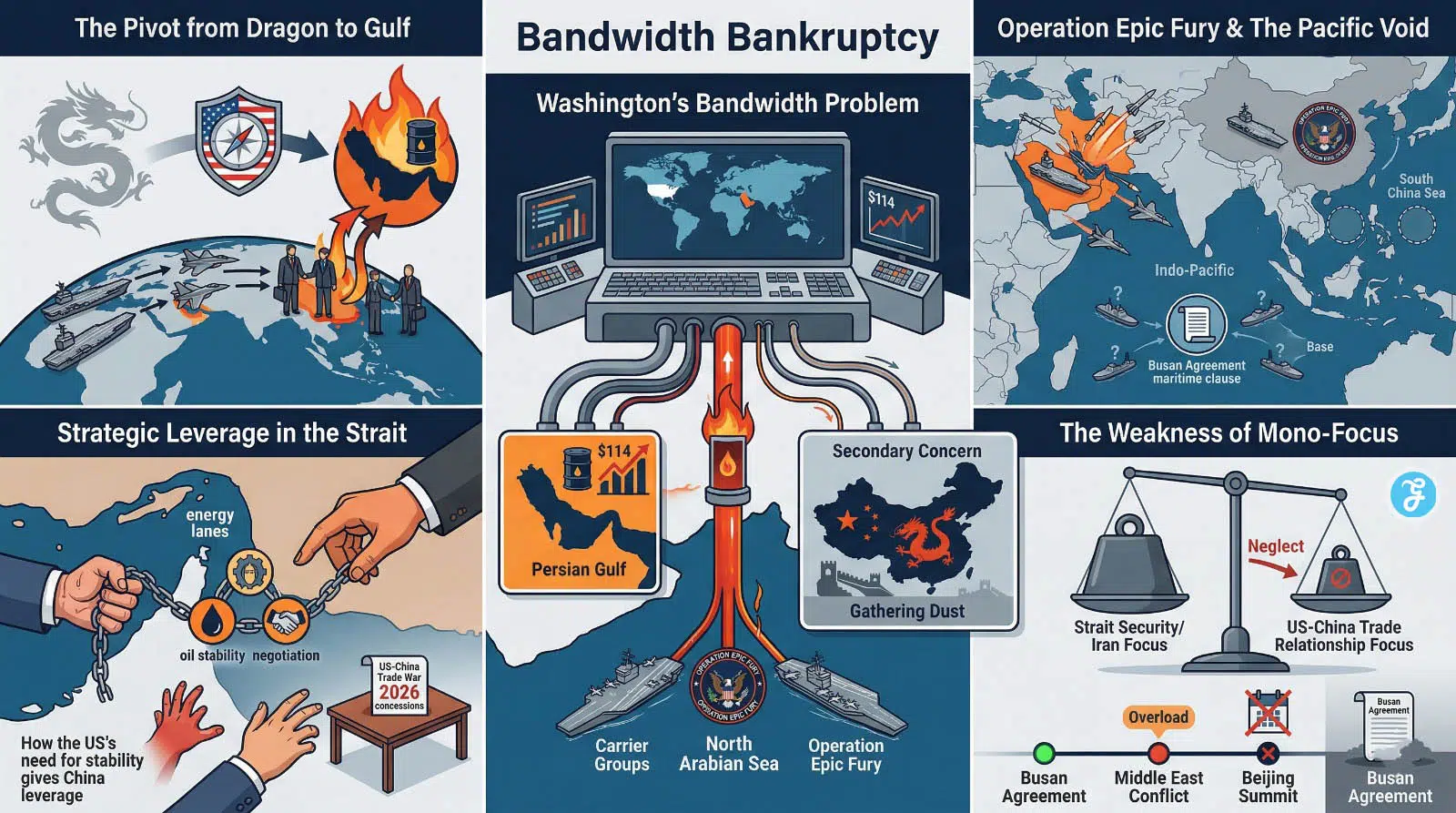
In this environment, the US-China Trade War 2026 feels like a secondary concern. The administration has moved its best negotiators and its most powerful carrier groups, including those typically stationed in the Pacific, to the North Arabian Sea to support Operation Epic Fury. Beijing is watching this shift with quiet, calculated interest.
Strategic Leverage in the Strait
China understands how to turn an American distraction into a Chinese advantage. The president recently made this link explicit by tying his upcoming visit to Beijing directly to the volatility in the Middle East. He noted that China relies on the Strait of Hormuz for a massive portion of its oil supply. The administration wants Beijing to use its leverage in Tehran to keep those energy lanes open. By vocalizing this need, Washington has accidentally handed China a powerful bargaining chip. Beijing is now in a position to demand concessions in the US-China Trade War 2026 in exchange for stabilizing the Iranian crisis. The trade relationship is no longer being judged on its own merits; it is now a hostage to the security of the Gulf.
Operation Epic Fury and the Pacific Void
The cost of the Middle East pivot is measurable in more than just missed meetings. As the administration launches “Operation Epic Fury” to secure the Gulf, the Indo-Pacific has become a secondary theater for the first time in a decade. The relocation of carrier strike groups to the Mediterranean has left a literal void in the South China Sea. Beijing is filling this space with “gray zone” activities, testing the limits of the Busan agreement’s maritime clauses. Washington is learning that you cannot deter a global rival while your primary naval assets are thousands of miles away chasing regional stability in the desert.
The Weakness of Mono-Focus
Global superpowers are historically expected to manage multiple strategic theaters simultaneously. Currently, Washington is struggling to do so. This mono-focus on Iran has left the Busan agreement in a state of neglect. When a government can only handle one crisis, it becomes reactive rather than strategic. The postponement of the Beijing summit to May 14 is a symptom of this bankruptcy. We are seeing the limits of personal diplomacy. Without a dedicated, consistent focus on the trade relationship, the progress made in Busan will simply evaporate. You cannot manage a global trade war as a part-time job.
The Great Decoupling by the Numbers
Diplomats may use the language of de-escalation, but the ledger tells a different story. While the world waits for the May 14 meeting, the physical movement of goods is already reflecting a permanent shift. The global economy is not waiting for a permission slip from the White House or the Forbidden City.
The 39.9 Percent Collapse
The start of this year provided a cold reality check for anyone hoping for a trade rebound. In January and February 2026, two-way trade between the United States and China plummeted by 39.9 percent compared to the same period last year. This is the steepest decline in nearly two decades. It suggests that the US-China Trade War 2026 is moving into a phase of structural separation. Even with the Busan truce in place, American companies are pulling back at a record pace. They are not just hedging their bets. They are closing their accounts.
The Taiwan Surge
While trade with the mainland withers, the flow of goods to Taiwan is exploding. US-Taiwan trade volume saw a staggering 80.4 percent jump in the first two months of 2026, reaching $51.81 billion. This is the ultimate provocation to Beijing. For the Chinese leadership, this is not just an economic shift. It is a strategic realignment. Every shipping container arriving in Taipei represents a step away from the integrated Pacific economy of the last thirty years. It makes the “Cold Peace” feel like a temporary mask for a much deeper and more dangerous rivalry.
Mexico as the New Frontier
The real winner in this divorce is not in Asia. It is right across the southern border. Mexico has now firmly established itself as the primary trading partner of the United States. During the first two months of this year, two-way trade with Mexico hit $147.32 billion. The consolidation of the USMCA trade bloc is effectively the death knell for the trans-Pacific era. Supply chains are becoming shorter and more regional. The era of relying on a factory six thousand miles away is over. This shift to the “Nearshore” is the most tangible evidence that the decoupling is no longer a theory. It is a daily reality for the American consumer.
China’s High-Tech Counter-Offensive
Washington is not the only side pivoting. While the US focuses on the Persian Gulf, Beijing is executing a massive redirection of its economic power. If the US-China Trade War 2026 was meant to contain Chinese growth, the early data suggests the opposite is happening. Beijing is not retreating. It is finding new ways around the blockade.
The Ships, Chips, and Autos Strategy
The Chinese government has abandoned its reliance on the American consumer. Instead, it is flooding markets in Africa, Southeast Asia, and Europe. In the first two months of 2026, Chinese exports to Africa surged sharply, with customs estimates pointing to growth in the 25-to-30 percent range.
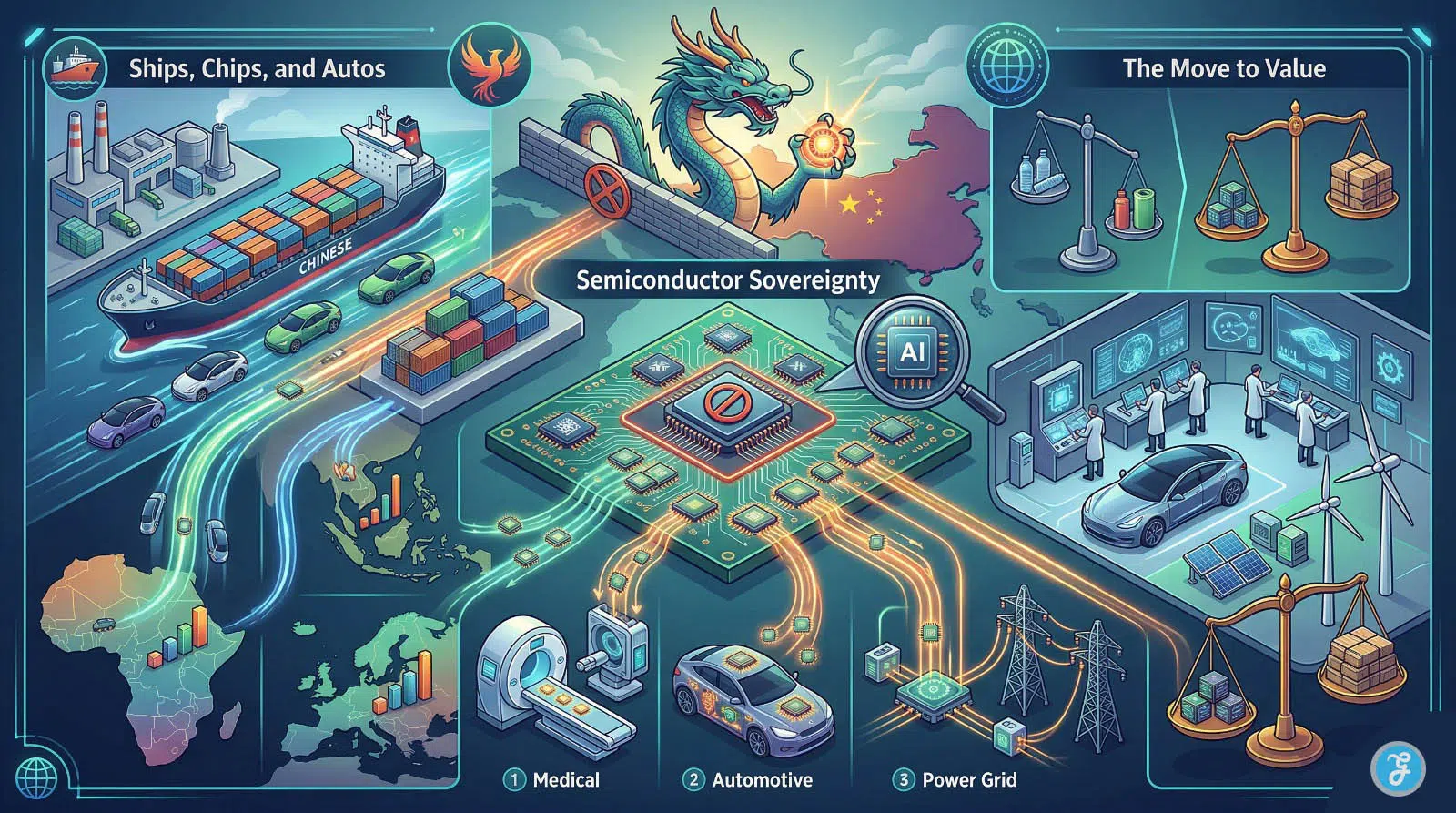
Meanwhile, exports to the European Union and ASEAN regions have seen sustained growth in the high-teens to low-twenties percent range. Beijing is using its dominance in shipping and electric vehicles to build a new trade map. By the time Washington turns its attention back to the Pacific, it may find that the world has already moved on to Chinese standards.
Semiconductor Sovereignty
The most striking defiance is happening in the tech sector. Despite heavy American restrictions on high-end equipment, Chinese semiconductor exports jumped 72.6 percent in early 2026. This growth is driven by a massive national push for self-sufficiency. Beijing is focusing on “legacy” chips—the type used in cars, medical devices, and home appliances. By flooding the global market with these essential components, China is making itself the indispensable foundation of the global tech stack. They are proving that you do not need the most advanced chips to control the most important markets.
The Move to Value
We are seeing a fundamental shift in the nature of Chinese exports. For decades, the “Made in China” label meant cheap and high-volume. That is no longer the case. In 2026, the value growth of Chinese exports is actually outpacing volume growth. This means Beijing is selling higher quality, more expensive goods. It is no longer just the world’s factory. It is becoming the world’s engineering hub. From electric vehicles that rival Western luxury brands to sophisticated green energy tech, China is no longer just a low-cost option. It has become a strategic necessity for the global energy transition.
The Legacy Chip Lock-in
While the US focuses on high-end artificial intelligence, China has secured the foundations. In early 2026, Chinese production of legacy semiconductors surged by over 70 percent. These are the chips that power the everyday world: car brakes, medical imaging, and power grids. By flooding the global market with high-quality, low-cost essential components, Beijing is creating a structural lock-in. If the US-China Trade War 2026 escalates into a full embargo, Western industries would not just lose their future; they would lose their ability to build the present. The “Cold Peace” is melting, but China has already built the infrastructure to survive the thaw.
The Fragile May Deadline: High Stakes or High Theater?
The upcoming meeting on May 14 and 15 is being billed as a rescue mission. Two days in Beijing are meant to bridge a growing chasm in the US-China Trade War 2026. However, the reality on the ground suggests a massive gap between diplomatic ambition and political possibility.
The May 14-15 Forecast
What can actually be settled in forty-eight hours? Not much. The agenda has been stripped down to “logistics” and “process management.” Negotiators are no longer talking about ending the trade war. They are talking about preventing it from becoming a total blackout. The goal for this summit is modest: agree on a date for the next summit. In the world of high-stakes diplomacy, this is the equivalent of treading water while a storm approaches.
Frustration in Zhongnanhai
Beijing is not hiding its irritation. The leadership in Zhongnanhai views the recent American scheduling changes as a sign of disrespect. To Chinese officials, the pivot to the Middle East shows that Washington does not treat the Pacific relationship as its top priority. This “unorthodox” approach to scheduling has soured the mood before the first plane has even landed. Trust is a currency that the US administration is spending rapidly. If the Chinese side feels they are being treated as a secondary concern, they have little incentive to offer meaningful concessions.
The Risk of Over-Expectation
The danger of this meeting lies in the hype. If May fails to produce a concrete roadmap, the Busan agreement will likely expire in October 2026 without a successor. We are currently living on borrowed time. If the “Cold Peace” melts completely, there is no backup plan. The world is watching to see if this is a genuine effort to save the relationship or merely a piece of political theater. If it is the latter, the economic fallout this autumn will be severe. The clock is running out on the Busan reset.
The Structural Shift: A Bird’s-Eye View
The “Busan Break” is more than a calendar conflict. It reveals a shift in how global power is actually exercised. While Washington is forced into a reactive mode by the volatility in the Middle East, Beijing is moving toward a more proactive, autonomous model. This is not just a trade war; it is a competition for the very foundation of the global economy.
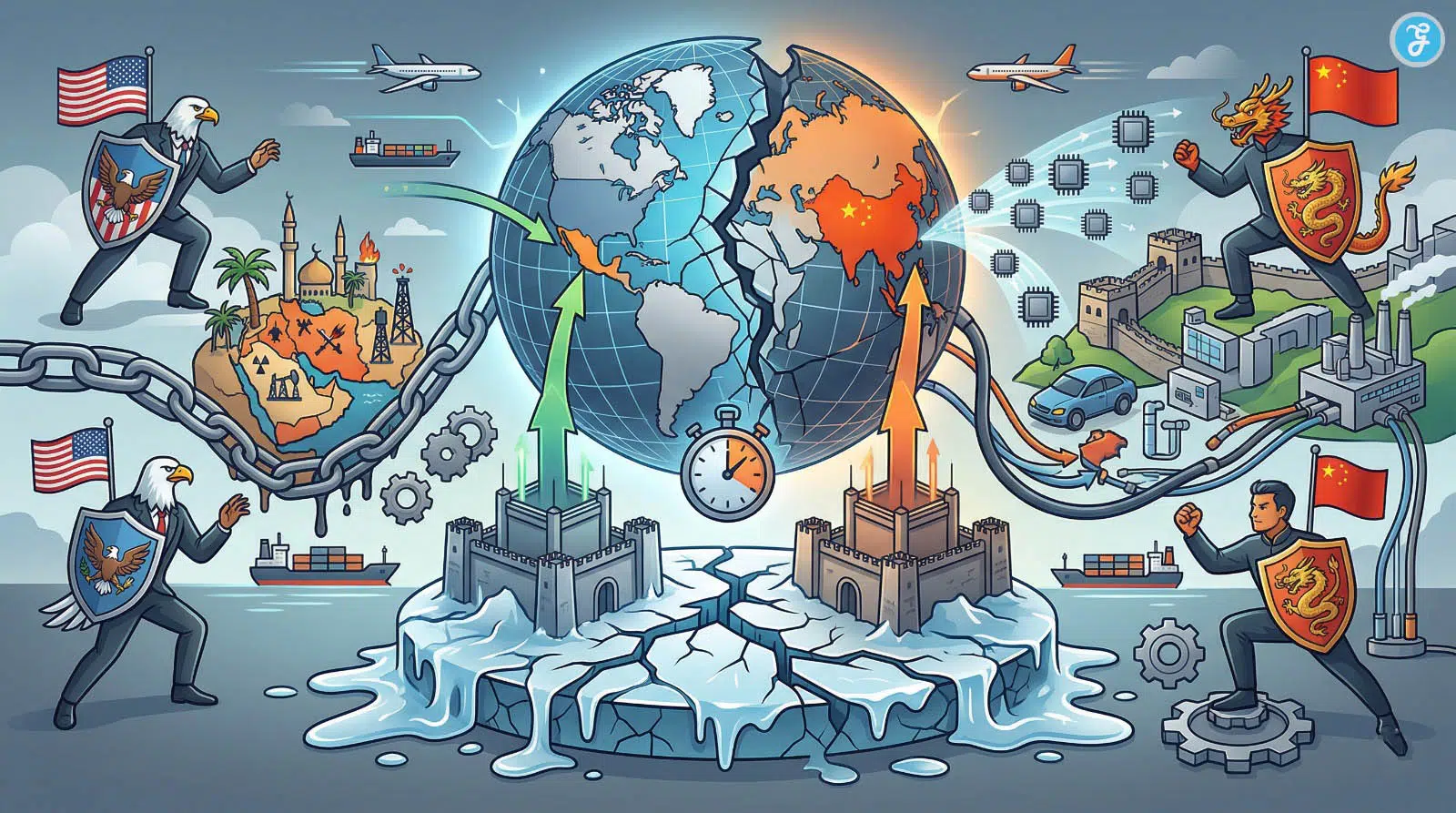
By flooding the world with legacy chips and securing its own supply chains, China is making itself indispensable. They are not waiting for American approval. They are building a world where Western industries have no choice but to rely on Chinese manufacturing. The recent pivot to the North Arabian Sea has given Beijing the room it needs to accelerate this plan.
We are seeing the end of the globalist era and the rise of regional fortifications. The surge in trade with Mexico and Taiwan is the most visible sign of this new reality. The global economy is being pulled apart by the gravity of these two superpowers. The “Cold Peace” is melting because the foundation it was built on, a single, integrated world market, is simply gone.
Beyond Managed Competition
The era of the grand bargain is over. We have entered the Post Busan period where the objective is no longer to win or even to reconcile. The goal is survival. As the US-China Trade War 2026 shifts into this more volatile phase, the pretense of a “reset” has become a liability. The global economy is recalibrating in real time. It is moving toward a world of fragmented blocs and regional fortifications.
The “Cold Peace” did not fail because of a lack of effort. It failed because it was built on a foundation of temporary convenience. It was a tactical pause in a structural conflict. A realistic foreign policy must now acknowledge that the unipolar trade world is dead. We cannot wish away the decoupling that the numbers already confirm.
When the negotiators finally meet in May, they will be facing a world that looks very different from the one they imagined in South Korea last year. The focus keyword for the future is resilience, not integration. We are witnessing the birth of a new, harsher global order. It is a world where the two largest economies live in a state of permanent, managed friction. The Busan Break was not a mistake. It was an honest reflection of a relationship that has run out of easy answers.