You want to make money trading currencies, but you keep losing. Price movements are watched and charts are studied—yet trades still fail. Many retail traders face this exact same problem. They jump into currency pairs without a solid plan. They guess instead of using proven methods, and their accounts shrink fast.
It is a frustrating cycle.
Here is the reality of today’s market: specific forex trading strategies are essential to achieving consistent profits. The right tools are already available. Platforms like MetaTrader 4, MetaTrader 5, and TradingView provide everything needed to trade effectively. Retail traders have access to the same core resources used by professionals.
This guide covers ten proven approaches that work in modern markets. It includes everything from fast-paced scalping methods to longer-term swing trading setups. Each strategy outlines clear steps along with essential risk management techniques to help protect capital.
Stop guessing and start trading with confidence.
Understanding Forex Trading Strategies
Forex trading strategies form the backbone of successful currency market trading. A strategy acts as your roadmap. It guides you through price movements, market trends, and trading sessions.
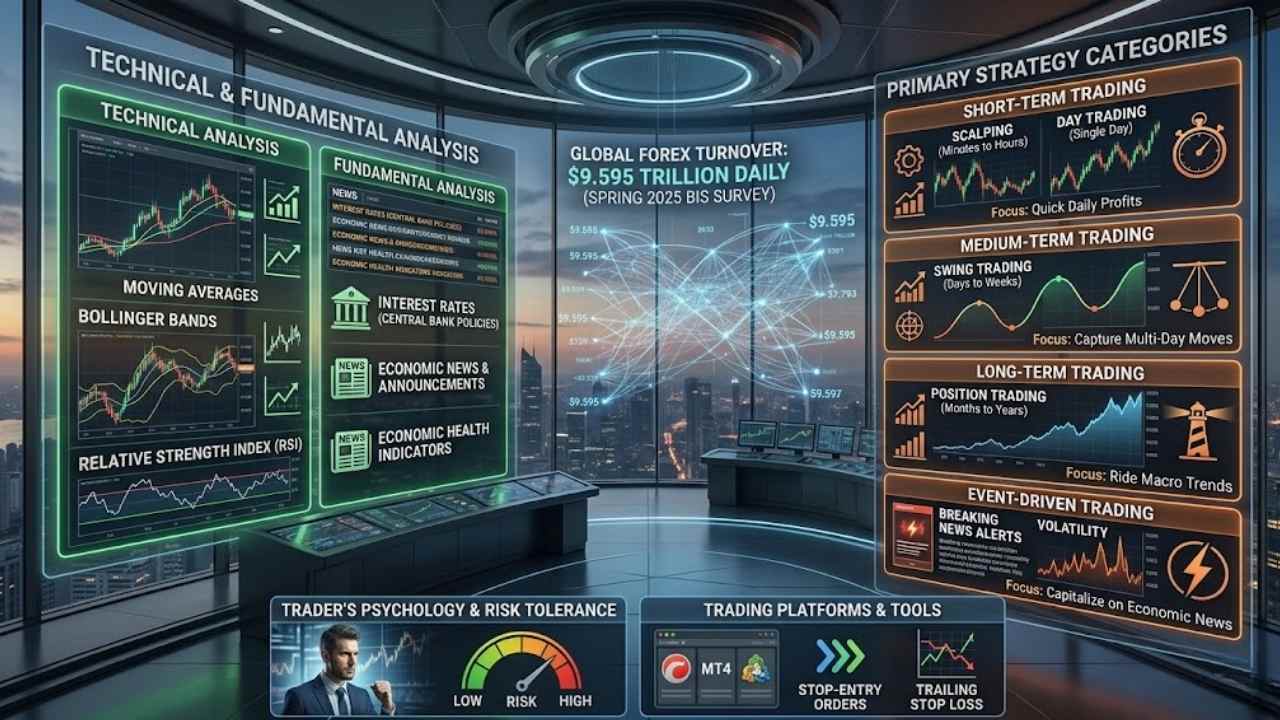
The market is absolutely massive right now. A Spring 2025 Bank for International Settlements survey revealed that average daily forex turnover hit a record $9.595 trillion. You need a clear plan to handle that kind of volume.
Traders use technical analysis tools like moving averages, Bollinger bands, and the relative strength index to spot opportunities. Fundamental analysis matters too. Interest rates set by the central bank and economic news shape currency values.
The best traders combine both methods to make smart decisions about EUR/USD, GBP/USD, and other major pairs. Different strategies work for different traders based on their goals and how much risk they can handle.
Here are the primary categories of strategies you will encounter:
- Short-term trading: Includes scalping and day trading for quick, daily profits.
- Medium-term trading: Uses swing trading to capture moves over several days.
- Long-term trading: Relies on position trading to ride macro trends for months.
- Event-driven trading: Capitalizes on economic news and major market announcements.
Your trading psychology and risk tolerance shape which approach fits you best. Tools like MT4 and cTrader help traders execute these strategies with precision. Features like stop-entry orders and a trailing stop loss protect your capital from big losses.
Top 10 Forex Trading Strategies That Actually Work
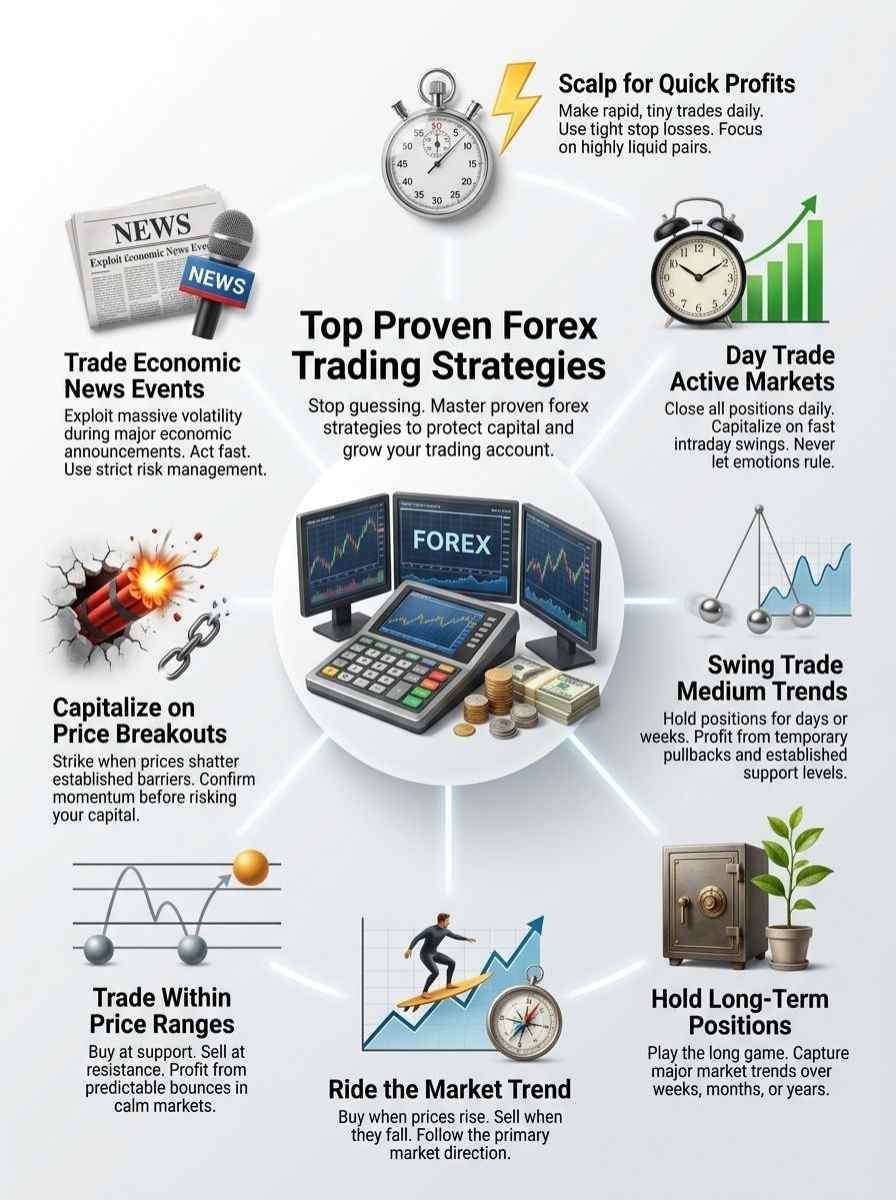
Traders use ten proven strategies to make money in the forex market every single day. Each strategy works best for different traders, market conditions, and time frames.
Before we break down each specific method, here is a quick overview of how these popular options compare based on time commitment and holding periods.
| Trading Strategy | Average Holding Time | Required Time Commitment |
|---|---|---|
| Scalping | Seconds to minutes | Very High |
| Day Trading | Minutes to hours | High |
| Swing Trading | Days to weeks | Medium |
| Position Trading | Months to years | Low |
Scalping Strategy
Scalping stands as one of the most important and popular forex trading strategies for people who want quick profits. Scalpers make many small trades throughout the day. They hold positions for just seconds or minutes.
They target tiny price movements, usually aiming for just 5 to 10 pips per trade. They often use momentum indicators and the relative strength index (RSI) to spot fast opportunities.
This approach works best in liquid markets where currency pairs move constantly. For example, trading the EUR/USD is ideal because US brokers often provide spreads below 1 pip on this pair.
Scalpers must stay glued to their screens and react fast. They typically use a forex VPS to cut delays and grab every possible profit. The strategy demands strict discipline.
To succeed at scalping, you need specific technical advantages:
- A high-speed internet connection to prevent trade execution lag.
- Direct market access software to execute your trades instantly.
- A tight stop loss on every single position to prevent wipeouts.
- A focus on high-frequency trading times, like the London open.
Technical analysis forms the backbone of this method. Traders read candlestick patterns and use exponential moving averages to spot momentum shifts in real time.
This strategy suits active traders who thrive on fast action. Scalpers often trade the same currency pairs repeatedly to learn their unique behavior patterns.
Day Trading Strategy
Day trading represents a commonly used forex trading strategy that appeals to active traders in the currency markets. These traders buy and sell currency pairs within a single trading day.
They close all positions before the market shuts down, avoiding overnight fees. Day traders use tools like the stochastic oscillator and candlestick strategy to spot quick price movements.
If you trade from the US, the absolute best time for day trading is the New York and London overlap. This period runs from 8 AM to 12 PM Eastern Time, offering the highest liquidity and tightest spreads of the day.
Market sentiment and technical analysis help day traders make split-second decisions. The EUR/USD currency pair alone moves an average of 90 to 120 pips on a normal day. This gives day traders plenty of room to catch profitable swings.
“The secret to day trading isn’t finding a magic indicator. It is about waiting patiently for the perfect setup during the most volatile hours.”
Risk management techniques matter most here. A trader might use algorithmic forex trading systems to execute trades faster than humans can think.
Day trading demands discipline, sharp focus, and quick thinking. Grid trading and mean reversion strategy approaches work well for day traders who trade the same price ranges repeatedly.
Success comes from following a solid plan and sticking to your stop losses. Day traders who master these skills turn fast market movements into real profits.
Swing Trading Strategy
Swing trading sits among the most popular forex trading strategies for traders seeking medium-term opportunities. This approach captures price movements over days or weeks.
You hold positions longer than scalpers do, but shorter than position traders. A typical swing trade lasts anywhere from two to six days.
Because you hold trades overnight, you must factor in swap fees. These are overnight interest rates applied by your broker that can either add to your profit or eat into your margins.
Swing traders use technical analysis tools like parabolic SAR and Fibonacci retracements to spot entry points. They profit from temporary price pullbacks within larger trending movements.
This strategy works wonderfully on major cross pairs. Here are a few ideal currency combinations for swing trading:
- EUR/JPY: Offers clear, sustained trends over several days.
- GBP/AUD: Provides high volatility for wider, more profitable price swings.
- USD/CAD: Reacts beautifully to oil price changes and economic shifts.
- AUD/NZD: Great for predictable, range-bound swing trading.
You can also trade forex CFDs, indices CFDs, commodities CFDs, and shares CFDs using these same swing trading methods. Machine learning and sentiment analysis now help traders identify swing opportunities much faster.
Swing trading requires solid risk management techniques to succeed. You must set stop losses below support levels and take profits near resistance points.
Position Trading Strategy
Position trading is the long game in forex. Traders hold currency pairs for weeks, months, or even years to capture major market moves.
This strategy works best when you follow the big trends and let your money sit tight. You pick a direction based on strong technical analysis and fundamental analysis.
Position traders rely heavily on macro-economic data. For example, many US traders study the CFTC Commitments of Traders (COT) report. This report is released every Friday at 3:30 PM Eastern Time and shows exactly where institutional money is moving.
Unlike scalping or day trading, position trading demands deep patience. You do not need quick fingers to win here.
Here is how position trading compares to short-term scalping:
| Feature | Position Trading | Scalping |
|---|---|---|
| Goal per Trade | 500+ pips | 5 to 10 pips |
| Chart Timeframe | Daily and Weekly charts | 1-minute to 5-minute charts |
| Stop Loss Size | Very wide (100+ pips) | Very tight (3-5 pips) |
Position traders use tools like Fibonacci levels and linear weighted moving averages to spot entry points. They set their stops far away from the current price, giving the trade room to breathe.
The carry trade strategy often pairs well with position trading. This lets you earn interest while you hold your fx positions based on the interest rate differential between two countries.
You need a solid plan and clear goals. This approach suits traders who have other full-time jobs, since you do not need to watch charts all day long.
Trend Trading Strategy
Trend trading strategy sits at the core of forex success. It follows Dow Theory principles to catch sustained market movements.
You identify the direction that prices are moving, and then you ride that wave until it stops. This approach works perfectly because markets trend more often than they stay flat.
To confirm a long-term trend, the 200-day Simple Moving Average (SMA) is the absolute gold standard. If the price sits above the 200-day SMA, the market is in a confirmed uptrend.
Your goal is delightfully simple. Buy when prices go up, and sell when prices go down.
Smart trend traders follow a few basic rules to stay safe:
- Never try to pick the exact top or bottom of a market move.
- Use trailing stop losses to lock in profit as the trend grows.
- Ignore minor daily news spikes that do not break the main market structure.
- Wait for a clear, obvious pullback before entering a new position.
Technical analysis tools like trend envelopes v2 help traders see these movements clearly on their charts. You watch support and resistance levels to confirm that a trend remains strong.
Quantitative trading systems also use trend following logic to automate decisions. Banks and large institutions rely on trend following strategies because they work across different time frames and market conditions.
Range Trading Strategy
Range trading works like fishing in a pond with clear boundaries. Traders spot currency pairs that bounce between two defined price levels, called support and resistance.
You buy near the bottom price and sell near the top price. This strategy makes money from price movements within defined ranges, rather than chasing big trends.
To confirm a market is actually ranging, professionals use the Average Directional Index (ADX). A reading below 25 on the ADX indicator strongly suggests a weak or sideways market.
The range trading forex strategy allows traders to profit from currency pairs moving sideways. You do not need dramatic price swings to succeed.
“The biggest mistake in range trading is assuming the range will last forever. Always place a tight stop loss just outside the boundary to protect yourself from sudden breakouts.”
Grid trading strategy and range trading share similar DNA. Both methods divide price action into sections and capitalize on repetitive, predictable movements.
This method works best in calm market conditions when prices lack strong directional momentum. News trading strategy differs sharply here, since economic events can easily shatter your range.
Breakout Trading Strategy
Breakout trading is a popular strategy that profits from sudden price movements. Traders watch for the exact moment when a currency pair breaks through established support or resistance levels.
This approach works best when prices have been stuck in a tight box for a while. The market builds up energy like a coiled spring.
To measure the potential power of a breakout, traders often use the Average True Range (ATR) indicator. A spike in the ATR shows that volatility is expanding, which validates the breakout.
To avoid dangerous fakeouts, look for these four confirmation signals:
- A noticeable increase in trading volume as the price breaks the line.
- A candle that closes firmly outside the support or resistance zone.
- A fundamental news catalyst pushing the price in the new direction.
- A price close well beyond the previous swing high or low.
CFD trading strategies often use this same principle. It lets traders profit from big price swings without owning the actual currency.
High-frequency forex trading firms use breakout detection algorithms to spot these moments in milliseconds. You will want to set your stop loss just inside the old range to protect your account if the breakout fails.
Retracement Trading Strategy
Retracement trading takes advantage of temporary price pullbacks within larger trending movements. Traders spot when a currency pair pulls back from its main trend, and then jump back in at better prices.
This approach works beautifully because markets never move in straight lines. They naturally zigzag upward or downward to shake out weak positions.
Traders rely heavily on Fibonacci retracements to find these specific entry zones. The 61.8% level is known as the golden ratio and is widely respected by US traders looking for a solid bounce.
You find support and resistance levels, wait for the price to bounce back, and then enter your trade. Counter-trend forex trading sometimes confuses this strategy, but retracement traders actually follow the main trend.
News Trading Strategy
Economic news moves currency markets faster than almost anything else. Traders who trade on news make decisions based on economic reports and central bank announcements.
The absolute biggest event for US traders is the Non-Farm Payrolls (NFP) report. Released on the first Friday of every month at 8:30 AM Eastern Time, it routinely causes 50 to 100 pip swings in a matter of seconds.
The news trading strategy involves watching an economic calendar closely. You identify high-impact events and place trades right before or after these announcements hit the market.
This strategy carries significant risk because volatility spikes dramatically during news events. Market spreads can widen instantly, causing dangerous slippage on your market orders.
Price Action Trading Strategy
Price action trading strategy cuts through the noise. Traders who use this method read raw price movements instead of relying on complex, lagging indicators.
They study exactly how prices move, where they bounce back, and where they break through support and resistance levels. This approach works because price action reveals what other traders are actually doing right now.
One of the most powerful price action signals is the “pin bar” candlestick pattern. A pin bar has a long tail and a small body, showing clear market rejection of a specific price level.
To master price action, focus on these core elements:
- Candlestick shapes: Learn to read the story behind the wicks and bodies.
- Swing highs and lows: Identify the natural rhythm of the market trend.
- Consolidation zones: Spot areas where buyers and sellers are fighting for control.
- Trendline breaks: Catch the exact moment that market momentum shifts.
Breakout trading and retracement trading both fit nicely into price action work. The fakeout strategy and turn trade strategy represent advanced techniques that help traders handle tricky markets.
Price action trading requires practice, but it teaches you to see markets clearly. Your eyes become your absolute best tool.
Key Elements of a Successful Forex Trading Strategy
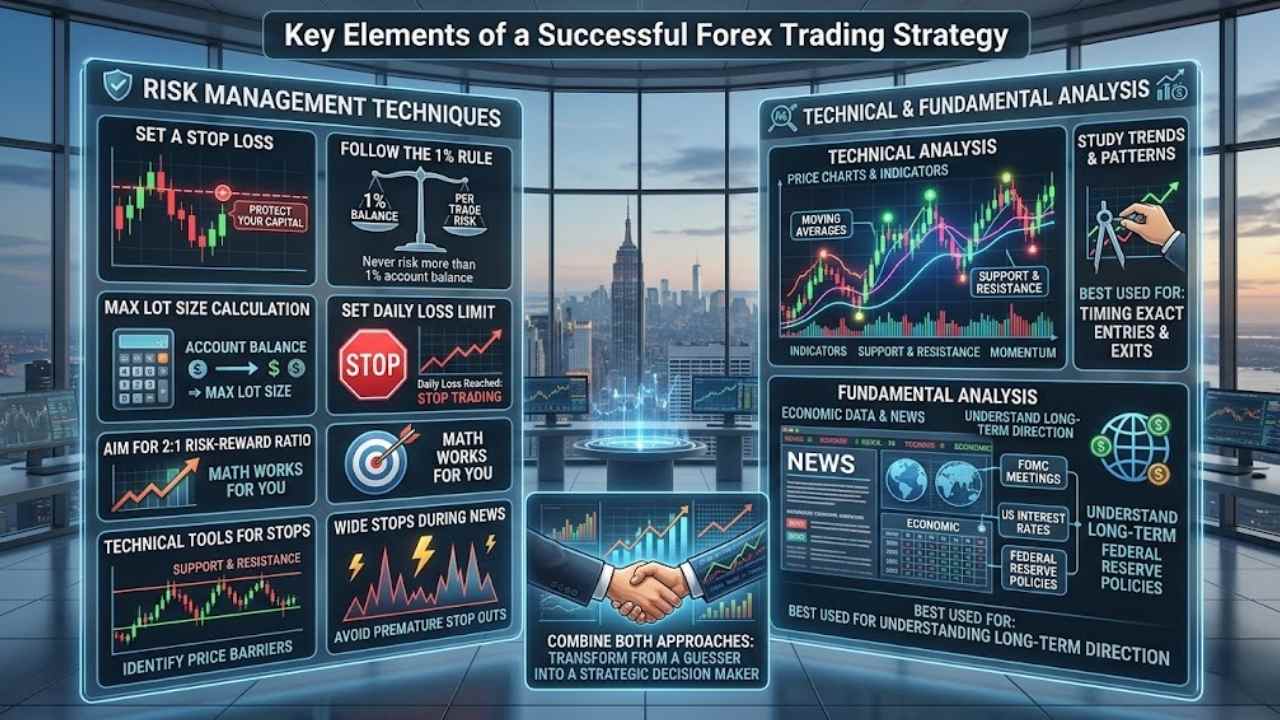
Every trader needs two vital things to win consistently. You must have smart risk management and solid market analysis.
You must protect your money first. Only then should you make your moves based on what the charts and economic news tell you.
Risk Management Techniques
Risk management will make or break your forex trading career. You must set a stop loss on every single trade you place.
Most successful traders strictly follow the 1% rule. This means they never risk more than one percent of their total account balance on a single trade idea.
US traders also need to follow the NFA’s FIFO (First In, First Out) rule. This regulation prevents you from hedging the same currency pair in the same account simultaneously.
To protect your account effectively, follow these critical steps:
- Calculate your maximum lot size based entirely on your account balance.
- Determine your stop loss level before you ever enter the trade.
- Set a daily loss limit, and stop trading immediately if you hit it.
- Aim for at least a two-to-one risk-reward ratio to make the math work for you.
Technical analysis tools help you identify exactly where to place your stops. Support and resistance levels show you natural price barriers in the market.
News trading strategy requires extra caution because economic events create sudden price swings. Always use wider stops during major announcements to avoid getting stopped out prematurely.
Importance of Technical and Fundamental Analysis
Technical analysis gives traders a very clear picture of price movements and market trends. Traders study charts, patterns, and momentum indicators to spot where prices might go next.
Tools like moving averages, support levels, and resistance points help traders make smart, objective decisions. Jeff Sekinger and other successful traders emphasize that technical tools work best when applied with strict discipline.
Fundamental analysis looks at the bigger economic picture. For example, the Federal Reserve’s Federal Open Market Committee (FOMC) meets eight times a year to set US interest rates. These specific rate decisions heavily dictate the long-term value of the US dollar.
Here is a quick look at how the two approaches compare:
| Analysis Type | Primary Focus | Best Used For |
|---|---|---|
| Technical Analysis | Price charts and indicators | Timing exact entries and exits |
| Fundamental Analysis | Economic data and news | Understanding long-term direction |
Retracement trading strategy becomes much more reliable when you grasp the economic forces pushing prices around. Smart traders mix both approaches together.
Technical signals show you the exact timing, while fundamental data shows you the long-term direction. This combination transforms you from a guesser into a strategic decision maker.
How to Choose the Right Forex Trading Strategy
Picking the right forex trading strategy matters much more than most traders think. You want to perfectly match your approach with your personal trading style and money goals.
Your choice will naturally shift based on whether markets stay calm or swing wildly. Smart traders pay close attention to current market conditions before they place their first order.
Assess Your Trading Style and Goals
Your trading style shapes every single decision you make in the forex markets. Your financial goals determine which specific strategies will work best for your unique situation.
Before adopting a new method, ask yourself these crucial questions:
- What is your personality type? Scalping strategy demands quick decisions, while swing trading allows much more time to think and plan.
- How much time can you dedicate? Day trading requires constant attention during market hours. Position trading lets you check the markets just once a day.
- What is your true risk tolerance? Some traders handle large price swings easily, while others feel anxious immediately. The US NFA limits major pair leverage to 50:1, which already caps some of your extreme risk.
- Are you skilled at chart reading? Trend following strategy is a fundamental approach that requires solid chart reading abilities.
- What is your starting capital? Your account size dictates your position sizing and limits the strategies you can safely execute.
Examine your schedule flexibility throughout the week. Some people work full-time jobs and can only trade in the evenings, making long-term strategies a much better fit.
Consider Market Conditions and Volatility
Market conditions shift constantly, and volatility changes how your trades perform. Understanding these unseen forces helps you pick the right forex trading strategy for any given situation.
To gauge total market fear or confidence, many US traders monitor the CBOE Volatility Index (VIX) or the US Dollar Index (DXY). High volatility creates massive opportunities but also severe risks.
Keep these conditions in mind as you trade:
- Low Volatility: Often favors range trading forex strategy, where you profit from currency pairs bouncing between defined price ceilings and floors.
- High Volatility: Suits breakout strategy approaches, since prices shatter established support levels more forcefully.
- News Events: Economic announcements create sudden volatility spikes, making news trading strategies highly effective.
- Clear Momentum: A trend trading strategy works beautifully when the market shows clear, sustained directional movement.
- Choppy Action: Scalping strategy remains popular during unpredictable sessions, as traders capture tiny, rapid price movements.
Momentum indicators and natural language processing tools help assess current market sentiment. They give you data-driven insights to adjust your approach on the fly.
Final Thoughts
You have just learned ten powerful forex trading strategies that work in real markets today. Each path offers a different way to profit, depending entirely on your personal style and goals. Success comes from picking a strategy that fits your personality. You must apply solid risk management and strong technical analysis to back up every trade.
Your ability to read charts, understand economic news, and protect your capital matters immensely. Jumping between methods every week will only hurt your account. Start with one strategy and practice it until you master it completely. Watch your trading results improve steadily over time.
Take action today. Pick your first strategy, and begin your journey toward becoming a confident trader who consistently makes money.