
The global tech market moves incredibly fast, and tracking where companies protect their intellectual property gives us the clearest map of the future. The artificial intelligence sector isn’t just a buzzword anymore; it dictates national security, economic dominance, and global trade flows. Looking at the data from 2024 through early 2026, the concentration of innovation reveals a massive gap between the absolute leaders and the rest of the pack. Governments heavily subsidize research, corporate giants pour billions into machine learning models, and patent offices are completely overwhelmed. Understanding the top countries with the most AI patents requires looking past the raw application numbers to see the geopolitical strategies, private funding disparities, and deep-tech focus areas that drive true market leadership.
The Global Intellectual Property Race
Tracking where tech companies file their intellectual property gives us the clearest map of global economic priorities and technological momentum. The raw data from 2024 and early 2026 shows a massive concentration of talent, compute power, and venture capital in just a few strategic regions across the globe. As nations aggressively scramble to secure their digital sovereignty, patent offices are completely overwhelmed with complex machine learning and generative algorithm applications. Top countries with the most AI patents completely dominate this landscape, leaving the rest of the world fighting over highly specialized, regional niches. Asian economies command the sheer volume of filings, while Western markets prioritize foundational software and massive private funding rounds.
| Global Patent Metric | 2024/2025 Data Point | Market Implication |
| Global Patent Applications | 3.7 Million (+4.9% YoY) | Fastest growth rate since 2018, driven heavily by computer tech. |
| Asian IP Office Share | 70.1% of all global filings | Asia acts as the unquestioned hub of hardware and AI volume. |
| Global Patents in Force | 19.7 Million (+6% YoY) | Companies fiercely protect legacy tech while pushing frontier models. |
| AI Patent Families (GenAI) | Exponential Growth | Massive spike in deep learning models capable of generating text/images. |
Why AI Patenting Matters Now
We are witnessing an unprecedented surge in intellectual property protection. Innovators submitted a record-breaking 3.7 million patent applications worldwide in 2024, representing a 4.9% increase over the previous year and marking the fifth consecutive year of sustained growth. Asia serves as the absolute epicenter of this activity, with regional IP offices receiving seven out of every ten patent applications filed worldwide. You don’t see this kind of localized concentration in many other industries.
When you dig into the AI patent landscape, the numbers get even more staggering. The World Intellectual Property Organization (WIPO) notes that computer technology, which heavily encompasses machine learning and pattern recognition, recently became the leading field for applications at the European Patent Office (EPO), surging past medical technology with over 16,800 applications in a single year. This growth isn’t just about writing code; it’s about owning the foundational algorithms that will power the next century of enterprise software, autonomous vehicles, and industrial robotics. The gap between the nations that create AI and the nations that merely consume it is widening rapidly, and the intellectual property data proves it.
China’s Absolute Dominance in AI Innovation
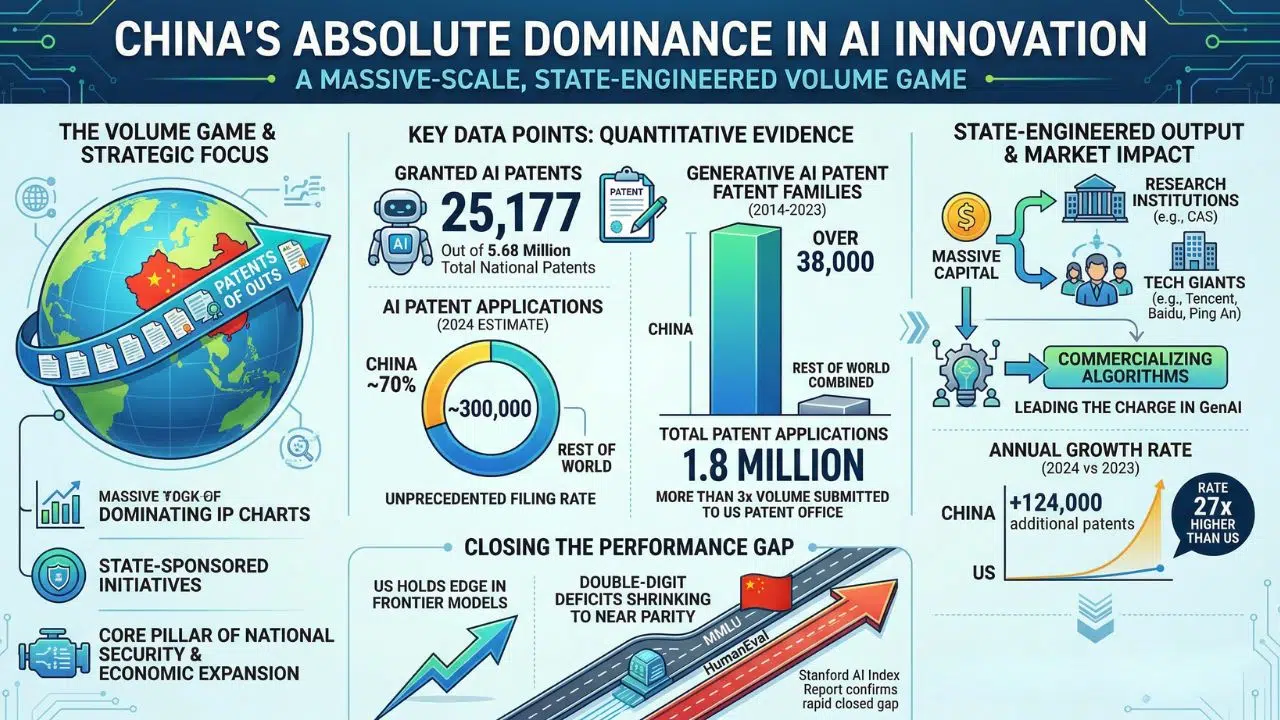
China plays a volume game that no other nation on earth can currently match, dominating the global intellectual property charts across nearly every tech sector. State-sponsored initiatives drive massive capital into research institutions, ensuring that domestic entities file applications at an unprecedented rate. The country treats artificial intelligence development as a core pillar of its national security and economic expansion strategy. While critics often debate the commercial viability of every single filing, the sheer scale of China’s output reshapes the global technology supply chain. Top countries with the most AI patents list simply cannot be discussed without acknowledging China’s insurmountable lead in raw numbers.
| Chinese AI Ecosystem Fact | Data Point | Strategic Focus |
| Granted AI Patents | 25,177 | Total market dominance in overall volume. |
| Total National Patents | 5,688,867 | Broad industrial and technological protection. |
| Generative AI Patent Families | ~38,000 (2014-2023) | Surpasses all other nations combined in GenAI. |
| Key Innovators | Tencent, Baidu, CAS | Blend of state-backed academia and corporate tech giants. |
State-Backed Mega-Corporations Lead the Charge
China sits comfortably at the number one spot, securing 25,177 granted AI patents out of a massive 5.68 million total national patents. To put this into perspective, Chinese entities filed approximately 300,000 AI-related applications in 2024 alone, accounting for roughly 70% of the world’s artificial intelligence patent applications. The National Intellectual Property Administration of China (CNIPA) received 1.8 million total patent applications in 2024, which is more than three times the volume submitted to the US Patent and Trademark Office.
This output doesn’t happen organically; it is highly engineered. State-sponsored initiatives push massive capital into research institutions like the Chinese Academy of Sciences (CAS), which frequently out-patents private corporations. However, tech giants like Tencent, Baidu, and Ping An Insurance Group lead the charge in commercializing these algorithms. China’s absolute dominance is especially visible in the generative AI sector. Between 2014 and 2023, Chinese innovators filed over 38,000 patent families specifically for GenAI, completely eclipsing all other nations combined. Furthermore, China issued approximately 124,000 additional patents in 2024 compared to 2023, a rate 27 times higher than the US. While the US still holds an edge in producing the highest-tier frontier models, the Stanford AI Index report confirms that Chinese models have rapidly closed the performance gap on major benchmarks like MMLU and HumanEval, shrinking double-digit deficits to near parity.
The United States Prioritizes Quality and High-Impact Models
The United States takes a distinctly different approach to protecting artificial intelligence inventions, prioritizing high-impact foundational models over sheer volume. Regulatory frameworks and stringent patent office guidelines push American companies to file carefully crafted, highly practical applications rather than flooding the zone. The focus remains heavily on deep learning, generative models, and the core software infrastructure that powers global enterprise operations. While it trails China in raw application numbers, the U.S. commands massive influence through the creation of the world’s most capable large language models. The top 12 countries with the most AI patents highlight this intense rivalry between American software quality and Asian filing volume.
| US AI Ecosystem Fact | Data Point | Strategic Focus |
| Granted AI Patents | 17,307 | High-quality, market-defining software models. |
| Private AI Investment | $471 Billion | Dwarfs the rest of the world combined. |
| Notable AI Models (2024) | 40 Models | Focuses heavily on frontier capability and enterprise tools. |
| Key Innovators | IBM, Microsoft, Google | Corporate-led innovation scaling rapidly across global markets. |
The Private Funding Disconnect
The United States holds 17,307 granted AI patents, maintaining a very strong but distant second place globally in terms of volume. However, the U.S. approach focuses heavily on market-defining technologies rather than incremental patent padding. In 2024, U.S.-based institutions produced 40 highly notable AI models, significantly outpacing China’s 15 and Europe’s three. Giants like IBM, Microsoft, Google, and Qualcomm file thousands of applications annually, dominating the software and foundational model ecosystem.
A fascinating disconnect emerges when you compare patent volume to private capital. The United States leads the world in private AI funding by an absurd margin, raising an unprecedented $471 billion—more than the rest of the world combined. To put that in context, China sits in second place for funding with $119 billion. Why does the US dominate funding but trail in patents? The U.S. Patent and Trademark Office (USPTO) maintains rigorous standards for software patents. Because mathematical relationships and algorithms are often considered abstract ideas under US patent law, tech companies must demonstrate a clear, practical application to get an AI patent approved. This forces companies to file highly detailed, robust patents, or simply keep their core algorithms protected as trade secrets. Furthermore, training frontier models is getting wildly expensive; OpenAI’s GPT-4 cost an estimated $78 million in compute to train, while Google’s Gemini Ultra hit $191 million. U.S. capital flows toward scaling these massive compute clusters rather than just filing paperwork.
South Korea and Japan: The Hardware and Robotics Titans
South Korea and Japan maintain a tight grip on the hardware and robotics sectors, ensuring that artificial intelligence integrates smoothly into the physical world. Both nations boast highly structured innovation pipelines driven by massive corporate conglomerates with decades of manufacturing expertise. Instead of fighting Silicon Valley over pure software platforms, these countries embed machine learning directly into consumer appliances, optical systems, and semiconductor designs. Their high patent-to-population ratios prove a deep cultural and economic commitment to technological advancement. Both nations comfortably secure their spots among the top 12 countries with the most AI patents through relentless industrial engineering.
| Hardware Hub Fact | South Korea Data | Japan Data | Market Focus |
| Granted AI Patents | 5,635 | 4,811 | Consumer electronics, robotics, automation. |
| Total National Patents | 1,312,294 | 2,085,215 | Deep legacy in manufacturing intellectual property. |
| Key Corporate Drivers | Samsung, LG | Canon, Toyota | Integrating AI into physical hardware and vehicles. |
| Patent-to-GDP Ratio | 7,309 per $100B | 3,974 per $100B | Unmatched economic focus on domestic innovation. |
Chaebols and Legacy Manufacturing
South Korea secures the third spot globally with 5,635 granted AI patents, an incredibly impressive feat for a country of its size. This success stems directly from an astronomical commitment to R&D. South Korea files over 7,300 resident patent applications per $100 billion of GDP, far outpacing China (4,875) and the United States. The ecosystem relies heavily on giant conglomerates, or chaebols. Samsung Electronics stands out as an absolute titan, filing over 6,000 AI patent applications globally in a single year, making it the most prolific AI patent filer of any single corporate entity worldwide. South Korean innovation heavily favors hardware integration, pushing the boundaries of smart consumer electronics and mobile network infrastructure.
Japan holds the fourth position globally with 4,811 granted AI patents and over 2 million total legacy patents. Unlike the software-centric approach of the US, Japanese patenting activity leans heavily into robotics, industrial automation, and optical systems. Corporations like Canon and Toyota drive this momentum, seamlessly blending legacy manufacturing prowess with next-generation machine learning. Japan filed around 26,400 AI patent applications in 2024, maintaining a consistent innovation pipeline that dates back to its ambitious Fifth Generation Computer Systems project in the 1980s. The Japanese Patent Office (JPO) processes a massive volume of these applications, ensuring that local manufacturers retain strict control over the intellectual property that powers the world’s factory floors and automotive assembly lines.
European Leaders: Germany, France, and the UK
Europe trails behind the United States and Asia in raw patent volume, but its leading nations punch well above their weight in specialized industrial applications and ethical AI governance. The European tech ecosystem focuses heavily on responsible development, healthcare integrations, and automotive automation. Strict regulatory frameworks, like the EU AI Act, shape how companies approach research, often pushing them toward highly transparent and practical machine learning applications. While they may lack the sheer filing volume of China, the European players on the list of top 12 countries with the most AI patents drive the global conversation on safety, standards, and industrial IoT.
| European Leader Fact | Germany Data | France Data | UK Data |
| Granted AI Patents | 436 | 142 | 119 |
| Private AI Funding | Part of EU Total | Part of EU Total | $28 Billion |
| Primary Tech Focus | Automotive AI, Industrial IoT | Aerospace, Defense Algorithms | Health Tech, Responsible AI |
| Ecosystem Strength | Heavy manufacturing integrations | Government-backed research | Massive venture capital influx |
Industrial Applications and Ethical Governance
Germany acts as the unquestioned engine of the continent’s artificial intelligence output. Securing 436 AI patents, Germany is one of the only European nations to break into the top five. German innovation is deeply tied to its industrial roots; powerhouse companies like Siemens and Bosch file heavily in areas like predictive maintenance, industrial IoT, and autonomous driving. European inventors filed about 22,000 AI patent applications via the European Patent Office (EPO) in 2024, with German applicants making up a massive 12% of all EPO filings across all fields. France follows Germany with 142 granted AI patents, focusing heavily on aerospace, defense, and localized generative models.
The United Kingdom ranks ninth globally with 119 granted AI patents, representing a highly specialized and heavily funded market. While AI patents account for a tiny fraction (0.02%) of the UK’s massive 744,130 total patents, the country allocates capital incredibly well. The UK ranks third globally in private AI investment, securing a massive $28 billion, trailing only the US and China. UK inventors file heavily with the EPO, prioritizing medical technology and computer sciences. Rather than fighting a volume war, the UK positions itself as a global leader in AI governance and responsible AI. By building a regulatory environment designed to attract high-tier talent and ethical AI development frameworks, the UK ensures its innovations are globally trusted and easily commercialized across borders.
The Rise of the Asia-Pacific: India and Australia
Beyond the established global tech superpowers, countries across the Asia-Pacific region are carving out highly lucrative niches in the artificial intelligence sector. These nations leverage massive talent pools, strong academic institutions, and strategic geographic advantages to scale local startups and attract foreign capital. The growth rates in these markets regularly outpace the established leaders, signaling a major shift in where future deep-tech development will occur. By focusing on practical, applied technologies rather than purely theoretical models, India and Australia firmly secure their status among the top 12 countries with the most AI patents.
| APAC Leader Fact | India Data | Australia Data | Market Dynamics |
| Granted AI Patents | 138 | 298 | Rapidly scaling IP portfolios driven by unique domestic needs. |
| Application Surges | ~26,000 (2024) | Quadrupled since 2015 | Unprecedented year-over-year filing growth. |
| Key Innovators | Massive IT Services sector | CSIRO, Monash Uni, Canva | Blending private SaaS with state-backed applied research. |
| Tech Specialization | Fintech, IT Automation, NLP | Applied Mining, Agriculture, Health | Solving real-world physical and demographic challenges. |
Applied Tech and Software Prowess
India currently holds the eighth position globally with 138 granted AI patents. However, looking purely at the granted number obscures a massive, underlying surge in intellectual property activity. In 2024, India filed approximately 26,000 AI patent applications, showcasing extraordinary year-over-year growth. Globally, patent applications filed by India-based innovators surged 19.2% in 2024, marking six consecutive years of double-digit growth. Historically known as the world’s IT outsourcing hub, India is rapidly transitioning into a primary product-development powerhouse. The massive influx of venture capital encourages local developers to patent natural language processing tools, fintech algorithms, and predictive analytics platforms designed specifically for the subcontinent’s massive, mobile-first digital population.
Australia ranks sixth in the world for granted AI patents, securing 298 out of 163,069 total national patents. Australia’s innovation ecosystem takes a highly pragmatic, applied approach to technology. Rather than attempting to out-compute Silicon Valley on foundational language models, Australian researchers apply machine learning to their robust legacy industries. Research from the CSIRO (Australia’s national science agency) and major universities focuses heavily on medical laboratory technologies, livestock production, horticulture, and sustainable energy. AI-related patents in Australia nearly quadrupled from 170 in 2015 to 629 in 2024. Leading domestic applicants include top-tier academic institutions like Monash University, alongside massive private tech success stories like Canva and Aristocrat Technologies.
Latin America’s Tech Awakening: Mexico and Brazil
Emerging economies in Latin America realize that missing the artificial intelligence wave guarantees long-term economic disadvantage. These regions build localized solutions for regional problems, developing tools for native languages, sustainable agriculture, and financial inclusion for unbanked populations. Government roadmaps actively push domestic companies to patent their software and hardware integrations to prevent intellectual property flight. The innovation filed in these nations increasingly attracts massive foreign direct investment, turning local tech hubs into prime acquisition targets. Both Mexico and Brazil have forced their way into the top 12 countries with the most AI patents by recognizing their unique regional strengths.
| LatAm Leader Fact | Mexico Data | Brazil Data | Regional Impact |
| Granted AI Patents | 57 | 37 | Leading the Latin American shift toward domestic tech ownership. |
| National Initiatives | National AI Strategy (1st in LatAm) | EBIA Strategy, OBIA Observatory | Government frameworks actively driving private sector adoption. |
| Key Tech Sectors | Fintech, Insurtech, Nearshoring | Agrifood Tech, NLP for Portuguese | Solving highly specific regional market gaps. |
| Foreign Investment | Microsoft ($1.3B), Ascendion | Philips, Qualcomm hold 6% of AI IP | Global giants recognize and fund local talent pools. |
Fintech, Agrifood, and NLP Solutions
Mexico unexpectedly secures the tenth position globally with 57 granted AI patents, beating out traditional European intellectual property hubs like the Netherlands, Spain, and Sweden. Mexico acts as the vanguard for Latin America, becoming the first nation in the region to adopt a national AI strategy. The country’s fintech ecosystem is booming, capturing 60% of regional VC funding. Major global players are pouring money into the local infrastructure to capitalize on nearshoring trends, evidenced by Ascendion’s $100 million GenAI center and Microsoft’s massive $1.3 billion investment. The Mexican Institute of Intellectual Property (IMPI) recently reported the highest number of patents granted to Mexican individuals in 30 years, proving that domestic innovators are aggressively protecting their code.
Brazil closely follows at number eleven, holding 37 granted AI patents. Brazil leads the Latin American tech space in sheer scale and academic output, hosting 144 research centers dedicated to artificial intelligence. The Brazilian Patent and Trademark Office (BRPTO) recently issued new draft guidelines to clarify the patentability of AI inventions, signaling a real maturation of the local regulatory market. Innovation in Brazil heavily targets agrifood tech, carbon farming, and health logistics. Furthermore, Brazilian academic institutions like the Center for Artificial Intelligence (C4AI/USP) lead the charge in Natural Language Processing (NLP) specifically tailored for Portuguese and over 150 indigenous languages, ensuring that AI tools serve local demographics effectively. Foreign multinationals clearly recognize this potential; Philips (752 patents) and Qualcomm (559 patents) alone hold 6% of all AI patents filed in Brazil.
Malaysia: The Strategic Semiconductor Hub
Malaysia leverages its historical dominance in hardware manufacturing to pull artificial intelligence innovation within its borders. Rather than competing purely on software, Malaysia provides the physical backbone required for advanced computing, blending its semiconductor packaging expertise with next-generation machine learning supply chains. The government actively funds and protects domestic research, recognizing that hardware and AI software are becoming permanently intertwined. Rounding out the top 12 countries with the most AI patents, Malaysia represents a perfect example of how targeted industrial policies yield real intellectual property results.
| Malaysian AI Fact | Data Point | Strategic Tech Focus |
| Granted AI Patents | 30 | Focused on smart supply chains and infrastructure. |
| Global Hardware Market | 13% of global semiconductor packaging | Provides the physical hardware backbone for AI compute. |
| National Policy | National AI Roadmap 2021-2025 | Aims for 1,000 domestic AI patents per year by 2030. |
| Key Ecosystem Players | MIMOS, Skymind, SmartOSC | Fostering local talent and open-source deep learning. |
Government Roadmaps and Supply Chain Synergies
Malaysia rounds out the top 12 globally with 30 granted AI patents, sitting ahead of wealthy European nations like Luxembourg and Sweden. Malaysia leverages its massive footprint in the semiconductor industry to drive tech adoption. Contributing 13% of the global market in semiconductor packaging, assembly, and testing, Malaysia provides the exact physical hardware required to run massive AI models. The government is not content with just building hardware for other nations; the National AI Roadmap 2021–2025 sets aggressive intellectual property targets, aiming for local companies to submit 1,000 AI patents per year by 2030.
Local startups and research organizations are executing on this vision. Entities like MIMOS (Malaysia’s national applied research and development centre), Skymind, and SmartOSC are actively filing patents in areas like supply chain automation, smart city infrastructure, and predictive maintenance. The government actively subsidizes this push with double tax deductions for AI-related R&D, ensuring that companies have the financial runway to file patents. Furthermore, the framework for adoption aggressively targets every level of the economy, pushing Tier 1 firms to fully integrate AI while offering SMEs basic automation tools, ensuring that the tech ecosystem scales uniformly.
Analyzing the Broader AI Patent Landscape and Trends
The sheer volume of filings only tells half the story when evaluating global artificial intelligence dominance. Understanding the qualitative shifts, open-source movements, and corporate monopolies provides a much clearer picture of who actually controls the future. Strategic investments today translate directly into the granted patents of tomorrow. Tracking these shifting variables explains why some nations lead in academic citations while others completely dominate enterprise revenue generation. The top 12 countries with the most AI patents highlight a landscape that is both rapidly expanding and fiercely concentrated.
| Market Trend Indicator | Global Data Point | Impact on Innovation |
| Open-Source Explosion | 1.8M AI projects on GitHub (2023) | Tripled GitHub stars in one year, showing massive developer interest. |
| Academic Publications | ~240,000 AI publications (2022) | Nearly tripled since 2010; China leads in total academic output. |
| Generative AI Boom | 8x increase in filings since 2017 | Massive shift toward LLMs and image generation models. |
| Corporate Concentration | Top 5 countries hold >90% of AI IP | High barrier to entry for smaller nations and independent developers. |
Generative AI and Corporate Concentration
Generative AI completely disrupted the patent landscape starting around 2022. WIPO’s data confirms that generative models drove unprecedented filing spikes, with China alone registering over 38,000 patent families in this specific sub-sector. However, these patents are highly concentrated. Across the top 12 countries, a tiny fraction of massive corporations controls the majority of the intellectual property. In the US, it is IBM, Google, and Microsoft; in China, it is Tencent and Baidu; in South Korea, it is Samsung. The top five AI patent-filing countries account for over 90% of global AI patents. This deep concentration forces smaller nations and independent startups to pivot toward highly specific applications of AI rather than attempting to build and patent foundational large language models.
Simultaneously, the open-source community is exploding. Since 2011, the number of AI-related projects on GitHub has seen a consistent increase, growing to approximately 1.8 million in 2023, with a sharp 59.3% rise in that year alone. Academic output mirrors this frenzy; between 2010 and 2022, the total number of AI publications nearly tripled, rising from approximately 88,000 to more than 240,000. We are witnessing a dual-track ecosystem: open-source developers freely share code to push the boundaries of what’s possible, while massive tech conglomerates instantly patent the commercial applications of those breakthroughs.
Final Thoughts
The data dictating Top countries with the most AI patents clearly outlines the future of global technology leadership. China and the United States will undoubtedly continue their geopolitical tug-of-war, balancing sheer filing volume against foundational software breakthroughs and unprecedented private funding. Meanwhile, corporate heavyweights in South Korea and Japan will keep physical hardware and robotics permanently intertwined with machine learning capabilities.
Perhaps most exciting is the rapid rise of emerging markets. By leveraging regional advantages, drafting incredibly smart domestic tech policies, and focusing strictly on applied technologies, nations like India, Mexico, Brazil, and Malaysia prove that the artificial intelligence revolution is not entirely restricted to the laboratories of Silicon Valley or Shenzhen. As generative models become ubiquitous across all sectors of the economy, the true value of intellectual property will inevitably shift from who can build the largest algorithm to who can integrate it most effectively into the physical world. Understanding top countries with the most AI patents gives investors and developers the ultimate roadmap to navigate this rapidly changing economy.
FAQs About Top 12 Countries With the Most AI Patents
Why do US patents sometimes hold more commercial value than Chinese patents despite the massive volume gap?
While China files significantly more applications, U.S. patents are often cited more frequently in academic and commercial literature, indicating foundational breakthroughs. Furthermore, the USPTO has incredibly strict guidelines regarding software patentability. Because an algorithm must demonstrate a specific, practical application to overcome an “abstract idea” rejection in the U.S., the patents that do survive the intense examination process are usually highly robust and commercially actionable.
How do patent families affect global AI rankings?
Inventors rarely file a highly valuable patent in just one country. A tech giant in Japan will likely file the exact same artificial intelligence patent in the US, Europe, and China to protect its global market share. Patent databases group these identical cross-border filings into a “patent family”. Therefore, looking purely at the number of applications processed by an office does not always indicate where the invention originated. The data must be adjusted to track the “origin” of the inventor to accurately rank nations.
Are abstract AI algorithms actually patentable in these top countries?
Generally, no. Pure mathematical models, equations, and abstract algorithms are notoriously difficult to patent globally. Major offices like the USPTO, EPO, and Brazil’s BRPTO require the AI to solve a concrete technical problem. This is exactly why countries like Germany and Australia excel in AI patents despite lower overall tech funding; their massive legacy industries (automotive and mining) apply AI to physical, mechanical problems, which easily bypass abstract-idea rejections. You can’t patent the math, but you can patent the machine that uses the math to sort minerals or drive a car.