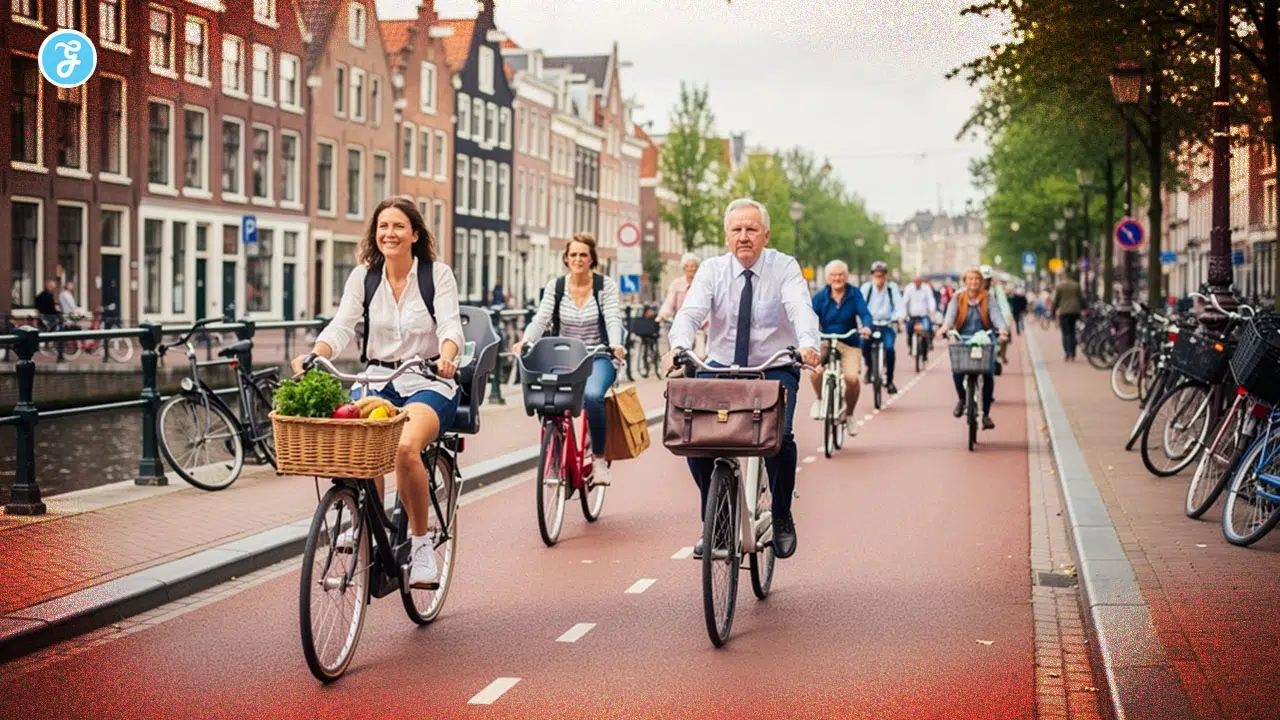
Picture a rainy Tuesday morning in Utrecht. The dedicated transit paths are packed. You see thousands of commuters in tailored suits heading to the office. Parents pedal past with toddlers tucked safely inside wooden box bikes known as bakfietsen. Elderly residents glide by on their daily grocery runs. Everyone moves in a silent and efficient stream. The rain does not stop them. They hold umbrellas and keep pedaling. This effortless flow is the reality of cycling in the Netherlands; here, the bicycle is not a gym membership, it is a human right.
In most parts of the world, riding a bicycle is a hobby. People treat it as a sport. They buy specialized gear. They track their heart rates and plan weekend routes. In the Netherlands, the bicycle is a utilitarian extension of the human body. People do not wear spandex or aerodynamic helmets. They wear office attire or jeans. They simply get on and go.
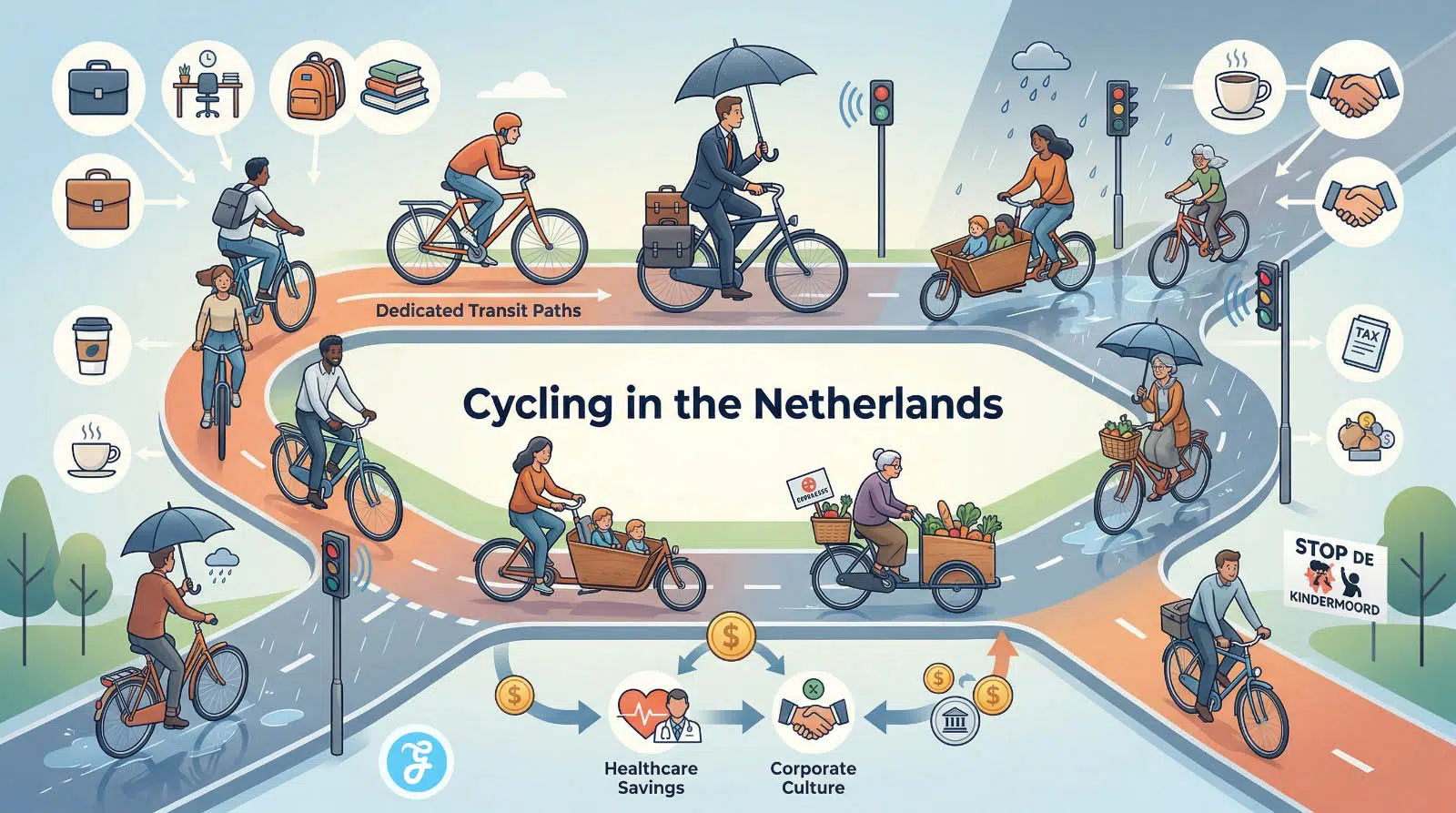
Global cities experienced a massive transit shift after the pandemic. Urban planners spent millions painting green lanes on asphalt. Yet, as we navigate 2026, these global cities are still trying to catch up to a standard the Dutch established decades ago. It is about getting to work, meeting a friend, or dropping kids off at school. This seamless movement represents the absolute pinnacle of urban mobility. It works perfectly because the entire system assumes the rider is just a normal person trying to get from point A to point B.
7 Everyday Life Truths
Cycling in the Netherlands succeeds by treating the bicycle as a basic utility rather than a fitness choice. These seven principles define the national standard.
- Social Equality: The bike acts as a universal equalizer across all professional levels.
- Built-in Safety: Infrastructure serves as the primary protection; helmets are unnecessary.
- Deliberate Policy: This culture was a political choice forced by 1970s grassroots protests.
- Financial Parity: Employers reimburse cycling mileage with the same legitimacy as car allowances.
- Network Advantage: Bike paths are designed to be more direct and efficient than driving routes.
- Passive Health: Wellness is a seamless byproduct of transit rather than a scheduled chore.
- Smart Priority: Modern sensors prioritize cyclists during rain to ensure a faster, drier commute.
The “Stop de Kindermoord” Movement
The streets were not always this quiet. In the early 1970s, the Netherlands looked very much like the United States. Cars completely dominated public spaces. Planners bulldozed historic neighborhoods to build highways. Traffic fatalities soared as vehicle ownership increased. The breaking point arrived when motor vehicles killed over four hundred children in a single year. Citizens decided they had enough. Activists and grieving parents formed a massive protest movement. They called it “Stop de Kindermoord” or Stop the Child Murder.
This grassroots outrage forced a permanent political reckoning. The government realized they could not simply widen roads indefinitely without destroying their cities.
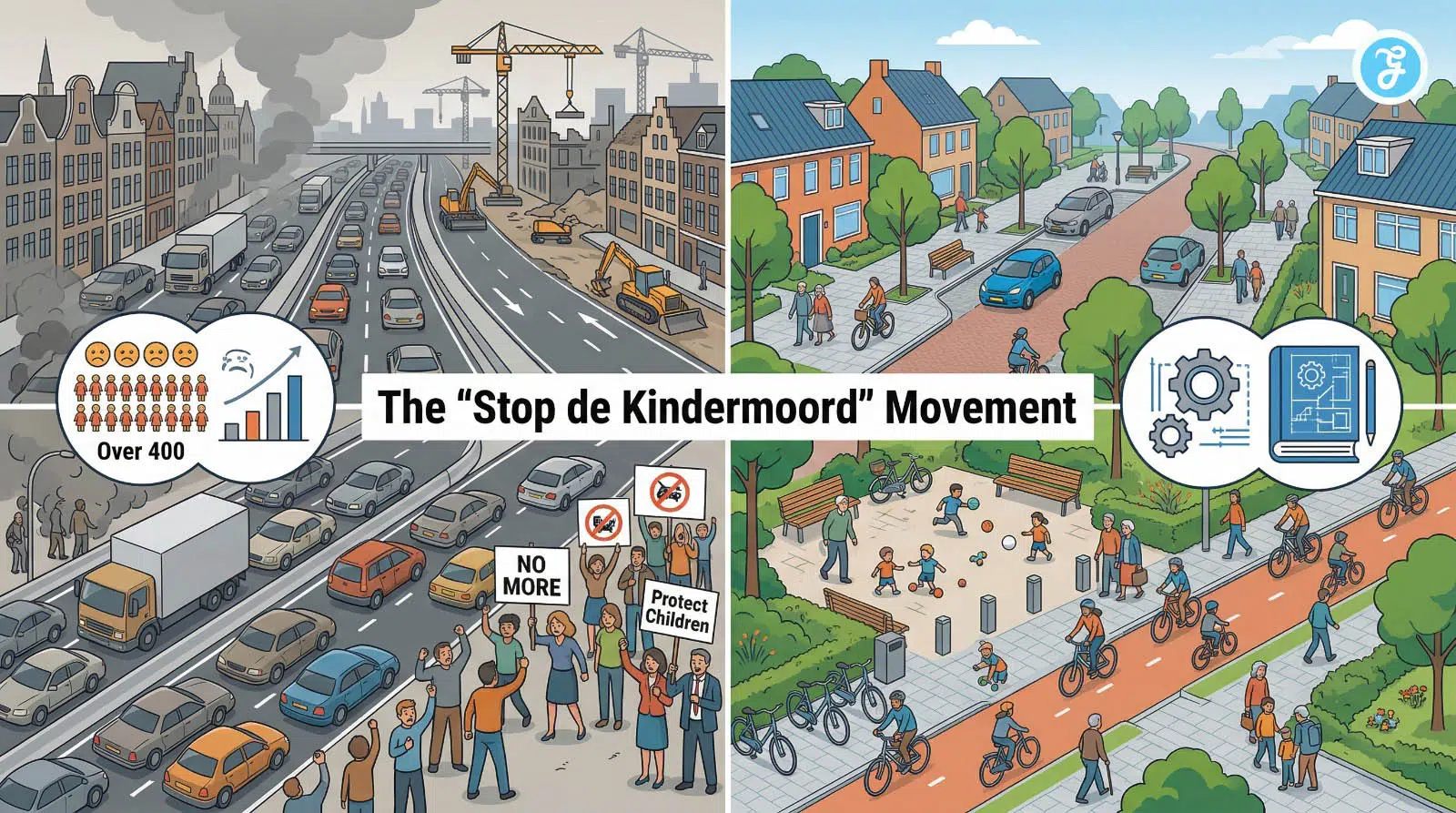
They made a conscious policy pivot toward human-centric design. Planners introduced the concept of the Woonerf or Living Streets. In these residential zones, pedestrians and cyclists hold the absolute right of way. Cars operate strictly as guests. The physical design uses trees and paving stones to force drivers to slow down to a walking pace.
To scale this concept nationwide, engineers needed a standardized rulebook. They developed the CROW manual. This comprehensive guide serves as the foundational standard of Dutch infrastructure. It dictates exactly how to physically separate heavy vehicles from human bodies. It built the foundation for true sustainable transit. Planners integrated these safe roads with early shared mobility models like the Witte Fietsen public bike system. The Dutch removed the guesswork from street engineering. They proved that safety is an engineered outcome. By demanding better design, they permanently changed how their society moves.
The Infrastructure of Intuition
Dutch street design removes the burden of decision making from the traveler. Engineers do not rely on a rider’s bravery or a driver’s perfect focus to prevent accidents. They build a physical environment that makes the correct behavior feel like the only option. It is a logic based landscape that prioritizes the human body over the combustion engine.
Physical Separation and Sustainable Safety
The core of this system is a principle known as Sustainable Safety. It is a simple but powerful rule of physics. Heavy vehicles and light bicycles should only share the same space when speeds are extremely low. In any zone where cars travel faster than 30 kilometers per hour, the two modes are physically separated.
Curbing and green buffers create a distinct sanctuary for anyone cycling in the Netherlands. This is not about a painted line on the ground. It is about a structural barrier that protects a child on a bike from a delivery truck. This separation is why Dutch residents do not feel the need for helmets or reflective vests. The road itself is the safety gear.
The Network Effect
A single bike lane is a dead end. A network is a solution. Dutch cities are mapped to ensure that a bicycle path is never a fragmented afterthought. It is a continuous and interconnected grid. This systematic approach often makes the bicycle the fastest way to navigate an urban center.
Planners often design “filtered permeability” into their maps. This means a bicycle can take a direct shortcut through a park or a neighborhood while a car must take a long loop around a ring road. This network effect turns a transit choice into a time-saving strategy. When the bike route is shorter and more direct than the driving route, the choice to ride becomes a natural part of everyday life.
Smart Tech and 2026 Flow Sensors
As we move through 2026, the physical infrastructure is getting a digital upgrade. Many cities now use “Flow” sensors at intersections. These devices detect a cluster of cyclists approaching a light. They can extend a green light to prevent a group from being split up.
Some of these sensors are even connected to local weather stations. When the sky opens up and it starts to rain, the system automatically prioritizes the bicycle lane. It gives riders a green wave so they can reach their destination faster and stay drier. This technology proves that the government values the comfort of the commuter. It is a high tech commitment to an analog way of moving.
The Economics of Two Wheels
Choosing a bicycle is a financial decision as much as a lifestyle one. The Dutch government views the bicycle as a high return investment rather than a cost. It reduces the physical burden on the national health system and the structural burden on the asphalt. This fiscal logic transforms every pedal stroke into a saved Euro.
Cost-Benefit Analysis and Healthcare Savings
Every kilometer spent cycling in the Netherlands generates a direct profit for the taxpayer. Research from the University of Utrecht shows that the country saves roughly 19 billion Euros every year in healthcare costs. This is not a theoretical number. It is the result of a population that maintains low-intensity cardio as a baseline.
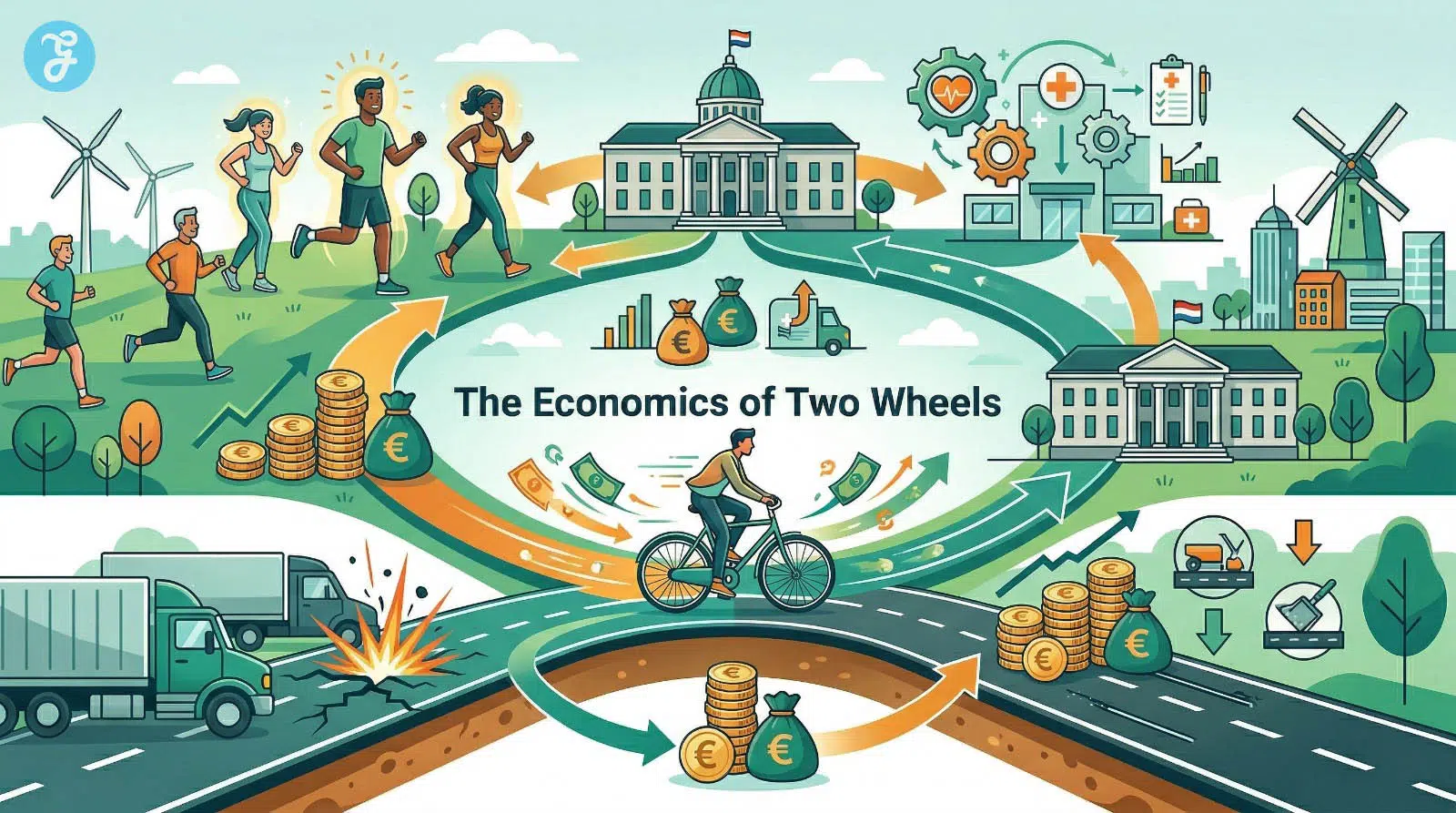
Road maintenance costs also plummet. A bicycle weighs a tiny fraction of a car and causes almost zero wear on the pavement. By moving thousands of people onto light frames, cities can extend the life of their infrastructure by decades. It is a rare example of a public policy that improves public health while simultaneously balancing the municipal budget.
Corporate Culture and Kilometer Reimbursement
Dutch employers treat the bicycle with the same professional legitimacy as a company car. The tax code allows businesses to pay employees a tax-free allowance for every kilometer they cycle to work. As of 2026, this rate sits at or above the 0.23 Euro benchmark to ensure it remains a genuine incentive.
This corporate culture removes the “poor man’s transport” stigma often found in other nations. A senior executive might earn the same mileage reimbursement as an intern. Many offices also provide high-quality showers and secure, heated indoor parking. These amenities prove that the company values the rider as a productive professional. It turns a morning commute into a paid wellness session.
The 2026 E-Bike Revolution
The e-bike has completely redefined the boundaries of the Dutch commute. Recent 2026 market data shows that electric-assisted models now outsell traditional bicycles in nearly every demographic. They have turned the 15 to 20 kilometer intercity trip into a feasible daily routine.
This technology has killed the “sweat barrier” for professionals. You can arrive at a meeting after a 45-minute ride without needing a change of clothes. These bikes have also expanded the mobility of the aging population. They allow seniors to stay active and independent long after they might have stopped driving. The e-bike is not just a gadget. It is the primary vehicle for a new era of regional connectivity.
Sociology: The Great Equalizer
Society moves best when its citizens share the same space. In many nations, your vehicle is a loud announcement of your bank balance. In the Netherlands, the path is a neutral zone where different lives intersect without friction. It is a social model built on the humble frame of a bicycle.
Status Blindness and the Prime Minister
The Dutch do not view a bicycle as a luxury or a sign of struggle. It is a simple tool for movement. You might see the Prime Minister cycling to a high stakes meeting with a leather briefcase on his rack. A university student or a retired teacher might be riding right next to him.
This lack of hierarchy is a core tenet of Dutch culture. When everyone uses the same mode of transport, the city feels more approachable. It removes the glass barrier that usually separates the powerful from the public. It is a daily exercise in democracy. No one is too important to pedal.
Safety in Numbers and the Smeed Effect
A counterintuitive rule of physics governs the Dutch road. The more people who are cycling in the Netherlands, the safer the streets become for everyone. This is known as the “Safety in Numbers” principle or the Smeed effect. It is a psychological shift that happens inside the mind of a driver.
When cyclists are everywhere, drivers automatically become more alert. They expect a bicycle at every corner and at every intersection. This heightened awareness reduces the risk of collisions for cars as well. The presence of a massive cycling population forces a slower and more deliberate pace of life. It turns a chaotic urban environment into a predictable and human space.
The Everyday Clothes Culture
A visitor to Amsterdam might be surprised by the total absence of Lycra and neon. You will rarely see a Dutch person wearing a helmet or specialized cycling shoes for a commute. They ride in what they are already wearing. This includes evening dresses, three piece suits, or heavy winter coats.
This cultural nuance is a statement of total confidence in the system. When you trust the road design, you do not feel the need for protective armor. The bike is not a piece of sporting equipment that requires a costume change. It is just a way to get to your destination. This normalcy is the ultimate goal of any transit system. It proves that the bicycle has truly become a part of the person.
Scaling the Model: Can it be Exported?
The Dutch blueprint is no longer a localized secret. Urban centers across the globe are attempting to replicate this success to solve their own gridlock. It requires more than just paint on the road. It requires a fundamental shift in how a city values its residents.
The Paris and London Comparison
Paris is currently the most aggressive student of the Dutch model. Mayor Anne Hidalgo has transformed the French capital by removing thousands of parking spots. She replaced them with wide and protected bike lanes. The result was an immediate explosion in rider numbers. Paris proved that if you build a safe path, people will leave their cars at home.
London is finding the transition more difficult. The city has installed several “Superhighways,” but the network remains fragmented. Many paths still end abruptly at dangerous junctions. This inconsistent design creates a barrier for new riders. It shows that cycling in the Netherlands works because the network is a complete circuit. You cannot build half a bridge and expect people to cross.
Debunking the Geography Myth
Critics often claim the Dutch model only works because the country is flat. They argue that hilly cities like San Francisco or Lisbon cannot adopt these habits. This is a persistent misunderstanding of human behavior. Recent data shows that the “hill” excuse is effectively dead.
The e-bike has leveled the global playing field. Electric motors provide the necessary boost to conquer steep inclines without breaking a sweat. In many hilly regions, e-bike sales are now outpacing traditional models. People are realizing that geography was never the primary obstacle. The real barrier was always the lack of safe and dedicated space. When the infrastructure is right, the incline no longer matters.
The Future is Analog
The success of cycling in the Netherlands offers a profound lesson for the modern world. It proves that a city does not need more lanes or faster cars to thrive. It needs a commitment to the scale of the individual. When planners prioritize the human body over the machine, the entire society becomes more resilient. Health improves. Stress levels drop. The air becomes cleaner and the streets become quieter.
This transformation is the ultimate evidence that human-centric design leads to a better quality of life. It creates a community where a child can ride to a park without a parent fearing for their safety. It builds a workforce that arrives at the office energized rather than exhausted by a stagnant commute. These are not just transit statistics. They are the building blocks of a stable and happy population.
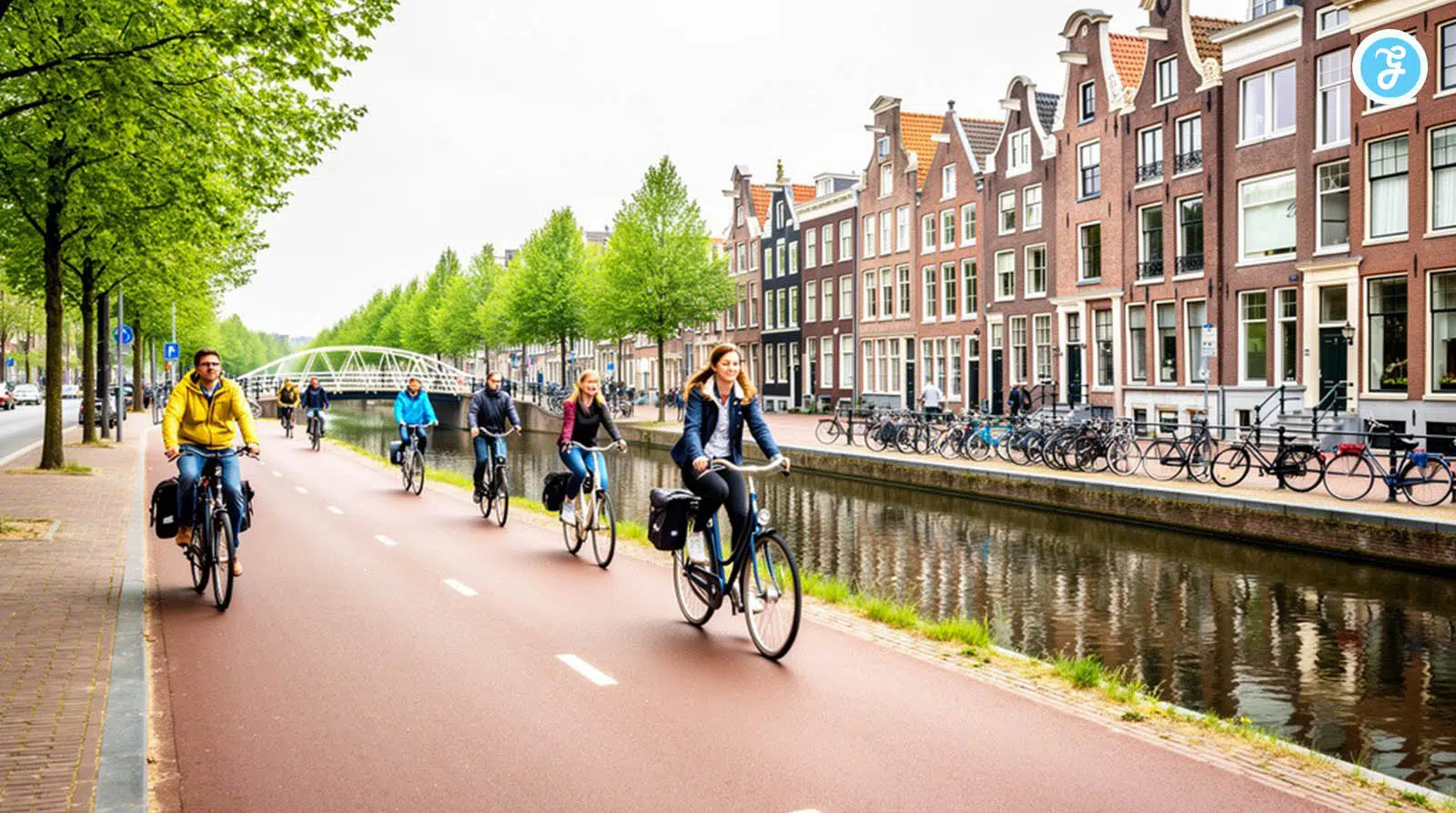
The story of the Dutch road is not really about the bicycle itself. It is about something much deeper. It is about the absolute freedom of movement. It represents a world where you do not need to own an expensive vehicle or pay for fuel just to participate in society. You simply step outside, get on a saddle, and go. This analog solution is the most sophisticated answer to the digital age. It reminds us that the best way forward is often found by looking back at the simple and timeless rhythm of the pedal. This is the enduring legacy of a nation that decided to move differently.
Frequently Asked Questions
Understanding the mechanics of cycling in the Netherlands requires looking beyond the bike path. The system relies on specific legal and cultural protocols to maintain order. These common queries highlight the rules that keep Dutch transit fluid and safe.
Is it legal to use a smartphone while riding?
No. Since July 2019, holding any electronic mobile device while cycling is strictly prohibited. This includes checking maps or changing music. If caught, you face a fine of 160 Euros. You must use a hands-free holder attached to the handlebars.
Are bike lights mandatory during the day?
Lights are only required at night or in poor visibility like heavy fog. You must have a steady white front light and a steady red rear light. Flashing or blinking lights are illegal and carry a 70 Euro fine.
Do I need a license for an e-bike?
Standard e-bikes with a 250 watt motor and a 25 kilometer per hour limit do not require a license or insurance. High speed models known as Speed Pedelecs are different. These require a moped license, a yellow plate, and third-party insurance.
Can I park my bicycle on the sidewalk?
Parking is usually allowed on sidewalks if you do not block pedestrians. However, busy city centers and train stations have strict “P-zones.” Bicycles parked outside designated racks in these areas are often impounded by the city.
Is it illegal to cycle after drinking alcohol?
Yes. The legal blood alcohol limit is 0.5 promille, the same as for car drivers. While random checks are rare, police will fine you for erratic riding. A conviction can sometimes impact your motorized vehicle driving privileges.