Have you ever looked at your supply chain and wondered where your products actually come from? Customers and governments now demand absolute transparency. Companies that ignore these issues risk losing business or facing heavy fines. You need to know how ESG criteria are reshaping global procurement today.
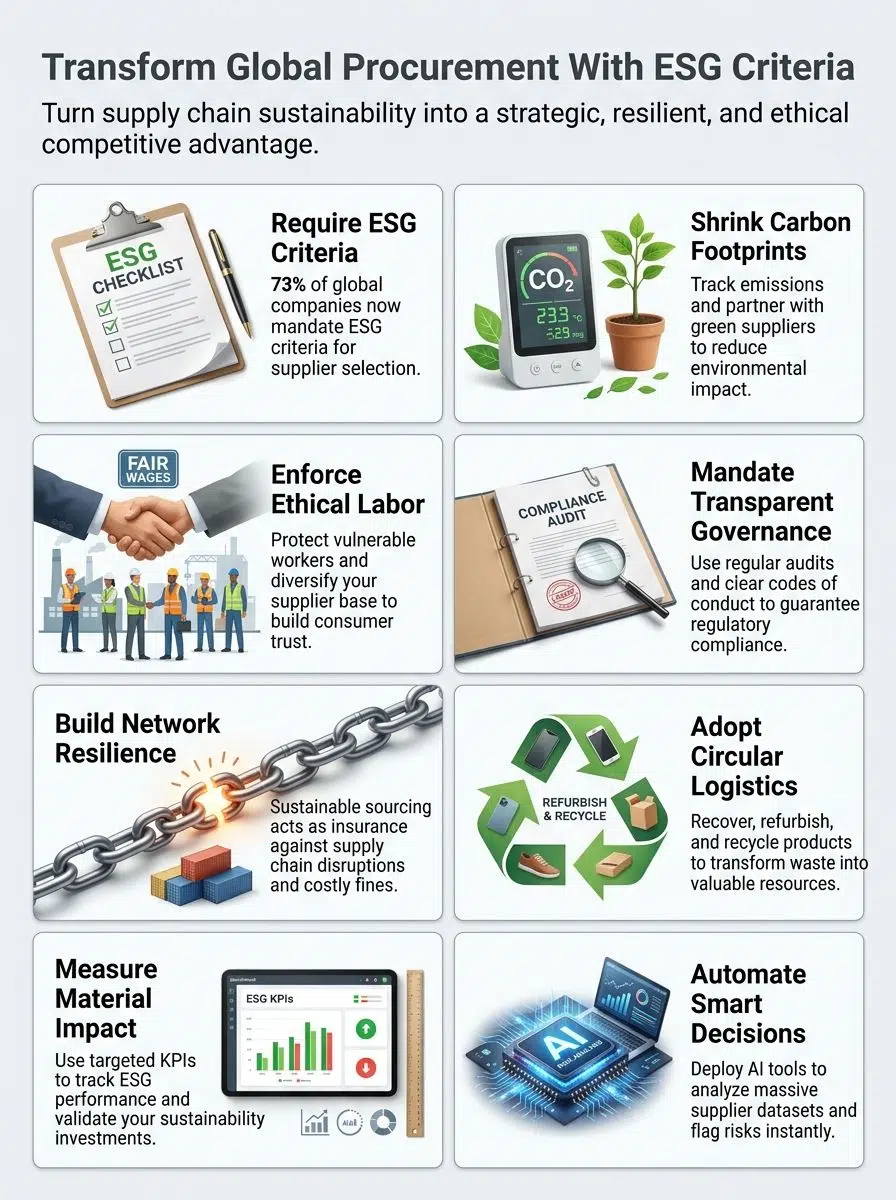
A Deloitte report found that 77 percent of companies see growing demand for responsible supply chains. Adding to that, 73 percent of global companies already include ESG criteria in their supplier selection process. ESG in Procurement is no longer optional.
It has become a business requirement that separates leaders from the rest of the pack. I am going to walk you through the steps to build a better purchasing strategy. You will discover practical steps your company can take right now. So grab a cup of coffee, and let us go through it together.
What is ESG in Procurement?
Now that we have set the stage, let us define what ESG actually means in procurement. ESG stands for Environmental, Social, and Governance. It represents a framework that companies use to evaluate suppliers and manage their supply chains responsibly.
Think of it as a three-legged stool. If you remove one leg, the whole thing topples over. Procurement teams now assess suppliers on how well they treat workers, reduce waste, and operate with transparency.
This shift transforms procurement into a strategic tool for corporate social responsibility. The US Securities and Exchange Commission recently introduced climate disclosure rules that force large companies to track this data. Because of this, organizations measure environmental impact through carbon footprints and sustainable sourcing practices.
- Environmental: Tracking carbon emissions.
- Social: Checking labor conditions.
- Governance: Examining compliance records.
To get ahead of these regulations, smart teams use assessment platforms like EcoVadis or Sedex. These tools give you a standardized score for each supplier, saving you hundreds of hours of manual auditing.
ESG in procurement is a business imperative that shapes how organizations source, partner, and compete globally.
The Three Pillars of ESG
Below are the three pillars of ESG to revolutionize your purchasing strategy.
1. Environmental: Reducing carbon footprints and sustainable sourcing
Companies today face real pressure to shrink their carbon footprints. Procurement leaders sit right at the center of this shift.
Your supply chain generates massive emissions from manufacturing to shipping. A recent report from the Carbon Disclosure Project found that supply chain emissions are, on average, 11.4 times higher than direct operational emissions. These are known as Scope 3 emissions.
If you want to make a real environmental impact, you have to focus on your suppliers. Sustainable sourcing means picking vendors who measure their emissions and take concrete steps to reduce them.
Suppliers who adopt renewable energy and cut waste become your best partners. Procurement teams now track carbon emissions across every stage of production.
2. Social: Ethical labor practices and supplier diversity
Ethical labor practices form the backbone of responsible procurement. Your suppliers’ workers deserve fair wages and safe conditions.
In the US, the Uyghur Forced Labor Prevention Act changed everything. U.S. Customs and Border Protection detained over 6,600 shipments in the first half of 2025 alone. If you cannot prove your goods are free of forced labor, your shipment gets seized.
This makes social governance a critical financial risk. You must map your tier-2 and tier-3 suppliers to avoid massive border delays.
Here are three ways to improve social governance:
- Map tier-2 suppliers: Identify high-risk regions in your extended network.
- Partner with diverse firms: Look for minority-owned and women-owned businesses through networks like the Billion Dollar Roundtable.
- Audit labor conditions: Ensure fair wages and safe facilities.
3. Governance: Transparent policies and compliance
Beyond fair wages and diverse suppliers, companies must build trust through clear rules. Governance shapes how organizations make decisions and follow laws across all markets.
Strong corporate governance means suppliers know exactly what standards they must meet. The Forced Labor Enforcement Task Force recently expanded its entity list to 144 companies in 2025. If you do business with anyone on that list, you face immediate penalties.
Transparent policies create accountability at every level. Suppliers receive written codes of conduct that spell out labor rules and environmental limits.

Good governance is about building a supply chain where everyone wins and risks are minimized.
How ESG Criteria Are Reshaping Global Procurement Today
ESG criteria are reshaping the global supply chains by using some key strategies.
Enhancing supply chain resilience
Your supply chain breaks down when one link fails. ESG criteria act like insurance for your entire operation. By choosing suppliers with strong environmental and social governance practices, you build a network that can weather storms. A recent study by Axidio showed that 85 percent of investors view ESG-aligned companies as more resilient to market shocks.
Ethical sourcing practices mean your suppliers stay in business longer. They face fewer legal troubles and invest in their own stability. This creates a chain that bends but does not snap when pressure hits.
Mitigating risks and ensuring compliance
A resilient supply chain shields your business from disruption. Compliance transforms that shield into armor.
Companies that embed compliance into procurement decisions catch problems before they spiral into costly crises. Under current laws, importers must present clear and convincing evidence that no forced labor was involved in their products.
To protect your supply chain, focus on these compliance steps:
- Require thorough supplier audits.
- Implement transparent reporting systems.
- Collect clear evidence of labor compliance.
Building brand reputation
Your brand’s reputation lives or dies by the choices you make in your supply chain. Customers today care deeply about where products come from.
Companies that embrace ESG principles build trust with consumers and partners. Deloitte notes that up to 83 percent of large companies now view ESG as a major source of competitive edge.
When you select partners who share your values on environmental impact, you are buying credibility. This commitment translates into customer loyalty and stronger market positioning.
Key ESG Practices in Procurement
There are some key practices in procurement, including ethical sourcing and supplier evaluation. These practices help businesses transform waste into opportunity.
Ethical sourcing and supplier evaluation
Ethical sourcing shapes how organizations select and partner with suppliers. Supplier evaluation processes determine whether vendors align with your sustainability goals.
Here are five key steps to evaluate your partners effectively:
- Audit facilities: Verify working conditions and wage standards meet international benchmarks.
- Request transparency: Ask for reports showing material origins so you understand the full journey of your goods.
- Assess environmental impact: Examine each supplier’s carbon footprint and waste management systems.
- Verify certifications: Check for Fair Trade, ISO 14001, or SA8000 standards.
- Conduct risk assessments: Identify potential violations of labor laws or governance standards before problems arise.
Integration of circular economy principles
Beyond evaluating suppliers, companies push further by adopting circular economy principles. This shift transforms how organizations use products and manage waste.
Rather than following the old model of take, make, and dispose, businesses design processes that keep materials in use longer. A 2022 study published in Nature Food found that food production accounts for 26 percent of global greenhouse gas emissions. Supply chain emissions far exceed processing and retail.
Circular procurement means companies buy products designed for reuse or recycling. Procurement teams integrate systems to lower carbon footprints and save money.
Reverse logistics for sustainability
Reverse logistics means taking products back through the supply chain after customers use them. This practice transforms waste into opportunity.
In the US retail sector alone, returns create billions of pounds of landfill waste every year. Specialized software platforms like Optoro help companies route returned goods back to shelves or recycling centers efficiently.
To implement reverse logistics, focus on these core practices:
- Organize return programs: Collect used products from customers to reduce landfill waste.
- Sort intelligently: Examine returned items to determine what can be refurbished or safely disposed of.
- Refurbish goods: Clean and repair functional items to keep them out of waste streams.
- Recover materials: Break down products to extract metals and plastics for new manufacturing.
- Optimize transport: Move returned products efficiently to minimize fuel consumption.
- Track performance: Use data analytics to see which products return most often.
ESG Metrics and Frameworks
ESG metrics and frameworks are standardized tools and specific, measurable values used by companies to report on sustainability, risks, and performance.
Importance of materiality assessments
Materiality assessments form the backbone of smart ESG procurement strategies. These evaluations help organizations identify which factors matter most to their operations.
Your company cannot track everything. Materiality assessments cut through the noise and highlight what actually impacts your business. The Sustainability Accounting Standards Board provides excellent industry-specific standards to help you define these material issues.
A food supplier faces different ESG priorities than an electronics manufacturer. Using established standards ensures you focus on metrics that investors actually care about.
Risk management improves dramatically when procurement teams understand their actual exposure points. Organizations that skip this step often waste resources on low-impact initiatives.
KPIs for tracking ESG performance
Tracking ESG performance requires clear indicators that tell you if your efforts are working. Establishing baseline numbers helps you measure progress accurately.

| KPI Category | Specific Metrics | Why It Matters |
|---|---|---|
| Environmental | Scope 3 carbon emissions; Water consumption reduction; Waste diverted from landfills. | Demonstrates climate commitment and reduces operational costs. |
| Social | Supplier diversity spend, Labor safety incidents, and Fair wage compliance rate. | Protects brand reputation and prevents supply chain disruptions. |
| Governance | Supplier audit completion rate, Policy violations, and Transparency reporting scores. | Reduces legal risks and maintains stakeholder trust. |
| Resilience | Supplier diversification ratio; On-time delivery rate; Geographic risk concentration. | Prevents single-source dependencies and protects revenue streams. |
Technology platforms automate data collection. This makes it easier to monitor these KPIs without drowning in spreadsheets. Your suppliers need visibility into these same metrics so they understand your expectations.
The Role of Technology in ESG Procurement
Technology drives ESG procurement by using enhanced visibility, analytics, and automation to track and minimize supply chain footprints.
Procurement automation and paperless processes
Procurement automation transforms how companies buy goods across the globe. Going paperless cuts waste and speeds up decision-making.
Cloud-based systems like Coupa or SAP Ariba let teams access supplier information from anywhere. You can use these six methods to modernize your approach:
- Eliminate manual entry: Use digital platforms to reduce human error and save time.
- Automate workflows: Route purchase requests instantly to cut processing time.
- Track performance: Monitor supplier metrics in real time to ensure sustainability standards.
- Consolidate orders: Analyze spending patterns to group orders with ethical suppliers.
- Verify compliance: Run automated checks on labor standards before approving contracts.
- Centralize contracts: Store agreements in searchable databases to verify ESG commitments.
AI tools for sustainable decision-making
Artificial intelligence transforms how companies make sustainability choices. AI tools analyze massive amounts of supply chain data in seconds.
Platforms like FRDM or CO2 AI map your Scope 3 emissions automatically. They identify suppliers with weak governance structures or environmental violations so you can take action early.
These systems predict which suppliers follow strong environmental standards. You can risk-rank vendors by carbon intensity before you even sign a contract.
Technology transforms procurement from a reactive function into a strategic advantage where data drives every decision.
Case Studies: ESG Success Stories
Real-world ESG examples prove that weaving sustainability into core operations generates both measurable impact and financial returns.
Mobile phones and reverse logistics
Mobile phones create a perfect storm for reverse logistics. Manufacturers now collect old devices to recycle rare earth elements.
Apple leads the way with its specialized recycling robots, Daisy and Dave. These machines disassemble iPhones to recover critical materials like tungsten and cobalt. This circular economy approach cuts waste dramatically.
Suppliers who handle phone returns must track inventory across multiple countries. They manage compliance with different environmental laws while extracting value from old products.
This shift demonstrates that sustainability is great for the bottom line. It turns end-of-life products into valuable resources.
Public procurement driving ESG compliance
Governments worldwide use their purchasing power to push ESG compliance. Public procurement offices set strict standards that suppliers must meet.
In the US, the Federal Sustainability Plan mandates net-zero procurement by 2050. Companies competing for federal contracts face immense pressure to reduce carbon footprints and adopt ethical labor practices.
If you want federal contracts, you must adopt these ESG standards:
- Track and report Scope 3 emissions.
- Adopt ethical labor practices.
- Maintain transparent governance structures.
Challenges in Implementing ESG in Procurement
The implementation of ESG principles within procurement encounters significant systemic barriers. Chief among these are substantial upfront financial requirements, limited supply chain visibility, and challenges in acquiring verifiable monitoring data. Furthermore, enterprises must navigate the inherent tension between financial efficiency and sustainable practices, while addressing poor supplier integration, internal inertia, and a fragmented landscape of reporting frameworks.
Balancing cost and sustainability
Many procurement leaders face a tough choice between cutting costs and going green. The truth is that these goals do not have to clash.
A 2025 report from Council Fire notes that companies integrating ESG factors consistently cut operational costs by 5 to 10 percent. They achieve this through better efficiency and reduced waste.
Focus on high-impact areas like energy-efficient transport or reduced packaging first. These early wins pay for themselves and help fund broader initiatives.
- Start with packaging reductions to save material costs.
- Optimize shipping routes to lower fuel expenses.
- Partner with suppliers to share the costs of green upgrades.
Overcoming resistance to change in supply chains
Supply chain teams often dig in their heels when ESG initiatives arrive. Workers fear new processes will slow things down. Leading companies partner with suppliers through phased approaches rather than demanding overnight transformation. Walmart’s Project Gigaton is a perfect example.
Walmart hit its goal to reduce 1 billion metric tons of supply chain emissions six years early in 2024. They succeeded by providing free tools, training, and clear guidance to their vendors. This collaborative stance transforms potential obstacles into massive opportunities for mutual growth.
Final Words
ESG criteria have moved from optional ideals to mandatory business practices in global procurement. You must evaluate suppliers on environmental impact and social responsibility today.
Your team can start small by assessing current supplier practices and setting clear goals. Use the tools available to map your risks and automate your reporting.
The companies that master how ESG criteria are reshaping global procurement will build stronger supply chains. They will attract loyal customers and lead their industries into a highly profitable future.
Frequently Asked Questions
1. What does ESG mean in global procurement?
ESG stands for environmental, social, and governance standards, which act as a helpful guide for buying goods while caring for the planet and people. According to the 2025 EcoVadis US Business Sustainability Outlook, these standards are now an operational necessity that keeps supply chains running smoothly.
2. How are ESG criteria changing supply chain choices?
Companies now look past just price and speed to see if partners use green energy, treat workers well, and follow honest rules. In fact, a 2024 Thomson Reuters report found that 97 percent of US global trade professionals say ESG is a major factor in deciding which suppliers they choose.
3. Why do buyers care so much about ESG today?
Buyers care because avoiding risks like pollution scandals protects their brand reputation, plus a 2025 Institute for Supply Management report notes that strong ESG performance can actually reduce operational costs by up to 10 percent.
4. Can small businesses keep up with these new ESG demands?
Yes, your small business can easily keep up by using supplier data platforms like Veridion to track and share your good actions, such as recycling or paying fair wages. Sharing these everyday wins openly builds deep trust with clients who value ethical choices just as much as cost savings.